
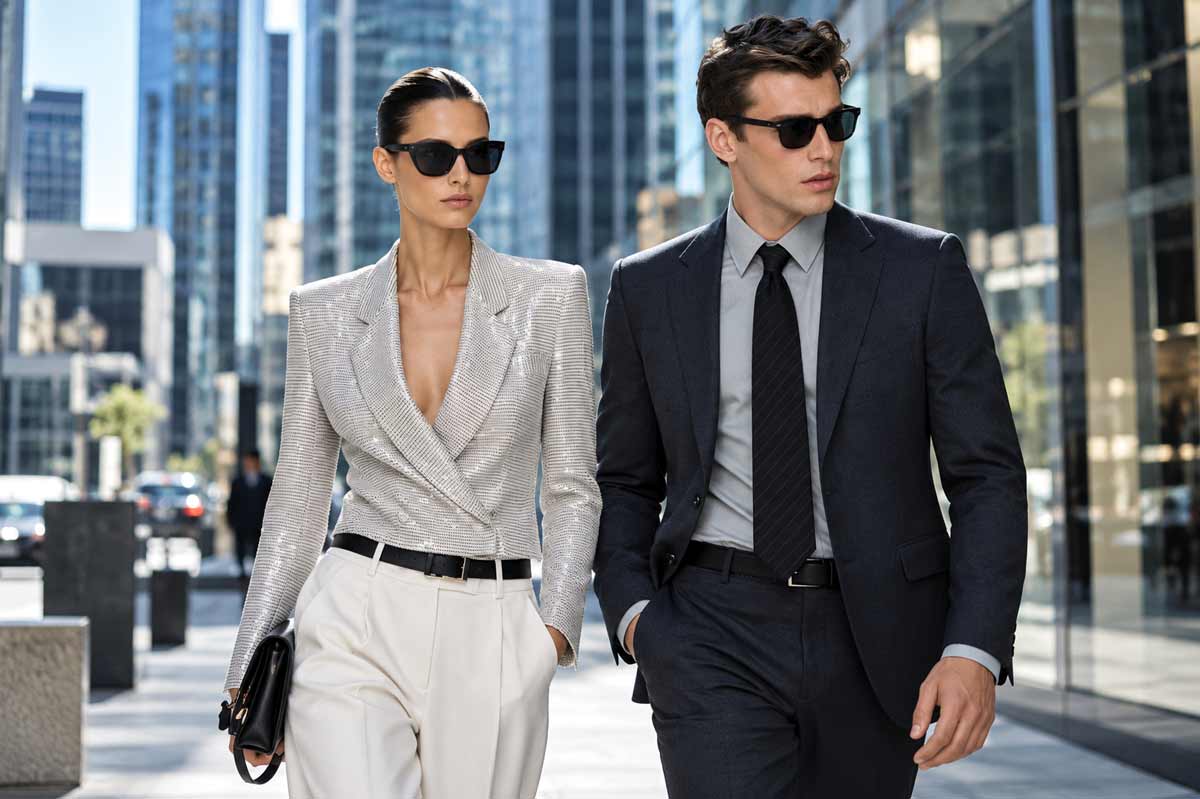
A Few Seconds at the Rack: How to Read and Choose a Jacket
Why the shoulder decides everything while the price decides almost nothing
The next time you find yourself in a store, try one thing. Take the sleeve of a jacket and pinch the fabric between your thumb and forefinger. Remember the sensation: that is wool and lining, two layers, nothing more. Now do the same on the front panel, just below the lapel. If your fingers detect a third, separate layer between cloth and lining, one that shifts ever so slightly, you are holding a canvassed jacket. If the two layers are fused into a single dense sheet that refuses to be parted, you are holding a fused jacket.
A few seconds. No specialist knowledge. And you've learned more about the garment than the price tag will ever tell you. Because in this category, price lies more often than in any other. The label on the lining tells you nothing. The fabric composition tells you less than people assume. And that third layer, invisible and unmentioned, determines whether in five years the jacket will look like a garment or like a garment bag.
Three Layers and Horsehair
A jacket is built in three dimensions. Cloth on the outside, lining on the inside, and between them, what tailors call the canvas.
A classic canvas is made from horsehair, sometimes blended with wool, camel hair, or mohair. It isn't glued in. It's sewn in, often by hand, with stitches that allow the layer to "float" between the cloth and the lining without being rigidly fixed to either.
Here's the point. Cloth on its own is flat; a person is not. The canvas creates volume where it's needed: the chest, the shoulder, the roll of the lapel. It holds the shape and keeps the jacket from sagging. And because it's free to move, over time it takes on the shape of one particular body. A fully canvassed jacket fits better after a year of wear than on the day it was bought, a rare quality among objects of any kind.
Fused construction solves the same problem differently: a thin layer of synthetic interfacing is bonded to the cloth with a heat press. It's fast, it's cheap, and it makes industrial-scale production possible. The overwhelming majority of what hangs in shopping malls is made this way.
There are three complaints against the fused jacket. It's stiffer, because bonded layers can't glide against each other and don't follow movement. It breathes poorly, because the adhesive is airtight. And it denies the lapel that soft, dimensional roll that is the very reason a lapel exists. A fused lapel lies flat, like pressed paper.
Between the extremes lies a compromise: the half-canvas, in which a true canvas runs through the chest and lapels while the lower portion is fused. For most people in most circumstances, this is a sensible choice: eighty percent of the benefits for roughly forty percent of the price.
One caveat for anyone who intends to check. Some manufacturers advertise "half-canvas" but fuse the lapels anyway, leaving only a loosely hanging chest piece inside, unattached by any padding stitch. The lapel on such a jacket stays flat. Your fingers can feel it.
Three Different Garments Called by One Word
In everyday speech, it's all simply "a jacket." In reality we're dealing with three distinct garments, each with its own origins, degree of formality, and rules.
A suit jacket is cut from the same cloth as the trousers and is conceived as part of a set. Its fabric is usually smooth, worsted, without pronounced texture. Separated from its trousers, it looks orphaned, like half of a parted couple, and the eye registers this instantly, even if it can't explain why.
The blazer descends from the navy and the rowing clubs of the nineteenth century. It's a solid colour, canonically navy, usually with metal buttons and more structured than its younger sibling. A blazer is designed to stand on its own and to pair with trousers of a different colour.
The sport coat comes from the English countryside and the hunt. Hence everything about it: textured cloths, checks and herringbones, patch pockets, sometimes elbow patches, sometimes an extra small ticket pocket above the right one. It is the least formal of the three.
From this comes a rule worth memorizing, because it explains nine-tenths of all mistakes: the smoother the cloth, the more formal the garment; the more visible the texture, the more relaxed. Smooth worsted wool means meetings and negotiations. Tweed, cotton twill, and linen mean weekends, dinner, travel.
Details That Speak
Everything on a jacket communicates something. Here are the essentials.
Lapels. The notch lapel, what most people think of as the "ordinary" lapel with its triangular cut, is universal and goes with everything. The peak lapel, with its upper point swept upward, signals heightened formality; it canonically appears on double-breasted jackets, and on single-breasted ones when you want to add gravitas. The shawl lapel, smooth and rounded, belongs exclusively to the evening wardrobe: the dinner jacket and the smoking jacket. In an office it's out of place and looks as though its wearer has mistaken the time of day.
Vents. No vent at all is the Italian tradition: the cleanest possible line at the back, immaculate while the wearer stands, and unsightly the moment he sits down or slips his hands into his trouser pockets. A single centre vent is the American inheritance, practical and democratic. Two side vents are the English school, and the most sensible solution for real life: the jacket keeps its shape whether seated or in motion.
Pockets. Flap pockets are the everyday norm. Jetted pockets without flaps, smooth and flat, are the evening and formal option. Patch pockets are the most relaxed, natural on linen, tweed, and anything summery.
Sleeve buttons. Working buttonholes are a mark of good craftsmanship, but honesty is in order here: the habit of leaving the last button undone so that others are sure to notice has long since passed from elegance into poor taste. A garment that tries too hard to announce its price announces something else entirely.
Fabrics: A Number That Doesn't Mean What You Think
The label reads Super 150s, and the price is higher. The logic seems obvious. The logic is wrong.
The "Super" number measures one thing: the fineness of the fibre. The higher it is, the finer the yarn, the softer the cloth, and the more pronounced its noble sheen. And the worse it copes with life.
Fine fibre wears through faster at the elbows and seat, creases more easily, and demands more care. Super 180s is a material for an evening suit worn a few times a year. For a jacket worn weekly, the Super 100s-120s range is wiser in every respect, the aesthetic included.
There's also an outright absurdity worth learning to spot: expensive fine cloth in a fused jacket. Cloth of that fineness needs a construction that allows it to drape; bonded to interfacing, it becomes its own opposite.
Far more important than the "Super" number are the weight of the cloth and the type of yarn.
Worsted wool, from which suits are made, is spun from long, combed fibres: smooth, strong, able to hold a crease. Woollen cloth, sometimes called carded, is spun from short, tangled fibres: fuzzy, warm, soft. Flannel and tweed belong to this second category, which is why they're warmer at the same weight.
What's Made of What, and Where to Wear It
Wool remains the default material, for reasons that have nothing to do with tradition. Wool fibre is resilient: it returns to its original form after compression, which means creases fall out on their own overnight on a hanger. It breathes, regulating moisture better than any synthetic. It takes dye deeply and evenly. And it lasts for decades.
Among wool textures, a few are worth knowing by name: fresco, with its high twist and open weave, the finest summer cloth there is, letting the air straight through and barely creasing; hopsack, a basket weave and the natural choice for an informal blazer; birdseye and nailhead, small worsted patterns and a classic of relaxed business dress; and flannel, the winter velvet of the business wardrobe.
Silk is the subject of the most widespread misconception in this field, and it deserves to be taken apart.
It's commonly believed that silk is a durable material and that a silk blend adds life to a garment. In reality, the opposite is true on almost every count. Silk fibre handles friction poorly and wears through at the elbows and lapels faster than wool. It yellows in sunlight. It picks up water spots. It creases, and unlike wool, it holds the crease.
Wool-silk blends, sold as a step up in class, have a rather poor reputation among people who wear their clothes for years: they pill and take on a worn look sooner than pure wool of the same weight. A sensible proportion is eighty to twenty in wool's favour, with silk present for its noble matte shimmer, not for strength.
There is one exception, and it deserves respect: dupioni, a silk with an uneven yarn and visible slubs. It's precisely that deliberate irregularity that disguises creasing, which is why black dupioni has been used for evening jackets for generations.
The conclusion is simple: silk is a guest fabric, not a working one. Evenings, summer, celebrations, a few outings a year. It will never make an everyday jacket.
Linen creases within the first hour and keeps on creasing all day. That's its nature, not a flaw, and that's the whole point. It's exactly why pure linen reads as vacation, weekend, and the south, and exactly why it's out of place in a boardroom.
But here a correction is in order, one that is usually omitted. Linen-wool blends, as well as three-way wool-silk-linen blends, are a different story altogether: they retain breathability while nearly losing their tendency to crease. A jacket like that is entirely appropriate at a summer wedding, a daytime reception, or the office in July.
Cotton: twill, moleskin, poplin. An honest, informal material that ages handsomely, but it bags at the elbows and knees and loses shape faster than wool. Summer, weekends, travel.
Cashmere offers an incomparable feel under the hand and yields to nearly everything in resistance to friction. In pure form it makes sense in an overcoat, where the strain is slight; in a jacket, as a small share blended with wool. A jacket of pure cashmere is a luxury whose lifespan is measured in months.
Mohair, by contrast, works in exactly the opposite way: the hair of the Angora goat is stiff, springy, and stubborn. It holds its shape, breathes beautifully, has a dry, noble lustre, and lasts a long time. It was the cloth of 1960s suits and summer evening wear, and this season it is making a confident return.
Tweed: the countryside, autumn, weekends, the university lectern.
Synthetics and viscose: the one point on which folk wisdom is entirely right. Viscose loses strength when damp, stretches, and never springs back. Within a season, the jacket turns into a sack, and there's no restoring it. Polyester doesn't breathe and, worse, begins to shine at points of friction: the elbows, the seat, the lapels. That shine is irreversible; it can't be cleaned or steamed away.
A rule that works at the counter: natural fibres should make up no less than seventy to eighty percent. Small additions are perfectly legitimate and even useful: two to four percent elastane adds ease of movement, five to ten percent polyester helps a garment survive a suitcase. Look directly at the composition, not at phrases like "premium technical material."
Colour and Pattern
Two laws apply here, and once you know them, the rest can easily be worked out on your own.
The first: the more muted and uniform the colour, the more formal the garment. The second: the larger the pattern and the higher its contrast, the more relaxed the garment.
Navy is the only truly universal colour. It looks right in daylight and under artificial light, pairs with more colours than black does, and suits virtually every complexion and hair colour. Your first jacket should be in this colour, without question.
Charcoal is the most formal of the non-black shades. Negotiations, official occasions, everything serious. For everyday wear it's slightly heavy.
Mid-grey and light grey: daytime, businesslike, unburdened. Good in summer and with almost everything.
Black has a far narrower range than most people assume. In the North American menswear wardrobe, a black suit means evening and celebration, and funerals; a black jacket worn as daytime business attire reads as a service-staff uniform. In women's wardrobes, black behaves differently and remains a legitimate everyday foundation. It's one of the few places where the rules for men and women genuinely diverge.
Brown, chocolate, tobacco: the colour of this season. Daytime, warm, informal by origin. The old London rule, "no brown in town," doesn't apply in North America and never did.
Camel and beige: daytime, warm-weather, very elegant, and entirely unsuited to evening.
Olive and dark green: the new territory of relaxed business style, working beautifully with grey and navy trousers.
Burgundy and wine: evening, autumn, a statement. Excessive in daylight and in offices.
Pale blue, powder, pastels: summer, daytime, receptions, attending a wedding as a guest. Not for the office or a business meeting.
Now the patterns, arranged from most formal to most relaxed.
Solid cloth stands at the top: evening, the most consequential meetings.
Pinstripe is the territory of business authority, and it's gradually returning. The narrower and more closely spaced the stripes, the more severe. It never works as casual wear.
Chalk stripe: the same idea, softened, with wider spacing and a blurred edge, most often on flannel. Winter, daytime.
Herringbone is the most versatile pattern in existence: a fine one goes to the office, a bold one to the country.
Glen check and Prince of Wales: a clever compromise between rigour and ease. Relaxed business, smart casual, but not official occasions.
Houndstooth: characterful and rural by origin; a small one works at the office, a large one stays for the weekend.
Windowpane: sport-coat territory, not suit territory.
Bold, high-contrast checks: weekends in the country only.
And three rules that eliminate most mistakes. When mixing patterns, vary the scale: a fine shirt stripe with a large jacket check works, while two similarly sized patterns side by side argue with each other. For evening, solids only. For a job interview, a solid, or something that reads as solid from a couple of metres away.
The Canadian Correction
Here it's necessary to say something the European guides never do.
The standard "all-season" suiting weight of roughly 260 to 300 grams per metre isn't all-season at all in North America. A climate where January brings minus twenty and July brings plus thirty with high humidity demands two different wardrobes, not a single compromise.
A summer jacket here must be genuinely summery: fresco, linen, cotton, lightweight hopsack, an open weave, minimal lining or none at all. An unlined jacket isn't a simplified jacket but a different one: its internal seams are visible and finished by hand, a sign not of economy but of craftsmanship.
A winter jacket, by contrast, is entitled to be heavy. Flannel of more than four hundred grams, wool blended with cashmere: things considered marginal exotica in Milan and Paris simply work here. Heavy cloth also drapes better: it hangs rather than bristles.
In a Canadian climate, a compromise "all-season" jacket means a garment that is equally uncomfortable ten months of the year.
What Has Changed by 2026
The era that ran roughly from 2013 to 2022 is over. Narrow shoulders, six-centimetre lapels, short jackets with shirts peeking out beneath them, and trousers tapered to the point of tights have finally departed, and departed, by all appearances, for a long time.
Today's silhouette is built on the opposite principle.
The shoulder is natural or slightly extended. Not padded as in the eighties, but not clinging to the deltoid either. The shoulder seam ends where the shoulder ends, or a centimetre beyond.
Lapels are wider: eight to nine centimetres is now considered the golden mean.
Length: the jacket once again covers the seat. A guideline: the hem should fall roughly at the base of the thumb when the arm hangs naturally.
The double-breasted jacket has returned after three decades on the sidelines, and returned in modern form. Today's double-breasted sits on a soft shoulder, buttons lower, and follows the waist without the boxy rigidity of its predecessor.
Colour has moved away from the black-and-grey range toward earth tones: chocolate, camel, olive, warm navy.
Texture has returned along with them. Corduroy, mohair, stripes, herringbone, wool with a visible weave.
Out of use: the skinny lapel, the cropped jacket, glossy and "wet-look" fabrics with synthetic sheen, the too-short sleeve revealing half a palm's width of shirt, and that particular shade of blue that was everywhere in 2014.
The Women's Chapter
The history of the women's jacket unfolds differently, and it deserves separate treatment, because it is not a version of the men's.
It begins with Chanel, who in the twenties turned men's tailoring into a soft, unlaced garment that required no corset. It continues with Annie Hall and Diane Keaton, who turned the jacket-and-trousers combination into an intellectual manifesto. It passes through the eighties and their sculptural shoulder. And it arrives at the present day, where a woman has something a man does not: her silhouette is not prescribed.
Contemporary tailoring holds two directions at once, and both are legitimate.
The first is volume: an elongated line, a pronounced shoulder, ease through the chest, the jacket as outerwear over a turtleneck or fine knit. The second is the waist: a fitted cut, a belt, darts, a silhouette the nineties would have claimed as their own. Between them sits the cropped jacket, appropriate in exactly one situation: when the bottom half is high-waisted and the jacket's hem meets the waistband rather than leaving a stripe of bare skin.
In this season's women's wardrobe, matte and textured fabrics are the ones that work: wool-linen, crepe, cady, brushed cotton, tweed. Shine is confidently on its way out, satin and "wet-look" surfaces included, unless it's a deliberate evening statement.
A practical piece of advice worth more than any trend: buy first a softly structured single-breasted jacket falling to roughly mid-thigh, with a moderate lapel, in a fabric that contains wool. It will outlast three changes of fashion. Buy second the one that changes the proportion: cropped, collarless, belted, or voluminous, depending on what you wear below. Two different jackets are more useful than five similar ones.
What Belongs Where
North American dress codes have shifted more over the past five years than in the previous thirty, and it helps to understand where we've landed.
Business formal survives in its pure form in law, finance, and high-level negotiations. A suit, smooth worsted wool, navy or charcoal, a tie.
Business casual is what nearly everything else means today. This is where the jacket has become the central garment of the wardrobe: it has turned into the minimum signal of serious intent. A blazer with trousers of a different colour, a shirt without a tie.
Smart casual: a sport coat, texture, patch pockets, perhaps dark indigo jeans without distressing.
Cocktail: a dark suit; for a woman, a jacket can replace an evening dress, provided the fabric is good and the fit is precise.
Black tie: a dinner jacket, shawl or peak lapel, jetted pockets, no exceptions. It's the last remaining dress code in which improvisation reads as ignorance.
Attending a wedding: not white, not the colour of the groom's suit, not brighter than the bride. Everything else is permitted, within reason.
A job interview: one notch more formal than the company's norm. Always.
What Never Changes
Silhouettes come and go. Three things remain.
The first is the shoulder. It's the one place on a jacket that a tailor can't truly fix. Sleeve length, waist, jacket length, trousers: all of it can be altered. The shoulder cannot be reworked; it's built into the construction. If the shoulder seam droops or, conversely, digs in, the jacket isn't yours, however beautiful it may be and whatever the discount.
The second is the cuff. A centimetre to a centimetre and a half of shirt should show beneath the jacket sleeve. That narrow white line does more for the impression than the cost of the cloth: it tells the world the garment has been fitted and that its owner paid attention.
The third is navy. It suits virtually everyone, works in daylight and evening light alike, pairs with more colours than black, and hasn't gone out of fashion for a single season in a hundred years.
The jacket remains the last garment in the wardrobe that still knows how to speak.
Shoes have grown softer, shirts looser, the tie has all but vanished, the suit is no longer obligatory. The jacket survived because it does what nothing else does anymore: it builds a shoulder, establishes a vertical line, and announces that the person wearing it