
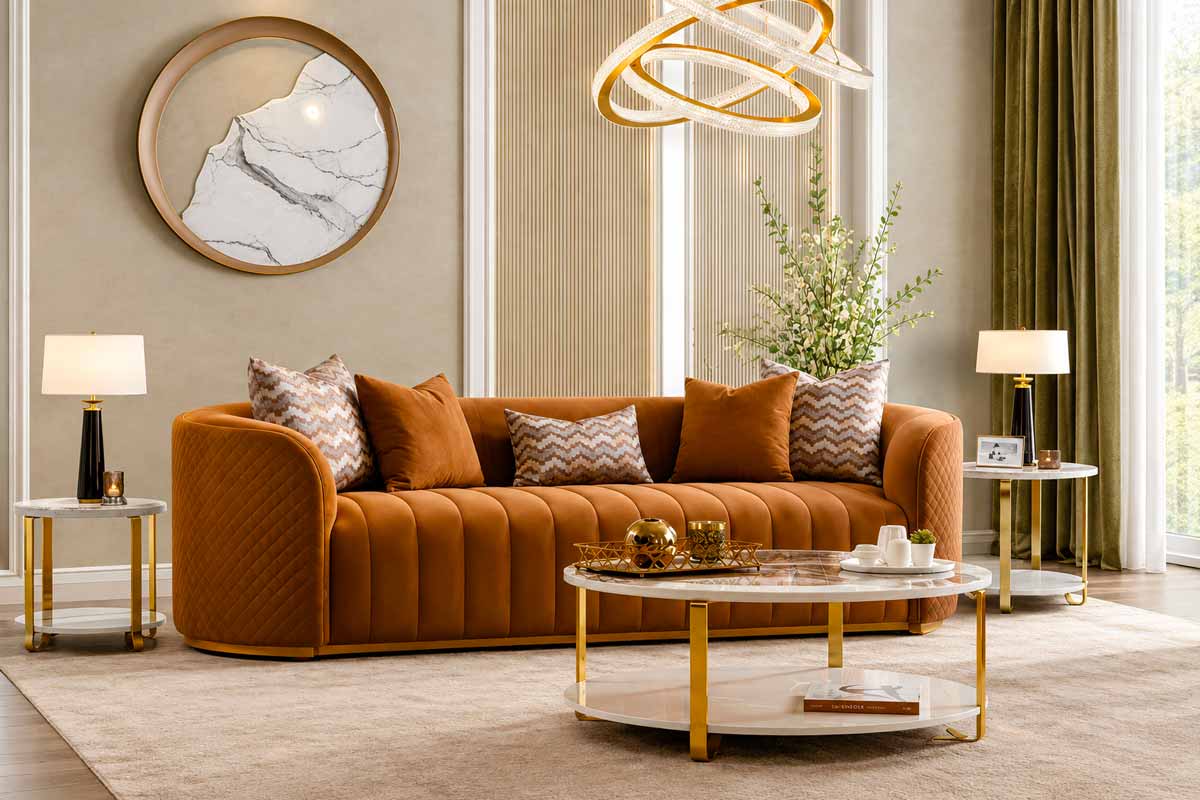
The New Luxury of Home
Tactility, Sustainability, and Soft Minimalism
Interior trends today resemble a list of fashionable objects less and less, and a conversation about how we want to live more and more. The home has ceased to be merely a beautiful stage set or a showcase of taste. After several years of anxious headlines, real estate turbulence, remote work, relocation, information overload, and a persistent sense of instability, we now ask far more of our private spaces. They must not only impress but soothe. Not only look expensive but be genuinely comfortable. Not only follow fashion but stand the test of time.
In Toronto, as in other major North American cities where so many people live in condos or townhouses, every square foot has to work. Windows aren't always generous, winters are long, light is scarce, and renovations and furniture are far too costly to redo an interior for every passing whim of the season. That's why today's defining trend isn't blind devotion to images from catalogues or Instagram, but a more mature approach: less random décor, more quality, texture, thoughtful lighting, enduring materials, and individuality.
A contemporary interior is no longer obliged to prove status. It reveals it instead - through the grain of wood, soft light, noble metal, a nuanced wall colour, beautiful fabric, a comfortable sofa, a well-planned kitchen, and the unmistakable sense that this is a home in which one can actually live.
Sustainability Without Naïveté
The word "sustainable" has long since become obligatory in the language of interiors. It's used by makers of furniture, finishing materials, textiles, lighting, kitchens, and accessories alike. And that is precisely why it deserves closer scrutiny. In a good interior, sustainability isn't simply a bamboo basket, a linen cushion, or a stool made of recycled plastic. It's a question of a material's origin, its lifespan, whether it can be repaired, the quality of the air inside the home, its resistance to wear, and the honesty of how it was made.
Until recently, "eco" meant, almost automatically, wood, stone, linen, wool, ceramics, and a palette drawn from nature. These materials aren't going anywhere: natural wood, especially in light and warm tones, remains one of the defining emblems of quiet luxury. Stone, travertine, limestone, marble, and porcelain with natural texture hold their ground too - particularly in kitchens, bathrooms, and around fireplaces.
But today the list of sustainable choices has grown longer. It now includes recycled metal, glass, textiles woven from reclaimed fibres, panels made from wood waste, low-emission paints, furniture of certified timber, restored pieces, and fine vintage. Even plastic, long the very symbol of disposability, has been reconsidered - provided we're speaking of recycled material, a long service life, and thoughtful design, rather than yet another round of "green" marketing.
Therein lies the shift: sustainability has ceased to be a style. It has become a question of responsibility and quality. An object that will serve for ten, twenty, or thirty years is often more sustainable than a "fashionable" piece bound for the landfill two seasons from now. For interiors, this matters profoundly: truly sustainable design begins with the decision not to buy what you don't need.
Conscious Consumption: Vintage as a New Form of Taste
Vintage has long since stopped being a compromise for those looking to save money. Today it's one of the most expressive ways to make an interior personal. New furniture is often flawless, but too smooth. Vintage brings what no mass-market catalogue can sell: age, the patina of time, history, imperfection, character.
Vintage works especially well in Canadian homes, where the architecture tends to be calm and practical. A single old wooden table, a pair of mid-century armchairs, a mirror with patina, a desk lamp inherited from another era can lend a space more depth than an entire suite of new accessories. This doesn't mean a home should become an antique shop. On the contrary, the most contemporary approach is to combine old and new in measured doses: a vintage piece in a restrained interior looks not accidental but chosen.
Conscious consumption works on several levels at once here. First, it reduces the volume of new production. Second, it allows you to acquire better-made pieces for reasonable sums. Third, it gives a home individuality. And finally, it helps you step off the endless treadmill of "new arrivals," which date visually so quickly precisely because they belong so obviously to a single season.
A good interior today shouldn't look as though it was assembled in a single day from a single showroom. It benefits from a biography.
AI and Digital Tools: The New Atelier
Artificial intelligence and digital tools are entering interior design ever more actively, but it's important not to get carried away. AI doesn't replace taste, experience, a sense of scale, knowledge of materials, or an understanding of a client's real life. It can quickly generate visual options, propose forms, speed up a search, and reveal unexpected combinations. But a poor prompt and a weak idea still yield a weak result.
In the right hands, however, digital tools genuinely transform the process. They make it possible to test palettes, proportions, furniture arrangements, lighting, floor plans, and the mood of a future interior far more quickly. This is especially valuable in projects where the cost of error is high: kitchens, built-in millwork, bathrooms, reconfigured layouts, finishes selected for an entire home. The more precise the visualization and advance modelling, the fewer improvised decisions on site, and the fewer unnecessary samples, redos, and waste.
But technology's most interesting role isn't to make an interior "futuristic." Quite the opposite: the best contemporary solutions are often nearly invisible. Light that shifts gently over the course of the day; climate control that doesn't disrupt the aesthetic; concealed speakers; discreetly integrated chargers; intelligent storage; appliances that don't clutter every surface. True technological sophistication in a home today isn't a display of gadgets, but the feeling that a space simply works, naturally.
From Cold Minimalism to Warm
A few years ago, minimalism was often understood too literally: white walls, bare surfaces, black accents, a grey sofa, glass, metal, sterility. Such interiors photographed well, but weren't always fit to live in. Today minimalism has softened. It still loves clean lines, order, and the absence of visual noise, but it no longer strives to be cold.
In its place has come warm minimalism. It embraces wood, textiles, rounded forms, calm tones, matte surfaces, and muted light. It doesn't overload a home, but neither does it strip it of human warmth. This direction suits Canadian interiors especially well, where the long winter itself calls for softness: heated floors, textured rugs, layered lighting, pleasing fabrics, surfaces you want to touch.
Such an interior isn't necessarily expensive. But it demands discipline. There's no hiding behind quantities of décor. Every piece must be considered: the shape of the sofa, the height of the coffee table, the tone of the wood, the texture of the curtains, the quality of the light, the ease of storage. Warm minimalism doesn't tolerate randomness, but nor does it require museum-grade perfection.
Japandi: Not Merely a Style, but a Way to Quiet a Space
Japandi - a fusion of Japanese restraint and Scandinavian functionality - remains one of the most enduring directions. Its popularity is easy to explain: it answers several contemporary longings at once. People want less visual noise, more naturalness, calm, and simplicity, and the sense that their home supports their nervous system rather than assaulting it.
Unlike the old "Scandi," where it was all too easy to drift into endless throws, candles, cushions, and charming trinkets, Japandi is stricter. Here what matters are low silhouettes, clean geometry, wood, stone, ceramics, linen, imperfect textures, a muted palette, and emptiness as an element of composition. It's a style that values not only the object, but the space around it.
In Toronto, Japandi is especially practical. It helps small rooms feel larger, never overwhelms a condo, works beautifully with natural light, and adapts easily to a resale-friendly interior. Make the foundation too eccentric, and a home becomes harder to sell. Japandi strikes a rare balance: it looks current without shouting, individual without being too much of a gamble.
Tactility: A Home You Feel Through Your Skin
One of the defining trends of recent years is the return of tactility. This is no accident. The more of our lives pass through a screen, the stronger our need for materials that return the body to reality. Bouclé, wool, linen, textured ceramics, matte wood, micro-textures, soft rugs, velvety surfaces, warm stone - all of these have become not merely decorative devices but a way to make a home emotionally steadier.
After the pandemic years, many longed for a "cocoon home": a plush sofa, an armchair you could sink into, enveloping fabrics, calm colours. That longing hasn't disappeared, but it has matured. Today it's no longer only about softness, but about layered sensation. An interior shouldn't be uniformly fluffy and cozy in every corner. Far more compelling is the play of contrasting textures: smooth stone against coarse linen, a matte wall against gleaming metal, a soft armchair against a severe wooden table, a warm rug against cool ceramic.
It's contrast that brings an interior to life. A home in which everything is equally smooth quickly becomes faceless. A home with varied textures begins to work almost like fine clothing: you sense it not only with your eyes, but with your body.
Metal: Not Coldness, but Structure
Metal has indeed returned to the interior, but not in its old decorative sense. For a long time, private spaces relied mostly on warm brass: handles, light fixtures, furniture legs, mirrors, faucets. Today the palette has grown wider and cooler: aluminum, stainless steel, chrome, nickel, dark metal, aged bronze, copper. Interest in aluminum and steel surfaces is especially notable - they bring a sense of precision, modernity, even a subtle architectural rigour.
But metal demands restraint. All-metal furniture can look striking at a trade fair, yet in a private home it quickly becomes too hard-edged. Far wiser to use metal as an accent: a kitchen island, cabinet fronts, handles, a coffee table, a light fixture, a mirror frame, a decorative panel, a fine line in a shelving unit. In these measures, it doesn't chill an interior; it pulls it together, lending it clarity and a certain stature.
Metal works especially well alongside warm materials. Aluminum with wood. Steel with wool. Chrome with a soft cream palette. Copper with deep green. Such contrasts give an interior a contemporary complexity - without any hint of the office.
Colour: After the Grey World
For a long time, the safe choices were white, grey, beige, and a touch of black. In Canada this palette took especially firm root: it's light, neutral, easy to sell, and never irritating. But now interior fashion is clearly moving away from flat greyness. In its place come nuanced warm shades: mushroom, taupe, clay, sand, olive, sage, deep green, soft terracotta, muted blue, creamy white, warm brown.
Peach Fuzz, which came into vogue a couple of years ago, mattered less as a particular shade than as a signal: people want softness, warmth, a sense of the physical, colour without aggression. Today the tendency has grown broader. What's current isn't one fashionable colour but the very idea of a layered palette, in which shades create depth.
Colour becomes especially interesting in color blocking - no longer in its stark graphic form of pure red, blue, and yellow, but more softly: varied shades within a single natural range, zones of colour, warm contrasts, accent ceilings, alcoves, doors, kitchen islands, textiles. Colour used this way doesn't disturb an interior's calm; it makes it more cohesive.
For those wary of experimenting, the best path is to begin not with the walls but with furniture and textiles. An armchair in a nuanced shade, a rug, a headboard, curtains, decorative ceramics, or a painted side table can give a space character without the risk of quickly tiring of the colour.
Light as the Principal Material
Light is often remembered too late, though it's light that decides whether an interior will look expensive. Even the most beautiful materials lose their power under poor lighting. In North American homes this matters especially: in winter there's usually little natural light, and by evening an interior easily turns flat and weary.
The contemporary approach to lighting is layering. Not a single chandelier in the middle of the room, but several scenarios: soft general light, focused light for reading, kitchen lighting, an accent on a painting or a textured wall, low warm light in the evening, concealed lighting in alcoves and cabinetry. A home should change its mood over the course of the day. Bright and clear in the morning. Supportive of activity by day. Calming by evening.
The wellness-interior trend begins, in large part, with light. The right colour temperature, dimmers, the absence of glaring points, the ability to lower the brightness before sleep - none of this is luxury any longer. It's simply part of the quality of life.
Kitchen and Bath: Less Show, More Longevity
In a Canadian home, the kitchen and bathroom are the most expensive and the most important spaces. This is precisely where trends must pass through the strictest filter. A glossy image may date within a year, but a kitchen stays with you for a long time. So the defining trend here isn't spectacle but quiet longevity.
In kitchens, there's a noticeable movement away from cold white gloss toward warm natural surfaces, matte cabinet fronts, wood, deep greens and browns, stone textures, quality hardware, and concealed storage. People have grown tired of kitchens that look like laboratories. They want a kitchen where it's a pleasure to cook, talk, drink coffee, help the children with homework, and welcome guests.
In bathrooms, the same shift: less sterility, more of a spa sensibility. Warm stone, large-format tile, micro-textures, wood or a fine imitation of it, soft light, niches, practical storage, sumptuous towels, calm tones. The bathroom is no longer merely a utilitarian room. It's one of the few places in a home where a person can be alone with themselves.
What Matters Most: Interiors Are Becoming More Personal
Gather all these trends together - sustainability, vintage, AI, Japandi, warm minimalism, tactility, metal, nuanced colour, soft light - and they might seem to contradict one another. But in truth they share a single longing: people want to live in spaces that not only look beautiful but correspond to the lives they actually lead.
We no longer want homes that resemble hotel rooms. We don't want interiors where a book can't be left on a table or a cup on a nightstand. We don't want a sterility that demands constant vigilance. But neither do we want the old chaos of things. The contemporary home must be at once calm and expressive, practical and personal, distinguished and humane.
That is why true interior luxury today lies not in the number of costly objects. It lies in the precision of choice. In good light. In a comfortable layout. In materials that are a pleasure to touch. In furniture that won't fall apart in three years. In colours that don't exhaust the eye. In technology that serves you rather than demanding your attention. In objects with a history. In air you want to breathe. In a home with room for both beauty and ordinary life.
Trends change, but a good interior shouldn't age along with them. Its purpose isn't to prove that its owners are up to date on the latest Milan fair, but to create a space in which it's easier to be oneself.
Today the home resembles a stage less and less, and a refuge more and more. Not a refuge from life, but a place to recover, to gather oneself, to find one's footing, and to step back out into the world. And so the defining interior trends of the new season speak not of fashion at all, but of ourselves: we want less noise and more warmth, less ostentatious luxury and more genuine quality, fewer random things and more of the kind of space that holds us, day after day.
Therein lies the new standard of the contemporary home: it gracefully expresses taste and modernity - in every material, every line, every considered decision.