
The Chronograph as Myth
Jack Heuer, Formula 1, and the Birth of Sporting Luxury
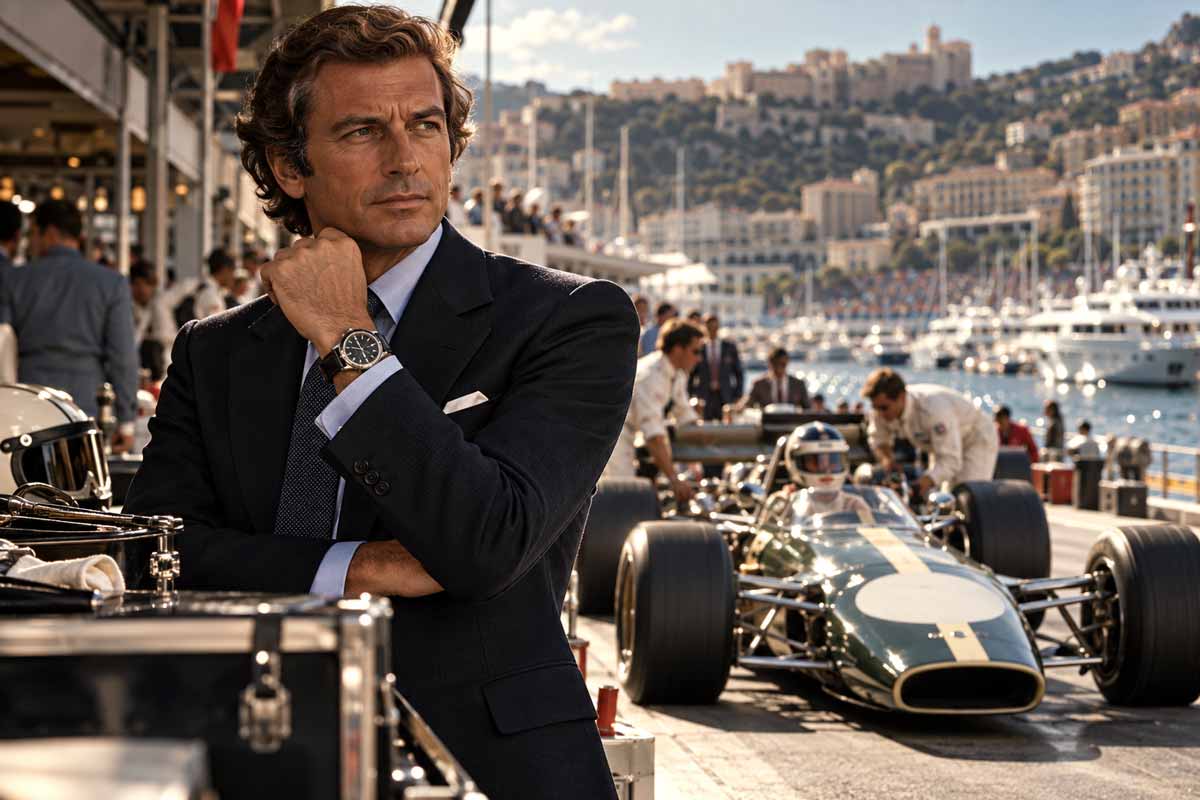
In the world of watches, there are brands that sell precision. There are brands that sell status. And then there are the rare names that managed to sell the sensation of time as adrenaline: the seconds before the start, the fractions of a second at the finish line, risk, the roar of an engine, the smell of gasoline, the glitter of Monaco, Steve McQueens racing suit, and a chronograph hand frozen on the border between engineering and myth.
Heuer became exactly that kind of brand, and not by accident. Behind it stood a man who understood that in the twentieth century, a watch could no longer be merely an instrument. It had to become a way of life. Jack Heuer didn't invent motorsport, didn't make the film Le Mans, didn't drive for Ferrari, and didn't build Formula 1 cars. But he did something no less significant: he bound the chronograph to the culture of speed so convincingly that, decades later, the connection still holds.
Today TAG Heuer is a global luxury brand, part of the vast machinery of the luxury industry, an official partner of high-profile sporting events, and the maker of watches that inhabit two worlds at once: the boutique and the racetrack. But one of the defining chapters of this story began long before today's advertising campaigns - in an era when the Swiss watch company was still called Ed. Heuer and Co., and its future looked anything but assured.
An Heir Who Refused Simply to Inherit
Jack Heuer was born in 1932 into a family for whom watches were not merely a business but a hereditary destiny. The company had been founded by his great-grandfather, Edouard Heuer, in 1860. By the time Jack arrived, the family already had a long history of precision instruments, patents, chronographs, and sports timing behind it. But belonging to a dynasty doesn't automatically mean wanting to carry it forward.
Jack's childhood was Swiss, privileged, and European in the old sense of the word. Languages, mountains, skiing, music, a demanding school, family discipline. He grew up in a milieu where precision was understood not as a dry technical category but as part of a culture: to play precisely, to speak precisely, to keep one's word precisely, to measure time precisely.
Yet his interests ranged well beyond the traditional watchmaker's craft. He studied at the Swiss Federal Institute of Technology in Zurich, choosing electrical engineering. For a family firm, that was a meaningful signal. Jack was no romantic heir intent on piously guarding the past. He belonged to a generation that could already sense another era approaching: electronics, new materials, international markets, American scale, and sports marketing.
This is precisely why his role at Heuer proved not custodial but transformative. He didn't simply receive an old business. He set out to find it a new language.
The First Lesson: A Product Must Solve a Specific Problem
One of the early episodes in Jack Heuer's story involves the Solunar, a watch that displayed the times of the tides. It was an unusual commission: an instrument that would help fishermen, hunters, and people whose lives depend on natural cycles. For a watch company, this wasn't merely an appealing idea but an engineering challenge - how do you translate the movement of the moon, the tides, and local conditions into a legible mechanism on the wrist?
Jack was not yet a seasoned executive, but the experience revealed a principle that would run through his entire career: great watches begin not with ornament but with function. They must be needed by a specific person in a specific situation.
The Solunar never became a mass cultural symbol on the scale of the Monaco or the Carrera, but it already contained the logic of the future Heuer: a watch doesn't merely tell time, it helps you act. For the fisherman, understanding the tides. For the racer, timing laps. For the navigator, avoiding error in a rally. For the athlete, measuring a result. For the referee, controlling a match. For the engineer, trusting an instrument.
This wasn't abstract luxury. It was a tool.
America as a Reality Check
In the late 1950s, Jack Heuer faced a choice: remain within the familiar Swiss orbit, or attempt to build the company a new market. His father and the family offered him the American business. For a young man, it was a challenge far more compelling than a comfortable seat in an old family firm.
The America of that era was every manufacturer's dream, and also a merciless examination. It wasn't enough there simply to be "a good Swiss brand." You had to understand exactly who was buying, why they needed the product, and why they should choose Heuer in particular.
The first approach proved naïve: catalogues, mailings, and waiting for orders. The market responded with silence. And that was a valuable lesson. America didn't buy heritage for heritage's sake. It needed a clear proposition.
Jack began to look more closely. He realized that ordinary wristwatches would never give Heuer a strong position. But chronographs, stopwatches, and rally instruments opened a niche in which the company could be not one of many, but a specialist. Car culture was booming in the United States; sports car clubs, enthusiasts of European automobiles, racing, rallying, and precise timekeeping were all gaining momentum. Where other brands wanted to look elegant, Heuer could be useful.
This was strategic clarity: not trying to please everyone, but becoming indispensable to its own people.
A Rally, a Mistake, and the Birth of an Idea
One of the most telling episodes comes from Jack's personal experience in a car rally. He competed as navigator, responsible for the map and the timing. The team was in contention for first place, but an error in reading the time off the dashboard stopwatch cost them the result. Under real race conditions, the dial simply wasn't legible enough: speed, tension, vibration, a hurried glance - and a one-minute mistake.
For a weak leader, this would have been an unfortunate accident. For a strong one, it was a message from the market.
It became the impetus for improving rally instruments. Heuer grew even more serious about legibility, functionality, clarity of scales, and the logic of dial layout. In motorsport, beauty must never get in the way of speed. An instrument that is hard to read is a bad instrument, however elegant it may be.
This philosophy would later become part of the brand's DNA. Heuer chronographs always carried not the languor of jewellery but the energy of an instrument. These were watches not for contemplating time, but for seizing it.
Autavia: The Name That Outlived the Instrument
The name Autavia was born from the fusion of two worlds - automobile and aviation. Originally it referred to dashboard chronographs for cars and aircraft, but Jack Heuer saw greater potential in it. The old instrument could fade away; the name could endure.
In the early 1960s, Heuer released the Autavia wristwatch chronograph. It was a significant step: instrument logic migrated from the dashboard to the wrist. A rotating bezel, multiple scales, utilitarian purpose, sporting character - the Autavia became a watch for people who understood time as part of action.
Heuer made no attempt to look like a classic dress-watch house. Its world became racetracks, cockpits, starts, finishes, sport, and machinery. It was one of those rare cases where function itself created style.
Carrera: When Danger Becomes a Name
In 1963, Jack Heuer introduced the Carrera. The name referred to the Carrera Panamericana, the legendary Mexican road race - one of the most dangerous and most romanticized in motorsport history. The word itself sounded perfect: race, career, path, motion, fate.
But the Carrera's strength lay not only in its name. Jack wanted to create a chronograph with an utterly clean, legible, modern dial. No visual noise. No clutter. No decorative fuss. This was a watch in which sportiness met graphic rigour.
The Carrera became one of Heuer's greatest design achievements. It possessed what we now call timeless design: an object born of a specific era, yet never trapped within it. It didn't look dated even as fashions changed. That is the power of good industrial design: it doesn't decorate function, it makes function beautiful.
The Leonidas Merger and a Bet on Scale
In the 1960s, Heuer was no giant. It was a company with deep expertise but limited resources. Competition in the Swiss watch industry was fierce, and the market demanded not only good ideas but a broad range, production capacity, and international presence.
The merger with Leonidas was a crucial step. Leonidas also specialized in chronographs and stopwatches, so the union strengthened both the product range and the manufacturing base. For Jack, it was a pragmatic move rather than a romantic one: if you want to play on a larger field, you need resources.
After the merger, Heuer-Leonidas gained greater scope for developing sports instruments and wrist chronographs. Various models emerged in this period, including the Camaro and vivid yachting chronographs. The brand was expanding not only its technical map but its emotional one: motor racing, aviation, sailing, sport, precision, risk, colour, movement.
Heuer was gradually becoming not merely a watch manufacturer but a brand of active modern life.
Marketing Without a Budget: Precision of Aim Instead of Volume
One of Jack Heuer's greatest strengths was his ability to market when there was no money for big marketing. Heuer could not afford lavish campaigns on the scale of the great luxury houses. So the task wasn't to shout louder than everyone else, but to speak precisely where the right people were listening.
Advertisements appeared in magazines read by potential customers: car enthusiasts, athletes, people interested in engineering, racing, sailing. It was a precise choice of audience. Not everyone. Not some abstract "successful public." But those to whom a chronograph could genuinely be useful and meaningful.
The advertising pages were then put to work a second time: displayed in shop windows, turning a magazine spread into a point-of-sale argument. Today we'd call it smart content repurposing. Back then, it was simply the practical thinking of a man who knew the value of every franc.
But his real genius lay not in the advertisements. It lay in his ability to connect watches with heroes.
Steve McQueen and the Monaco: The Chance That Became Eternity
In 1969, Heuer introduced the Monaco - a square automatic chronograph with an unconventional case, a striking blue dial, and an avant-garde energy. To the conservative watch world, it was almost a provocation. The watch looked as though it had arrived from the future: sharp, bold, cinematic.
But the Monaco didn't become a cult object overnight. Its destiny was changed by the film Le Mans, starring Steve McQueen. On screen, McQueen wore the Monaco, and the Heuer logo appeared on his racing suit. It was one of those marketing triumphs that can never be fully planned, only prepared for.
McQueen wasn't simply an actor. He was the embodiment of cool masculinity, speed, independence, and American style. He didn't look like someone who'd been "paid to advertise." He looked like someone who would genuinely wear that watch. And that is precisely what made the image immortal.
The Monaco became more than a model. It became a cultural object. A watch that was initially a difficult commercial proposition, even too daring for its time, went on to become one of TAG Heuer's defining icons. It's an important lesson: sometimes a brand creates a symbol before the market is ready to understand it.
Project 99 and the Race for the Automatic Chronograph
The late 1960s were a turning point for the entire watch industry. Automatic watches had long been the norm, but the automatic chronograph remained a formidable technical challenge. The market was shifting, competitors were moving, and Heuer could not afford to be left behind.
Thus was born the secret Project 99 - a collaboration between Heuer, Breitling, Büren, and Dubois Dépraz. The goal was ambitious: to create one of the very first automatic chronograph movements. In 1969, the result was unveiled to the world as the Calibre 11, or Chronomatic.
For Heuer, this was more than a new movement. It was a passage into a new era. The Autavia, the Carrera, and the Monaco all received an automatic chronograph. The crown ended up on the left - a technical quirk that could easily have been perceived as an oddity. But the team turned it into a signature: if the crown no longer needs daily winding, it can become the emblem of a new logic.
This was among the finest of marketing instincts: a weakness can be transformed into character, if it is explained with confidence.
Formula 1: When a Logo Becomes Part of Speed
Heuer's bond with motorsport was never limited to evocative names. In the late 1960s and early 1970s, the brand entered the world of Formula 1 with a boldness rare for a watch company. The Heuer logo appeared on racing cars, and the company went on to become Ferrari's partner. Drivers wore Heuer chronographs, while the electronics division developed timing systems, including the Centigraph.
This was no longer mere advertising. It was integration into the very infrastructure of racing. Heuer measured time where time decided everything. For a chronograph brand, no more persuasive stage could be imagined.
Jack Heuer grasped something essential long before it became a marketing cliché: a brand must live inside the culture it wishes to symbolize. You cannot simply paint a racing stripe on a dial and become a motorsport brand. You have to be at the track. You have to work with the teams. You have to know the drivers. You have to give them a tool. You have to become part of their world.
And Heuer did.
The Quartz Crisis and the Price of Change
But even a strong strategy offers no protection against tectonic shifts. In the 1970s and 1980s, the Swiss watch industry was struck by the quartz crisis. Electronic watches, Asian manufacturers, new price points, new consumer expectations - all of it abruptly rewrote the rules of the game. The mechanical complexity Switzerland had taken such pride in suddenly ceased to be an obvious advantage for the mass buyer.
For Heuer, it was a punishing period. A company that had built its fame on mechanical chronographs and sports timing found itself in a world where precision had become cheap and mechanics were no longer a necessity but a choice. Not everyone would survive.
In the mid-1980s, Heuer came under the control of Techniques d'Avant-Garde, a group closely tied to motorsport and high technology. And so TAG Heuer was born. To purists, it may have looked like the end of the old family chapter. But in historical perspective, it marked the beginning of a new era.
The brand preserved its bond with speed, while gaining new resources, a new aggression, a new visual language. TAG Heuer Formula 1, vivid quartz models, partnerships, a new sporting luxury - all of this belonged to another age. But the foundation had been laid earlier. Without Jack Heuer, there would have been no mythology for TAG to build upon.
What Jack Heuer's Real Talent Was
Jack Heuer was not simply a watchmaker. Nor was he merely an heir. His defining talent was the union of engineering thinking and marketing instinct.
He understood the product: a dial must read instantly, a movement must solve a problem, a function must be honest. But he also understood the dream: the buyer of a chronograph isn't only buying the ability to time something. He is buying a sense of belonging to a world in which seconds matter.
Under Jack, Heuer sold neither "men's watches" nor "Swiss quality" in the abstract. It sold precision for people of action. For racers, pilots, navigators, referees, athletes, engineers, adventurers. It was a powerful identity - and it is precisely that identity that has outlasted the decades.
His marketing decisions were bold, but never hollow. McQueen worked because the Monaco genuinely was radical. Ferrari worked because Heuer genuinely was in the business of timing. The Carrera worked because its design genuinely matched the spirit of racing. In the finest brands, myth doesn't replace the product; it amplifies it.
Legacy: The Watch as Culture
Today TAG Heuer continues to draw on the codes forged in Jack Heuer's era: Carrera, Monaco, Autavia, Formula 1, motorsport, precision, the avant-garde, celebrities, racetracks, speed. But his greatest legacy isn't in the model names. It lies in the understanding that a watch can be a cultural symbol.
For most buyers, the chronograph long ago ceased to be a necessary instrument. A phone keeps time more accurately. A fitness tracker gathers more data. Automotive electronics have long since moved far ahead. And yet people still want a mechanical chronograph. Why?
Because it measures more than seconds. It recalls a world in which a person presses the start button themselves. Where time is not merely observed but set in motion, stopped, captured. Where a small mechanism on the wrist connects its owner to a history of racing, engineering, risk, and personal discipline.
Jack Heuer understood this sooner than most. He saw that precision could be emotional. That an instrument could become a style. That the right hero on screen could do more for a watch than a thousand advertising slogans. That motorsport isn't merely a platform for a logo, but a mythology in which time becomes drama.
The lesson applies to any industry. A product must be good. But quality alone is not enough. You have to find the world in which that product becomes necessary, desirable, and symbolic. Heuer found that world in speed. And ever since, the hand of its chronograph has continued to sweep not only across a dial, but across the history of modern luxury.