
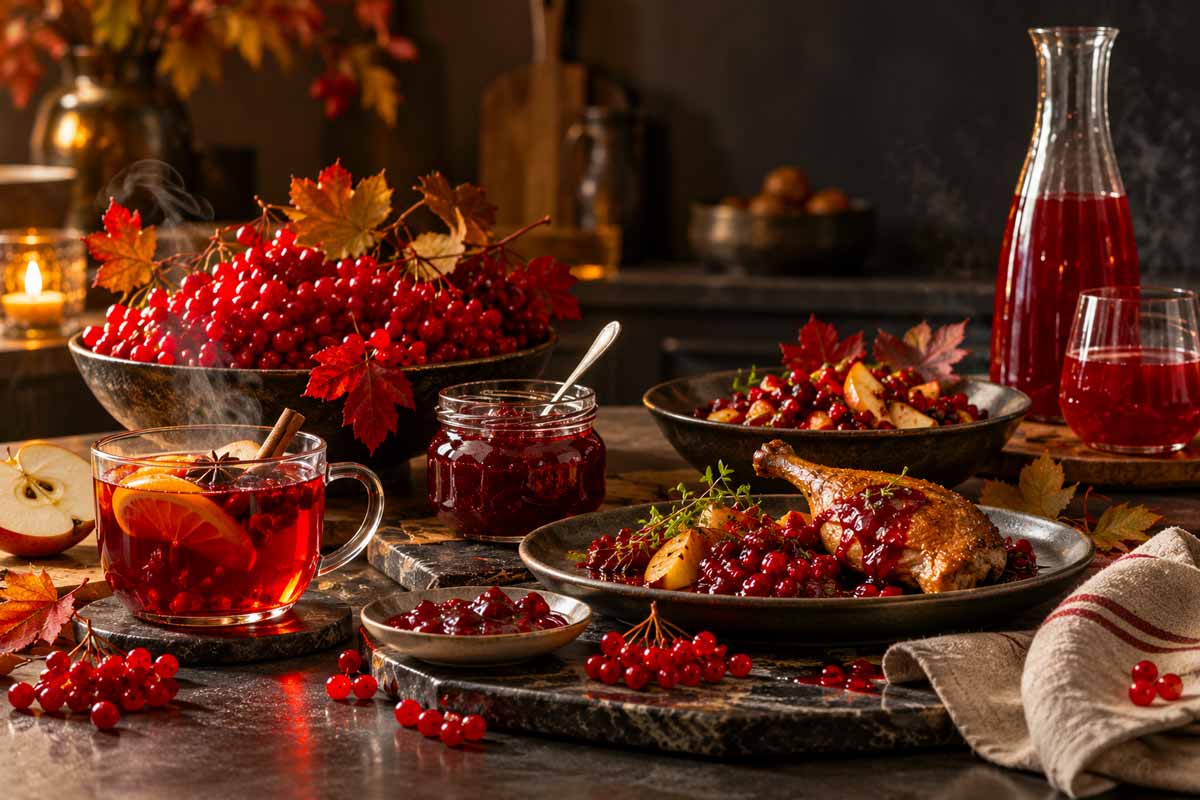
The Bitter Berry with Character
Why Highbush Cranberry Deserves a Place in the Modern Diet
There are foods that need no explanation. Almost everyone likes strawberries. Blueberries long ago embedded themselves in the modern urban diet. Raspberries sell beautifully, easily, without resistance. And then there are berries of an entirely different type - ones with character, memory, and a complex flavour. Kalina, the highbush cranberry, belongs firmly in that category. You do not eat it absentmindedly, the way you eat dessert. You have to understand it first.
For many of our readers, this isn't simply a berry but a cultural symbol, an almost folkloric image. It comes back to memory alongside village gardens, autumn branches under the first frost, fruit drinks, preserves, and conversations about how "after the frost it won't be so bitter." But it's precisely this reputation that so often gets in the way of looking at it afresh. For too long, kalina was presented either as a near-medicinal remedy for every occasion, or as a product from the past - useful, but not particularly desirable. And yet today it's interesting for reasons that have nothing to do with the home medicine cabinet or a grandmother's pantry.
Kalina is a complex, expressive berry, and very contemporary in spirit. In an era when people are once again drawn to northern flavours, wild fruit, fermented drinks, natural bitterness, and foods with character, it unexpectedly finds itself in extremely relevant company. This isn't a "sweet berry for pleasure" but a product with depth: tart, vivid, slightly astringent, with a rich aroma and a strong gastronomic personality.
Scientific interest in kalina is far from accidental either. Contemporary reviews describe the fruit of Viburnum opulus as a source of polyphenols, vitamin C, carotenoids, organic acids, and other bioactive compounds. But an honest caveat matters here: a considerable distance separates "an interesting biochemical profile" from "a proven therapeutic effect." Which is exactly why kalina is worth discussing not as a miracle remedy but as a rich, distinctive food that can sensibly complement a diet.
Why it's bitter - and why that isn't a flaw
The main thing that puts people off is the taste. Kalina rarely wins anyone over on first encounter. There's bitterness in it, astringency, pronounced acidity, and that particular, slightly sharp aroma that some call noble and others call too "wild" and heavy. This is precisely why kalina almost never became a mass-market berry in the way blueberries or grapes did.
But its advantage is hidden right there. Bitterness isn't a defect but part of the flavour profile. An important shift happened in cooking long ago: taste stopped being obliged only to please. It can intrigue, complicate, and organize a dish around itself. Like a good olive, dark chocolate, grapefruit, or amaro, kalina asks not for instant approval but for a certain amount of palate experience.
And the folk observation about the first frost didn't come from nowhere. After cold weather, kalina's flavour genuinely does soften, and processing - freezing, pressing, making fruit drinks, sauces, or jellies - helps make the berry less harsh and fuller in flavour. Studies and reviews of kalina's food properties likewise describe the fruit as bitter and astringent; which is exactly why fresh kalina is rarely perceived as a "convenient fruit" and is more often used in processed form.
What is genuinely valuable in kalina
If you strip away the folk myths and the marketing rhetoric, kalina is left with a perfectly respectable set of reasons to earn a place on an autumn and winter menu.
First, it's a berry with a notable content of polyphenolic compounds and antioxidant activity. These are largely what explain researchers' interest in kalina as a raw material for functional foods, juices, purées, and concentrates. Second, it genuinely does contain vitamin C, though the precise amount depends on variety, ripeness, growing conditions, and processing. Third, kalina is interesting not only for its nutrients but for its food profile as such: it contains almost no fat, isn't a high-calorie product, and fits easily into seasonal drinks, sauces, desserts, and savoury dishes.
Here, though, one adult caveat matters. When a berry is written about as something that "cures everything from a cough to your kidneys," that's almost always bad writing. In kalina's case, the more accurate framing is this: it has an interesting composition, a traditional history of use, and a body of experimental data pointing toward potential antioxidant, antimicrobial, and other biological effects. But turning that into a promise of clinical results means oversimplifying the subject and misleading the reader. Even studies that look promising more often concern extracts, concentrations, and laboratory models rather than an ordinary bowl of berries in a kitchen.
Why kalina still reads as "medicine" rather than food
Kalina has one cultural problem: for far too long, people ate it not for the taste but for the benefit. This happens frequently with northern, tart, and non-obvious fruit in general. As soon as a product is consistently presented under the logic of "you need this because it's good for you," it quickly loses its gastronomic standing and settles in the mind somewhere between a herbal decoction and a home remedy kept around "just in case."
But kalina has everything it needs to return to the realm of food proper. It can be used wherever what's wanted isn't sugary berry comfort but structure of flavour. It works excellently in fruit drinks made with less sugar than old recipes call for. It produces a genuinely convincing jelly to serve with meat and poultry. It belongs in sauces for game, in tart berry chutneys, in seasonal desserts with apple, pear, and spices, in hot drinks with citrus and ginger. Look at kalina not as a "folk remedy" but as a northern bitter berry, and it suddenly starts looking very contemporary.
For Russian-speaking readers there's an additional dimension to this. In North America, foods that work simultaneously as memory and as new experience are especially valued. Kalina is squarely among them. It connects the Eastern European habit of preserving with today's interest in local, seasonal, slightly wild flavour. And in that sense it's far more interesting than many "trendy superfoods," which have packaging but no biography.
When kalina is genuinely appropriate, and when it isn't
This piece needs to speak carefully not only about benefits but about limits. Kalina isn't a universal product "for everyone, always." Because of its pronounced flavour and composition, it doesn't suit everyone. People with a sensitive stomach, high acidity, a tendency toward low blood pressure, and a range of other conditions should approach it carefully. Certain sources in herbal medicine also note contraindications for particular forms of use, especially when it comes not to eating the berries as food but to concentrated herbal preparations and extracts. In this sense, kalina doesn't call for fear but does call for common sense. If someone has chronic conditions, is pregnant, has significant blood pressure issues, or is on ongoing medication, turning a berry into a home "treatment" without a doctor is a bad idea.
Which is exactly why kalina's most pragmatic role today isn't medicinal but culinary and cultural. Not "drink this instead of your prescriptions," but "bring back into your diet a food with strong flavour and an interesting composition, if it suits you."
How to handle it so it doesn't disappoint
The main mistake is trying to eat kalina the way you eat sweet berries. It will almost always lose in a direct comparison. It shouldn't be set against raspberries or blackberries but used according to different rules.
Kalina opens up best: after freezing; with brief heat treatment; in combination with honey, apple, pear, orange, and spices; in drinks where its astringency becomes an asset; in sauces where bitterness works as a counterweight to fat and salt.
If you want to preserve maximum nutritional value, freezing is generally gentler on vitamin C and a range of bioactive compounds than prolonged boiling. Research on processing kalina shows that heat treatment and storage genuinely do affect levels of vitamin C and polyphenols, and that gentler methods retain them better. This is one more argument for not automatically turning kalina into a long-simmered sweet preserve.
Kalina as the taste of maturity
There are foods you like immediately. And there are those you have to grow into yourself. Kalina belongs firmly in the second category. It's hard to picture it as a berry of childhood delight. But it's very easy to picture it as the taste of an adult autumn: slightly bitter, vivid, tart, making no attempt to please everyone.
And perhaps that's exactly what makes it so interesting today. Against a backdrop of endlessly sweet, convenient, soft flavours, kalina reminds us that food can be not only pleasant but distinctive. That a berry can have not only nutritional value but an intonation. That bitterness isn't always something to be eliminated; sometimes it's precisely what makes a flavour alive.
Kalina needs neither myths nor exaggeration. It doesn't need to promise miracles to justify its place at the table. It's enough to acknowledge something simple: this is a complex, northern, distinctive berry with an expressive flavour, an interesting composition, and a great deal of cultural memory.
It's worth eating not because it's "obliged to save you from every illness," but because it returns to the diet something increasingly rare in it: seasonality, character, astringency, and a flavour that isn't required to please you instantly.
Which is why kalina sounds contemporary again today. Not as a relic from the past, but as a rare product that doesn't pretend to be convenient - and is all the more valuable for it.