700 Islands. One Archipelago. Completely Different Worlds.
A Guide to The Bahamas for Travelers Who Want More
Most people think they already know The Bahamas. Atlantis on Paradise Island with its water slides and casino. A cruise ship docked in Nassau for a few hours while tourists buy magnets and rum cakes. A beach, a cocktail, a hotel, and a flight home. That version of The Bahamas certainly exists. For some travelers, it is exactly the right kind of vacation. But the real Bahamas are far more layered and far more interesting.
The country consists of nearly seven hundred islands, with only around thirty permanently inhabited. And each island feels like a completely different conversation - a different atmosphere, a different history, a different rhythm of life, even a different color of water.
For residents of North America, The Bahamas are surprisingly close: a direct flight to Nassau takes just over two hours. In roughly the same amount of time it takes to drive to Montreal, you can arrive in places where Ernest Hemingway wrote, Martin Luther King Jr. worked on his Nobel Prize speech, and Johnny Depp bought a private island simply to disappear from the world.
This is not a tourism advertisement. It is an attempt to describe what The Bahamas are actually like beyond cruise ports and postcard clichés.
First - an honest word about safety
Before talking about beauty, it is important to address something most travel brochures prefer to avoid.
Nassau and Freeport - the largest cities in the archipelago - do face real issues with street crime. Both U.S. and Canadian travel advisories recommend increased caution, particularly in certain areas of New Providence and Grand Bahama.
Some neighborhoods south of Shirley Street in Nassau, especially the Over-the-Hill district, are considered problematic. Tourists rarely enter these areas, but petty theft near beaches, ports, and tourist zones can still occur, even during daylight hours.
The atmosphere changes dramatically on the so-called Family Islands, also known as the Out Islands - Exuma, Eleuthera, Abaco, Bimini, and Andros. These islands are quieter, less crowded, and shaped by the natural social structure of small island communities.
The practical rule is simple: Nassau requires awareness, Paradise Island is considerably safer, and most outer islands feel like a completely different world.
Bimini: the island of three great legends
Just fifty miles off the coast of Florida lies Bimini - one of the smallest yet most legendary islands in The Bahamas.
In the early 16th century, Spanish explorer Juan Ponce de León arrived here searching for the mythical Fountain of Youth. To this day, locals point visitors toward places connected to that legend, including the famous Healing Hole - a freshwater mineral spring hidden among mangroves that many islanders still consider restorative.
During the 1930s through the 1950s, Ernest Hemingway regularly lived and fished in Bimini. The island later influenced parts of his work, including themes associated with “The Old Man and the Sea.” His favorite gathering place was The Compleat Angler hotel, which was destroyed by fire in 2006 along with part of its historical archive.
In 1964, Martin Luther King Jr. came to Bimini seeking peace and solitude. He worked here on the speech connected to his Nobel Peace Prize.
But Bimini’s most mysterious story is tied to the so-called “Bimini Road.” In 1968, divers discovered large rectangular underwater stone blocks arranged in surprisingly regular formations. Geologists classify them as a natural limestone structure. Supporters of the Atlantis theory, however, immediately recalled Edgar Cayce who claimed that traces of Atlantis would be discovered near Bimini in either 1968 or 1969.
Exuma: water that barely looks real
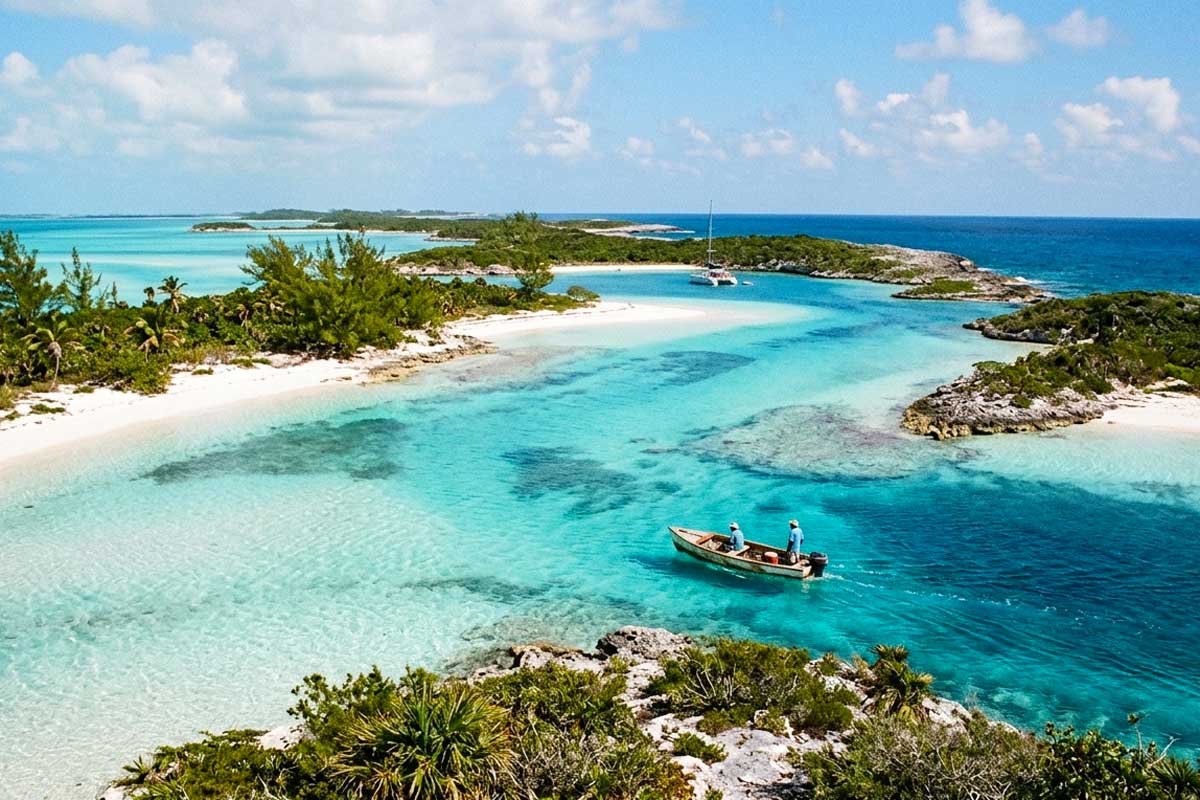
The Exumas are a chain of 365 islands and cays stretching south of Nassau. Locals like to joke that there is one island for every day of the year.
This is where you will find Thunderball Grotto, the famous underwater cave featured in the James Bond films “Thunderball” and “Never Say Never Again.” Today it is one of the region’s best-known snorkeling sites.
Nearby lies Big Major Cay - better known as Pig Beach. In the early 1990s, pigs were moved here from a neighboring island. Over time, they learned to swim toward approaching boats expecting food. Social media later transformed the swimming pigs into one of the Caribbean’s most recognizable travel images.
Not far away is Leaf Cay, home to a protected colony of iguanas and strict environmental development restrictions.
The island Johnny Depp bought for privacy
In 2004, during the filming of “Pirates of the Caribbean,” Johnny Depp purchased Little Hall’s Pond Cay for approximately $3.6 million.
The forty-five-acre island operates largely on solar power because of its protected environmental status. Depp built a panoramic main residence, several guest cottages, and private beach areas.
Two of the beaches were named after his children, Lily-Rose and Jack.
The actor famously referred to the property as “F*** Off Island,” explaining that he wanted complete privacy. In many ways, privacy remains one of the greatest luxuries of the Bahamian Out Islands.
Eleuthera: the island people fall in love with
Eleuthera is a long, narrow island east of Nassau whose name comes from the Greek word for “freedom.”
There are no giant resorts here. No mega-casinos. No cruise terminals.
Instead, there is Glass Window Bridge - one of the most extraordinary landscapes in the archipelago. At this narrow point, the island shrinks to just a few meters wide. On one side lies the deep-blue Atlantic Ocean. On the other, the bright turquoise waters of the Caribbean.
The contrast is so dramatic that it looks digitally enhanced until you see it in person.
Eleuthera is also home to the famous Pink Sand Beach on Harbour Island. Its blush-colored shoreline is not a marketing trick but the result of microscopic fragments of coral and marine organisms mixed with white sand over countless centuries.
Harbour Island has become one of the Caribbean’s most elegant yet understated destinations: pastel colonial homes, boutique hotels, quiet restaurants, and almost no large-scale resort development.
Atlantis and the real Bahamas are two different worlds
Atlantis on Paradise Island is the largest resort complex in the Caribbean. It includes thousands of hotel rooms, an enormous water park, casinos, restaurants, pools, aquariums, and shopping areas.
For families and travelers seeking convenience, entertainment, and everything in one place, it is exceptionally successful at what it does.
But Atlantis is its own carefully constructed universe - not the full reality of The Bahamas.
The true character of the archipelago begins where the cruise terminals and mega-resorts end.
Andros: the largest island nobody talks about
Andros is the largest island in The Bahamas and one of the least touristy.
It is home to the Andros Barrier Reef - one of the world’s largest barrier reef systems, stretching nearly two hundred miles.
Nearby are the famous Blue Holes, vertical underwater cave systems descending hundreds of feet into the ocean floor. Experienced divers consider Andros one of the Atlantic’s great hidden treasures.
The island still preserves vast mangrove forests, pine woodlands, and untouched natural landscapes. Here, The Bahamas feel less like a resort destination and more like an isolated world surrounded by ocean.
What to know before you go
The Bahamas welcome millions of visitors every year, but most travelers only see Nassau’s cruise port and a few nearby streets.
The Family Islands operate on a completely different rhythm. Reaching them often requires small regional flights, ferries, or private boats. Yet this is where travelers discover the extraordinary water of the Exumas, the sunsets of Eleuthera, the silence of Andros, and a sense of open space that has become increasingly rare in modern tourism.
For residents of North America, The Bahamas are among the closest tropical destinations on the map. But more importantly, they are far more than a beach vacation. They are an archipelago layered with history, atmosphere, and stories that run much deeper than most visitors ever realize.
What not to do
Do not limit your trip to Nassau if your goal is to experience the real Bahamas.
Do not expect the Family Islands to offer the polished infrastructure of large luxury resorts. Service is slower, internet and electricity can occasionally be unreliable, and life moves at a very different pace.
And do not forget that June through October is hurricane season. That does not mean constant storms, but it does mean flexibility matters.
The Bahamas are an archipelago most travelers never truly see.
They see a port, a nearby beach, and a souvenir market. But the real Bahamas are islands where Hemingway wrote, where Martin Luther King Jr. searched for silence, where divers still debate the remnants of Atlantis beneath the water, and where the pink sand is not a filter or a marketing illusion but millions of years of coral history.
That is why The Bahamas remain one of the Atlantic’s most underestimated destinations - especially for travelers who are looking not just for a vacation, but for the feeling of genuine discovery.