
Dubai Chocolate, Decoded
The Original, the Dupes, and What is Inside
Here is the single fact that should shape how you shop for Dubai chocolate in North America: the company that actually invented it has no website, does not ship internationally, and sells its bars almost exclusively out of a handful of physical counters in Dubai and two other airports. Its own verified social media accounts state this in plain, all-caps language. Which means that nearly every site online promising to FedEx you the authentic original bar, fresh from Dubai is, definitionally, lying to you - and quite a few of them, as documented consumer complaints show, are running an outright scam. The good news is that once you understand what the real thing actually is, judging the honest imitations sold at Costco and Trader Joes becomes easy. This is the story of both halves of that puzzle.
A Pregnancy Craving, an Engineer, and a Chef
Dubai chocolate exists because of a very specific craving. In 2021, Sarah Hamouda, a British-Egyptian engineer living in Dubai, was pregnant and fixated on a flavor combination she couldn't find anywhere on the market: something that tasted like the knafeh her mother used to make, wrapped in chocolate. Knafeh is a beloved dessert across the former Ottoman world, traditionally built from kadayif - fine, hair-thin strands of pastry dough, similar to shredded filo - layered with a soft cheese and soaked in syrup. Hamouda began experimenting in her own kitchen, then brought in Nouel Catis Omamalin, a Filipino chef and pastry consultant, to help engineer the concept into an actual bar. Omamalin, whose own favorite Middle Eastern dessert happened to be knafeh, suggested building the flavor into a chocolate shell for both its nostalgic pull and its crunch.
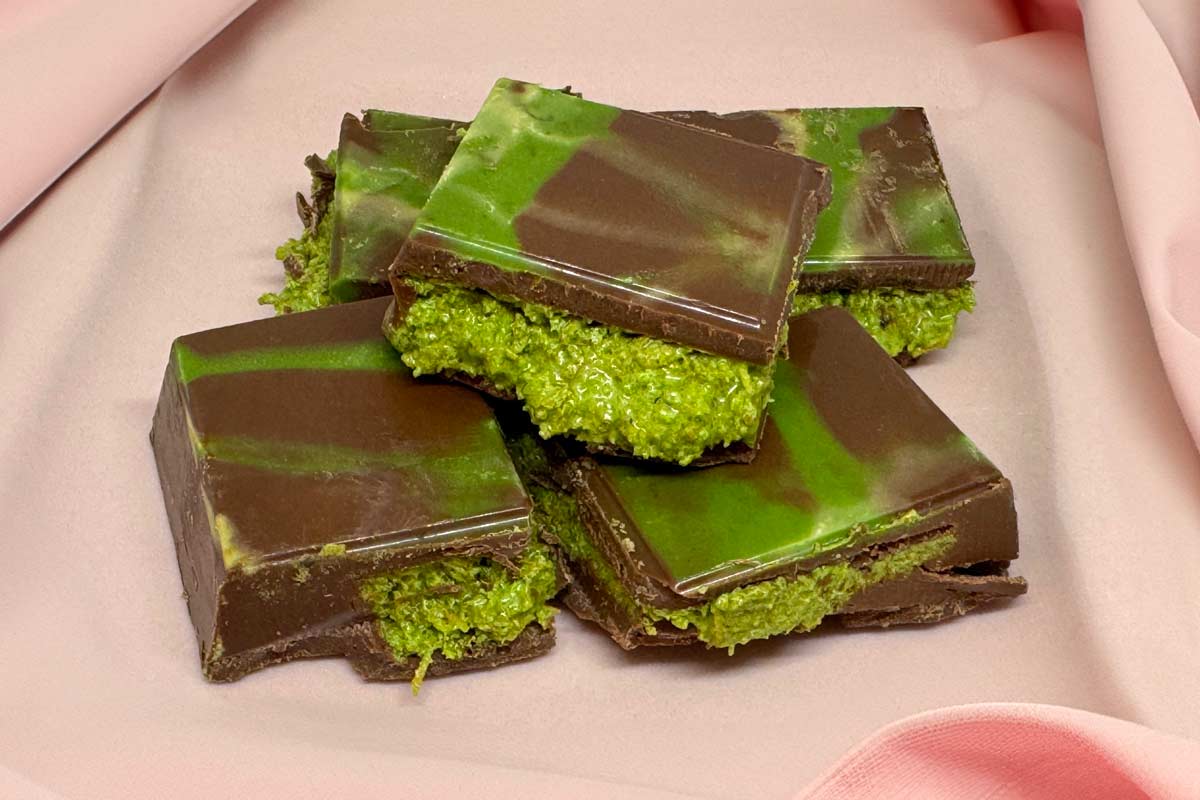
What they landed on was a thick milk chocolate bar filled with a sweet pistachio-tahini cream and toasted, crisped kadayif strands, sold under the name Fix Dessert Chocolatier and packaged in bright yellow and green. Hamouda's husband and business partner, Yezen Alani, came up with the pun-heavy names that would later define the brand's voice - the original bar was called "Can't Get Knafeh of It." Every bar was made entirely by hand: a small team working six to eight hours could produce roughly 25 bars a day, initially sold at a rate of about one bar per customer per week. It took over a year of continued refinement, well past the brand's 2022 launch, before Hamouda felt they'd genuinely nailed the recipe balance in early 2023.
How One TikTok Video Turned a Dubai Side Hustle Into a Global Obsession
Fix stayed a modest, largely local Dubai phenomenon until December 2023, when food influencer Maria Vehera posted an ASMR-style video of herself unwrapping and biting into a bar in her car. That single video has since been viewed more than 124 million times. The audio of the crunch, paired with the visually striking contrast between dark chocolate shell and vivid green interior, turned out to be perfectly engineered for how people actually consume food content on social platforms - and within months, Fix's daily order volume went from single digits to hundreds, while imitators began appearing everywhere from London chocolatiers to German supermarket chains. In September 2024, the brand created a bespoke flavor, inspired by Emirati halwa, for Hamdan bin Mohammed Al Maktoum, the Crown Prince of Dubai, after his own public endorsement of the bar helped cement its status as a genuine cultural export rather than just an internet fad.
The Part Almost Nobody Realizes: You Cannot Actually Buy the Original Here
This is the detail that matters most for anyone in North America who has typed "Dubai chocolate" into a search bar. Fix Dessert Chocolatier's own verified Instagram and TikTok accounts, followed by well over half a million people, state their availability in plain terms: physical counters at Dubai International Airport, Singapore's Changi Airport, and Harrods in London, plus limited daily online drops at two fixed times through a single delivery app inside the UAE - and, printed directly in their bio with a warning symbol, the explicit statement that they have no website at all.
Against that backdrop, a cluster of professional-looking websites has emerged over the past year, each claiming to be the official Fix Dessert Chocolatier store, each claiming to ship the authentic bar fresh from Dubai to addresses across the United States and Canada within days. Every one of these claims contradicts what the real, verified brand says about itself. Documented customer complaints describe a now-familiar pattern: an initial payment for the bars, followed by a request for additional shipping fees, then an insurance fee, then a customs charge - with no tracking number ever materializing and no chocolate ever arriving. Cybersecurity researchers who study seasonal shopping fraud have flagged the Dubai chocolate craze specifically as fertile ground for exactly this kind of scam, precisely because the real product's scarcity creates the emotional urgency that makes people skip the due diligence they'd normally apply. The takeaway is blunt: if a website is offering to ship you "the original Fix bar" anywhere in North America, that claim alone is disqualifying, regardless of how convincing the site looks.
What Happens When Demand Outruns Quality Control
There is a second, more serious reason to be cautious about buying "Dubai chocolate" from unverified international sellers, and it isn't hypothetical. Germany's Baden-Württemberg consumer protection ministry tested eight imported Dubai chocolate products sourced from the UAE and Turkey and found every single one defective in some way. Five of the eight used fats other than cocoa butter in the coating - which, under German and EU labeling law, disqualifies a product from legally being called "chocolate" at all, since compound coatings made with cheaper vegetable fats are a different, lower category of product entirely. More seriously, five samples, all traced to the same UAE-based producer, were found unfit for consumption due to elevated levels of glycidyl fatty acid esters and 3-MCPD - contaminants linked to low-quality palm oil processing that regulators classify as probable carcinogens. Separately, food safety authorities in the UK have recalled counterfeit Dubai-style bars that used Fix's branding without authorization and failed to disclose major allergens, including peanuts and tree nuts, on their packaging. None of this means every small producer is unsafe - but it's a genuine, documented illustration of what can happen when a viral flavor explodes faster than any regulatory or quality-control system can keep pace with it, particularly through informal import channels and social media sellers rather than established retailers.
What's Actually Sold as "Dubai Style Chocolate" in North America
The honest, and much safer, version of this story is what's happened at mainstream North American retail over the past year, and it's worth separating clearly from the scam ecosystem above, because it operates in good faith and is labeled accurately. Lindt developed its own permanent "Dubai Style Chocolate" recipe, launching first through limited retail drops before rolling out nationwide to Walmart, Target, and Walgreens. Trader Joe's introduced a notably affordable version, made by a chocolate group called Patislove, using a dark chocolate shell rather than milk. Costco began selling an ice cream adaptation. Shake Shack built a limited-edition milkshake around the flavor profile; Crumbl developed a brownie spinoff; Ghirardelli ran a limited sundae. Beyond the big names, a wave of independent and craft chocolatiers across the US and Canada - including small-batch makers like Charles Chocolates, which topped several blind taste-test rankings for balance and quality - have released their own interpretations, often with more restraint on sweetness and a more generous hand with real pistachio than the mass-market versions.
None of these products are pretending to be the original Fix bar, and that's precisely the point: they're labeled "Dubai style," an honest disclaimer that signals inspiration rather than authenticity, which is both accurate and, given everything above, the safer category to be shopping in.
How to Actually Judge What You're Buying
Since the original is effectively unobtainable in North America through any legitimate channel, the more useful question isn't "is this authentic," but "is this well made." A handful of concrete markers separate a genuinely good version from a cheap, rushed one.
Start with the chocolate itself. A quality bar lists cocoa butter as the fat in its coating; if the ingredient list instead shows palm oil, vegetable fat, or a generic "vegetable oil blend" as the primary fat, you're eating a compound coating rather than real chocolate, and it will taste noticeably waxier and less complex on the tongue. Next, look at the filling's color. Genuine, generously used pistachio paste produces a color that's closer to olive or muted sage green - natural pistachio pigment is simply not that vivid. A filling that's neon, almost fluorescent green is a strong signal that the color is doing work the pistachio content isn't; that's usually paired with a thinner, less flavorful filling stretched with sugar and green food dye rather than genuine nut paste. The kadayif matters too: it should read as distinctly crisp and toasted, contributing real textural contrast, not soft, soggy, or swapped out entirely for a cheaper filler like puffed rice, which some mass-market versions do to cut costs. And while not every legitimate version includes it, the presence of real tahini - providing a faint, savory, sesame bitterness that balances the sweetness - is generally a sign of a more faithful, better-balanced interpretation rather than a purely sugar-forward one built to appeal to the broadest possible palate.
The Pistachio Story Nobody Saw Coming
One of the stranger side effects of this entire phenomenon is what it did to global pistachio markets, and it's a genuinely interesting case study in how a single viral food trend can ripple through agricultural commodities most people never think about. Pistachio kernel prices climbed from roughly $7.65 a pound to about $10.30 within about a year - driven by a combination of a disappointing US harvest, the world's largest pistachio-growing country, and a genuine demand shock. Iran, the second-largest global producer, exported 40 percent more pistachios to the UAE in the six months through March 2025 than it had shipped in the entire previous year, as chocolatiers scrambled to secure kernels. Industry traders described the global pistachio supply as essentially fully committed, with growers and shippers unable to meaningfully increase output on short notice, since pistachio trees take years to mature and can't simply be planted in response to a TikTok trend. It's a strange but genuine illustration of just how far a single dessert's virality can travel outward - from a Dubai kitchen counter to commodity markets on three continents.
The Practical Version of All This
If you're in North America and someone is offering to ship you "the real Fix bar," treat that claim itself as the red flag - the company's own official channels say plainly that this isn't something they do. If you want to actually taste the original, the only reliable options are traveling through Dubai International, Singapore's Changi, or Harrods in London, or asking a friend making the trip to bring one back. For everyone else, the honestly labeled "Dubai style" versions now widely available across North American retail are the right category to be shopping in - and among those, reading the ingredient list for real cocoa butter, a natural rather than neon-green filling, genuinely crisped pastry, and a hint of tahini will tell you more about quality than any packaging or price tag ever could. The chocolate itself, it turns out, is happy to tell you the truth. You just have to know what to look for.