
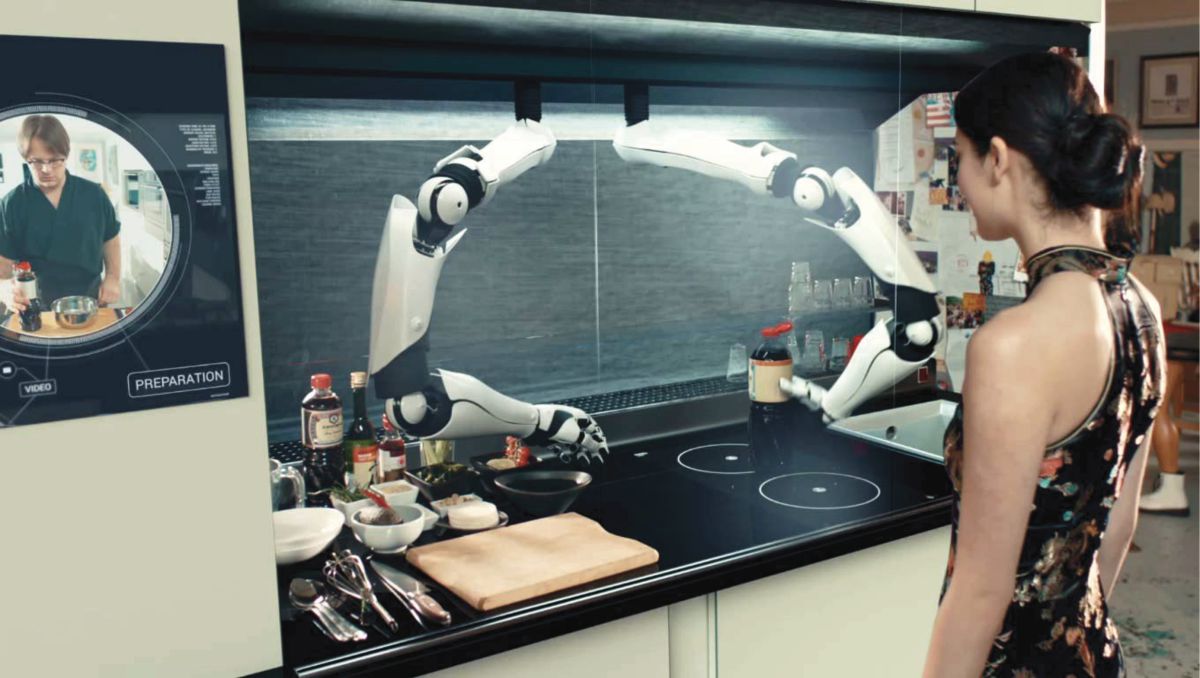
A two-armed robot cook will replace the hostess in the kitchen
A robot chef controlled from a smartphone and capable of cooking meals from digital recipes once sounded like something from science fiction. But the idea of a robotic home kitchen has long since moved beyond fantasy. One of the best-known projects in this field is the system developed by Moley Robotics - a robotic kitchen with two mechanical arms designed to reproduce the movements of a professional chef and prepare complete dishes inside a specially equipped kitchen module.
The first Moley prototype was presented in 2015 at the Hannover Messe industrial fair. The project was founded by Mark Oleynik, and the system quickly attracted the attention of technology media, investors and professionals in the food-tech industry. At first, the company announced plans to bring a consumer version to market as early as 2017, but reality proved more complex: developing such a system to commercial maturity took significantly longer. Later, Moley introduced the robotic kitchen as a premium product for the luxury residential market, aimed at high-end private homes and exclusive kitchen projects.
The concept is impressive: two robotic manipulators are positioned above the hob, oven, work surface and sink. They can handle kitchen utensils, stir, pick up cookware, work with ingredients and reproduce human movements recorded in advance. Unlike an ordinary kitchen appliance, this is not a single device, but an integrated system: robot, worktop, hob, sink, cabinets, refrigerator, storage areas and software control.
One of Moley’s central ideas was to turn culinary skill into a digital recipe. The movements of a professional chef are recorded using cameras and sensors, then converted into a format the robot can reproduce. In an early demonstration, the system used the movements of Tim Anderson, winner of the British MasterChef 2011 competition. The robot did not simply receive a list of ingredients and instructions. It copied technique: how to pick up a spoon, how to stir, when to add an ingredient, how to work with the hob and cookware.
From a technical point of view, this is one of the most difficult challenges in domestic robotics. A kitchen is not a sterile factory conveyor belt where everything is always in the same place. It contains hot surfaces, liquids, steam, sharp knives, fragile dishes, ingredients of different sizes and the constant possibility of the unexpected. That is why a robot chef must be not merely fast, but precise, safe and predictable.
According to Moley’s vision, the user can select a dish through a touchscreen or an app. In the future, the system is intended to use a library of digital recipes, where famous chefs could offer their signature dishes to owners of robotic kitchens. The idea resembles music or video platforms: only instead of downloading a song or a film, the user downloads a culinary script, and the robot performs it in the kitchen.
The creators of the project also spoke about remote control from a smartphone, built-in storage zones, a refrigerator and a dishwasher. In the ideal version, such a kitchen would not only cook, but also partially clean up after itself: moving dishes, clearing the work surface and maintaining order within the kitchen module. When the robotic arms are not in use, they fold away, freeing the space above the work area.
Special attention is paid to safety. A robotic kitchen deals with hot pans, knives, electrical appliances and an open work area, so protective elements are not decorative extras but necessities. Early concepts included protective glass, motion-control systems and fire-safety protection. In a home environment, this is especially important: the robot must be safe around children, guests and the owner, as well as in situations where a person is in another room.
Moley engineers have said that future versions of the system should be able to interact more effectively with different kitchen appliances and learn new actions. In the long term, such technology could move far beyond cooking. If a robot can work precisely with its hands, recognize objects, follow complex instructions and operate in a domestic space, it could theoretically become a universal assistant not only in the kitchen, but in other household tasks as well.
At the same time, it is important to be realistic: the mass-market robotic kitchen has not yet become an ordinary household appliance like a dishwasher or robot vacuum. It remains an expensive, complex and largely premium technology. Contrary to the optimistic forecasts of the mid-2010s, systems of this kind did not appear in every home by 2017. But the direction proved real: Moley continued development, introduced commercial versions and now positions the product as a high-technology kitchen of the future for the luxury segment.
The most interesting part of this story is not even whether the robot can perfectly cook soup or prepare pasta. The deeper point is that cooking is beginning to become a digital skill - something that can be recorded, stored, transmitted and reproduced. In the past, a recipe was a text, a video or a family memory. In the world of robotic kitchens, it can become a sequence of movements, gestures, temperatures, pauses and precise actions.
Perhaps in the future, famous chefs really will sell not only books and master classes, but also digital recipes for home robots. And a person will be able to choose dinner not according to their own level of fatigue or cooking ability, but according to mood: tonight, restaurant-style pasta; tomorrow, an Asian soup; the day after, a family dish recorded once and preserved forever.
More information about the project and materials explaining how the robotic kitchen works can be found at moley.com.