
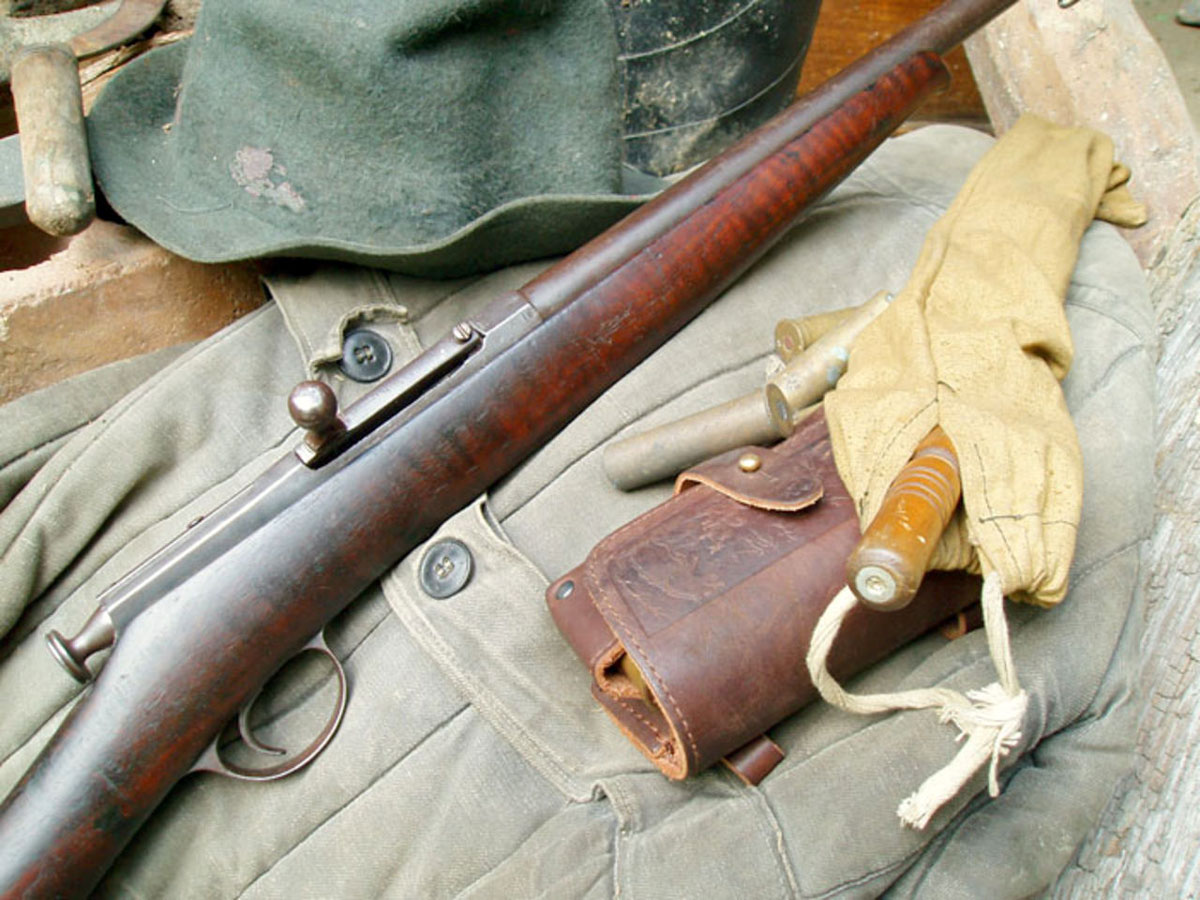
What is Berdanka or Berdans snipers
Any experienced hunter has heard the word berdanka at least once. Someone’s father or grandfather may have hunted with one, someone may have seen one in an old gun cabinet, and someone may know the name only from stories. Yet today, not everyone understands exactly what this word means. Some consider the berdanka a military rifle; others think of it as a hunting shotgun converted from a military weapon; still others see it as a special type of hunting gun; and some use the word for almost any smoothbore gun made from an old rifle. In each of these opinions, there is a piece of truth.
The main clarification is this: in the strict historical sense, a berdanka is first of all a Berdan-system rifle, which served in the Russian army in the second half of the nineteenth century. But in hunting language, the same word later came to describe numerous civilian conversions of old Berdan military rifles - both rifled and smoothbore. The confusion did not arise by accident. The word berdanka truly lived several lives.
At the same time, the common belief that smoothbore berdankas were necessarily small-calibre guns is incorrect. Conversions existed in various calibres, from small bores to quite serious hunting versions.
It is also important not to confuse a smoothbore berdanka with hunting guns converted from the Mosin rifle. Weapons based on the famous Russian three-line rifle were often called frolovkas, after P. N. Frolov, who developed this type of conversion. Frolovkas were produced from the early years of Soviet power until the beginning of the Second World War. Unlike classic berdankas, which were single-shot firearms, frolovkas could be either single-shot or magazine-fed and were usually found in 20, 24, 28 and 32 gauge.
In 1945-1947, the USSR also produced a single-shot 32-gauge hunting gun using parts from the Mosin rifle - the TOZ-32, or T-1. These are related in spirit, but different in origin and construction, branches of hunting-gun history.
More about the berdanka
The story of the berdanka begins in the 1860s, when the Russian army was actively looking for a new breech-loading rifle using a metallic cartridge. In 1866, Colonel A. P. Gorlov of the Main Artillery Directorate and Lieutenant K. I. Gunius of the Weapons Commission were sent to the United States to study and select a new rifle. At that time, American gunmakers were already regarded as leaders in the creation of modern small arms.
During their mission, Gorlov and Gunius paid close attention to Hiram Berdan’s rifle with a trapdoor-style breechblock. However, the Russian specialists did not simply accept the ready-made design. They made serious changes to both the firearm and the cartridge. The result was a 4.2-line, or approximately 10.67-mm, cartridge with a metallic case and a rifle with a hinged breechblock. In the United States, the weapon was often associated with the Russian order, while in Russia it became known as the Berdan system. Yet the contribution of Gorlov and Gunius was so substantial that the Berdan No. 1 rifle can fairly be viewed as the product of Russian-American collaboration.
It entered service as the 4.2-line infantry rifle, model 1868, or Berdan No. 1. At first, it was issued primarily to rifle units because of its excellent accuracy for the time.
The Berdan No. 1 rifles were ordered from Colt, and cartridges from an American factory in Bridgeport. But this system never became the mass infantry rifle of the Russian army. In 1869, Hiram Berdan arrived in Russia and proposed a new version with a rotating bolt. The metallic cartridge allowed the advantages of this action to reveal themselves fully: it chambered the cartridge, extracted the spent case, accelerated reloading and eventually became one of the most common mechanisms in rifle design.
In 1870, the new system was adopted as the Berdan No. 2 rapid-firing small-calibre rifle. This became the classic berdanka known from Russian military and hunting history. Later, variants were approved for different branches of service: infantry, dragoon and Cossack rifles, as well as a cavalry carbine.
The Russian 4.2-line cartridge for the berdanka was powerful and accurate for its time. The case had a bottleneck shape; the bullet was first cast and later swaged, and in the cartridge it was wrapped in paper. The colour of the paper wrapping indicated whether the charge was full or reduced. A four-sided bayonet was adopted for the rifle. In terms of its characteristics, the model 1870 rifle was one of the best single-shot systems of its era.
The Berdan No. 2 became the last single-shot rifle of the Russian army and remained in service until the adoption of the Mosin rifle, model 1891. But its story did not end there. After being replaced by the three-line rifle, old berdankas were converted in large numbers into hunting weapons and served in that role for decades.
Large stocks of Berdan rifles and ammunition were also kept in depots, fortresses and training institutions as a mobilization reserve. Destroying old weapons was expensive and impractical, so it was more sensible for the state to sell or convert them for civilian use. By the beginning of the First World War, many berdankas still remained in storage.
Early combat losses and the inability to supply the army quickly with enough Mosin rifles forced the authorities to remember these old stocks. Initially, berdankas were intended for rear-area use - guarding bridges, railways, warehouses and other facilities. This was logical: Mosin rifles freed in this way could be sent to the front. But the rapidly growing shortage of weapons meant that outdated single-shot berdankas sometimes reached front-line units as well.
On the front, black-powder firearms did not last long. The smoke from each shot revealed the shooter’s position, the rate of fire was insufficient, and the system itself was clearly inferior to modern magazine rifles. The use of old berdankas was a forced and temporary measure, after which they finally left the battlefield for history.
After the Russian army rearmed with Mosin rifles, a practical question arose: what should be done with hundreds of thousands of withdrawn Berdan rifles? The answer was simple - convert and sell them. In the early twentieth century, the Main Artillery Directorate authorized barrels, receivers and other parts of Berdan rifles to be sent to the Tula Arms Plant for boring out and later sale to craftsmen and small gunsmithing workshops.
Tula craftsmen actively bought parts from old weapons, converted them and assembled hunting guns. Such smoothbore berdankas were sold in various calibres, from 12 to 32 gauge, with different finishes: bluing, engraving, nickel plating, birch stocks or walnut stocks. At the same time, the Tula Arms Plant itself also produced hunting guns based on Berdan rifles, operating a special hunting workshop from 1902 onward.
In addition to smoothbore guns, rifled hunting carbines based on the Berdan rifle were produced for Smith and Wesson and Winchester .44-calibre cartridges. After 1915, because of the First World War, the manufacture of hunting conversions largely stopped, later resuming in limited quantities under Soviet rule. In the 1920s and 1930s, a number of smoothbore berdankas were produced in Tula and Izhevsk.
Thus, in Russian firearms usage, the word berdanka could refer to several types of weapon at once: the Berdan No. 1 military rifle with a hinged breechblock; the Berdan No. 2 military rifle with a sliding bolt; hunting rifles and carbines converted from the Berdan No. 2; and smoothbore hunting guns of various calibres made on the same basis.
Hiram Berdan and his sharpshooters
Hiram Berdan’s story is interesting not only because of the rifle connected with the Russian army. In the United States, his name is associated above all with the Civil War and the famous sharpshooter units of the Union army.
By the mid-nineteenth century, rifled firearms had sharply increased the range and accuracy of infantry fire. In armies around the world, enthusiasts of long-range marksmanship began to appear. In the United States, this culture developed especially quickly: the country had strong hunting traditions, many experienced shooters and a deep interest in firearms innovation. As early as the eighteenth century, American hunters and settlers using long-barrelled rifles were hitting targets at distances that seemed very serious to many European marksmen.
During the Civil War of 1861-1865, both sides actively used skilled marksmen. Their tasks were broad: reconnaissance, ambushes, suppressing artillery crews, targeting officers and commanders, supporting breakthroughs and disrupting enemy attacks. The difference lay in organization. In the South, the best shots were more often distributed among various units, while the North created specialized formations. The most famous of them was the 1st United States Sharpshooters, formed by Hiram Berdan.
Selection for the regiment was strict. Recruits had to prove exceptional accuracy by firing at a target from 200 yards. The unit also stood out visually: instead of the standard blue uniform of the Union army, many of Berdan’s sharpshooters wore green uniforms better suited to concealment. This was unusual for the federal army and emphasized the unit’s special status.
At first, Berdan’s sharpshooters used a variety of weapons, including their own precision rifles and Colt revolving rifles. The latter offered a high rate of fire for the time, but they were dangerous: if something went wrong, several chambers of the cylinder could ignite at once. Later, Berdan’s men received Sharps rifles - more reliable breech-loading weapons with good speed and excellent accuracy.
Hiram Berdan himself was a contradictory figure. He had serious organizational talent, knew how to promote his ideas and obtain supplies, but as a field commander he drew considerable criticism. Contemporaries accused him of lacking personal courage and avoiding exposure to fire. Nevertheless, the units he created performed effectively and inflicted significant damage on the enemy.
Sharps rifles were especially valued for their accuracy. Some marksmen used telescopic sights, although these differed greatly from modern optics: long tubes almost matched the length of the barrel. More common were adjustable aperture sights, which allowed accurate fire at long distances. In the hands of an experienced marksman, such a weapon became a formidable instrument.
The Confederates also had strong marksmen, often rural men, hunters and people accustomed to firearms since childhood. But they lacked specialized weapons. Many used British Enfields, while the most skilled and fortunate could receive the famous Whitworth rifles.
The Whitworth rifle occupied a special place among the precision weapons of its day. Joseph Whitworth patented a barrel with hexagonal polygonal rifling in 1854. This system provided extremely high accuracy. In comparative trials in 1857, the Whitworth outperformed the Enfield in accuracy, but because of its high cost it was never widely adopted by ordinary army units. For the Confederacy, which constantly suffered from a shortage of quality arms, these rifles were rare and valuable acquisitions.
Several famous Civil War episodes are associated with Whitworth rifles. The best known is the death of General John Sedgwick on May 9, 1864, at Spotsylvania. Trying to encourage soldiers who were taking cover from Confederate fire, Sedgwick uttered the legendary phrase: “They couldn’t hit an elephant at this distance.” Almost immediately afterward, he was mortally wounded by a bullet fired from a very long distance, usually estimated at about 700 to 800 yards. The exact identity of the shooter remains uncertain, but tradition often connects the shot with a Confederate marksman using a Whitworth rifle.
Another well-known episode took place at the Battle of Chickamauga on September 19, 1863, when a Confederate marksman armed with a Whitworth mortally wounded General William Lytle. Such incidents showed how dangerous a single skilled shooter could be when he had an accurate weapon, a good position and a steady nerve.
Sharpshooters were disliked by both sides. They were seen not merely as soldiers, but as professional killers capable of selecting an officer, artilleryman or commander and eliminating him with a single shot. Captured marksmen often could not expect mercy. That is why many of them did not like to speak about their exploits after the war and preferred to remain in the shadows.
The American Civil War demonstrated that one accurate shooter could influence not only a single firefight, but the morale of an entire unit. Sharpshooter fire slowed attacks, forced officers to take cover, disrupted artillery crews and created constant psychological pressure. In this sense, Berdan’s sharpshooters became an important forerunner of the sniper’s future role in the wars of the twentieth century.
Thus one surname - Berdan - became connected with several histories at once: the Russian rifle, hunting conversions, American sharpshooters and a transitional era in which firearms were rapidly changing the very nature of battle.