
The Kitchen Triangle Is Dead
Here Is What Actually Replaced It
For eighty years, North American kitchens were planned around three points. Now the zone system is taking over that ground, and it turns out the triangle was never abolished. Nor was it invented by the woman whose name it carries. Two hundred and eighty-one steps. That is what it took a woman to make one strawberry shortcake in an American kitchen of the late 1920s. Nobody counted them out of idle curiosity. A time-and-motion analyst did, and once the kitchen had been rearranged, the same shortcake took forty-five steps. Fewer than one in six.
The person doing the counting was Lillian Moller Gilbreth. She was an engineer and a psychologist, a mother of twelve, the first woman to hold a professorship in Purdue's engineering school, and the first woman elected to the U.S. National Academy of Engineering.
She could not cook.
By several accounts, the only thing she could reliably turn out was a cake. When she eventually designed her own kitchen, she laid it out for baking exactly that.
Nearly every kitchen built in North America over the past eighty years follows a rule that grew out of her calculations. Designers now say, more and more often, that the rule no longer works. Dig a little, though, and it turns out the rule isn't quite hers, nobody plans to retire it, and what is happening now is far more interesting than a change in fashion.
The Science of Wasted Motion
To see where the idea of counting steps in a kitchen came from in the first place, you need to know what the Gilbreths were doing beforehand.
Lillian and her husband, Frank, founded the discipline known as time-and-motion study. They filmed workers, broke every task down into its smallest gestures, and methodically cut out the ones that produced nothing. This was the age of Frederick Taylor, and a good deal of it was harsh: a worker was tuned like a machine tool. The Gilbreths were different because Lillian was a psychologist, and she argued for the human factor long before anyone had a name for it. She cared about fatigue as much as speed. A wasted motion, to her, was a form of needless suffering more than a lapse in efficiency.
That is no flattering gloss added in hindsight. After the First World War, the Gilbreths worked with veterans who had lost an arm or a leg, redesigning their workplaces and homes around them. Lillian kept at it after Frank died in 1924 and left her with eleven surviving children, a firm to run, and a reputation that clients refused to credit to a woman.
The kitchen caught her eye as an engineering problem. In the house she grew up in, and in the homes she studied, a woman walked a distance every day that nobody had ever measured, because it never occurred to anyone that anyone would care.
The Gas Company That Wanted to Sell Stoves
Now for the most overlooked part of the story.
The "Practical Kitchen" that Gilbreth unveiled at the Women's Exposition in New York in 1929 was no academic exercise. It was commissioned by the Brooklyn Borough Gas Company, whose motive was entirely down to earth: to sell more gas appliances. A model kitchen laid out by the most famous efficiency expert in the country was superb marketing.
And the gas company was run by Mary Dillon, one of the first women to head a utility in the United States. Behind the most influential floor plan in the history of the American kitchen, then, stand two women. One counted the steps. The other sold the stoves and signed the cheque.
The project had a forerunner who is seldom remembered, too. From 1912, Christine Frederick ran the Applecroft Home Experiment Station out of her own house outside New York, putting some eighteen hundred household products to the test in search of anything that saved labour, and she is credited with standardizing the height of the kitchen counter. Gilbreth built directly on her work. In Germany in 1926, Margarete Schütte-Lihotzky designed the "Frankfurt kitchen" for social housing, pushing the same economy of motion to laboratory precision.
The idea was in the air across the Western world, and for a very concrete reason: the servants were vanishing. For the first time in generations, the middle-class housewife was alone in her kitchen, and how much labour that kitchen took out of her was no longer an abstract question.
A Shape She Never Drew
Here is the detail that changes the meaning of the whole story.
Gilbreth did not invent the triangle.
What she designed, she called "circular routing": a closed loop in which the cook moves between stove, sink and food storage, with short distances between each station. The result was L-shaped, and in that form her idea lives on today.
The word "triangle" and the numbers that go with it came almost twenty years later, and from somewhere else. Between 1946 and 1949, the Small Homes Council at the University of Illinois studied kitchen layouts, and that is where the guidelines every contractor knows by heart originated. Three points: refrigerator, sink, stove. Each side between four and nine feet. All three sides together between thirteen and twenty-six. Cabinets and islands should not cut into any side by more than a foot, and household traffic is best kept out of the triangle altogether.
The Council was not after beauty. The postwar building boom was underway, the country was putting up homes by the million, and it needed a way to standardize construction and keep costs down. The triangle did that perfectly. It handed builders a single set of numbers for planning an inexpensive house without much thought, and the kitchen that came out of it actually worked.
Builders took to it at once and have never let go. It is that rare design guideline that proved both correct and profitable.
So Gilbreth's name sits on a rule she never wrote, in a shape she never drew, with figures worked out by a committee she never served on. Her real contribution was humbler and more profound: she was the first to prove, in numbers, that a kitchen layout is something you can measure rather than a matter of taste.
The Household the Triangle Described
The triangle was not arbitrary. It was cut to fit one very specific kind of kitchen and one very specific kind of family.
One person. One cook, working in sequence: out of the fridge, into the sink, onto the stove. Three appliances, three points, one straight line of work. The kitchen itself was a separate room with a door, a service space where guests did not go. Whatever happened inside stayed inside: the mess, the steam, the smell.
That picture stopped matching real life, and it stopped quite some time ago.
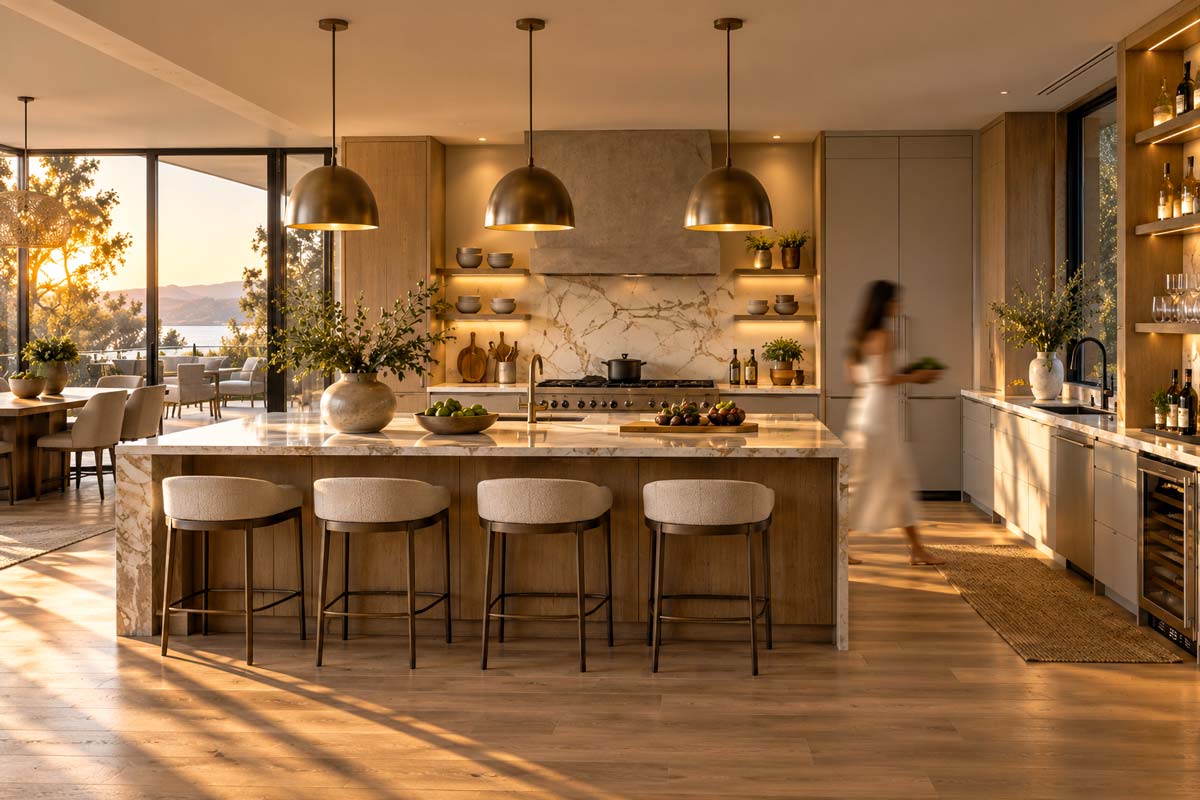
People now cook in pairs and threes. The open plan has merged kitchen, living room and dining room into one continuous space where homework, laptop work and entertaining all happen at once. There is so much more equipment that three points can no longer cover it: a coffee station, a wine fridge, a second prep sink, a warming drawer, a built-in microwave, a dishwasher, sometimes two. A three-step process has turned into a dozen overlapping tasks, and no single geometric figure has room for them all.
Zones
What replaces the triangle is a different way of thinking rather than a new shape. Function takes over from form.
The prep zone. Generous counter space, knives within reach, easy access to the things used all the time: oil, salt, spices, onions, garlic. It is the most underrated spot in the kitchen. In most layouts, prep happens in whatever corner is left over, one nobody ever planned for the job.
The cooking zone. Cooktop and oven, with pots, pans, spatulas and seasonings close at hand. There is one test here: whoever stands at a working stove should never have to leave it.
The cleanup zone. Sink, dishwasher, and pull-out bins for garbage and recycling, all together. The idea is to clear dirty dishes off the table and the island and get them out of sight in a single trip.
The storage zone. Refrigerator, freezer, pantry. This is where the most visible comeback is underway: the walk-in pantry, all but written off in the compact layouts of the 2000s and 2010s, is in serious demand again. The reason is mundane. Bulk buys, small appliances and general clutter all disappear behind one door.
The drinks and serving zone. A second sink, a coffee machine, a wine cabinet, glassware. The goal is to let a guest pour a coffee or a glass of wine without once getting in the cook's way.
The great advantage of this approach over the triangle is that it scales with the number of people. Several cooks can work in different zones without bumping into each other. Each zone can be fitted to one particular family's particular habits. And sightlines become part of the design: from the stove, a parent can keep an eye on a child doing homework, while the cluttered prep counter stays hidden from guests on the far side of the island.
What Didn't Actually Happen
This needs to be said plainly, because it is exactly where the trade press has been stretching the truth for the past couple of years.
Nobody has abolished the triangle.
The National Kitchen and Bath Association still publishes it in its planning guidelines, with the very same numbers: four to nine feet a side, thirteen to twenty-six in total. It is still in the training courses, the design software and the contractors' standards. No organization has issued a document retiring it, and none intends to.
What's more, in narrow kitchens, the single-wall and galley layouts of city apartments and condos where one person cooks at a time, the triangle still works better than any zone plan. There is simply no room for zones to spread out.
What has changed is the order of the questions. A conversation with a designer used to start with "where do the three points go?" Now it starts with "who actually uses this kitchen, and when? How many of you are in it at once? What do you cook on a Wednesday night, and what do you cook when twelve people come over?" The triangle has gone from the starting point to one tool among several, brought out when it fits.
It is a quiet change, but a fundamental one. Diagnosis has replaced the universal rule.
Out at the Edges
A handful of specific shifts now turn up in projects so often that they have hardened into standard practice.
The island is no longer just a work surface. It has become the kitchen's hub. Larger homes increasingly get two, one for prep and one for gathering and serving. In mid-sized kitchens, a single island gets stretched to nine or ten feet precisely so it can do several jobs at once. Alongside this has come a taste for islands that look like furniture instead of a built-in slab, down to an old wooden farm table standing in for the island.
The pantry has split into two distinct types. The first is the practical walk-in, with an aisle at least three feet wide, finished to match the main kitchen so it doesn't feel like a closet. The second is the scullery, or back kitchen: a separate room with its own sink and counter where the messy work gets done and where the dishes retreat after a dinner party. It is an idea revived from the nineteenth century, and it has returned to houses with the square footage to allow it.
The formal dining room keeps losing ground to built-in dining nooks, banquettes worked right into the architecture of the kitchen. They soften the scale of an open plan and fix an unexpected problem at the same time: in a house where the only place anyone ever sits is a stool at the island, families stop eating together.
Finally, there is now a real backlash against the open plan. Designers call it the broken plan: arches, glass partitions, half-walls, pass-throughs between kitchen and living room. Full-height pantry walls. Appliance garages, where the toaster and blender hide behind a cabinet door. And a return of L- and U-shaped layouts that put some kind of boundary back between cooking and living.
Air
This return to boundaries has a cause that gets the least attention of all, and it matters directly to our readers.
An open kitchen has no walls to hold in smell and sound. With pasta and salad, that is no problem. But think of how we really cook at home: fried fish, kotlety, the onion-and-carrot base for borscht, cabbage rolls, chebureki, anything that sits on the burner for an hour. At that point the open plan starts working against its owner. The smell works its way into the living room fabrics, the curtains, the upholstery, the upstairs. Anyone who has ever fried crucian carp in an apartment with an open kitchen knows this better than any designer.
The industry's answer is a powerful range hood. And this is where the surprises start for most buyers.
Hood capacity is measured in cubic feet per minute. For a gas range, the rule of thumb is simple: about 100 CFM for every 10,000 BTU of burner output. A serious professional-style range can easily call for 600 to 800. An island hood, with no walls to help trap the rising plume, needs more still.
U.S. building codes also set a threshold: any hood that exhausts more than 400 cubic feet per minute from a house requires a make-up air system. This is no bureaucratic whim. In a tightly sealed modern house, a strong hood creates negative pressure, and the house goes looking for air wherever it can find it, including down the flue of a gas water heater or a fireplace. The draft in the chimney can reverse, pulling combustion gases, carbon monoxide among them, back into the home.
In a northern climate, that brings one more thing worth knowing before the renovation rather than after. In winter, the make-up air system pulls outdoor air into the house, and that air has to be heated. Add a dedicated duct, a damper, the heater itself, and somewhere to put the equipment.
The closed kitchen of 1949 needed none of this. It had a door, and you shut it.
Lillian Gilbreth lived to ninety-three and died in 1972. By then, the triangle that bore her name was already gospel in the industry.
Yet nearly every reader's home holds two things she really did invent, used daily without a second thought. The pedal bin, which opens with a foot so you never touch the lid with dirty hands. And the shelves on the inside of the refrigerator door, butter compartment and egg tray included.
That is a very precise portrait of the way she thought. No grand geometry. Just two motions nobody has to make anymore.
A woman who built her reputation on watching how people really move, rather than how they are told to, would hardly be troubled to learn that a single shape could not describe every kitchen in every house forever. More likely, she would sit down and start counting steps again.
Because the question she asked in 1929 has not gone anywhere, and it is the only one worth asking before a renovation.
How many times a day do you get up in this room - and why.