
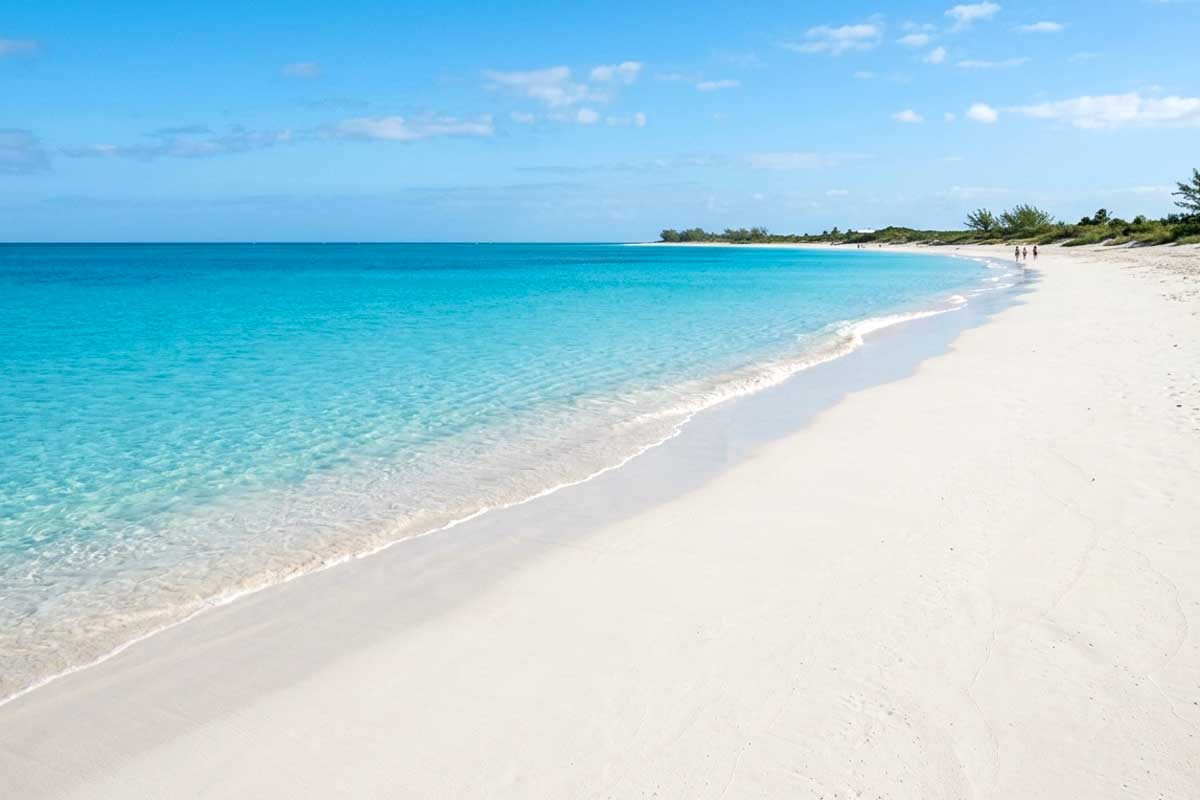
Where the Atlantic turns turquoise
Turks and Caicos
Turks and Caicos: What Lies Beyond the Worlds Most Beautiful Beaches? In photographs, it barely looks real. The water is such an intense shade of turquoise that it feels digitally enhanced. The sand is so fine and perfectly white it resembles sifted flour. The horizon is flat, the sea calm - and along the shoreline there is not a single rock, cliff, or strip of seaweed in sight.
This is Grace Bay Beach on the island of Providenciales. For years, it has ranked among the best beaches on Earth in awards and international travel rankings, including World Travel Awards and TripAdvisor. And unusually for a destination this famous, the photographs are not exaggerating very much.
But behind this beach - and behind the forty islands that make up Turks and Caicos - lies a story most visitors never hear. A story about salt that supplied the Atlantic world for three centuries. Cold War military bases. The first American astronaut to splash down nearby. And a single hotel that, in 1984, effectively created the modern tourism economy of an entire territory.
This is not simply luxury beach tourism. It is an archipelago with multiple layers of history - and most travelers only ever see the first one.
Why the Water Looks Like This
It is not marketing. And it is not an Instagram filter.
Roughly a mile offshore from Grace Bay lies one of the largest coral barrier reef systems in the Atlantic. The reef functions as a natural breakwater, absorbing the force of the ocean and leaving the water near shore calm, shallow, and exceptionally clear.
The combination of bright tropical sunlight, shallow depth, and a white coral seabed creates the electric turquoise color for which Turks and Caicos has become famous. In many places, the water is so transparent that the ocean floor remains clearly visible several meters below the surface.
The reef is protected as part of the Turks and Caicos marine reserve system. Commercial fishing, coral harvesting, and environmentally destructive activity are heavily restricted. That protection is one of the main reasons the reef remains healthier than many others across the Caribbean region.
The Beach That Used to Be Empty
The name Grace Bay did not originate from the beauty of the landscape.
The bay was named after Grace Jane Hutchings, the wife of British commissioner Hugh Houston Hutchings, who governed the islands during the 1930s. At the time, the archipelago revolved around salt production, fishing, and maritime trade. Tourism barely existed.
Until 1984, Providenciales had no international airport. No proper paved roads. Only a few fishing settlements and a dusty landing strip suitable for small aircraft.
The beach that now tops global rankings simply sat there untouched - without resorts, restaurants, or international attention.
How One Hotel Changed the Islands Forever
By the early 1980s, the economy of the British Overseas Territory was struggling. The salt industry that had sustained the islands for centuries had largely collapsed, and fishing alone could no longer support the local economy.
British officials began negotiations with the French resort company Club Med.
The agreement transformed the islands. In exchange for building the first major resort, the British government financed a new international airport and the first paved road connecting it to the future hotel site.
In 1984, Club Med Turkoise opened on Grace Bay.
Before that moment, Providenciales had almost no modern tourism infrastructure. Afterward, everything changed. Luxury resorts began appearing within a few years, followed by global hotel brands, private villas, and a rapidly growing high-end real estate market.
Today, properties such as Amanyara, Ritz-Carlton, and COMO Parrot Cay attract affluent travelers from around the world. Much of the modern economy of Turks and Caicos can be traced back to that single investment decision forty years ago.
John Glenn and the Cold War
On February 20, 1962, astronaut John Glenn became the first American to orbit Earth.
After completing three orbits aboard Friendship 7, his capsule splashed down in the Atlantic near Grand Turk. Twenty-one minutes later, it was recovered by the USS Noa.
But the American military presence on the islands extended far beyond the space program.
During the Cold War, Grand Turk hosted U.S. military facilities involved in tracking Soviet submarines and missile activity across the Atlantic. During the Cuban Missile Crisis, intelligence gathered from the region carried strategic importance.
Today, a full-scale replica of the Friendship 7 capsule stands outside JAGS McCartney International Airport - a reminder that the history of space exploration unexpectedly intersects with this small tropical archipelago.
Three Hundred Years of Salt
Long before tourism arrived, the islands survived almost entirely because of salt.
In the seventeenth century, British colonists from Bermuda discovered that the shallow lagoons of Turks and Caicos were ideal for sea salt production. The climate did most of the work naturally: heat, wind, intense sun, and minimal rainfall created perfect evaporation conditions.
For roughly three centuries, the islands became one of the Atlantic world’s major salt suppliers. Salt preserved fish, meat, and leather - essential goods in the era before refrigeration. Without it, transatlantic trade would have functioned very differently.
On Salt Cay, remnants of that era still remain: old salt warehouses, windmill ruins, and the geometric outlines of evaporation ponds carved into the landscape.
Fewer than one hundred people live there today. There are no major hotels, almost no cars, and a sense that time moves more slowly than it does on Providenciales.
It is also one of the best places in the region to observe migrating humpback whales during winter.
Whales Near the Shore
Between Turks and Caicos and Haiti lies a deep-water channel known as the Columbus Passage - one of the Atlantic migration routes used by humpback whales.
From January through March, whales travel through these waters toward warmer breeding grounds. Near Salt Cay and Grand Turk, they can often be seen directly from the beach.
Massive twelve- to fifteen-meter whales breach only a few hundred meters offshore. For many travelers, it becomes the defining memory of the entire trip.
Beyond Providenciales
Roughly ninety percent of visitors remain on Providenciales - or Provo, as locals call it.
But the rest of the archipelago feels entirely different.
North Caicos and Middle Caicos are accessible by ferry and remain largely untouched by mass tourism. Here, travelers find mangrove lagoons, flamingo habitats, deserted beaches, and the largest cave system in the territory: Conch Bar Caves.
Providenciales itself is also home to Chalk Sound, a nearly enclosed lagoon dotted with tiny limestone islands and water so vividly turquoise it can look surreal even by Turks and Caicos standards.
And unlike Grace Bay, there are very few people.
Conch: The Flavor of the Islands
If Turks and Caicos has a culinary symbol, it is the giant queen conch - Strombus gigas.
It is served raw in salads, fried in batter, added to soups, and shaped into fritters. The large spiral shells - pink-orange and unmistakably tropical - appear everywhere: beside restaurants, fishing docks, and local homes.
The fishery is tightly regulated because the species is protected. But fresh conch remains one of the defining flavors of the islands and one of the strongest sensory associations visitors carry home.
What to Know Before You Go
The local currency is the U.S. dollar. English is the official language. Turks and Caicos remains a British Overseas Territory, which means driving is on the left side of the road.
The best time to visit is from November through May. June through October brings hurricane season and heavier rainfall. December and January are peak season, with the highest hotel prices. February and March are often considered the ideal balance between weather, pricing, and whale migration season.
And if you venture beyond Grace Bay and Providenciales, the archipelago reveals an entirely different side of itself: small islands, abandoned salt ponds, nearly empty beaches, coral reefs, and the strange feeling of the Atlantic suddenly turning impossibly turquoise.
Turks and Caicos began as a salt colony, became part of America’s space history, evolved into a strategic Cold War outpost, and was later transformed almost accidentally into one of the most exclusive beach destinations in the Atlantic world.
And yet most of the archipelago still exists beyond the postcards.