The land nobody wanted
Bal Harbour
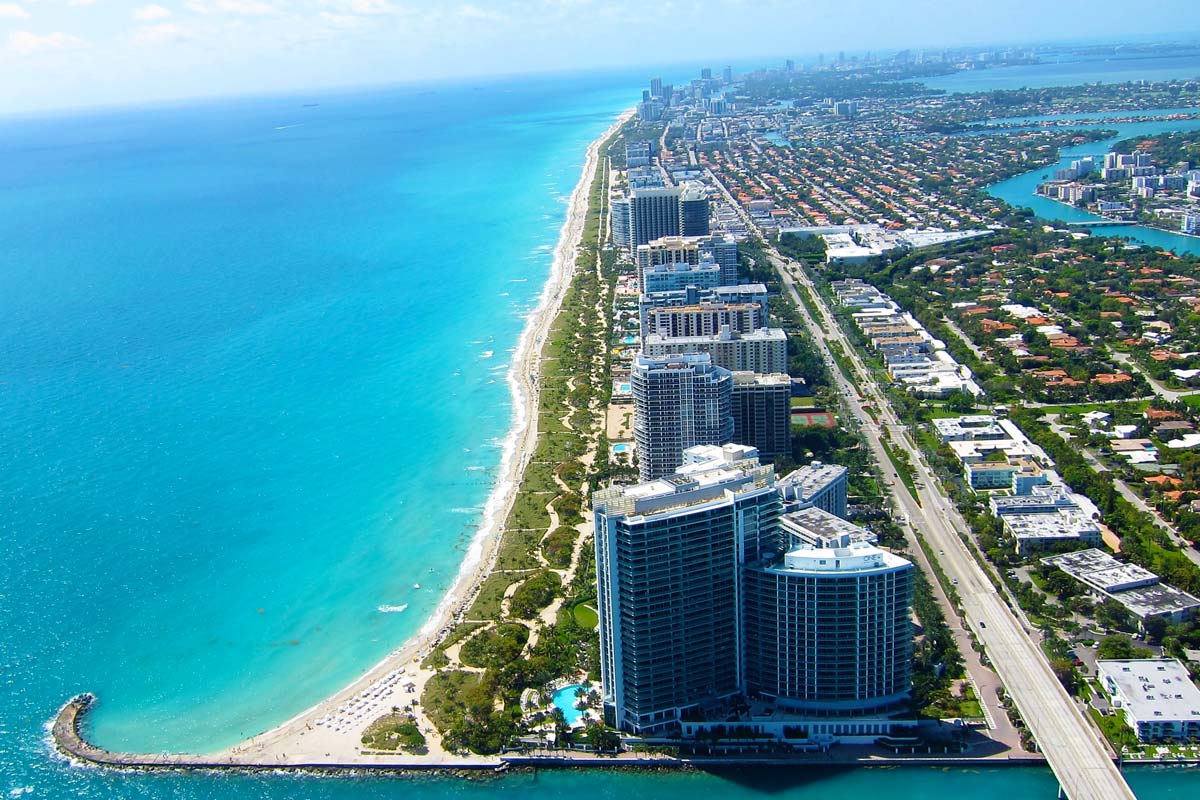
How 245 acres of swampland on the edge of Miami became the most valuable retail address in the world? Walk out of Bal Harbour Shops and head east, and within a minute you are standing on one of the most beautiful stretches of Atlantic coastline. White sand, calm water, remarkably few people. To the north, the shoreline flows toward Sunny Isles Beach. To the south, toward Surfside and Miami Beach. It is difficult to believe that right here, between Biscayne Bay and the Atlantic Ocean, sits a place that for decades has generated the highest retail sales per square foot of any shopping center in the world. Higher than Fifth Avenue. Higher than Madison Avenue. Higher than Rodeo Drive. But the story of Bal Harbour did not begin with luxury. It began with a swamp.
Detroit Industrialists and the Vision of a Perfect Town
In the 1930s, a group of Detroit industrialists purchased 245 acres of marshland at the northern tip of Miami Beach - where Collins Avenue seems to disappear into water on both sides.
Robert Graham, Walter Briggs and Carl Fisher - the same Fisher whose name lives on through Fisher Island - were not dreamers chasing fantasy. They were disciplined visionaries with a very specific plan.
They hired Harland Bartholomew and Associates, one of America’s most influential urban planning firms of the era, to design an entirely new type of resort community. Wide boulevards lined with greenery. Underground utilities from the very beginning. Strict architectural standards. A marina. Controlled development. Order instead of chaos.
Bal Harbour became the first fully planned municipality in Florida where utilities were placed underground from day one.
The goal was simple: create a refined, elegant and carefully managed alternative to the increasingly crowded and chaotic Miami Beach.
Then World War II interrupted everything.
A Prisoner-of-War Camp Where Luxury Boutiques Stand Today
During the war, Robert Graham leased the entire property to the U.S. Army Air Corps for one dollar per year. It was an act of patriotism, not a business deal.
The military transformed the land. The oceanfront became a rifle range. Barracks rose along Collins Avenue. And on the exact site where Bal Harbour Shops now stands, the Army established a prisoner-of-war camp for captured German and Italian soldiers from North Africa and Europe.
When the war ended in 1945, the military departed and left the structures behind. The barracks were converted into apartments. Under Florida law, at least twenty-five registered male voters were required to officially incorporate a municipality, so Graham invited families to move into the newly converted housing.
On August 14, 1946, Bal Harbour officially became a village.
Its name combined two words: “bay” and “Atlantic.” A community suspended between two bodies of water.
Stanley Whitman and the Idea Nobody Understood
In 1957, developer Stanley Whitman purchased sixteen acres of land in Bal Harbour - the former POW camp site - for two dollars per square foot, a record price for retail real estate at the time.
But the price was not the real story. Whitman had spent years studying shopping centers across America and Europe and came to a radical conclusion: the industry was moving in the wrong direction. In the 1950s, developers were building massive enclosed malls filled with supermarkets, department stores and endless parking lots.
Whitman wanted the opposite. No grocery store. No hardware store. No mass-market anchors. Only small luxury boutiques arranged within an open-air tropical garden under the South Florida sky. Palm trees instead of fluorescent corridors. Fountains instead of noise. And one uncompromising principle for tenant selection: only the best brands - or none at all.
When Whitman traveled to New York and pitched his concept to luxury retailers on Fifth Avenue, many literally threw him out of their offices.
At the time, the idea of a luxury shopping mall sounded absurd. Luxury belonged on Fifth Avenue, Madison Avenue, Bond Street or Avenue Montaigne - not inside a shopping center in a small beach village outside Miami Beach.
1965: Bal Harbour Shops Opens
When Bal Harbour Shops opened in 1965, Whitman set minimum rents at five dollars per square foot - more than triple the national average.
Thirty New York retailers. Open skies instead of ceilings. Tropical landscaping instead of enclosed hallways.
Most industry experts expected failure.
By 1970, Bal Harbour Shops had already become the highest-performing shopping center in America by sales per square foot, surpassing Honolulu Ala Moana Center, long considered untouchable. Then it crossed the 1,000 sales-per-square-foot threshold. Then 2,000. Then 3,000. Today, sales approach roughly 4,000 per square foot - still among the highest figures in global luxury retail.
The Place Where Luxury Retail Changed in America
In 1971, Neiman Marcus opened its first store outside Texas at Bal Harbour Shops.
In 1976, Saks Fifth Avenue arrived, making Bal Harbour the first shopping center in the world to host both legendary department stores simultaneously.
In 1978, Gucci opened its boutique here - the brand’s first location inside an American shopping center.
For many European fashion houses, Bal Harbour became their first meaningful expansion into the American market outside New York City. Cartier, Bulgari and dozens of other luxury brands came because Whitman had created something unique: an affluent, international and exceptionally loyal customer base. He was right.
Three Generations
Stanley Whitman passed away in 2017 at the age of ninety-eight. Until late in life, he personally walked the property almost every day, inspecting every detail - from fallen leaves to the condition of the landscaping.
His son Randy Whitman joined the business in the 1970s and oversaw the major 1983 expansion that brought the tenant roster close to one hundred luxury brands.
Today, the property remains under the leadership of the third generation: Matthew Whitman Lazenby. Recent years have brought ambitious expansion plans, including new restaurants, additional luxury retail space and room for brands that have spent years on waiting lists hoping to enter the center.
It is one of the rarest things in modern America: one of the world’s most successful luxury retail projects still operating as a family business after six decades.
What Bal Harbour Represents Today
Today, Bal Harbour is one of the most exclusive municipalities in North America, occupying less than one square mile with a population of just over three thousand residents.
Along Collins Avenue stand properties such as St. Regis Bal Harbour and Ritz-Carlton Bal Harbour, surrounded by ultra-premium residential towers where apartments routinely trade for tens of millions of dollars.
But what truly defines the place is its atmosphere. Bal Harbour Shops remains an open-air environment filled with tropical flowers, fountains, shaded walkways and mature palm trees. No supermarkets. No mass-market retail. No visual chaos. Exactly what Stanley Whitman envisioned back in 1957 when almost nobody believed him.
A Story That Still Matters
There is a certain irony in how this story unfolded. Land nobody wanted became a military training ground and a prisoner-of-war camp. Then an almost forgotten piece of real estate. Then an idea people openly mocked. And finally, one of the most successful luxury retail destinations on Earth. At every stage, someone made a decision that appeared irrational or risky to everyone around them. And each time, that decision proved correct.
Bal Harbour is ultimately a story about vision, discipline and the willingness to reject conventional thinking - the very qualities that can transform limitations into extraordinary advantage.