
How to choose the right lighting for the interior
Modern lighting has long since stopped being just a chandelier in the centre of the room. Today, lighting is designed as a full part of the interior: it shapes the mood, emphasizes the architecture, helps zone the space and makes a home look visually richer. A good lighting scenario works almost invisibly, but it often determines whether an interior feels flat and accidental or deep, thoughtful and truly livable.
When it comes to style, the focus is no longer on one “fashionable lamp,” but on the ability to combine different sources of light. In current interiors, minimalism, industrial details, Art Deco, modernism, high-tech elements, natural materials and vintage accents can all coexist. The leading position belongs to considered eclecticism: a light fixture may be a sculptural object, but it should support the overall composition rather than compete with it.
Lighting needs movement and variation. A single overhead fixture rarely makes a room beautiful. A combination of diffused, directional, decorative and hidden light works far better. These layers allow the atmosphere to change: brighter for work and cleaning, softer for evening, more focused for dining, reading or quiet relaxation.
Pendant lights arranged in a straight line or in a freer composition are ideal for defining a dining area, kitchen island or long table. They are often installed at different heights to create a more individual and architectural lighting pattern. This technique makes the interior feel alive and can change the perception of the room with a single switch.
Dimmers today are not a luxury, but almost a necessary part of a well-designed interior. They allow you to control brightness, shift the mood and create different scenarios in the same room. With them, you can highlight a seating area, dining zone, artwork, mirror, textured wall, plant or beautiful piece of furniture. The important thing is to choose bulbs and fixtures that are compatible with dimming from the beginning; otherwise, the effect may be spoiled by flickering, the wrong light temperature or a limited adjustment range.
What is in style?
One of the strongest trends is layered lighting. Instead of relying on a single central chandelier, designers increasingly combine ceiling lights, sconces, table lamps, floor lamps, and lighting built into niches, furniture, stairs and architectural details. This approach is especially important in open-concept spaces, where the kitchen, dining area and living room are connected, but each zone needs its own mood.
Recessed and accent lights along the ceiling, floor, staircases and built-in niches are highly relevant. They help shape the space visually and emphasize wall texture, ceiling height and the direction of movement. At the same time, contemporary interiors are moving away from cold office-like light toward softer, warmer and more comfortable illumination. Fixtures with matte, translucent and textured shades are worth considering: they create a more pleasant diffused light and are easier on the eyes.
Pendant lights with flexible cords, fine lines and the possibility of free composition are also in demand. Popular materials include those that imitate natural surfaces or emphasize tactility: frosted glass, ceramic, metal with a soft patina, concrete, stone, paper, linen, rattan, wood and textured composites. Modern lighting increasingly looks less like a technical object and more like part of collectible design - almost a small sculpture.
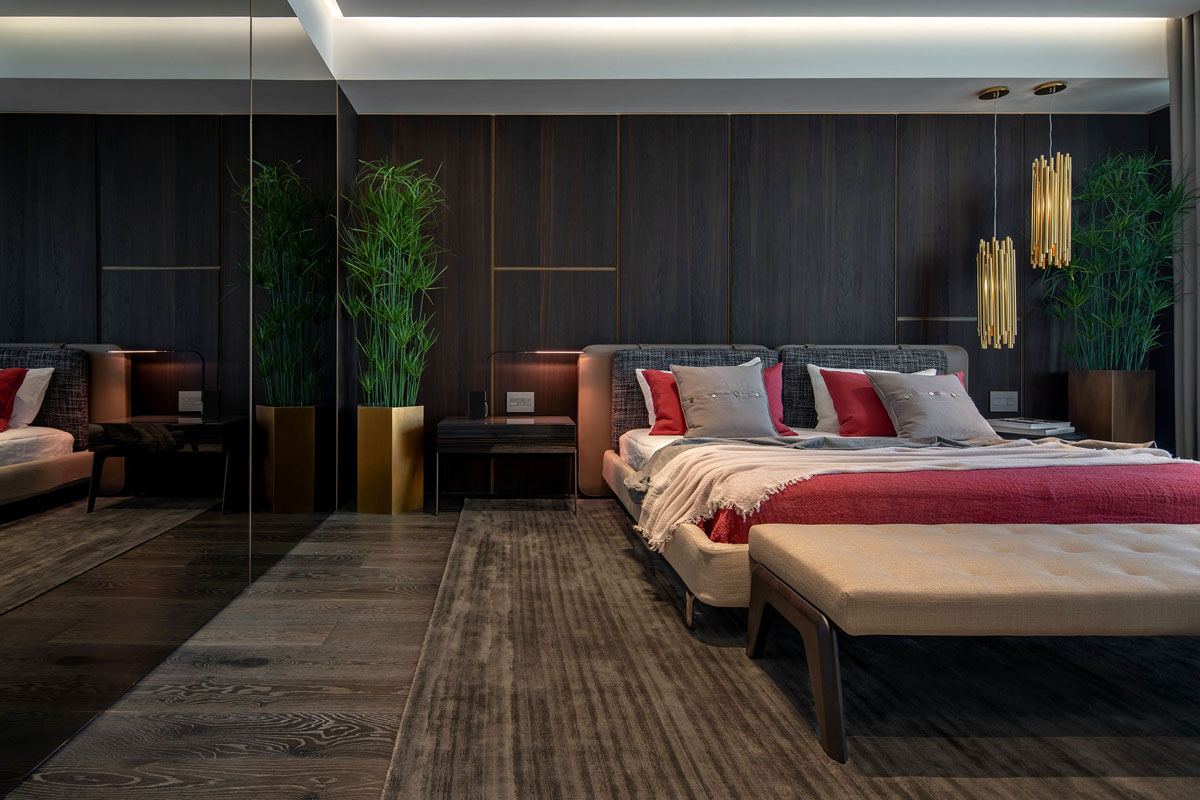
In bedrooms, hidden light sources work especially well. These may include LED strips integrated into the headboard, wall panels, ceiling coves, drywall niches, wardrobes or the base of furniture. This kind of lighting creates a soft, enveloping feeling and helps make the bedroom calmer. Lighting the base of a bed, dresser or nightstand can create the illusion of a floating object when done delicately and without excessive brightness.
Eclecticism remains one of the strongest directions. In one interior, minimalist linear fixtures, Art Deco sconces, a classic crystal chandelier and a contemporary floor lamp on a thin base can all appear together. But this freedom requires restraint. If every fixture tries to be the main character, the interior quickly becomes noisy. It is better to choose one expressive accent and keep the other light sources quieter.
Forms are also becoming more varied. Spheres, half-spheres, matte shades, illuminated panels, slim linear profiles and geometric structures remain relevant. At the same time, interest is growing in softer, more organic silhouettes: cloud-like forms, asymmetry, hand-crafted details, natural textures and fixtures that look slightly less perfect, but more alive.
High-tech and minimalism today are expressed not only through strict metal constructions, but also through intelligent control systems. Light can be adjusted by scenes, time of day, level of natural light and mood. But it is important not to become fascinated by technology for its own sake. Good smart lighting should simplify life, not turn an ordinary evening into the management of a complicated control panel.
Classic lighting has not disappeared either. Chandeliers made of crystal, Murano glass and decorative metal still look beautiful in traditional interiors and in modern dining areas, provided there is enough visual space and restraint around them. The contrast between old and new often works better than an attempt to keep everything in one style.
The main rule when choosing a light fixture remains the same: it should not merely be attractive on its own, but must suit the interior concept of the room. A fixture can be an accent, decoration or even an art object, but it must also solve a practical task: provide the right light, support the proportions of the room and make the space more comfortable. That is when lighting becomes not a final detail, but one of the main reasons the interior feels complete.