
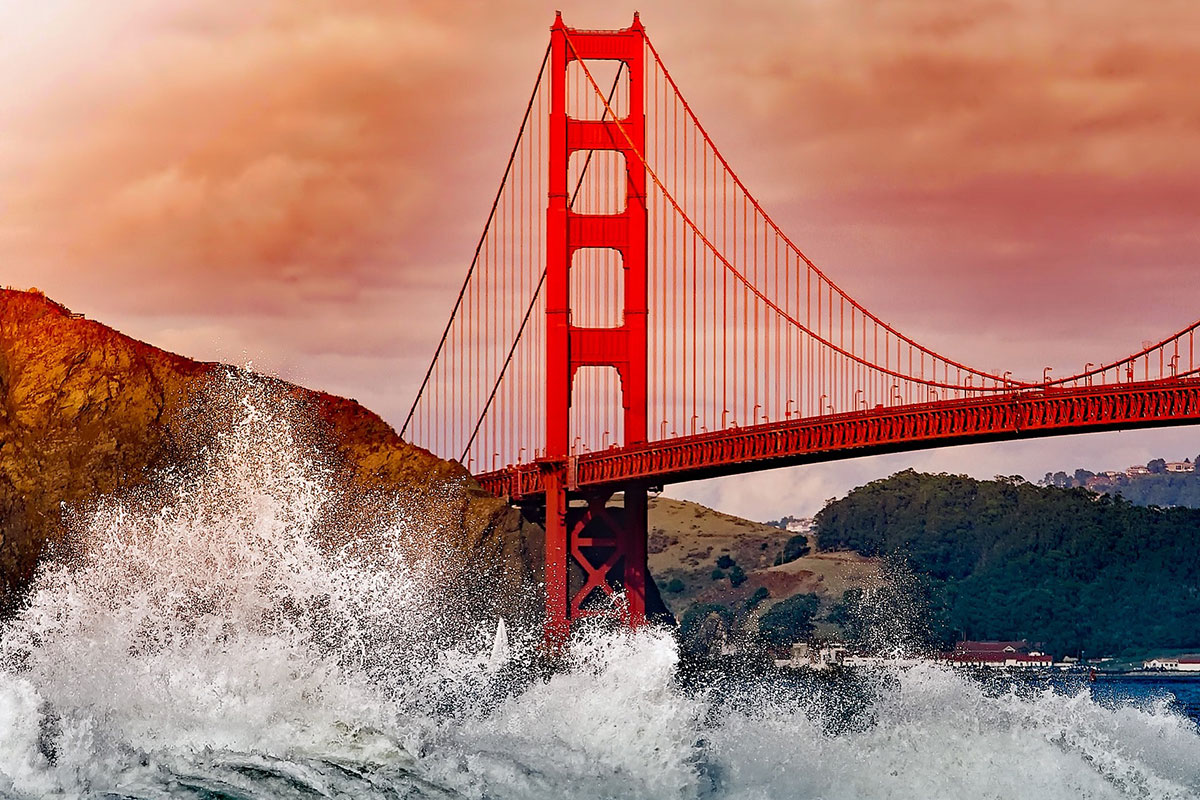
San Francisco Golden Gate Bridge
The Golden Gate Bridge has long been more than a symbol of San Francisco. It is one of the most recognizable architectural and engineering emblems of America. Its red-orange silhouette over the strait, the fog slowly wrapping around its towers, and the dramatic landscape between the city and Marin County have turned the bridge into an image known even to people who have never been to California. But behind that postcard beauty lies more than romance. The Golden Gate Bridge is a story of bold engineering, political struggle, enormous risk, human sacrifice and a decision that changed the development of an entire region.
The bridge connects San Francisco with the southern part of Marin County, crossing the Golden Gate Strait, which links the Pacific Ocean with San Francisco Bay. Before the bridge opened in 1937, the main way to travel north was by ferry. The ferry system was essential, but slow and limiting: the city was growing, Northern California needed a more reliable connection, and the region’s economy demanded a new level of mobility.
On the morning of May 27, 1937, the bridge opened first to pedestrians only. For the first hours, it belonged to people who walked, ran, danced and even crossed it on roller skates. The next day, May 28, President Franklin Roosevelt sent the signal from the White House that opened the bridge to automobile traffic. From that moment, San Francisco and Marin County were connected not by a ferry schedule, but by a permanent road across one of the most beautiful and difficult straits in the world.
The bridge is about 2,737 metres long, with a main span of 1,280 metres. At the time of its opening, it was the longest suspension bridge in the world. Its towers rise about 227 metres above the water, while the roadway sits roughly 67 metres above the bay. Even today, the Golden Gate Bridge remains one of the great engineering achievements of the twentieth century and one of the most photographed bridges on the planet.
An idea many refused to believe in
As early as 1921, engineer Joseph B. Strauss presented a plan to build a bridge across the Golden Gate Strait. The idea was enormously attractive: instead of long detours or ferries, Northern California would receive a direct connection to the region’s largest city. But the project raised serious doubts. The strait was deep, windy, foggy and subject to powerful tidal currents. Many believed that building a bridge of such scale there was almost impossible.
Strauss was an experienced engineer who had participated in the construction of hundreds of bridges, but the Golden Gate required a completely different level of solution. Early designs looked heavy and unsatisfying to both engineers and architects. Eventually, the project evolved into the more graceful full suspension bridge we see today, developed by a large team of specialists. Key figures included Joseph Strauss, engineer Leon Moisseiff, Charles Ellis and architect Irving Morrow, who played a major role in shaping the bridge’s final appearance.
In 1923, the Golden Gate Bridge and Highway District was created as a special district to finance, build and manage the future bridge. After long political debates, legal obstacles and economic doubts, the project finally received approval. Construction began in January 1933, in the depths of the Great Depression, when a project of such scale was itself an act of faith in the future.
Building above depth, wind and current
One of the hardest tasks was constructing the south pier on the San Francisco side. Work took place in cold water, strong currents, fog and storms. Builders had to create foundations and supports where the ocean and the bay seemed to collide with one another. Even by modern standards, this would be a difficult engineering challenge; in the 1930s, it looked almost reckless.
Once the towers were built, work began on the enormous steel cables. Each of the two main cables was assembled from thousands of individual steel wires. The total length of wire used in the cables was about 129,000 kilometres - enough to circle the Earth several times at the equator. Vertical suspender ropes descending from the main cables support the bridge deck.
The construction of the Golden Gate Bridge also became an important milestone in worker safety. A safety net was installed beneath the bridge, and it saved 19 men. Those workers later became informally known as the Half Way to Hell Club. But tragedy was not avoided completely: 11 workers died during construction, 10 of them in a single accident in February 1937, when a work platform collapsed and tore through the safety net.
The colour that became a legend
One of the main reasons the Golden Gate Bridge is so instantly recognizable is its colour. The bridge is not simply red or orange in the ordinary sense, but painted in a shade called International Orange. It was chosen by architect Irving Morrow. The colour proved ideal for several reasons at once: it is visible in fog, harmonizes with the surrounding hills and water, changes beautifully in different light and gives the bridge a warm, almost living character.
The colour was originally connected with the primer used on the steel, but Morrow saw its aesthetic power and argued for keeping the shade. As a result, the bridge received a visual identity without which San Francisco is now almost impossible to imagine. Painting the bridge is not a one-time procedure, but an ongoing maintenance process. Crews regularly inspect the coating and repaint areas where needed to protect the steel from corrosion.
Morrow also worked on the architectural details of the towers, lighting, railings, walkways and the overall style of the bridge. Because of this, the Golden Gate Bridge does not feel like a purely utilitarian engineering structure. It has that rare unity in which technology and aesthetics do not compete with each other, but strengthen the overall effect.
The bridge that changed a region
The importance of the Golden Gate Bridge is not limited to beauty. It radically changed the connection between San Francisco and Northern California and accelerated the development of the counties on the other side of the strait. Marin, Sonoma, Napa and other northern areas gained easier access to markets, jobs, ports and urban services. For business, agriculture, tourism and daily life, it was a major step forward.
The bridge cost about $35 million to build - an enormous sum for its time. The project was financed through bonds issued by the Golden Gate Bridge and Highway District, with costs later covered through tolls. Within a few decades, the bridge had paid for itself economically, but its real value proved far broader than accounting figures. It became infrastructure that reshaped the map of regional life.
An engineering classic
The Golden Gate Bridge is a classic suspension bridge. Its roadway is suspended from two main cables anchored in massive blocks on both sides of the strait. The cables pass over two tall towers, with vertical suspenders descending from them to support the deck.
Today, the bridge carries six lanes of vehicle traffic as well as pedestrian and bicycle routes. The flow of cars, tourists, cyclists and walkers makes the bridge not only a transportation artery, but also a living public space. For some, it is a daily commute. For others, it is an essential stop on a trip to San Francisco.
The bridge was designed to handle serious loads and extreme weather. One of its most famous tests came during a powerful storm in 1951, when winds reached hurricane force and the bridge visibly swayed and deflected. Despite the frightening movement of the structure, no serious damage was found. For suspension bridges, a certain amount of flexibility is not a weakness, but part of the engineering logic: the structure must work with wind and loads, not resist them in absolute rigidity.
Fog, beauty and the darker side of fame
In summer and early autumn, the famous fog often rolls over the bay and slowly covers the towers of the Golden Gate Bridge. Sometimes only the tops of the towers remain visible above the white veil; sometimes the bridge nearly disappears, leaving only fragments of its red-orange line suspended in the air. This image - a bridge between city, ocean and cloud - has become one of the strongest visual metaphors of San Francisco.
But the bridge’s fame also has a tragic side. For decades, the Golden Gate Bridge was one of the world’s most notorious suicide sites. The first deaths occurred soon after the bridge opened, and by the early twenty-first century the number of lives lost had reached many hundreds. For years, advocacy groups and families of those who died pushed for a physical deterrent barrier.
In 2024, the suicide deterrent net system was completed beneath the edges of the bridge. It does not completely change the dramatic silhouette of the Golden Gate, but it significantly reduces access to a fatal jump and has already shown a major reduction in deaths. For a bridge that has become a symbol of beauty and hope, this is an important and long-overdue change.
Why it still moves us
The Golden Gate Bridge has long stopped being merely a road across a strait. It has become an image of the American West, of engineering courage, of modernist faith in progress and of a distinctly Californian drama. It contains everything: ocean, fog, city, risk, beauty, history and human determination.
That is why the bridge continues to move people decades after its opening. It can be measured in metres, tons, cables and dollars, but its real power is not in the numbers. The Golden Gate Bridge is that rare case in which infrastructure became art, and an engineering structure became a cultural symbol recognized at first glance.