
A Desert That Should Not Exist
Lençóis Maranhenses - Brazils Most Surreal Landscape
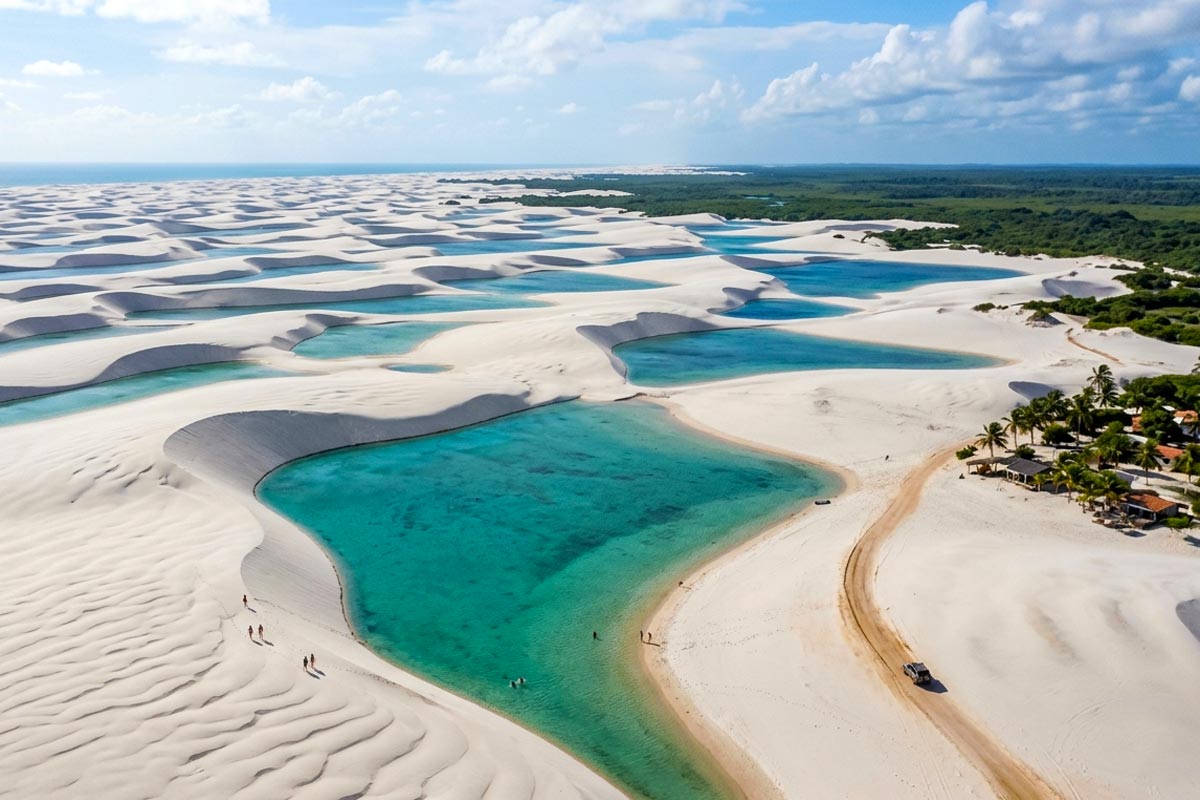
There are places that look like the successful work of artificial intelligence. Too unreal, too perfectly contradictory to exist in nature. Brazil’s Lençóis Maranhenses National Park, in the country’s remote northeast, is exactly that kind of place. In photographs, it resembles a mirage: thousands of snow-white dunes stretching endlessly toward the horizon, and between them - crystal-clear lagoons in shades of turquoise, jade, and liquid sapphire. In some images, it looks like the Sahara after rain. In others, like a science-fiction vision of another planet. But the greatest contradiction is this: technically, Lençóis Maranhenses is not a desert at all.
The region receives up to 1,600 millimeters of rainfall annually - more than many European cities. Nearby begin mangrove forests, humid tropical zones, and river systems connected to the Amazon basin. Winds sculpt dunes as if this were North Africa, while the rainy season transforms the landscape into a giant living watercolor painting. This place exists at the intersection of opposites - sand and water, drought and humidity, emptiness and life.
That paradox is precisely why Lençóis Maranhenses has become one of the world’s most talked-about adventure destinations. Yet unlike Dubai, the Maldives, or Iceland, it has not fully transformed into a stage set for mass tourism.
The Name That Explains Everything
“Lençóis Maranhenses” translates from Portuguese as “the bedsheets of Maranhão.” From the air, the reason becomes obvious: the wind shapes soft white dunes into endless folds that truly resemble giant linen sheets spread across the Earth.
The national park covers roughly 1,550 square kilometers, making it one of the largest dune systems in South America. But the real miracle begins after the rainy season, which lasts approximately from January through June.
Water collects between the dunes, creating thousands of temporary lagoons. Some survive for only a few months; others last nearly until year’s end. Then the sun slowly evaporates the water, and the landscape once again becomes almost monochrome.
Every year, the park quite literally recreates itself from scratch.
Scientists still consider this ecosystem unique. For thousands of years, rivers carried white sand here from Brazil’s interior, while Atlantic winds gradually pushed it inland. The result became one of the planet’s strangest natural paradoxes: a massive dune field in a climate where rain is not an exception, but the norm.
A Place the World Ignored for Decades
Today, Lençóis Maranhenses looks like the perfect backdrop for a luxury travel campaign, but for decades almost nobody outside Brazil paid attention to it.
The state of Maranhão long remained peripheral even by Brazilian standards. Tourism infrastructure developed slowly, and reaching the region was difficult. As recently as the 1990s, traveling here felt closer to an expedition: few proper roads, almost no communications, endless journeys in off-road vehicles and boats.
Even today, getting to Lençóis Maranhenses requires effort. Most routes begin in the coastal town of Barreirinhas, reached from São Luís - a colonial city with Afro-Brazilian culture, a Caribbean rhythm of life, and an unexpectedly French historical past. From there come transfers in open-top 4x4 vehicles, sandy tracks, river ferries, and long stretches where asphalt rapidly disappears.
Ironically, this difficulty protected the park from the fate of many “Instagram-famous” destinations.
There are still no giant resort complexes, waterfront skyscrapers, or artificial luxury environments here. Instead: small pousadas, fishing villages, and a feeling of geographic isolation that has almost vanished from the modern world.
Where the Desert Meets the Jungle
The biggest mistake is thinking of Lençóis Maranhenses as simply beautiful dunes.
In reality, this is a collision point between multiple ecosystems. On one side lies the Atlantic Ocean. On the other - humid tropical regions and the rivers of northern Brazil. Between them sits a sandy landscape that appears completely lifeless while being astonishingly alive.
During the rainy season, fish appear in the lagoons. For years, scientists debated how this was even possible. Later, researchers discovered that some species survive the dry months in a dormant state, hidden within the wet sand beneath dried lakebeds.
The wind here almost never stops. It constantly reshapes the dunes, erasing yesterday’s paths. That is part of why the park feels so hypnotic: the human eye instinctively understands that this landscape is unstable. It is not fixed forever.
Lençóis Maranhenses is not monumental nature like the Grand Canyon. It is nature in motion.
Why the Luxury World Suddenly Arrived
Just ten years ago, Lençóis Maranhenses remained mostly a destination for explorers, naturalists, and travelers exhausted by standard itineraries.
Now the situation is changing rapidly.
Global tourism is undergoing an important transformation: affluent travelers are becoming less interested in expensive hotels alone. The focus is shifting away from visible consumption and toward rarity of experience.
A private island no longer creates the same emotional impact it once did. But the opportunity to stand in a place that looks like another planet - and still has not become a tourist conveyor belt - absolutely does.
Lençóis Maranhenses fits that desire perfectly.
Fashion teams, filmmakers, architects, and contemporary artists have begun arriving in increasing numbers. Luxury brands frequently use the landscape for campaigns precisely because it appears almost digital - too clean and surreal to feel real.
And yet nothing here feels staged. Unlike many destinations, the park was not created for people. It exists independently - immense, indifferent, and ancient.
The Most Beautiful Season - And the Shortest
Lençóis Maranhenses has one defining characteristic: it never looks exactly the same twice.
The ideal season is surprisingly short - usually from June through September, when the lagoons remain full while the rains have mostly stopped. By October, many pools begin shrinking. By winter, some disappear completely.
That creates something rare in modern tourism: a sense of fragility.
People come here not simply to “see a place,” but to witness it in one specific state before it changes again.
That is why photographs of Lençóis Maranhenses affect people so deeply. They do not show a static landmark. They capture a temporary miracle.
Not a Backdrop - Almost a Philosophy
In an age of hyper-urbanization, Lençóis Maranhenses leaves an especially powerful impression on residents of North America - particularly those living among the glass towers of Toronto, Miami, New York, or Vancouver, where everything is optimized, calculated, and predictable.
This landscape works in the opposite direction.
It reminds us how strange and illogical nature can be. That the most powerful landscapes are often born not from perfect order, but from the collision of incompatible forces. Water inside sand. Jungle beside dunes. Life appearing where it should not exist.
And that is exactly why Lençóis Maranhenses fascinates modern travelers so intensely. In a world where algorithms increasingly shape reality, places still exist that look like a beautiful mistake in the fabric of the planet itself.