
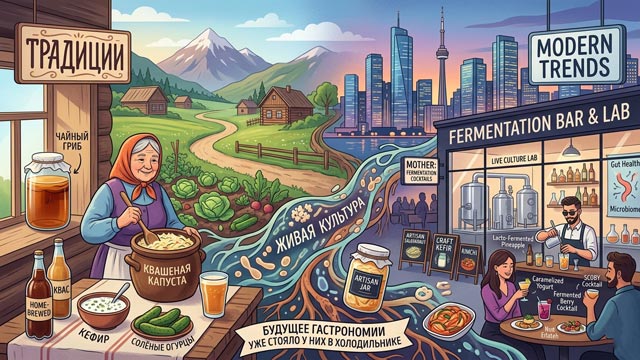
You were always ahead of the curve
How kefir, sauerkraut, and Eastern European fermented food culture quietly became one of North Americas most sophisticated culinary trends.
A few years ago, a Toronto bar called Mother opened its doors. The name was not meant in the traditional sense. It referred to the living starter cultures that make fermentation possible: the SCOBY in kombucha, sourdough starters, kefir grains, and other active microbial cultures.
Inside is a dedicated fermentation room where bartenders work with homemade kefir, lacto-fermented pineapple, caramelized yogurt, and fermented ginger. Acidity in cocktails comes not from citrus juice, but from fermented pears and berries. The flavors are layered, earthy, slightly umami, and unmistakably alive.
Today, this is considered one of Torontos most progressive directions in modern gastronomy.
For people who grew up with jars of sauerkraut in the refrigerator and homemade kombucha quietly fermenting under cheesecloth on the kitchen windowsill, however, the entire phenomenon feels different. Because to them, none of this is new. It is simply the food culture they have known all their lives - long before fermentation became fashionable in New York, Copenhagen, Los Angeles, or Toronto.
What Fermentation Actually Is
At its core, fermentation is controlled microbial transformation. Beneficial bacteria and yeast consume sugars and other compounds in food, producing acids, carbonation, alcohol, and complex aromatic flavors.
It sounds scientific, but in reality fermentation is one of humanity’s oldest and most refined culinary technologies - developed centuries before refrigeration, industrial food processing, or modern nutrition science.
Sourdough bread. Cheese. Wine. Beer. Yogurt. Kefir. Kvass. Kimchi. Sauerkraut. Miso. Soy sauce. Pickled vegetables. All are products of fermentation.
Which is why fermentation today feels less like a trend and more like a return to something deeply human and foundational.
Kefir Turned Out to Be More Modern Than Anyone Expected
Kefir originated in the mountainous regions of the North Caucasus, in what is now North Ossetia and Kabardino-Balkaria. Some historians trace its origins back thousands of years. Kefir grains - a living symbiotic culture of bacteria and yeast - were considered so valuable that families traditionally passed them down through generations rather than selling them.
By the twentieth century, kefir had become a daily staple throughout the Soviet Union. For millions of Eastern Europeans, it was never marketed as a wellness product or superfood. It was simply something that always existed in the refrigerator.
North America discovered kefir much later. Only in recent years has it moved from niche health-food stores into the mainstream. Today, kefir is sold everywhere from Costco and Whole Foods to Sobeys and Metro. Nutritionists, gastroenterologists, and microbiome researchers routinely recommend it. Wellness magazines regularly feature it as part of the future of gut health.
Ironically, people who grew up drinking kefir can now watch North America enthusiastically rediscover what their families quietly consumed for generations.
Why Real Sauerkraut Is Not Just “Pickled Cabbage”
This distinction is only now becoming widely understood in North America.
Pickled cabbage relies on vinegar. Traditional sauerkraut relies on natural lacto-fermentation, where naturally occurring lactic acid bacteria consume sugars inside the cabbage itself.
No vinegar. No sterilization. No industrial acidity.
The result is a flavor profile that is softer, deeper, more layered, and more alive - with subtle umami notes and complexity that evolves over time.
But the difference goes beyond taste. Fresh lacto-fermented sauerkraut contains living probiotic cultures directly connected to gut microbiome health. Once heavily processed or heat-treated for long shelf life, much of that living complexity disappears.
This is why fresh fermented cabbage from a cold cellar tastes fundamentally different from mass-produced supermarket versions.
Across Toronto, Montreal, Vancouver, and New York, small producers are now creating live fermented vegetables in small batches. What was once dismissed as ethnic food has quietly become part of contemporary culinary culture.
What Is Happening Now
Fermentation has moved far beyond home kitchens and become a serious part of the modern food scene.
Restaurants increasingly build entire dishes around fermented ingredients: kimchi in tacos, miso folded into caramel and desserts, fermented berries and vegetables appearing in fine dining tasting menus.
Bars experiment with homemade cultures, water kefir, kombucha, and fermented syrups. Several Toronto cocktail programs now revolve almost entirely around fermentation.
At the production level, Canadas market for craft kombucha, artisan kimchi, small-batch miso, and fermented beverages continues to expand rapidly. Since the pandemic, interest in home fermentation has surged as people began making sourdough starters, kefir, kvass, and pickled vegetables in their own kitchens.
And within all of this lies an interesting paradox: much of what is now celebrated as avant-garde gastronomy has existed for generations in Eastern European households.
Kvass: The Drink North America Still Has Not Fully Discovered
If kefir has already entered the mainstream, kvass remains one of the least understood fermented beverages outside Eastern Europe.
Which is remarkable, because authentic kvass is one of the worlds most sophisticated fermented drinks: lightly acidic, deeply malty, subtly caramelized, naturally low in alcohol, and extraordinarily complex in flavor.
A handful of Canadian and American craft producers have started experimenting with kvass, often adding hops, berries, or fruit. Yet authentic homemade kvass still remains something easier to make yourself than to find commercially.
Rye bread, water, sugar, and a starter culture - and within two days you have a beverage unlike almost anything currently available in North American beverage culture.
Why Fermentation Matters Again
The global revival of fermentation is not happening simply because it is fashionable.
Modern industrial food systems have spent decades making diets more sterile, more processed, and less microbiologically diverse. Antibiotics, preservatives, ultra-processed foods, and the disappearance of live cultures from everyday meals have reshaped the human microbiome in ways scientists are only beginning to fully understand.
Today, gastroenterologists, immunologists, and nutrition researchers increasingly connect gut microbiome health to immunity, inflammation, metabolism, and even mental well-being.
The wellness industry responded with probiotics, supplements, and functional foods worth billions of dollars.
Yet many traditional cultures already had their own answer long before the word “microbiome” entered mainstream vocabulary.
A bowl of real sauerkraut. A glass of kefir. Homemade kvass. Naturally fermented pickles.
For generations, these foods quietly delivered what modern wellness culture is only now trying to recreate.
The people who grew up with them never thought of it as biohacking, gut-health optimization, or functional nutrition.
To them, it was simply lunch.
As it turns out, the future of food had been sitting in their refrigerators all along.