
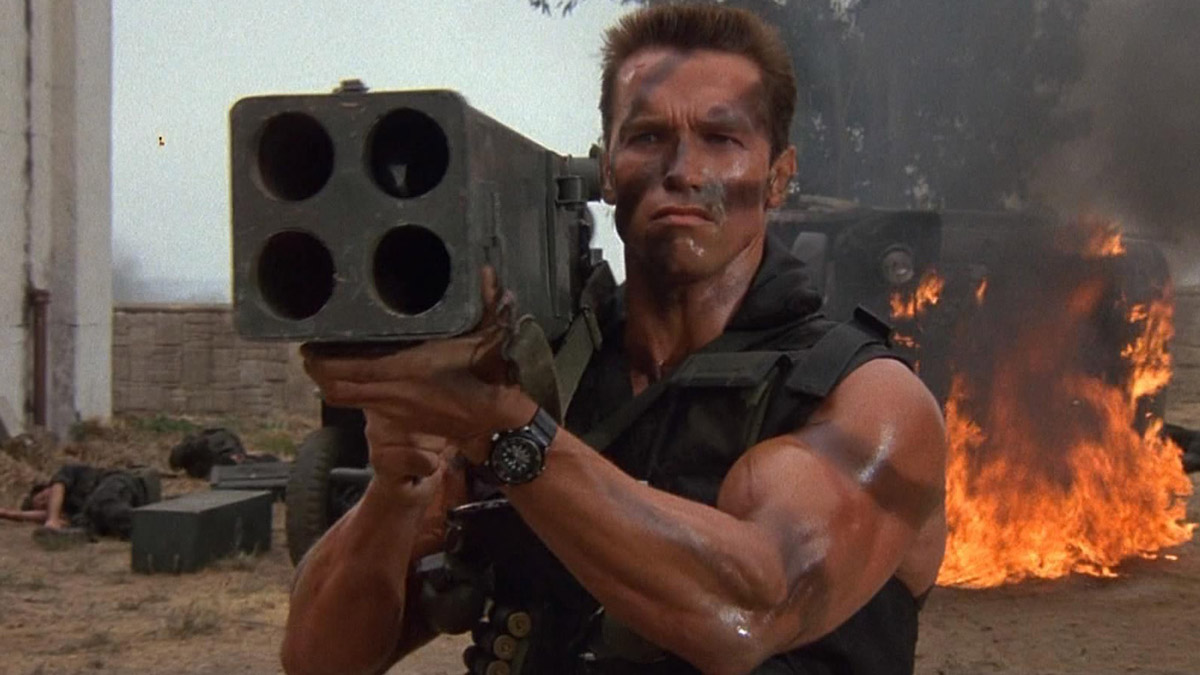
How Arnold Schwarzenegger became John Matrix in Commando
Sometimes a cult film is born not from a perfectly controlled artistic vision, but from a chain of almost accidental decisions: one actor turns it down, another does not quite fit, a studio urgently wants a star vehicle, the script is rewritten around a specific accent, body and screen presence - and suddenly an action movie appears that defines an entire era. That is how Commando was born: one of the most recognizable action films of the 1980s and perhaps the purest early Schwarzenegger formula - minimal doubt, maximum action, dry one-liners, absurd physical power and a hero who moves forward because there is simply no other direction available to him.
Today, it is almost impossible to imagine John Matrix being played by anyone else. But in the earliest version of the script, the hero was not an American retired special forces colonel. He was conceived as a former Israeli soldier, exhausted by war and trying to build a peaceful life in America. The project itself emerged largely in the wake of the success of Rambo: First Blood, in which a war-scarred super-soldier is forced to take up arms again - not for the state, but for himself, his pain and his survival.
Two young screenwriters, Jeph Loeb and Matthew Weisman, saw in that formula a new kind of action film. Their hero was a man who no longer wanted to fight, but whose past would not let him go. In their story, he leaves the service, brings his wife and daughter to America, hoping to hide them from old enemies, only for those enemies to find him and kidnap his family. After that, the former soldier once again becomes a machine of war.
Why an Israeli commando? Partly because the writers were Jewish. But the more practical reason was casting: the project was written with Gene Simmons in mind, the charismatic vocalist and bassist of Kiss, who was born in Israel. In the mid-1980s, Simmons was indeed trying to build a parallel career in film, and on paper the idea was intriguing: a rock star with an exotic background playing a dark former soldier forced back into violence.
But Simmons turned down the lead role. The producers then began looking for another performer. Nick Nolte was one of the possibilities, and the script began shifting away from the hero’s Israeli background toward a more universal image of an American retired soldier. But the film’s real destiny was decided by another meeting.
Barry Diller, then one of the key executives at Fox, met Schwarzenegger at a Hollywood party and was so impressed by his presence that he soon demanded the studio move quickly on an action film with Arnold in the lead. There was almost no time to develop a new project from scratch, and Commando proved to be the ideal material: the story already existed; it simply had to be reshaped around a new star.
Of course, the 37-year-old Schwarzenegger did not exactly look like an ordinary military retiree. But that was part of the strength of his screen image. The audience did not need to believe in the bureaucratic precision of his biography. It only needed to believe that this man had once done the dirtiest and most dangerous work imaginable, then withdrawn into the mountains to chop wood, feed deer and protect his daughter from a world he knew too well.
The script went back into revision. This time, the key figure was Steven E. de Souza, who was essentially given a clear assignment: fewer words, more action. This was not an insult, but a precise production calculation. Schwarzenegger’s strength at that stage was not in long dramatic monologues, but in physical presence, laconic lines and the ability to look convincing in scenes where another actor might have looked ridiculous.
De Souza reworked the material so that the action would begin quickly and barely stop until the final credits. He also moved the hero’s enemies into a new geography. Instead of a Middle Eastern conflict, the film introduced the fictional Latin American country of Val Verde - a name that can be translated as “green valley.” In the past, John Matrix and his comrades helped overthrow the dictator Arius there. Now the former ruler wants to return to power and kidnaps Matrix’s daughter in order to force him to carry out a political assassination.
In this way, the film gained one of the defining features of the 1980s Hollywood action movie: an invented country that resembled several real political conflicts at once, but did not bind the story to specific geopolitical responsibility. Val Verde created the feeling of international intrigue without turning the film into a complex political drama. Commando did not need realistic diplomacy. It needed a reason for the hero to pick up weapons and rescue his child.
The hero’s wife also disappeared from the script. This was not only practical, but dramatically useful. The producers doubted Schwarzenegger could convincingly play romantic scenes, while the image of a widower devoted to his daughter immediately made the hero’s motivation simple, strong and emotionally clear. The death of his wife explained why a man like this could leave the service and hide from his past. His daughter became his only vulnerability - and the only reason to become again what he once had been.
After that, the script was adjusted not only to the story, but to Schwarzenegger himself. The producers asked that lines be simplified or changed if they were difficult for the actor to pronounce. His accent, limited range in dialogue scenes and extraordinary physical charisma effectively shaped the final style of the film. Matrix did not need to explain much. He needed to appear, act and occasionally deliver a short line that landed like a blow.
It was precisely from these limitations that the power of Commando emerged. The film does not try to be a psychological portrait of a veteran, as First Blood was. It does not copy Rambo directly, but translates a similar starting point into another register - almost comic-book-like, hyper-muscular and aggressively direct. If Rambo was a wounded soldier whom society failed to accept, John Matrix became a mythological father-protector: a mountain of a man, a weapon in human form, someone capable of dismantling an entire army for the sake of one child.
That is why Commando has not aged in the way many ordinary action films have. It is too stylized to be judged by the laws of realism, and too full of pure screen energy to be dismissed as a simple studio product. It exists on the border between action film, action-film parody and the perfect promotional vehicle for a star who was, at that very moment, transforming from bodybuilder and Conan into one of the central figures of popular cinema.
In the end, everything that could have looked like a weakness became an advantage. Schwarzenegger’s accent turned lines into quotations. His limited dramatic flexibility made Matrix almost monumental. The unreality of the plot gave the film the freedom to move faster, louder and more joyfully. And the production need to quickly make an action film around an unmistakable star gave audiences one of the purest formulas of 1980s cinema.
Commando became more than a film about a retired special forces soldier rescuing his daughter. It became the moment when Hollywood fully understood how to use Schwarzenegger: do not hide his accent, do not force him to be an ordinary man, and do not overload him with words. Put him at the centre of a world where physical impossibility becomes style, and a short line is more convincing than a long explanation. That is how the former Israeli soldier of the early script became John Matrix - a hero impossible to imagine without Arnold.