
Four Hours in an Ancient Sea
Ontarios Most Photographed Place and What Is Worth Seeing Here
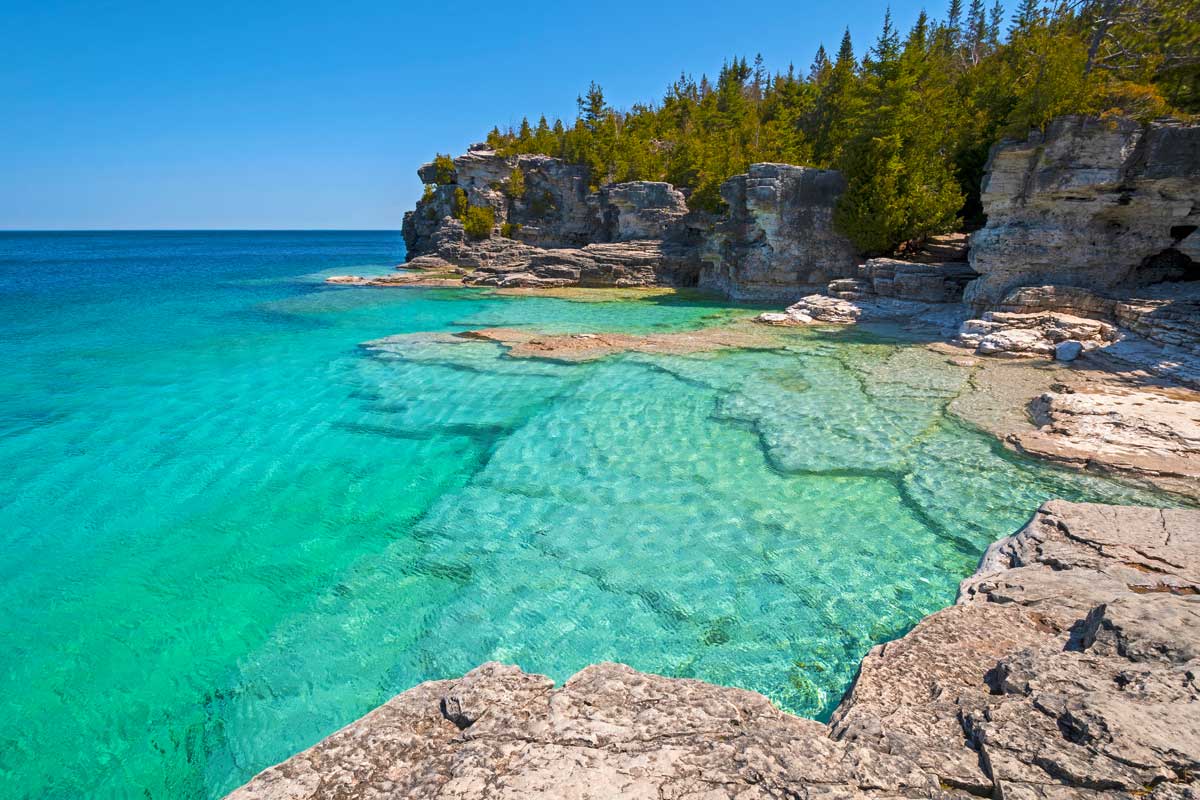
To swim in the Grotto, you need to secure a permit several months in advance, arrive at your assigned hour, show your reservation number at the gate, and be out within four hours. Four hours is the standard slot. There's an unintended irony in this that few people notice. The limestone you'll be walking across on your way to the cave is the floor of a tropical sea. It washed over this spot roughly four hundred million years ago, when Ontario sat near the equator and the first vertebrates were only beginning to crawl onto land.
Marine organisms died, settled, and were compressed into rock. Then the sea receded. Then the glaciers came and sheared through the layers, exposing the edge of the plate.
That edge is called the Niagara Escarpment. It runs more than seven hundred kilometres, from Niagara Falls to Manitoulin Island, and has been designated a UNESCO World Biosphere Reserve. Its most spectacular stretch lies within Bruce Peninsula National Park, on a narrow headland between Georgian Bay and Lake Huron.
Four hundred million years, and four hours to take it in.
But the most interesting thing here isn't the cave. And almost nobody knows about it.
The Trees Nobody Photographs
In 1989, ecologist Douglas Larson at the University of Guelph was studying lichens. His colleagues described his subject matter without much enthusiasm: "it's just scum on rocks, nobody's interested."
Larson switched to the cliffs.
Together with Peter Kelly, an ecologist and climber, he formed the Cliff Ecology Research Group and began rappelling down the sheer walls of the Niagara Escarpment. What interested them were the cedars, eastern white cedars growing directly out of cracks in the limestone. Crooked, twisted, often growing sideways or upside down, they looked like stunted undergrowth, unworthy of attention.
Larson and Kelly took core samples.
It turned out these trees were more than a thousand years old.
The oldest living tree east of the Rocky Mountains, an eastern white cedar on the cliffs at Lion's Head, an hour's drive from the park, germinated from a seed in the year 688 AD. It's more than thirteen hundred years old. It was already a mature tree when the Vikings landed in Newfoundland. It was already standing here when Genghis Khan was born.
In the same area, the group found two dead cedars. One had 1,653 preserved growth rings. Part of the second one's rings had weathered away, but Kelly estimated it to be roughly 1,890 years old.
The reason for this longevity is scarcity. A tree on a sheer cliff face gets almost nothing: a thin film of water in a crack, minimal soil, constant wind. It grows so slowly that it might add a few centimetres over the course of a century. The wood that results is dense, resinous, and rot-resistant. Fires never reach these trees, there's nothing here to burn. Loggers never took an interest in them: the trunks are contorted, and you can't get boards out of them.
Their own uselessness saved them.
Today, roughly seven million people live within a hundred-kilometre radius of the Niagara Escarpment. Thousands of them walk the trail to the Grotto every year, stop at the cliff's edge for a photograph, and never notice that the thing they're steadying themselves against is an organism older than most European cathedrals.
If you go, look at the rock face. Not down at the water. Sideways.
What the Grotto Actually Is
The Grotto is a sea cave carved into the limestone by waves.
Inside is a pool of water. From that pool, a flooded tunnel roughly nine metres long runs beneath the rock and opens into the bay at a depth of about three metres. That tunnel is what produces the effect people come here for: on a sunny day, light passes through it from below, and the water inside the cave begins to glow from within, a dense, almost neon turquoise.
That isn't a photo filter. That's what it actually looks like.
Getting down into the cave is a story of its own. There are two routes. The first is called the chimney, a narrow stone passage you have to descend corkscrew-style, maintaining three points of contact. The second is an open twelve-metre rock face. Both require proper footwear and a clear-eyed assessment of your own abilities. In summer, there's a two-way stream of people going both directions, which adds to the difficulty.
Officially, this section of the Bruce Trail shoreline route is classified as difficult. The park explicitly does not recommend it for inexperienced visitors or those with limited mobility.
Next to the Grotto is Indian Head Cove: the same water, the same colour, a gentle entry, and considerably easier. Plenty of people come here instead and only peer down at the cave from above. That's a perfectly reasonable plan.
Halfway Log Dump: The Same Thing, Without the Line
Ten kilometres east of the Grotto, there's a spot noticeably fewer people know about.
Halfway Log Dump is a stretch of shoreline with large cobblestones, limestone slabs, and the same clear Georgian Bay water. The name is a leftover from 19th-century logging: this is where logs were dumped into the bay and floated onward.
The differences from the Grotto are substantial.
There's no cave here, and therefore no crowd. The parking slot is six hours rather than four. Reservations are only required from June 19 to September 7; the rest of the year, parking operates on a first-come, first-served basis with self-registration on site.
The trail from the parking area to the shore runs about a kilometre and a half, roughly twenty minutes at an unhurried pace, with a gradual descent by steps. From the shore, you can head off along the Bruce Trail in either direction along the cliff edge: west toward Overhanging Point, a striking rock ledge jutting out over the water; or east toward High Dump, home to one of the park's two backcountry campsites.
The shore here is rocky, with no sand. You'll want water shoes to get into the water, wet limestone is slippery and painful barefoot.
If you're choosing between the Grotto and Halfway Log Dump and aren't up for the fight over a reservation, the second option is objectively calmer. The water is exactly the same.
The Water: The Main Thing to Understand
Georgian Bay looks like the Caribbean and behaves like a northern lake.
In July and August, the water temperature here rarely climbs above sixteen degrees. Usually it's lower. This isn't "bracing" water, this is the temperature at which cold shock sets in: an involuntary gasp on immersion, a sharp spike in breathing rate, loss of muscle control within the first few minutes. Cramps and exhaustion follow quickly.
Cliff jumping is prohibited in the park. This isn't a recommendation, it's a rule, and violating it carries fines and expulsion from the park. The reasons are specific: the bottom is uneven, submerged rocks and crevices are unpredictably placed, and depth is deceptive. Typical injuries include dislocations, fractures, and concussions. There have been fatalities here as well: several years ago, a twenty-three-year-old man from Toronto drowned in the Grotto area.
One less obvious risk: divers regularly work underwater near the cave. Someone jumping from above can't see them.
There are lesser-known dangers too. On one occasion, rescuers spent six hours freeing a person whose leg had become trapped in an underwater crevice at nearby Mermaid's Cove. The water was cold, and he was in it the entire time.
The practical conclusion is straightforward. You can and should swim here, but enter the water gradually, never alone, wearing footwear, and without attempting to swim the underwater tunnel unless you're a trained freediver.
Insects: An Honest Calendar
Tourism materials don't write about this, but it can determine how your entire trip goes.
Early May to mid-June: black flies. This is the worst stretch. The black fly doesn't buzz, it approaches silently, bites out a piece of skin, and leaves a wound that itches for two days. It's active only during daylight. It comes in swarms. Repellent helps partially; at peak season, a head net makes sense. If you don't have a specific reason to go in May, don't.
Mid-June to July: deer flies and horse flies. These appear with the first real heat. You can hear them, they drone as they circle your head and bite immediately upon landing. They're especially fond of pursuing people along open sections of trail. Light-coloured clothing helps: dark colours attract them.
All summer, dawn and dusk: mosquitoes. The usual story. It's easier along the shoreline, where the breeze off the bay blows them away.
Mid-July to late August: the optimal window. Black flies have moved on, nights are getting cooler, and there are fewer mosquitoes. Deer flies are still around, but tolerable.
September: the best time of year. Almost no insects, water at its warmest after summer (insofar as that word applies), noticeably fewer people, and the forest starting to change colour.
Separately: ticks are active at any temperature above four degrees. After walking through tall grass, a check is mandatory.
Who This Is For, and Who It Isn't
It's for you if you're willing to plan months ahead, handle walking on uneven rock without trouble, are coming for the water and the landscape rather than the amenities, and can enjoy a place where a hundred other people will be around you.
It isn't for you if you're counting on spontaneity. There is none here. It isn't for you if you want a sandy beach with loungers, the shore is stone. It isn't for people with serious joint or balance problems: the descent to the cave genuinely requires physical confidence. And it isn't for you if you're travelling with very young children and specifically planning on the Grotto, the chimney is not something to attempt with a child in your arms.
The good news: the park has alternatives for every one of these cases. Singing Sands on the Lake Huron side is a gently sloping sandy beach with shallow, warm water, ideal for children, and parking there operates without reservations. It's also home to rare orchids and carnivorous plants growing on the limestone alvars.
Trip Formats
A few hours. A Grotto slot, a quick descent, a swim at Indian Head Cove, and back. Realistic, but tight: budget an hour for the walk from the parking area and back.
A full day. The Grotto in the morning, then a drive and an afternoon at Halfway Log Dump or Little Cove. Two separate reservations, but it makes for a genuinely full day.
Hiking. The Bruce Trail is Canada's oldest and longest marked footpath, running the full length of the escarpment. The section within the park is both the most spectacular and the most demanding: constant elevation changes, roots, wet rock, and stretches right along the cliff edge. Walking from the Grotto to Halfway Log Dump along the shore takes most of a day and requires experience.
Camping. Cyprus Lake Campground is a standard drive-in campground with washrooms, showers, and drinking water; it's about three and a half kilometres on foot from here to the Grotto via the Georgian Bay Trail. Yurts on the lakeshore are an option for anyone who doesn't want to deal with a tent. The Stormhaven and High Dump backcountry sites are hike-in only, with full gear.
An important detail that catches many people out: staying at the campground does not entitle you to park at the P1 lot near the Grotto. Walking there from your campsite is fine. Driving there requires a separate reservation, same as everyone else.
Reservations: How It Works
The rules have changed several times in recent years, and they differ from location to location.
The Grotto (Cyprus Lake P1 parking) - reservations required from May 1 to October 31. Four-hour slot.
Halfway Log Dump - reservations required from June 19 to September 7. Six-hour slot. Outside that window, self-registration on site.
Little Cove - reservations from May 15 to September 15; this lot is administered by the municipality, not the park.
The booking window opens well in advance, and spots for popular summer weekends go quickly. Reservations can't be changed once made, only cancelled. Double-check your date, time, and licence plate before paying.
Worth knowing separately: the Canada Strong Pass makes park entry free from June 19 to September 7 in 2026. But free entry doesn't mean guaranteed access, parking is still paid, and a reservation is still required. These are two different things, and people get caught out by this regularly.
And finally: the parking areas at the visitor centre and at Singing Sands operate without reservations, but they don't give you access to the Grotto. You can't walk there from either, pedestrian traffic on Emmett Lake Road is prohibited for safety reasons.
Fuel, Charging, Food
The single most important practical fact about Tobermory has nothing to do with the park.
There is no gas station in Tobermory.
The nearest one is in Ferndale, forty-five kilometres south. Which means you need to fill up in advance, before you turn north. Especially if you're planning several days of driving between the park, the town, and points along the shoreline, distances add up faster here than you'd expect.
Electric vehicles. Tobermory does have fast charging: a hub with six DC stations delivering up to 120 kW at the community centre on Highway 6. It's the only fast charging in the northern part of the peninsula, and it can be occupied or under maintenance, so it's worth checking the status in an app before you set out and having a backup plan. In addition, the Bruce Peninsula Biosphere Association has installed roughly fifty Level 2 chargers at local inns, motels, and campgrounds: if you're staying overnight on the peninsula, your odds of charging overnight are good, just confirm when booking. There are also chargers in Lion's Head and Wiarton.
Food. Tobermory is a small town with a seasonal economy: everything's open in summer, about half of it in the shoulder season. Cafés and restaurants are concentrated around Little Tub Harbour. Fish and chips, smoked Lake Huron whitefish, bakeries, coffee shops. There's no food inside the park itself, no kiosks, no vending machines. You need to bring your own water and lunch, and pack your garbage back out.
Cell service. Coverage on the trails is patchy and absent in places. Download your maps offline.
What Else Is Nearby
Tobermory is also home to a second national park: Fathom Five National Marine Park. More than twenty documented shipwrecks lie on its floor, in very clear and very cold water. The most accessible is the schooner Sweepstakes near Big Tub Harbour: it sits at a depth shallow enough to be visible from the surface, and even snorkelers can reach it.
Boats also run from here to Flowerpot Island, with its limestone sea stacks carved by glaciers and waves into the shape of flower pots.
The park opened in 1987. It covers one hundred and fifty-six square kilometres on the traditional territory of the Saugeen Ojibway Nation.
Everything here is older than us by several orders of magnitude. The limestone was a sea floor when there were no trees on land at all. The cedars on the cliffs germinated before Gothic architecture appeared in Europe. The glacier that carved these cliffs receded twelve thousand years ago, which, on a geological scale, is yesterday.
The reservation system everyone finds so irritating came about because, within a few years, the number of people wanting to come exceeded what the shoreline could withstand. It's inconvenient. It works.
Four hours isn't much. But it's four hours on the floor of an ancient sea, among trees that have watched a thousand years pass and, if left alone, will watch a thousand more.
Look toward the rock. Not just down at the water.