
A Second Language Is Heard with a Different Ear
What has changed in the technology in recent years
There is an experience familiar to almost anyone who learned English as an adult. At home, at the dinner table, in your first language - everything is clear. On the phone with family - clear. But in a work meeting where several people talk at once, the ventilation hums and someone has an unfamiliar accent, you find yourself straining. In a restaurant with music playing - nearly impossible. And the most frustrating part: a film with subtitles is fine, but without them half the lines slip past. The usual explanation goes like this: it isn't my native language, so of course it's harder. That explanation is correct. But it is incomplete - and the gap is where the trap lies.
Why a second language works as an early indicator
Hearing doesn't work like a microphone. The ear delivers the brain an incomplete, perforated signal, and the brain fills in what's missing - from context, from grammar, from knowing which word is most likely to appear here.
In your first language, this system has so much redundancy that you can catch half a sentence and understand all of it. You never notice the losses, because your brain covers them instantly and for free.
In a second language, there is far less margin. The vocabulary is smaller, the intuition for likely endings is weaker, the accents around you are less familiar. The brain has less to build with - and every lost consonant becomes a lost word.
Which leads to something rarely discussed: for people living between two languages, hearing changes announce themselves earlier and more noticeably - but get attributed to language rather than to hearing. "I just don't catch English well in noise." That sentence gets said by people who have lived here for a long time and speak fluently at work.
Sometimes it really is about the language. Sometimes it isn't anymore.
What goes first
Age-related hearing changes don't begin with volume. They begin with clarity.
High frequencies typically go first. That is where the consonants live - the s, f, t, sh and th sounds that separate one word from another. Vowels, which carry most of the volume, sit lower and hold on longer. Which is why the classic early complaint sounds exactly like this: "I hear everything, I just don't always catch the words."
Now connect that to the previous section. English consonants carry an enormous share of the distinguishing work - and they are precisely the sounds hardest to reconstruct if the language was learned in adulthood.
The result is a double effect. Hearing gives up exactly the part of the signal that a second language is least able to compensate for. And the person is certain the problem is the language.
They live with that certainty for years.
Why medicine changed its view of hearing
Not long ago, hearing was treated as a comfort issue. The conversation is different now.
Major international research groups studying cognitive health in later life include unaddressed hearing loss among the factors a person can actually act on - unlike age or genetics. Two possible mechanisms are under discussion: the constant effort of decoding an incomplete signal consumes resources that thinking and memory need, and, separately, reduced hearing gradually narrows a person's social world.
Honesty matters here, because this subject attracts a great deal of exaggeration.
The large randomized trial devoted to this question found no significant effect across its overall group of participants. The effect appeared in a subgroup of people who already carried elevated risk of cognitive decline - there, hearing intervention meaningfully slowed the loss of memory and thinking ability.
The correct conclusion is not "hearing aids protect against dementia." Nobody is claiming that, and nobody can claim it yet.
The correct conclusion is more modest and more useful: hearing is one of the things that can be addressed. Age and genetics are not.
What changed in the devices themselves
The idea of a hearing aid as an amplifier is long out of date.
An amplifier makes everything louder at once - the clatter of dishes, the hum of the air conditioning, the conversation at the next table. That is exactly why older devices so often ended up in a drawer: in quiet they were intrusive, and in noise they didn't help.
Modern devices solve a fundamentally different problem. Not volume - separation. They analyze the sound environment around you and treat speech differently from background noise, preserving clarity where there used to be an undifferentiated wall of sound, and adjusting as you move from a quiet room into a loud one.
For someone living in two languages, this is the whole point. Noisy environments - restaurants, shopping centres, meetings - are exactly where the second language collapses first.
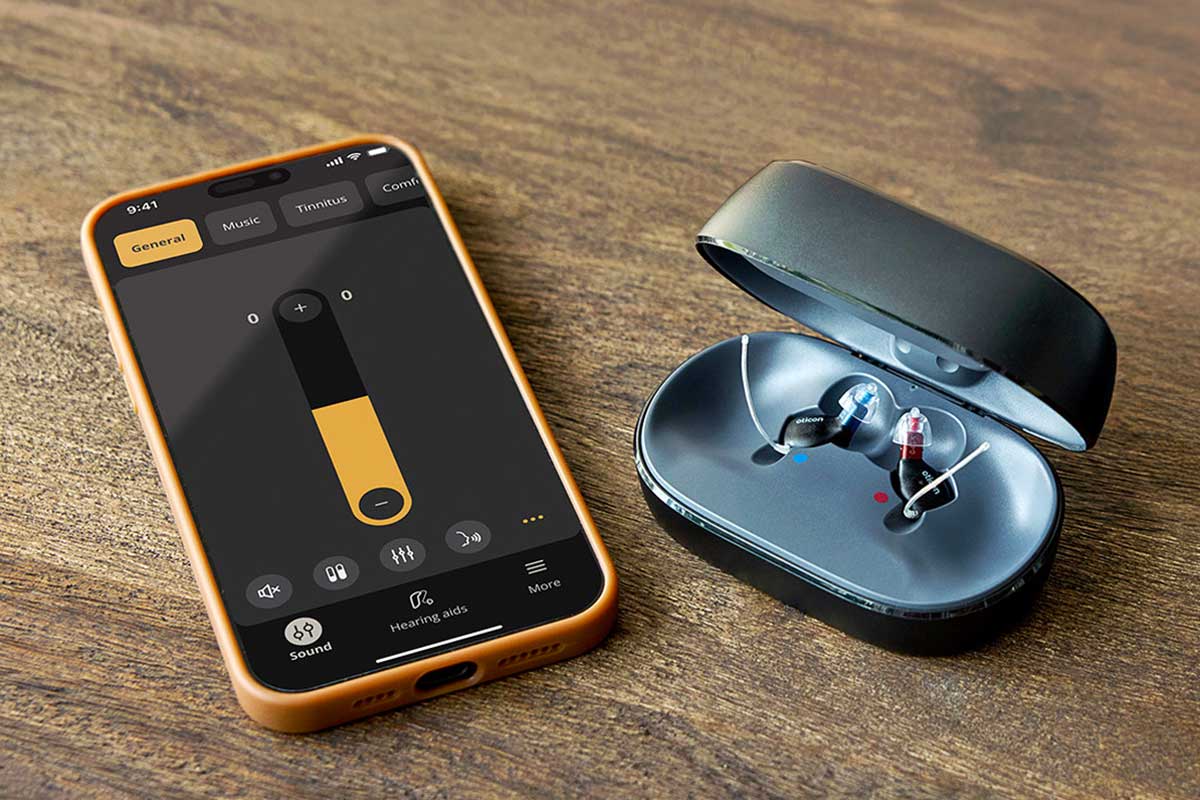
This is the principle behind Oticon Zeal™: it prioritizes speech over background noise and adapts as your listening environment changes, rather than simply amplifying everything around you.
The practical side has changed too. Rechargeable models remove the business of changing batteries. Bluetooth® connectivity lets compatible devices stream phone calls and music directly to the hearing aids - and a phone call, the hardest format of all in a non-native language, arrives straight in your ear without the room's noise on top of it. And the housings have become discreet enough that "I don't want it to be visible" has largely stopped being an argument.
How to know it's worth checking
Don't measure by volume. Measure by clarity - and by effort.
You ask people to repeat themselves more than you used to. The television is louder than the rest of the household finds comfortable. You avoid noisy places - and you have already worked out a reason why you don't like them. In a group you lose the thread and nod at the wrong moment. Phone calls in English drain you noticeably more than talking face to face. By evening you are as tired from conversation as you would be from physical work.
That last one is the most underestimated. Constantly reconstructing what's missing is real work, and it takes real energy. People describe it as being tired of English, without realizing they are not tired of the language - they are tired of compensating.
A hearing assessment requires no preparation and is no more unpleasant than an eye exam. The only difference is in how we treat it: when small print starts to blur, we go to the optometrist without an internal argument. With hearing, we behave as though making the appointment is itself an admission of age.
The years spent on that resistance are years of conversations heard only halfway.
Hearing isn't really about sound. It's about access - to grandchildren, to colleagues, to the joke at the far end of the table, to a film without subtitles, to the life in a second language that so much was built for.
The technology has changed more in recent years than most people's idea of it has.
It's worth finding out what it can do now.