
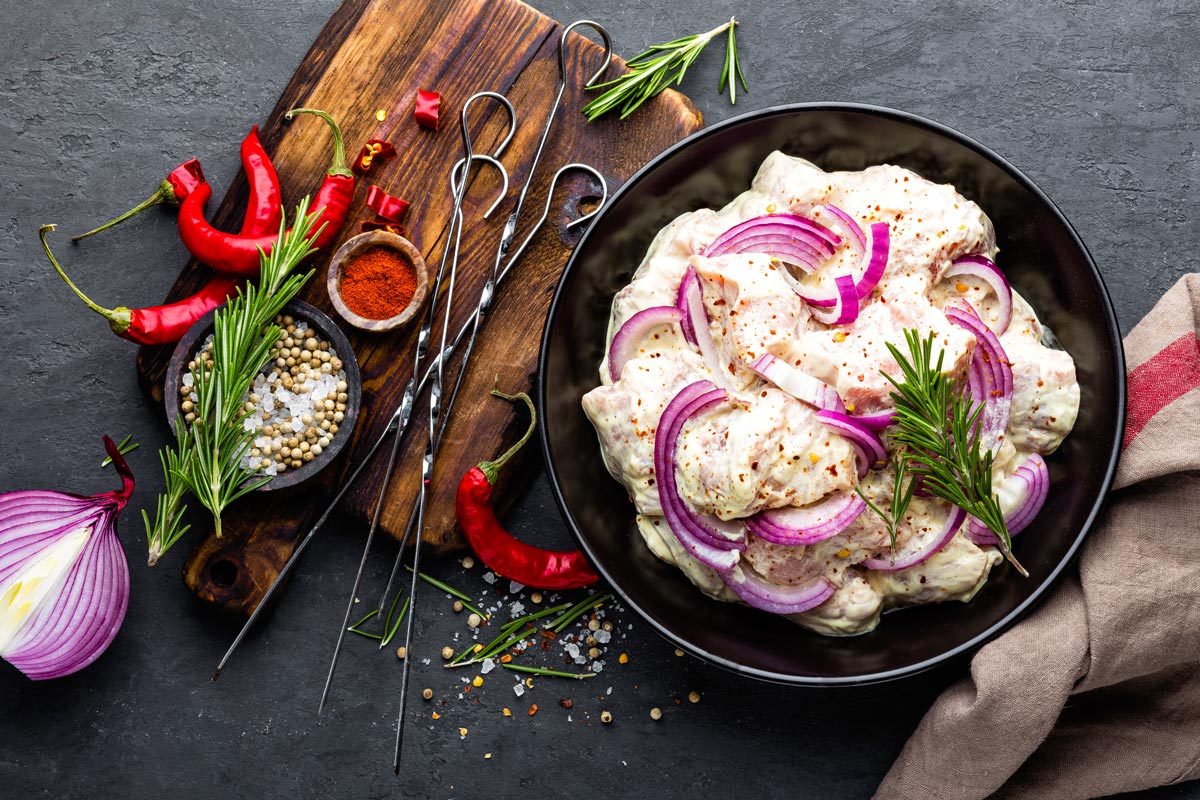
How and why to marinate shashlik
According to science
Good shashlik begins long before the meat touches the skewer. It begins the moment we decide what to marinate it in: wine, kefir, onion, mineral water, vinegar, yogurt, spices or a simple mixture of salt, pepper and time. Every family has its own recipe, every grill master has firm beliefs, and every summer table has its own legend about the only correct marinade. But behind this culinary tradition there is not only taste and memory. There is real chemistry.
A marinade cannot turn poor meat into something exceptional, and it cannot repair everything ruined by bad heat. But it can genuinely make meat tastier, more tender and juicier - if you understand how it works. And here it is important to separate romance from science: a marinade does not work by magic, and it does not always penetrate deeply into the meat. Most of the time, it works primarily on the surface, helps salt change the behaviour of proteins, adds aroma and partly affects texture. The real result comes from balance: the right cut of meat, a sensible amount of salt, moderate acidity, time and careful grilling.
What we casually call meat is, biologically speaking, mostly muscle tissue with some fat, connective tissue and sometimes bone. If we are talking about boneless meat for shashlik with a moderate amount of fat, its main components are water, proteins, fats and connective tissue. Proteins and water are what largely determine whether the finished meat feels tender and juicy.
Proteins consist of long chains of amino acids. These chains do not sit randomly inside the meat: they fold and arrange themselves into specific structures. In muscle, the especially important proteins are actin and myosin, which form dense fibres and are responsible for muscle contraction. As long as these protein structures remain too tight and firm, the meat is harder to chew. When the structure partially changes, the fibres loosen, and the cooked piece feels softer.
What acid does
Many classic marinades contain acid. Wine and vinegar contain organic acids; kefir and yogurt contain lactic acid; lemon juice contains citric acid. An acidic environment affects proteins by disrupting some of the bonds that hold their three-dimensional shape, causing denaturation. In simple terms, dense protein structures begin to partially unfold and change.
This is why meat marinated in an acidic mixture can feel softer. But there is an important trap here: more acid does not mean better. Too much acid, or too much time in contact with acid, can ruin the texture. The surface of the meat can become loose, chalky or unpleasantly “cooked,” and during grilling such a piece may hold its juices less effectively.
That is why aggressive vinegar-based marinades require caution. They can work for certain tougher cuts and shorter marinating times, but they easily cross the line where marinating no longer improves the meat and instead begins to damage it. Gentler fermented dairy marinades - kefir, yogurt, ayran - usually act more delicately. Lactic acid changes protein structure more softly, and the dairy environment helps the meat remain more tender and juicy.
Why salt matters more than it seems
If acid is responsible for part of the texture change and flavour character, salt is one of the main tools of juiciness. A good marinade almost always functions not only as a fragrant liquid, but also as a brine. Salt penetrates meat far more effectively than many aromatic molecules and changes muscle proteins in a way that helps them retain water during cooking.
At first, salt may draw a little moisture to the surface. That moisture then dissolves the salt, creating a natural brine that gradually moves back into the meat. As a result, the piece becomes better seasoned inside and loses less juice over the fire. This is why dry-brining or a marinade with a properly balanced amount of salt often gives a more predictable result than a complicated liquid with ten ingredients but no clear salt balance.
It is important to understand that spices, garlic, onion, herbs, oil and many aromatic compounds usually do not penetrate deeply into a dense piece of meat. They work mostly on the surface. That is not a problem - the surface is exactly what meets the fire, browns, caramelizes and creates the unmistakable aroma of shashlik. But if you want the meat to taste good beyond the surface, salt needs time.
Mineral water, kefir, wine and vinegar: what to choose
Mineral water is popular for a reason. It contains dissolved salts and carbon dioxide, and it acts more gently than vinegar-based marinades. It does not make the meat taste sour and can help create a more delicate marinating environment. But one should not expect miracles from it: the main work will still be done by salt, time and the quality of the meat.
Kefir and yogurt are among the best options for shashlik, especially when the meat is not perfectly tender. They provide gentle acidity, create a rounder flavour and combine beautifully with onion, garlic, pepper, coriander and herbs. This kind of marinade is harder to ruin than a vinegar marinade, as long as the meat is not left in it excessively long.
Wine works differently: it adds acidity, fruit notes, aroma and a light tannic edge. Red wine pairs well with lamb and beef; white wine works with pork, poultry and fish. But wine should be part of the flavour idea, not a way to disguise poor meat. If the wine is unpleasant to drink, do not expect it to make the marinade noble.
Vinegar is the sharpest tool. It changes the surface of the meat quickly and gives a recognizable flavour familiar to many from Soviet and post-Soviet shashlik traditions. But vinegar is also the ingredient most often responsible for a tough, dry or strangely loose texture. If you use it, use it moderately, diluted and not for too long.
Why oil belongs in a marinade
Vegetable oil is not mandatory in a marinade, but it can be useful. Many aromatic compounds from spices and herbs bloom better in fat. Oil helps carry these aromas onto the surface of the meat and improves the contact between spices and the piece. It can also slightly protect lean meat, poultry or fish from drying out over strong heat.
For pork or lamb with good fat marbling, oil is often unnecessary: the meat has enough fat of its own. But for chicken breast, turkey, lean beef or fish, a small amount of oil can make the result juicier and more aromatic. The key is not to turn the marinade into an oil bath. Fat should support flavour, not drown it.
A marinade cannot replace proper grilling
Even the smartest marinade will not save shashlik if the meat is overcooked. Juiciness depends not only on what happened before grilling, but also on how quickly and to what temperature the meat is cooked. Heat that is too aggressive on the outside and too long a wait inside is the surest path to dryness.
For shashlik, the size of the pieces matters, as does even cutting, the distance from the coals, the absence of open flame and the ability to remove the meat at the right moment. Acid, salt and spices can prepare the piece, but fire creates the final character. Good shashlik is not only a marinade. It is a partnership between chemistry and attention.
How long to marinate
There is no universal time. It depends on the type of meat, the size of the pieces, the strength of the acid and the amount of salt. Poultry and fish generally need less time. Pork and lamb can tolerate longer marination. Tougher cuts require a different approach, but even they should not be thoughtlessly left in an aggressive marinade for a full day or more.
For most home shashlik, a reasonable range is from a few hours to overnight if the marinade is gentle. If the marinade is acidic and sharp, shorten the time. If it is based mostly on salt, spices, onion and a little oil, the meat can rest longer. The goal is not to “marinate it into submission,” but to give the ingredients time to do their work without destroying the texture.
The history of marinade: from preservation to pleasure
Marinades appeared long before people began discussing juiciness and gastronomic nuance. Their original purpose was preservation. Before refrigeration, acids, salt, alcohol, spices and smoke helped slow bacterial growth and extend the life of meat, fish and vegetables.
Different cultures developed marinades in different ways. In the Mediterranean, wine, vinegar, olive oil and herbs were used. In Asia, soy sauce, fermented products, ginger, garlic and rice wine played an important role. In Mesoamerica, local plants and fermented acidic ingredients were used. Recipes always emerged from climate, available ingredients, habits and necessity.
Over time, marinades stopped being only a method of preservation. They became a language of cuisine. Some ingredients made meat more tender, others more aromatic, others helped retain moisture, and still others created a beautiful crust over the fire. Practical technology became part of gastronomic culture.
The main lesson
Marinating is not a ritual for ritual’s sake. It is a way of managing flavour, texture and juiciness. Acid can soften the surface, but too much of it will damage it. Salt helps retain moisture and seasons more deeply. Oil carries the aroma of spices and protects lean meat. Time is necessary, but not infinite. And the quality of the meat and the fire remain decisive.
The best marinade is not the most complicated or the most exotic. The best marinade is the one that understands the meat. For good pork, salt, onion, pepper and a little time may be enough. For lamb, a fermented dairy base, garlic, coriander and herbs can work beautifully. For poultry, yogurt, lemon zest, spices and a little oil are a strong combination. For fish, only brief contact with salt, aromatics and fat is needed.
This is the mature approach to shashlik: not arguing over the one correct recipe, but understanding the logic of the process. A marinade should not overpower the meat. It should reveal its character, help the fire do its work and leave at the table exactly the feeling for which we gather around the grill in summer: the aroma of smoke, a juicy piece of meat, lively conversation and the simple luxury of food cooked over open flame.