Bitter and Beautiful
Curaçao
Curaçao: the island where an orange became a liqueur, Sephardic Jews founded the oldest synagogue in the Americas, and a governor banned the color white.
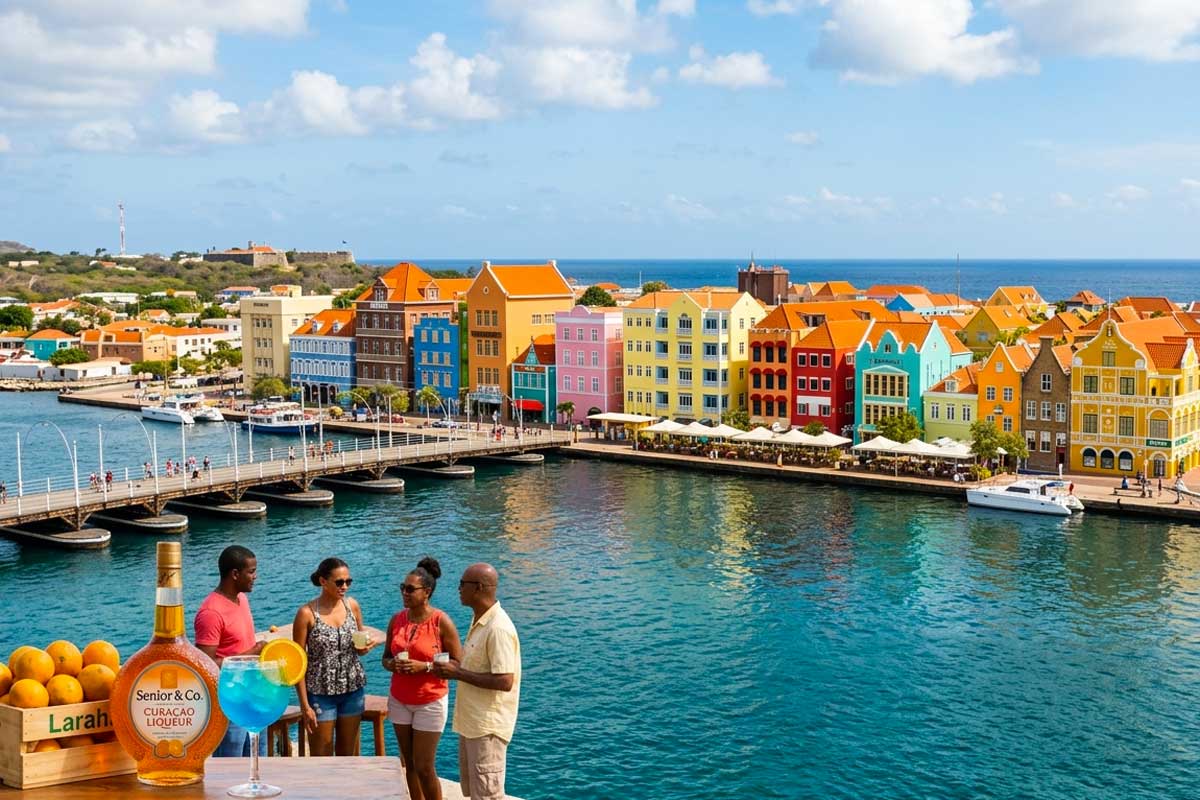
In the Sint Anna Bay harbor, at the edge of Willemstad - Curaçao’s Dutch Caribbean capital - stands a bridge. It is called the Queen Emma Bridge, nicknamed “The Swinging Old Lady,” and it is one of the few floating pontoon bridges in the world that opens sideways to let ships pass. When a cargo vessel or cruise ship enters the harbor, the bridge slowly drifts away from shore, while pedestrians, cyclists, and locals carrying shopping bags patiently wait for it to return. It happens several times a day.
On one side lies Punda, with its UNESCO-listed 17th- and 18th-century waterfront facades. On the other is Otrobanda, a historic district where colonial buildings are now covered in contemporary murals and transformed into boutique hotels, galleries, cafés, and bars.
The water is impossibly turquoise. The buildings are painted yellow, coral, mint, pink, and sea-green.
Together, it looks less like a real city and more like a film set designed by an art director who was never told to stop. But Curaçao is not a set. It is one of the most historically layered islands in the Caribbean - and nearly every story here takes an unexpected turn.
Why Willemstad Is So Colorful
In 1817, Curaçao’s governor Albert Kikkert signed an unusual decree. From that moment on, every building in Willemstad had to be painted any color except white. The official explanation was medical: the governor reportedly suffered from severe migraines made worse by sunlight reflecting off the island’s white limestone facades.
Locals, however, prefer another version of the story. According to island folklore, Kikkert secretly owned shares in a paint business and simply wanted to increase sales.
Historians have never fully agreed on which version is true. Perhaps both contain some truth.
The buildings themselves already had an unusual origin. Dutch ships arriving from Europe carried ballast bricks for stability during Atlantic crossings. Once in Curaçao, those bricks were unloaded and used for construction. Walls were coated with lime plaster made from crushed seashells, turning the city brilliantly white under the Caribbean sun.
Then came the governor’s decree. Residents picked up paintbrushes and transformed the city one building at a time. The result became the famous Handelskade waterfront - one of the most recognizable urban panoramas in the Caribbean: facades in shades of mango, papaya, turmeric, terracotta, coral, and mint reflected in the harbor water.
One of the world’s great postcard cityscapes may have been created by either a migraine sufferer - or an opportunistic businessman.
The Orange Nobody Could Eat
When the Spanish seized Curaçao in 1499, they brought Valencia orange seeds from Europe.
The climate seemed perfect.
But the island changed the fruit.
Under Curaçao’s relentless sun and on its dry limestone soil, the sweet Spanish orange mutated into something entirely different: small, greenish, thick-skinned, and so bitter that even goats refused to eat it. The plantations were abandoned. The trees spread wild across the island.
Then someone discovered something remarkable: the dried peels released an intensely aromatic citrus-floral scent.
This became the laraha - Curaçao’s unique bitter orange.
In the late 19th century, the Sephardic Jewish Senior family began experimenting with dried laraha peels, spices, and alcohol. After distillation, the result was a fragrant citrus liqueur that would later become famous worldwide as Curaçao.
In 1896, they founded Senior and Co., a company that still operates today.
Its original 19th-century copper still remains in use.
One important detail surprises many visitors: authentic Curaçao liqueur is naturally colorless.
The famous blue version came later - created purely for visual effect in cocktails and bars.
Real Curaçao is about the aroma of laraha, not the color in the bottle.
And Senior and Co. remains the only distillery still using genuine laraha peels grown on the island itself.
The Oldest Active Synagogue in the Americas
In 1492, Spain’s monarchs Ferdinand and Isabella signed the Alhambra Decree, expelling Jews from Spain.
Many families formally converted to Christianity while secretly continuing Jewish religious life under the constant threat of the Inquisition.
In hidden synagogues, floors were covered with sand to muffle the sounds of footsteps and prayer.
In the 17th century, several Jewish families from Amsterdam and other Dutch colonies settled in Curaçao under the protection of the Netherlands - one of Europe’s rare centers of relative religious tolerance at the time.
In 1651, they founded the Mikvé Israel congregation.
In 1732, the Mikvé Israel-Emanuel Synagogue opened - now recognized as the oldest continuously operating synagogue in the Western Hemisphere.
It still functions today. And its floor is still covered with white sand. What once began as a survival tactic became a living memorial to centuries of history.
Locals call the synagogue Snoa, the Papiamentu word for synagogue.
Nearby stands the Jewish Historical Cultural Museum and the Beit Chaim Bleinheim cemetery - the oldest active Jewish cemetery in the Americas, with gravestones dating back to the mid-1600s bearing Portuguese and Spanish surnames.
World War II: The Island That Fueled Allied Aviation
Like neighboring Aruba, Curaçao became unexpectedly important during World War II.
Royal Dutch Shell built one of the world’s largest oil refineries on the island, processing crude oil from nearby Venezuela.
During the war, a significant share of Allied aviation fuel came through Curaçao.
In February 1942, German submarines launched Operation Neuland - coordinated attacks against Caribbean oil infrastructure. Aruba and the waters around Curaçao became strategic targets. Had the Shell refinery been destroyed, it could have seriously weakened the Allied air campaign over Europe. But the refinery survived. And for decades after the war, oil remained the backbone of the island’s economy.
Pietermaai: The Neighborhood Rediscovered
There is one district in Willemstad many travelers discover too late. Pietermaai. In the 19th century, it was home to wealthy Dutch merchants. Later, the neighborhood declined: mansions stood abandoned, facades crumbled, windows were boarded shut.
Then, in the 2010s, something changed. Without a master plan. First came a restaurant. Then a wine bar. Then a boutique hotel. Then an art gallery.
Today Pietermaai is one of the Caribbean’s most atmospheric districts: live music drifting through courtyards, restored colonial homes, murals, intimate design hotels, cocktail bars, and the feeling that you discovered the place just before everyone else did.
At night, the neighborhood feels quietly cinematic.
The Floating Market
Every morning, boats from Venezuela enter Sint Anna Bay.
They dock directly beside Willemstad’s waterfront, turning their decks into open-air produce stalls.
Fish, tropical fruit, vegetables, herbs, and spices are sold straight from the boats just steps from UNESCO-listed buildings.
This is not a staged tourist attraction.
It is a trading route that has operated for generations - dating back to the era when Willemstad was one of the southern Caribbean’s most important commercial ports.
The Language Created by Everyone
On Curaçao, four languages coexist in daily life: Dutch, Papiamentu, English, and Spanish.
Most locals speak all four fluently.
Papiamentu developed from Afro-Portuguese creole roots combined with Spanish, Dutch, and Arawakan languages over the course of the 17th and 18th centuries, when Europe, Africa, and South America converged on one small island.
It is a language that belongs to no single culture. History itself created it.
Shete Boka and the Island’s Wild Side
Most visitors stay near Willemstad and the beaches of the western coast. But Curaçao’s northern and eastern shores feel like a different island entirely. Shete Boka National Park - “Seven Inlets” in Papiamentu - is a coastline of volcanic rock battered by the full force of the Atlantic Ocean. Waves explode through sea caves and natural blowholes with a sound that echoes across the cliffs.
Several beaches inside the park also serve as nesting grounds for loggerhead sea turtles. During nesting season, nighttime access is restricted, and ranger-led tours are among the few legal ways to witness the phenomenon responsibly.
The Beaches People Fly Here For
For all its history, Curaçao is still home to some of the Caribbean’s most beautiful beaches.
Playa Kenepa Grandi is the island’s iconic postcard view: white sand framed by limestone cliffs and water so vividly blue it appears digitally enhanced.
Cas Abao offers calm turquoise water and coral reefs close enough for snorkeling directly from shore.
Playa Porto Mari is famous for its double reef system and some of the best shore diving conditions in the region.
And then there is Klein Curaçao - a tiny uninhabited island reached by boat - where endless white sand, a weathered lighthouse, and shifting sapphire water create the classic Caribbean fantasy landscape people imagine but rarely actually find.
Sovereignty and Identity
Since October 10, 2010, Curaçao has been a self-governing constituent country within the Kingdom of the Netherlands.
The island has its own parliament, government, and domestic political system.
The Netherlands oversees defense and foreign affairs, but Curaçao governs itself.
You feel this distinction on the island.
Locals do not see themselves as a “Dutch colony” or a European tourist outpost.
This is a distinct Caribbean society shaped by four centuries of migration, trade, religion, language, and survival.
Practical Notes
Official languages are Dutch, Papiamentu, and English, while Spanish is widely spoken throughout the island. The official currency is the Caribbean guilder (XCG), which gradually replaced the former Netherlands Antillean guilder, though U.S. dollars are accepted almost everywhere.
Canadian citizens can enter visa-free.
Curaçao lies outside the main Atlantic hurricane belt, meaning there is effectively no true “bad season” in the traditional Caribbean sense. The best balance of weather and pricing is typically from November through April.
Curaçao was never simply a beach island.
A Spanish orange mutated here and became a liqueur recognized around the world. Jews fleeing the Inquisition built the oldest continuously operating synagogue in the Western Hemisphere and preserved its sand-covered floor for centuries. A governor with migraines - or perhaps a talent for business - banned the color white and accidentally created one of the Caribbean’s most recognizable cityscapes.
Curaçao’s history began with bitterness. And somehow became beautiful.