
How to Choose Sunglasses That Actually Suit You
More Than Just An Accessory
Here's a fact that tends to stop people mid-sentence: the first true sunglasses on record weren't designed to block the sun at all. They were designed to hide emotion. In 12th-century China, magistrates wore lenses ground from smoky quartz during court proceedings - not because the light bothered them, but so that no one in the room could read their face while they decided someones fate. Fourteen centuries later, this is still, in a strange way, exactly what a good pair of sunglasses does. It gives you a face the world can not fully read. Understanding that history changes how you think about buying a pair - because the right glasses aren't a costume you borrow from a celebrity. They're an instrument, built out of centuries of very practical human problems, that happens to also make you look extraordinary when it fits correctly.
A Much Older Invention Than You'd Think
Long before anyone worried about UV rays, humans were fighting a much older enemy: glare. The earliest known eye protection belonged to Arctic peoples, who carved narrow-slitted goggles from bone, driftwood, and walrus ivory as long as two thousand years ago to survive the blinding glare of sunlight reflected off snow - glare intense enough to cause temporary blindness within hours. The narrow slits did something else unexpected: by limiting the light entering the eye to a thin band, they sharpened vision the way a pinhole camera does, letting hunters see prey more clearly, not less.
The Roman historian Pliny the Elder wrote that Emperor Nero liked to watch gladiator fights through a polished emerald - probably more myth than habit, but a sign that even antiquity understood that raw sunlight and clear sight don't always go together. Then came the Chinese magistrates and their smoky quartz lenses: an invention that had nothing to do with weather and everything to do with power, secrecy, and the simple advantage of a face no one else could read.
For centuries after that, tinted lenses were almost entirely medical rather than fashionable - and for a while, they were something closer to a mark of shame. In the 19th century, tinted glasses were associated with illness, worn by people managing light sensitivity caused by conditions including untreated syphilis. Sunglasses did not become glamorous by accident; they had to be rescued from that association entirely.
How Shame Became Glamour
The rescue happened in Hollywood. Silent-film sets in the 1920s were lit with punishing carbon-arc lamps that left actors' eyes raw and light-sensitive between takes, and actors began wearing tinted glasses off-camera simply to recover. Photographers caught them doing it. The public decided it looked less like recovery and more like mystique - and the modern association between sunglasses and celebrity, privacy, and a certain untouchable cool was born almost by accident.
Mass production followed quickly. In 1929, an entrepreneur named Sam Foster began selling cheap celluloid sunglasses from a Woolworth's counter on the Atlantic City boardwalk, betting correctly that beachgoers would pay for eye comfort. Within a decade, roughly twenty million pairs were being sold annually in the United States, and Life magazine had officially declared sunglasses a national craze.
Then came the piece of the story with real engineering behind it. In 1936, inventor Edwin H. Land - who would later found Polaroid - patented a polarizing filter that could cut glare bouncing off flat surfaces like water, snow, and pavement. Bausch and Lomb used the technology to build teardrop-shaped, thin-metal sunglasses for U.S. Army Air Corps pilots, whose eyes needed protection from the intense glare found at high altitude. The style earned its now-famous name, Aviator, quite literally: it was built for aviators. The glasses went on public sale in 1937 under a name that described exactly what they did - Ray-Ban, because they banned the sun's most damaging rays. General Douglas MacArthur, photographed constantly in his aviators throughout the Pacific campaign, turned military-issue eyewear into an image of authority; returning soldiers brought the style home with them after the war, the same way they brought back bomber jackets and khaki chinos.
Hollywood then finished what it started. Tom Cruise's Wayfarers in Risky Business (1983) reportedly boosted sales of that style by roughly fifty percent; three years later, his aviators in Top Gun did something similar for that shape, driving sales up by around forty percent. A garment invented to survive snow blindness, refined to help pilots see enemy aircraft, had become one of the most reliable style signals in the world - proof that most of what feels timeless in fashion was, at some point, a genuinely practical solution to a real problem.
Protection Comes First - Always
In Canada, where sun can be deceptive not only in summer but in winter, when light bounces hard off snow, the right choice starts with protection, not fashion. Look for a label reading 100% UVA/UVB protection or UV400. Dark lenses without genuine UV filtering are a real trap: they create a false sense of security by dilating the pupil in low apparent brightness, which can let in more damaging UV than wearing no glasses at all.
Polarization is a separate feature from UV protection and serves a different purpose. It cuts the specific glare that bounces off flat surfaces - water, roads, snow, wet pavement - which makes it genuinely useful for driving, being near water, skiing, or walking through a city after rain. But polarization alone says nothing about UV protection; the two need to be confirmed independently.
Only once protection is settled does the interesting part begin: choosing sunglasses as a piece of your actual style.
The Core Principle: Balance, Not Repetition
The single most useful rule in eyewear is this: glasses should balance your face, not echo its weakest proportions.
If your face is soft and round, very round frames tend to amplify that softness and make features look less defined. Rectangular, square, or geometric shapes with a strong upper line work better - they add structure, visually lengthen the face, and read as more assured.
If your face is square, with a strong, defined jawline, rigid rectangular frames can look overly hard. Rounder, oval, softly teardrop, or gently rectangular shapes work better here - they don't fight the face, they soften its excess sharpness. Frames with a smooth curve and a lighter lower edge are particularly flattering.
An oval face is often called universal, which is true but slightly misleading - it doesn't mean anything works equally well. Aviators, wayfarers, rectangles, round frames, and retro shapes can all work, but scale and fit still matter enormously. Frames too small make the face look larger by contrast; frames too large swallow it entirely.
A longer, more elongated face benefits from frames with more lens height. Narrow, horizontal shapes can stretch the proportions even further, especially worn high on the face. Better choices visually "divide" the face and add width: aviators, larger rectangular frames, styles with a strong upper line or a touch of retro character.
A heart-shaped face - broader forehead, narrower chin - calls for caution with heavy top-weighted frames, which can exaggerate forehead width. Lighter frames work better: thin metal, soft aviators, oval shapes, clear acetate, anything without an aggressively bold upper line.
A triangular face, where the lower half is more prominent than the upper, often benefits from the opposite: frames with emphasis at the top - a stronger browline, a light cat-eye in women's styles, rectangular shapes with real character. These balance the face by adding visual weight where it's currently lacking.
Scale Matters More Than People Realize
Shape alone isn't enough. Glasses can be technically the "right" shape and still fail if the scale is wrong. A frame should roughly match the width of your face - never compressing the temples, leaving marks, sliding down the nose, or extending so far past the cheekbones that the face gets visually lost inside it.
A simple test: if the glasses are more noticeable than the person wearing them, they're overpowering the face. If they're barely visible and the face looks larger as a result, they're too small. The right pair looks as though it was designed alongside your face, not placed on top of it as an afterthought.
Fit matters just as much as scale. Glasses shouldn't rest on your cheeks when you smile, press into the bridge of your nose, or need constant adjusting. The top line of the frame should generally sit near the eyebrow line without fully covering it - brows are expressive, and hiding them entirely tends to flatten a face's liveliness, with exceptions made for deliberately dramatic, oversized fashion styles.
The bridge of the nose deserves its own attention. Sitting too low makes a face look tired; sitting too high can create an almost comic mask-like effect. Lower nose bridges are often better served by adjustable nose pads or lighter frames; higher bridges can carry heavier, more solid acetate designs.
Color: Frame, Metal, and Lens
Frame color should belong to your personal palette, not just catch your eye in a display case. Black is the most graphic, severe option - excellent with high-contrast coloring, dark hair, a classic wardrobe, urban minimalism, leather jackets, white shirts, and sharply defined outfits. On softer coloring, black can read as too harsh.
Dark brown, tortoiseshell, and cognac acetate tend to look richer and gentler. They pair beautifully with beige, olive, caramel, denim, suede, gold jewelry, and warm skin tones - an excellent choice for anyone who wants classic eyewear without office-issue sterility.
Clear, smoky, grey-beige, and milky frames read as modern and lighter. They suit a summer wardrobe, pale fabrics, relaxed urban style, and minimalism - situations where the glasses should be noticeable without feeling heavy.
Metal speaks its own language. Gold adds warmth, status, and a touch of vintage character. Silver and steel read as cooler, more technical, more restrained. Thin metal frames often suit people who don't want the glasses to become the face's main focal point - though on a larger face, an overly delicate frame can disappear, and overly bright metal can look cheaper than it costs.
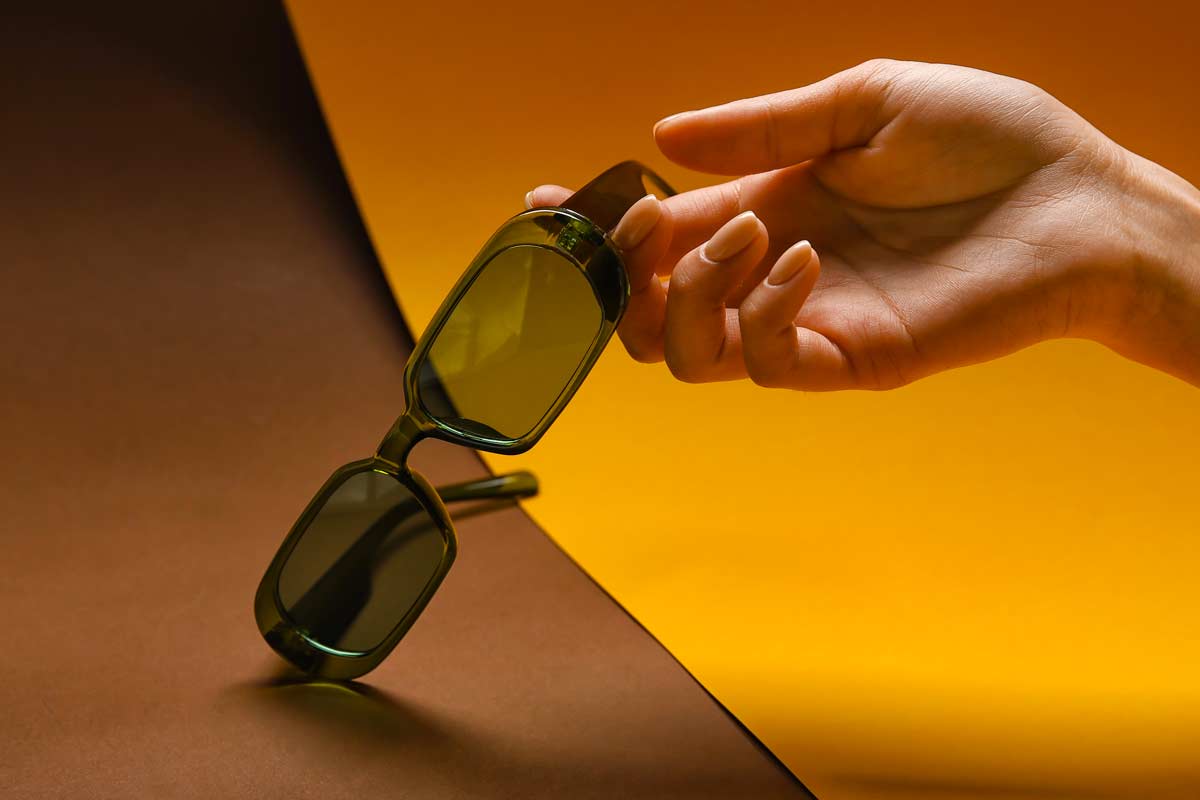
Lens color matters too, and not just aesthetically. Grey lenses are the most neutral choice: they distort color the least and work with nearly everything. Brown and amber lenses warm the world up, boost contrast, and pair beautifully with natural, earth-toned wardrobes. Green lenses read as more intellectual and slightly retro, particularly in classic shapes. Blue, pink, yellow, and mirrored lenses can be striking, but they tie a pair of glasses to a specific mood and season very quickly.
For an everyday pair meant to last years, calmer lens colors serve better: grey, brown, green, or a moderate gradient. If you want a fashion statement, let that be your second pair, not your only one.
Matching the Rest of Your Wardrobe
For a man who wears tailored suits, overcoats, polos, dark denim, and leather shoes, classic shapes generally work best: aviators, wayfarers, rectangular frames, browline styles, clean metal. For a more relaxed wardrobe - linen shirts, sneakers, resort-adjacent style, knitwear, overshirts - clear acetate, soft retro shapes, rounder frames, and warmer lens tones tend to fit better.
For women, sunglasses can introduce an entirely different character depending on the shape. Large square frames create a quiet, off-duty-celebrity effect: composed, expensive-looking, slightly distant. Cat-eye shapes add femininity and a natural lifting effect to the face, especially when the angle isn't too theatrical. Oval retro frames look artistic but demand a confident overall style to carry them. Aviators soften romantic outfits and add a sense of movement. Narrow rectangular frames look current but don't suit every face, and often function better as a seasonal trend piece than a long-term investment.
Lifestyle Is Part of the Decision
For driving, polarized lenses genuinely help - though it's worth checking that they don't interfere with reading a car's digital dashboard, since some polarized lenses can distort certain LCD displays. For the beach, a boat, a walk along the shore of Lake Ontario, sports, or winter sun, larger lenses or a more wraparound shape help block light from entering at the sides. For city life, more overtly stylish frames are fair game - but genuine UV protection should never become optional just because the shape is more fashion-forward.
What's Actually Worth Paying For
Don't buy sunglasses purely because the name on the temple is well known. A logo cannot fix a bad fit. And the reverse is equally true: an inexpensive pair isn't automatically inferior if it has real UV400 protection, decent lenses, a good fit, and suits your face. What justifies paying more is material quality, genuine optical clarity, durability, comfort, and design - not a visible name stamped on the arm.
The most reliable long-term strategy is owning two pairs rather than one. The first should be versatile: a calm shape, real protection, a neutral color that works with most of your wardrobe. The second can have more personality - larger, lighter, brighter, retro, sportier, more dramatic. Once you have both, sunglasses stop being an impulse purchase and become a genuine, considered part of your wardrobe.
The Checklist Before You Buy
Before committing to a pair, run a few simple tests. Look at yourself not only straight-on but in profile. Smile. Tilt your head. Check whether the lenses touch your cheeks, whether the arms press uncomfortably, whether the frame slides. Look at the glasses in actual daylight, not just under a store's lighting. Try them on with the clothes you genuinely wear, not the imagined outfit that only exists in a fitting room.
And the real test, the one that matters most: the glasses should make you look more like yourself, not like someone else's character. A good pair doesn't announce itself. It communicates something quieter - that this person has taste, has composure, and knows exactly who they are.
A Small Architecture for the Face
Sunglasses are, in the end, a small architecture built for the face - proportion, line, light, material, and function, all working together. Get it right, and they do far more than block the sun. They give the eyes real strength, complete an outfit, and give a person that particular quiet confidence that is, in the end, the entire point of style. It's the same instinct that shaped a piece of walrus ivory two thousand years ago and the same instinct a Chinese magistrate understood in the twelfth century: sometimes the most powerful thing you can wear on your face is the part the world can't fully read.