
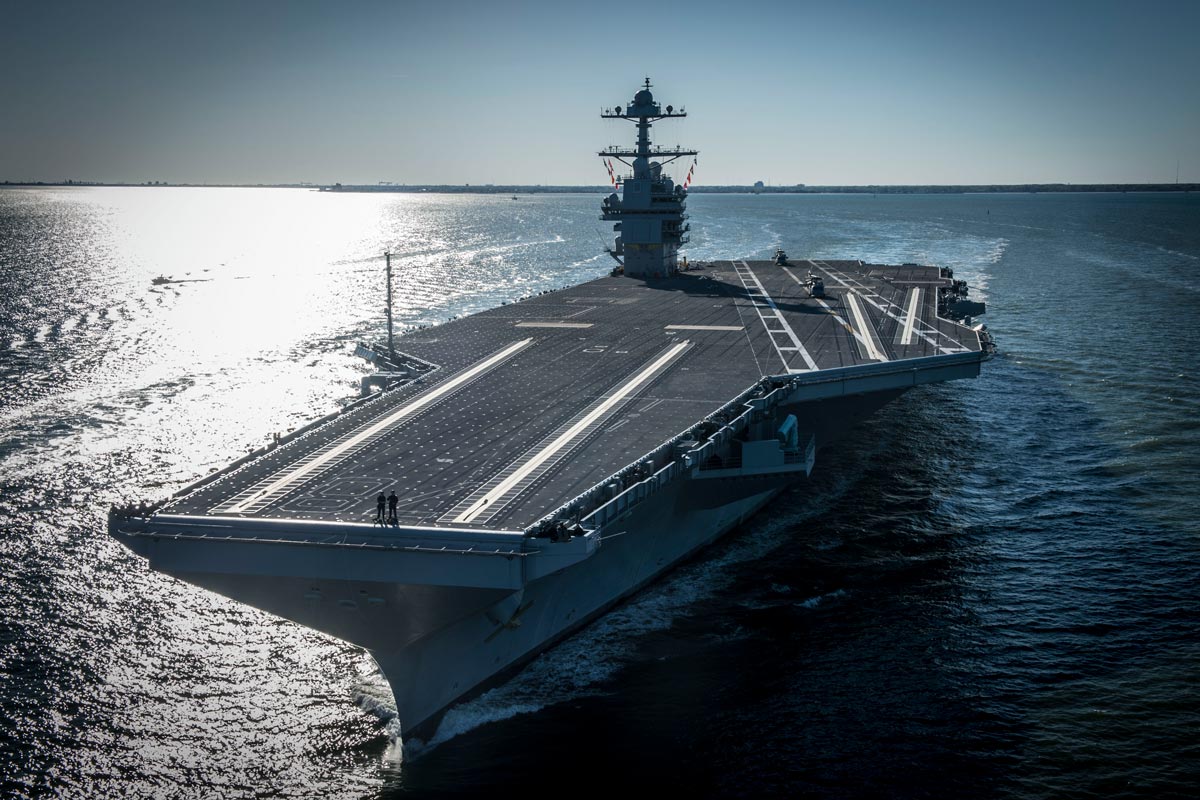
How America builds aircraft carriers
An aircraft carrier is not simply a large warship. It is a floating airfield, a nuclear power plant, a city of several thousand people, a communications hub, an arsenal, a symbol of power and one of the most complex engineering objects a modern state can build. That is why the story of USS Gerald R. Ford is interesting not only to military specialists. It shows how America creates its most ambitious technologies: expensively, slowly, with mistakes, with public criticism - and with a time horizon measured in decades.
USS Gerald R. Ford became the lead ship of a new class of aircraft carriers designed to gradually replace the legendary Nimitz-class ships. It is not simply another carrier with a new name. The Ford-class was conceived as a technological leap: more electrical power, a smaller crew, new catapults, new arresting gear, new weapons elevators, a higher sortie-generation rate and reserve capacity for future weapons and systems.
The ship, displacing around 100,000 tons, was built at Newport News Shipbuilding in Virginia, part of Huntington Ingalls Industries and the only builder of nuclear-powered aircraft carriers in the United States. The keel was laid in 2009, the ship was launched in 2013, and USS Gerald R. Ford was officially commissioned into the U.S. Navy in 2017. The cost of the lead ship exceeded $13 billion, making it one of the most expensive warships in history.
But the real meaning of the story lies precisely in that price and in those delays. Ford became an example of how difficult it is to build not merely a new ship, but a ship carrying an entire set of technologies that had never before worked together at such scale.
Why Gerald R. Ford became so complicated
At first glance, the new carrier might seem like a straightforward replacement for an older one. In practice, the U.S. Navy attempted to do far more. Instead of gradually updating individual systems, the project introduced several revolutionary technologies at once: the EMALS electromagnetic catapult, the new Advanced Arresting Gear for aircraft recovery, electromagnetic weapons elevators, a new power plant, a more complex electrical architecture and updated radar systems.
Each of these technologies was complicated on its own. Taken together, they turned USS Gerald R. Ford into a vast engineering laboratory at sea. That is why the ship encountered delays, cost overruns and a long period of refinement. In an ordinary commercial product, such a path might look like failure. In military shipbuilding, it more accurately reflects the price of trying to jump a generation in technology.
The aircraft launch and recovery systems caused especially intense debate. EMALS was designed to replace traditional steam catapults and launch aircraft more smoothly, more precisely and with less stress on the airframe. This matters not only for modern carrier-based fighters, but also for future unmanned aircraft, which may be lighter and more sensitive to launch forces. The Advanced Arresting Gear, in turn, was intended to provide more flexible and precise recovery for different types of aircraft.
On paper, the logic was clear. In practice, the new systems required a long process of debugging. They became one of the main reasons for delays, criticism and doubts over how quickly the ship could reach full combat readiness.
Energy as the main weapon of the future
One of the key differences between Gerald R. Ford and the Nimitz-class carriers is the new nuclear power plant. The two A1B reactors generate significantly more electrical power than the previous generation. For a modern aircraft carrier, this is crucial: future warfare requires not only propulsion, but enormous electrical capacity for catapults, radars, communications systems, computing centres, electronic warfare and potentially directed-energy weapons.
The Ford-class is designed for a 50-year service life. No one knows exactly what aircraft, drones, missiles, sensors and defensive systems will be needed 20 or 30 years from now. Electrical margin is therefore not a technical luxury, but a strategic insurance policy. In that sense, Gerald R. Ford was designed not only for today’s carrier aviation, but for a kind of warfare that has not yet fully taken shape.
The new power plant is also designed to operate for the ship’s entire service life without scheduled nuclear refuelling. This reduces the number of major and expensive procedures during the life cycle and should simplify operation compared with the previous generation.
A catapult without steam
The EMALS electromagnetic catapult became one of the most discussed systems on the ship. Traditional carriers used steam catapults for decades: powerful and proven, but heavy, mechanically complex and less flexible. EMALS uses a linear electric motor and allows more precise control over aircraft acceleration.
The central idea is simple: launch should be smoother and more adaptable to different aircraft types. A heavy fighter, an airborne early-warning aircraft and a future drone all require different launch profiles. An electromagnetic system potentially offers more control, less wear and a higher flight-operation tempo.
But this came at the price of complexity. EMALS was long criticized for reliability, cost and testing problems. Yet the logic of the transition remains understandable: if an aircraft carrier is expected to serve for half a century, building it entirely around yesterday’s technology would be strategically dangerous.
Weapons elevators: a small detail, a major problem
One of the most famous symbols of Gerald R. Ford’s delays became the Advanced Weapons Elevators - new electromagnetic elevators for moving munitions from magazines to the flight deck. At first, this may sound like a secondary system. In reality, without it, a carrier cannot conduct intensive combat operations efficiently.
If aircraft are the fist of the carrier, weapons elevators are part of its circulatory system. They must move munitions quickly, safely and at the right tempo to support aircraft operations. The new system promised higher speed, better safety and fewer logistical restrictions inside the ship.
But these elevators proved among the hardest systems to refine. Their delays drew criticism from Congress, the Pentagon and military analysts. The story revealed an uncomfortable but important truth: on a ship of this scale, there are no “small” systems. Any weak element can limit the capability of the entire carrier.
A new deck and a smaller crew
The Ford-class was designed not only to be more powerful, but also more efficient. The flight deck layout was revised, the island was made smaller and moved farther aft, and the internal movement of aircraft, weapons and personnel was rethought. The goal was to improve the efficiency of operations and reduce the number of people required to run the ship.
A smaller crew is an important economic idea behind the project. An aircraft carrier carries thousands of people, and the cost of their service, training, accommodation, food and support over decades is enormous. In theory, fewer crew members should reduce life-cycle costs by billions of dollars compared with the Nimitz-class.
There is, however, another side to this. The more automation and new technology a ship carries, the higher the demands on training, diagnostics, repair and technical culture. Saving on personnel does not always mean simplicity. Sometimes it means that every failure becomes more complex and requires more qualified intervention.
The air wing: from Super Hornet to the unmanned era
The core of the Gerald R. Ford air wing includes F/A-18E/F Super Hornet strike fighters, EA-18G Growler electronic-warfare aircraft, E-2D Advanced Hawkeye airborne early-warning aircraft, MH-60 helicopters and other aircraft. Over time, the F-35C and unmanned systems are expected to play an increasingly important role.
This is where the deeper logic of the new carrier becomes visible. Ford was not built only for today’s aircraft. It is meant to accommodate the aviation of the future: unmanned tankers, reconnaissance aircraft, strike drones, new aircraft and systems requiring different energy, logistics and digital architecture.
The carrier of the future will probably look less like the classic image of a deck filled only with manned fighters. It will become a mixed platform where humans and unmanned systems work together. That is why the Ford-class should be judged not only by today’s sortie rates, but also by how ready it is for the next phase of naval aviation.
An expensive ship and expensive doubts
Criticism of Gerald R. Ford was inevitable. The lead ship of the new class became extremely expensive, schedules repeatedly slipped, individual systems were not ready on time, and rising costs raised legitimate questions. Critics of large aircraft carriers argue that in an age of hypersonic missiles, inexpensive drones, satellite reconnaissance and anti-ship weapons, such ships are becoming targets that are both too large and too expensive.
There is also an economic argument. If the new carrier costs significantly more than a Nimitz-class ship, while the increase in flight-operation intensity is not proportional to the increase in price, the question becomes unavoidable: is the bet justified? Especially when one remembers that a carrier does not operate alone. It needs cruisers or destroyers, submarines, supply ships, an air wing, bases, thousands of people and an enormous daily operating budget for the entire strike group.
Supporters of aircraft carriers have their own answer. They argue that a carrier is not merely a platform for launching aircraft, but an instrument of global presence. It can arrive where there is no American base. It can send a political signal without immediately starting a war. It can provide air support, evacuation, deterrence, strike capability, reconnaissance and sea control. For the United States, whose military strategy is built around global mobility, this remains a unique tool.
Why America continues to build them anyway
Despite delays and criticism, the United States did not abandon the Ford-class. The second ship in the series, USS John F. Kennedy, is being built as the next step, while USS Enterprise and USS Doris Miller are intended to continue the class. This shows that the Navy sees the problems of Gerald R. Ford not as proof that the concept failed, but as the price of a lead ship on which solutions for the entire series are being worked out.
In American shipbuilding, the first ship of a new class is almost always difficult and expensive. It reveals errors, changes procedures, refines technologies and trains crews and contractors. The real question is not whether problems occurred. They did. The question is whether this painful experience can be transformed into more reliable and less risky follow-on ships.
For the Ford-class, that is especially important. If later carriers can be built faster, more affordably and with fewer technical surprises, Gerald R. Ford will enter history as a difficult but necessary transition. If not, critics will gain even stronger arguments against giant warships as a category.
An aircraft carrier as a mirror of the American system
The story of Gerald R. Ford reveals both the strengths and weaknesses of the American approach. The strength is the ability to attempt the nearly impossible: to build a ship combining nuclear power, electromagnetic catapults, new recovery systems, digital architecture, a vast air wing and a 50-year modernization horizon. The weakness is the price of complexity: budget overruns, delays, the gap between promises and reality, dependence on contractors and painful public criticism.
Yet that public nature is exactly what makes the story so interesting. In an authoritarian system, many such problems would simply be hidden. In the United States, they become the subject of reports, hearings, articles, investigations and political arguments. It may look messy, but it forces the system to correct mistakes and compels the military and contractors to answer uncomfortable questions.
Gerald R. Ford is not a perfect ship and not a flawless success story. It is something more interesting: an expensive, complex and controversial project that shows how difficult it is to build the future when that future must work not in a showroom, but in the ocean.
The bottom line: the price of a technological leap
USS Gerald R. Ford can fairly be criticized for cost, delays and technical problems. Those criticisms are valid. But the ship cannot be understood if it is seen only as an expensive replacement for the Nimitz-class. It is an attempt to create a carrier for a new era - an era of electromagnetic systems, drones, digital networks, enormous energy demands and warfare in which the speed of data processing becomes almost as important as the speed of the aircraft.
America builds aircraft carriers in exactly this way: on a vast scale, at high cost, with ambition, sometimes painfully, but with a 50-year horizon in mind. In that sense, Gerald R. Ford is not simply a ship. It is a bet that in the twenty-first century, the sea will remain an arena of great-power politics, and that a floating airfield with a nuclear heart will remain one of the strongest arguments of a nation accustomed to acting far from its own shores.