
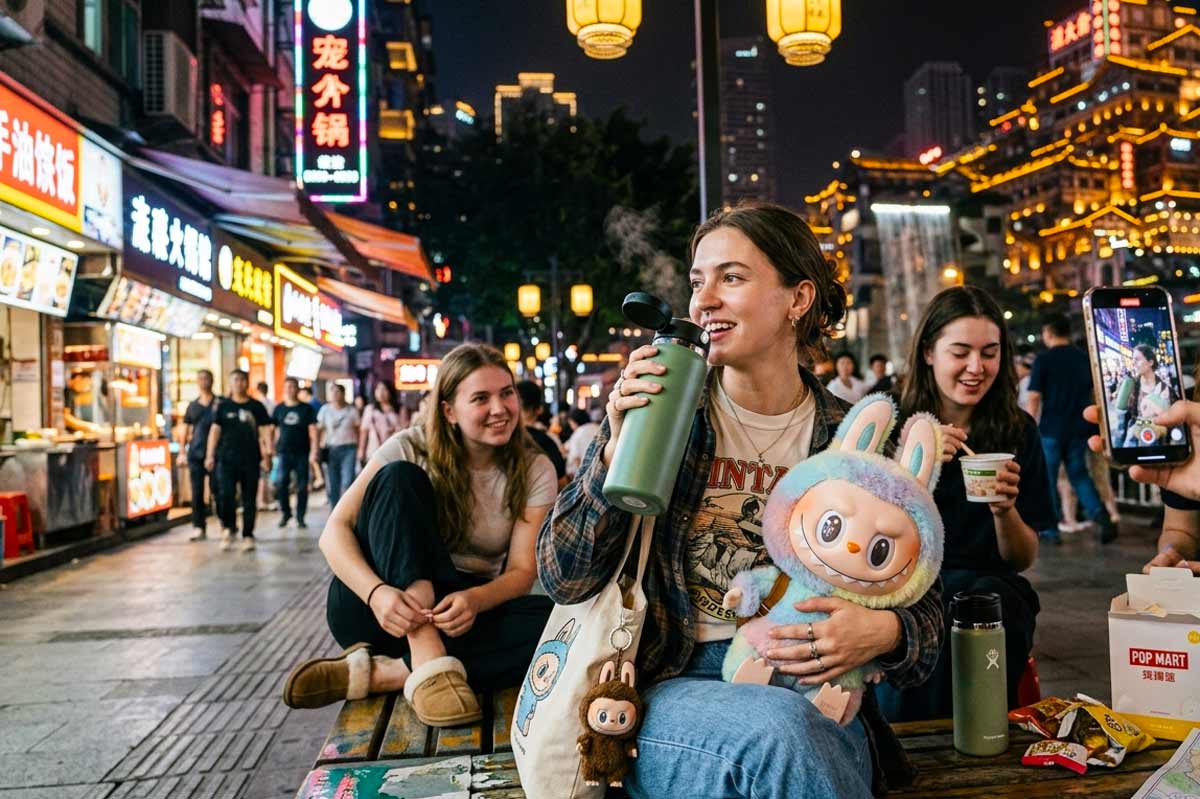
Hot Water and a Plush Monster
How China Won Over a Generation Without Even Trying
For two decades, Beijing spent real money and real diplomatic capital trying to make the world like China: language institutes on university campuses, panda loans to foreign zoos, state broadcasters translated into a dozen languages. Almost none of it stuck the way its architects hoped. Then, sometime in early 2026, American teenagers started filming themselves drinking hot water out of thermoses, captioning it you met me at a very Chinese time in my life - and did more for Chinas image in eighteen months than the state apparatus managed in twenty years. This is the story of how that happened, and what it actually reveals about both countries.
What "Chinamaxxing" Actually Is
The term borrows its back half from internet slang - "looksmaxxing," "gymmaxxing," the general online habit of taking any personal trait and optimizing it obsessively. "Chinamaxxing," also circulating under the gentler label "Becoming Chinese," describes primarily Western Gen Z users adopting or performing everyday Chinese habits: drinking hot water instead of iced coffee, wearing house slippers indoors, eating congee for breakfast, trying qigong, exploring traditional Chinese medicine, learning a few characters of Mandarin. The tone is deliberately hard to pin down - half wellness trend, half joke, half genuine curiosity, with almost every video calibrated to let the creator retreat into irony if anyone accuses them of taking it too seriously.
The specific spark traces to April 2025, when a throwaway post - "you met me at a very Chinese time in my life" - set the comedic template that would later define the genre. Chinese-American creators, most prominently Sherry Zhu, turned the joke into something more developed: half-tutorial, half-comedy videos on "becoming a Chinese baddie" that pulled millions of views by late 2025. But the trend's real accelerant was a matter of infrastructure, not content: in January 2025, facing a looming US ban on TikTok, hundreds of thousands of American users migrated overnight to Xiaohongshu - known internationally as RedNote - a Chinese social platform that had never previously had any meaningful American presence. For the first time, ordinary Americans and ordinary Chinese users were sharing the same feed, comparing rent prices, grocery bills, and daily routines in real time, unmediated by any government messaging on either side. The cross-pollination that followed did in a few weeks what two decades of formal cultural diplomacy had not: it made China feel like an ordinary place, populated by ordinary people, rather than an abstraction defined entirely by geopolitics.
The Streamer Who Made Chongqing Famous
Around the same period, American gaming streamer IShowSpeed - whose YouTube audience exceeds 55 million subscribers - toured China and broadcast genuine, unscripted amazement at what he saw: high-speed rail, night markets, and above all the neon sprawl of Chongqing, a mountain city whose layered highways and vertical architecture have earned it a reputation as China's real-life cyberpunk capital. His streams turned Chongqing into a bucket-list location almost overnight. A cottage industry has since formed around a specific piece of content: tourists riding on the back of a motorcycle through the city's night streets, filmed by a second rider carrying a stabilized camera, usually along the glittering waterfront strip of Nanbin Road. Packages typically run 400 to 700 yuan, or roughly $55 to $100, and no motorcycle license is required - only a willingness to sit still and look amazed. The volume of visitors backs up the online buzz: Chongqing recorded more than 760,000 foreign visitors in 2025, and in the first three months of 2026 alone, foreign arrivals through its airport were up 106 percent year-over-year.
The Toy That Did What State Media Couldn't
If Chongqing supplied the backdrop, a small toothy plush monster supplied the object everyone actually wanted to hold. Labubu was created in 2015 by Kasing Lung, a Hong Kong-born artist raised in the Netherlands, drawing on Nordic folklore he'd read as a child. Hong Kong-based collectible company Pop Mart licensed the character in 2019 and sold it inside sealed "blind boxes" - packaging that conceals which specific variant is inside until purchase, turning every transaction into a small gamble. For years it stayed a niche collector's item. Then, in 2024, BLACKPINK's Lisa posted a Labubu keychain to her audience of well over a hundred million followers, and the character crossed over completely. By 2025, Rihanna, Dua Lipa, and Kim Kardashian were all photographed with Labubus clipped to designer handbags, and in March 2026, Paris Fashion Week hosted a dedicated retrospective exhibition on the character, following earlier runs in Shanghai, Taipei, and Hong Kong.
The commercial numbers are genuinely startling. Pop Mart's full-year 2024 revenue roughly doubled to $1.8 billion; in 2025, revenue nearly tripled again to 37.12 billion yuan - about $5.4 billion - with net profit up 308 percent year-over-year. Markets outside mainland China, once a rounding error for the company, became central to that growth: North America alone posted quarterly sales gains exceeding 1,000 percent year-over-year at points in 2025, and by year's end Pop Mart operated more than 630 stores globally across roughly 20 countries, with London newly designated its European headquarters. A Harvard researcher, commenting to CNN, made the point plainly: small, seemingly disposable cultural objects like Labubu - alongside Chinese video games and animated films - are doing more to reshape Western perceptions of China than any formal messaging campaign.
Labubu wasn't traveling alone. Black Myth: Wukong, a 2024 action game built on the classical Chinese novel Journey to the West, became one of the fastest-selling titles in gaming history. Ne Zha 2, an animated feature drawing on the same mythological tradition, opened in early 2025 and went on to earn roughly $2.6 billion worldwide - enough to overtake Inside Out 2 and land among the five highest-grossing films ever made, entirely on the strength of Chinese and diaspora audiences before its Western release even landed. Domestically, all of this dovetails with guochao - literally "national wave" - a movement in which young Chinese consumers deliberately favor homegrown brands and traditional aesthetics over Western labels, a shift usually dated to Chinese sportswear brand Li-Ning's 2018 New York Fashion Week show built around Daoist-inspired, red-and-gold streetwear. That same aesthetic has since gone the other direction: Adidas built an entire New Chinese Style collection around Tang-dynasty motifs - mandarin collars, knot buttons, jade detailing - for Lunar New Year 2026, unveiled at Shanghai Fashion Week before rolling out to European stores that February.
Why the Old Playbook Never Worked
What makes the current moment genuinely strange is that it arrived through channels Beijing didn't design and, for the most part, doesn't control - after decades of trying to engineer exactly this outcome through official means. Starting in the early 2000s, China built a formal soft-power apparatus modeled loosely on the British Council or Goethe-Institut: Confucius Institutes attached to foreign universities, offering Mandarin classes, cultural programming, and study-abroad scholarships in partnership with host institutions. The network grew to roughly 500 centers worldwide between 2004 and 2015, peaking around 2018 with more than 100 operating in the United States alone. Then the politics caught up with the model. The US State Department formally designated the Confucius Institute US Center a "foreign mission" of the Chinese government, Congress restricted federal funding to universities hosting the institutes, and the first Trump administration publicly pushed for further restrictions, citing concerns about political influence on campus and national security. No court or investigation ever established espionage or a documented security threat - but the reputational damage was sufficient, and the vast majority of US-based institutes closed within a few years.
The deeper lesson is structural, not just political: a soft-power tool that's visibly run by a government inevitably reads as propaganda the moment it's scrutinized, no matter how genuinely cultural its content. A stuffed toy carried by Rihanna doesn't have that problem, because nobody designed it to persuade anyone of anything - it just happened to be irresistible, and persuasion arrived as a side effect rather than a strategy.
A Mirror as Much as a Window
Several researchers who study Chinese soft power argue the trend is doing two things simultaneously, and that's precisely what makes it effective. One academic who studies the phenomenon has described it as operating on two tracks at once: content that highlights American institutional dysfunction weakens confidence in the US narrative, while parallel content showcasing Chinese infrastructure and daily life makes the country look more attractive by direct comparison. Much of the online commentary supports this reading directly. Footage of spotless, punctual high-speed rail isn't simply a transit review - for a generation that has spent its adult life watching American institutions visibly strain, it functions as an implicit verdict. Multiple Gen Z creators have described their embrace of Chinese wellness habits in openly political terms, framing something as small as drinking rice porridge as a quiet protest against a home system perceived as indifferent to ordinary people's health and stability. Pew Research polling backs up the generational split: American adults under 34 consistently view China far more favorably than those over 50 - the first time in decades that assessment of a geopolitical rival has broken so sharply along generational rather than partisan lines.
The Pushback
None of this has gone uncontested, including from people with the most direct stake in the culture being borrowed. Members of the Chinese diaspora across North America, the UK, and Australia have described the trend, almost unanimously, as jarring - sometimes worse. A British food writer noted that being instructed on Lunar New Year customs by creators with no lived connection to the holiday felt like a direct challenge to her own identity, and other diaspora voices have gone further, framing the whole phenomenon as Orientalism wearing a friendlier outfit: an ancient, textured civilization flattened into a wellness aesthetic, consumed and then likely discarded once the algorithm moves on. Skeptics inside academic China-watching circles raise a related but distinct concern - that much of what's being romanticized is a highly curated, largely urban, upper-middle-class version of Chinese life that has little overlap with the daily experience of the roughly one-third of China's workforce employed in migrant, delivery, or construction labor. The comparison some critics reach for is pointed: it's not unlike a Western fascination with castles and knighthood that quietly imagines the viewer as nobility rather than as the much larger population who actually worked the land.
What Actually Moved
Strip away the memes, and there's a harder economic story running underneath all of it. China's 2025 trade surplus hit a record $1.2 trillion - 20 percent above the previous year's already-large figure - even as exports to the United States fell sharply under tariff pressure, because Chinese manufacturers simply redirected that volume toward Africa, Southeast Asia, Latin America, and Europe instead. Consumer brands have followed the same trajectory from anonymous manufacturing to recognizable identity: coffee chain Luckin has expanded aggressively against Starbucks' home turf, bubble-tea chain Chagee took its 30-year-old founder to billionaire status on the strength of a Nasdaq listing, and retailers like Miniso and Urban Revivo are increasingly marketed as Chinese by name rather than disguised as something else. China now sits in second place on the 2026 Global Soft Power Index, trailing the United States by the narrowest margin on record for that ranking.
Whether Chinamaxxing itself has staying power is almost beside the point. Fast-moving internet trends cool by design - some of the researchers who study it expected exactly that, and Pop Mart's own stock dropped sharply in early 2026 on investor doubts about whether Labubu-level demand is sustainable long-term. What looks durable is the underlying shift it exposed: a generation of young Westerners who no longer treat China purely as a geopolitical abstraction to be feared or managed, but as an ordinary place, worth being curious about on its own terms - for better or worse, exactly the outcome twenty years of government messaging never quite managed to produce.