
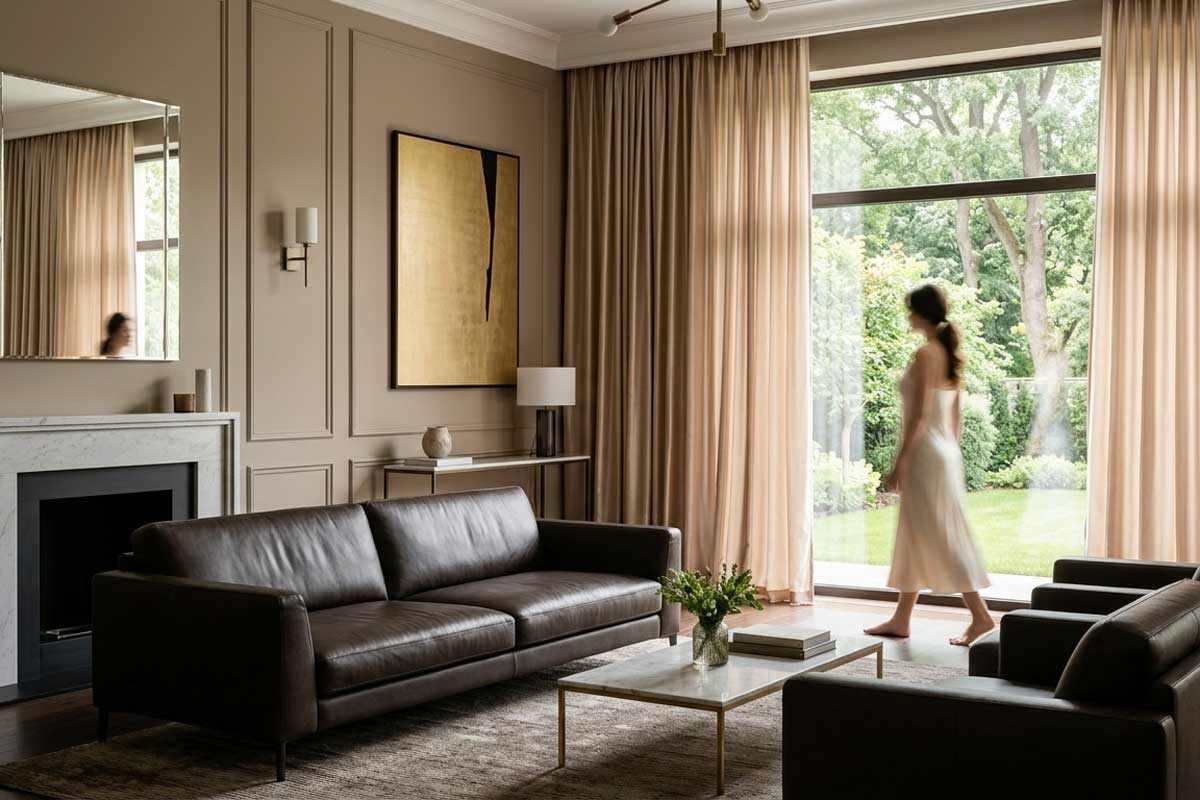
Elegant Luxury: How Neoclassicism Works Today
Some styles flare quickly and date just as fast. Others outlast trends - changing with time but never losing their internal composure. Neoclassicism belongs firmly to the second category. It is not an interior that tries to astonish the moment you walk in. Its purpose is different: to create a space where order, proportion, light, and materials converge into a sense of quiet, assured beauty. That quality - the ability to feel simultaneously classical and thoroughly alive - is what makes it one of the most enduring design languages available. And one of the most demanding to execute well.
Why It Lasts
The durability of neoclassicism comes from its foundations. It does not rely on dramatic gestures that enter fashion and exit just as suddenly. It rests on things a person registers almost intuitively: symmetry calms, rhythm organizes a room, the right molding makes a wall feel architectural, and good proportions make a space read as more expensive than its budget - without an excess of decoration.
Historically, neoclassicism grew from a desire for clarity, discipline, and noble restraint - a countermovement against the exuberance of what came before it. In the contemporary interior, that logic still holds, expressed now in a quieter, more livable register. The style is not trying to recreate a palace. It is trying to make a home feel considered.
But this is precisely where the first misunderstanding arises. The word "neoclassical" is applied to a very broad range of interiors, many of which have little to do with the real thing. For some people it means white walls with crown molding and a chandelier. For others, American traditional with panel-front cabinetry. For others still, minimalism to which someone has added a coffered ceiling. In practice, good contemporary neoclassicism is not a collection of borrowed elements - it is a precisely held balance between classical order and modern comfort. Lose that balance and the interior either becomes a heavy-handed period costume or a random assemblage that someone simply draped in trim.
This Is a Style of Architecture, Not of Objects
The most important thing to understand about neoclassicism: it does not begin with a sofa, a curtain, or a door handle. It begins with the architectural logic of the room. With a wall that looks resolved. With an axis around which the space organizes itself. With a correct center of gravity. With the rhythm of openings, light, and furniture in relation to each other.
This is why neoclassicism almost always looks better in spaces that have a degree of breathing room. Not palace proportions, but at least the sense that a room has room. In smaller apartments, the vocabulary can be used - but as a language of individual gestures rather than a comprehensive style. Otherwise, decorative lines, cornices, panel frames, heavy fixtures, and dense textures stop enhancing a space and begin fragmenting it. Instead of nobility, the result is visual noise.
Good neoclassicism does not overload. It works differently: it removes the accidental. It makes an interior feel composed. It disciplines the eye. This is why symmetry and compositional structure matter so much - not as academic dogma but as a way of creating the sensation of inner order. In a living room, this center might be a fireplace, a console, a large mirror, or a seating group. In a bedroom, the bed and symmetrically placed bedside lamps. In a dining room, the table and the light above it. When a room has no compositional center, neoclassicism simply falls apart.
Why This Style Almost Always Costs More Than It Looks
One of the most dangerous illusions is to think of neoclassicism as a safe, straightforward style. In photographs it appears simple: calm colors, familiar forms, a degree of detailing, fine fabrics, large mirrors, soft light. In practice it is one of those interiors where errors in execution are extremely visible.
Neoclassicism rarely forgives cheap compromises. This is not primarily about the cost of marble or solid wood as raw materials. It is about the difficulty of execution. Flawless painted surfaces. Moldings that hit the correct proportions of a wall rather than subdividing it arbitrarily. Cornices that read as architecture rather than decorative adhesive strips. Millwork in which door fronts, baseboards, casings, and wall panels speak the same language. Light fixtures that do not argue with the furniture. Fabric that does not read as stagecraft.
This is why neoclassicism so frequently fails when executed on a constrained budget - not because it cannot be done for moderate money, but because it requires discipline. Where minimalism can sometimes win on honest simplicity, neoclassicism almost always requires quality of craft. It costs more not only in materials but in the number of precise decisions that must be made correctly.
Lighter Is Not Better
Another common error: reducing neoclassicism to an endless range of white, beige, and grey-cream. This approach is understandable - a neutral palette feels safe, photographs well, and doesn't conflict with furniture. But these are precisely the interiors that now most often look exhausted. Design media has tracked a steady departure from sterile neutrality toward more complex, inhabited classical interpretations for several seasons.
True neoclassicism is not required to be colorless. It welcomes soft stone, cream, smoky green, tobacco, grey-blue, burgundy, ochre, and chocolate tones. The question is not brightness but depth. Color here should not declare itself - it should function as the background for form and light.
In practice, this resolves to a simple principle: one complex tone is better than three characterless ones. A warm grey-olive is better than another round of "safe greige" that looks expensive only in a rendering. A dark, library-toned bedroom with the right lighting is better than another infinitely pale room with nothing for the eye to hold onto.
Materials: Not Luxury for Its Own Sake, but Tactile Honesty
Neoclassicism responds well to materials that age beautifully. Wood, stone, matte metal, linen, wool, velvet, quality paint, good plaster, brass, glass. This does not mean everything must be natural and exorbitantly expensive. Contemporary composites and engineered surfaces can be genuinely convincing. But honesty matters: the imitation must not only "resemble" - it must hold the overall level of the space.
People often economize in the wrong places. They buy highly decorated furniture but install cheap doors. They hang a beautiful chandelier but cut corners on baseboards and casings. They put a marble slab on the kitchen island and place weak hardware beside it. In neoclassicism, this becomes visible quickly, because the style is held together not by a single impressive object but by the coherence of its level throughout.
When a space is modest in scale, the right move is to simplify the material palette rather than try to compensate with more. One good wood tone, a calm matte paint, textile without excess sheen, considered light fixtures, and one or two genuinely strong accents will almost always produce a more distinguished result than chasing the appearance of pseudo-luxury.
Furniture: Fewer Pieces, More Presence
Perhaps the most underappreciated quality of contemporary neoclassicism is its compatibility with restrained furniture. The style does not require comprehensive period styling. On the contrary - it is at its most convincing when a classical architectural backdrop meets cleaner, more contemporary silhouettes.
This is why a well-resolved project can comfortably hold moldings alongside a severe sofa, an antique mirror, a modern side table, and an abstract painting. Neoclassicism learned long ago to live with something other than damask and carved commodes. Moreover, too literal a period recreation almost always reads as weaker than a considered tension between old and new.
This is one of the most useful conclusions for a home in Canada: if the architecture is contemporary - large windows, open plan, an active kitchen, a family room, daily real-life use - there is no point in trying to impersonate a Parisian salon or an old European manor. An interior that acknowledges contemporary life while maintaining classical posture is always more compelling than one that performs history it has no actual connection to.
Light as the Primary Indicator of Quality
In neoclassicism, light is not a technical function - it is part of the architecture. It is what makes an interior feel resolved, layered, and different in the evening from what it is by day. For this reason, a single overhead chandelier almost never works alone. Wall sconces, table lamps, task lighting, floor lamps - sometimes a soft concealed source - all have roles to play. But without the technological spectacle and without excessive demonstration of the lighting plan itself.
The principle is this: light should support the rhythm of the space. Paired sconces flanking a mirror. Lamps to either side of a sofa. Symmetry in the bedroom. Warm local light that makes wall paneling and surface textures legible in the evening. This is what produces the sensation of quiet luxury that a single expensive chandelier, however beautiful, cannot deliver on its own.
Decoration: Not Volume, but Precision
Neoclassicism welcomes decoration but cannot survive decorative hysteria. It responds to large mirrors, works on paper, painting, sculptural objects, fine ceramics, books, consoles, trays, and classical frames. But quantity does not function here as it does in eclectic design. The more small objects, the higher the risk of dismantling the architectural clarity on which everything depends.
The simplest guiding principle: if an object adds no weight, rhythm, or meaning to the room, the room does not need it. Neoclassicism is one of those styles where empty space frequently works harder than one more beautiful thing.
Textile: The Layer That Makes It Livable
Textile is what most often saves neoclassicism from coldness and turns it into a home. Curtains, rugs, upholstery, decorative cushions, throws - this is the layer where a style becomes domestic or remains too staged.
In a well-considered interior, textile does not compete with the architecture - it softens it. It does not have to be heavy or ceremonious. Often it is precisely lighter fabrics, natural textures, and a restrained pattern that make a space read as more refined. The error is trying to "complete" the style with excessively formal drapery when everything else in the room is contemporary. Textile should tie an interior together - not impose a costume on it.
Why Neoclassicism Still Matters
Despite all the discussion of new minimalism, organic modern, and technology-forward interiors, neoclassicism has not gone anywhere. And not merely out of habit. It continues to answer a very human need - to live in a space that feels stable, composed, and culturally considered.
We tire of interior transience as we tire of fashion transience. Of relentless updating. Of things that feel dated three years after they were new. Neoclassicism survives precisely because it does not build itself on novelty at any cost. It builds itself on the idea that a home can be calm, beautiful, and adult simultaneously.
Good neoclassicism is not molding for the sake of molding, not a neutral-beige backdrop deployed for "an expensive look," and not an attempt to perform a historical theater that has no genuine context. It is a style about the discipline of space, the understanding of proportion, the honesty of materials, and an inner confidence that does not require ostentation.
This is why neoclassicism continues to work. Real elegance rarely looks sharply fashionable. It simply remains appropriate.