The new language of the era
Why memes have become the art of fast meanings
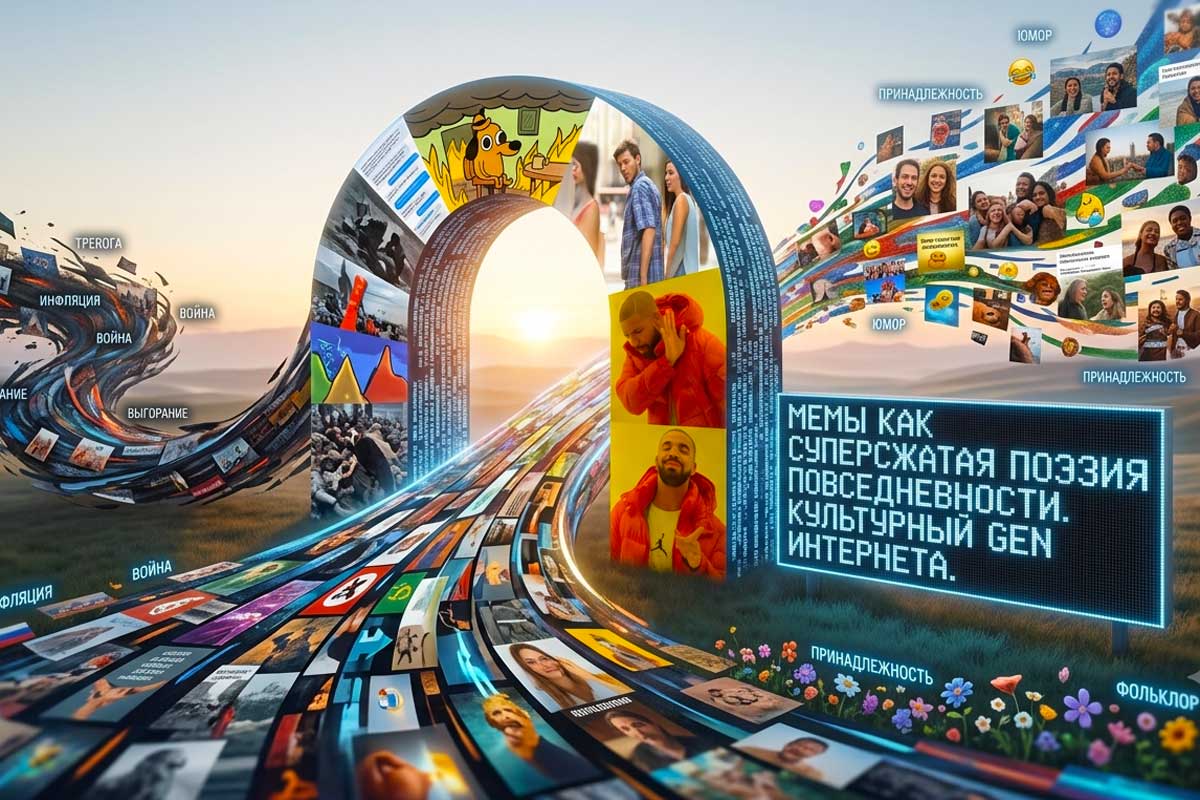
Memes stopped being just funny pictures a long time ago. Today they are the language through which society speaks about anxiety, politics, work, war, inflation, relationships, burnout, the absurdity of daily life, and the helplessness we feel scrolling through the news. Sometimes a single meme conveys what a paragraph of ordinary prose cannot. Sometimes it lands more precisely than a column, more gently than a therapist's formula, faster than any editorial cartoon. In an era of information overload and emotional exhaustion, the meme has become the defining artistic form of our time.
From Cultural Gene to Internet Shorthand
The word "meme" predates social media by decades. In 1976, British evolutionary biologist Richard Dawkins coined it in his landmark book The Selfish Gene to describe a unit of cultural transmission - an idea, a melody, a habit, a phrase, a fashion, a behavior that spreads from person to person, copies itself, mutates, and survives in the cultural environment much as genes do in the biological one. The internet later borrowed the word and narrowed it to what we know today: images, videos, phrases, and templates that people copy, remix, and circulate.
But the core Dawkinsian insight survived the translation. A meme lives only when it is repeated. It does not belong permanently to its creator. It mutates. It is appropriated, translated, localized, improved, misused, stripped of one context and dropped into another. This is precisely why memes so closely resemble modern folklore. Like a joke or a proverb, a meme in public consciousness often has no single "correct" owner. Its value lies not in originality as a museum object but in its capacity to become raw material for collective creativity.
Most memes do have real authors, and that matters. "This Is Fine" - the cartoon dog sitting calmly at a table while his room burns around him - did not emerge from anonymous void. It was born on January 9, 2013, as part of artist KC Green's webcomic series Gunshow, in a strip called "On Fire." A year later, its first two panels went viral on Reddit. The internet did what it does with powerful images: it severed the dog from its original storyline, turned him into a universal symbol, and sent him into independent cultural life. He became shorthand for denial in the face of catastrophe - and the caption "this is fine" became, as The Verge put it, a shorthand for when a situation becomes so terrible our brains refuse to grapple with its severity.
Memes as the New Poetry of Everyday Life
The claim that memes resemble poetry may sound overblown. But structurally, it holds. A good meme works not through direct explanation but through compression of meaning. It binds image, text, tone, cultural memory, and the viewer's own situation into a single charged moment.
Poetry often says more than what is literally written. The meme does the same thing in a different aesthetic register. It relies on implication, recognition, rhythm, repetition, contrast, and the subversion of expectation. Explain a meme too thoroughly and it dies - exactly like a joke, exactly like a well-placed metaphor.
In this sense, a meme is not a simplification of thought but its most compressed form. Think of it as an emotional and cultural ZIP file: open it, and inside is an entire archive of context. "Distracted Boyfriend" is not merely about infidelity - it is about the seduction of novelty, the betrayal of old commitments, consumer culture, political promises, and any moment when a person abandons what matters for what glitters. The Drake approval meme became a universal grammar of choice. "Woman Yelling at a Cat" became the perfect staging of any argument where one side is operatic and the other is baffling. These are not just images. They are syntax.
First Power: Memes Name What We Can't
Many states of modern life resist easy labeling. This is not simply tiredness, not simply anxiety, not simply irony, not simply anger. It is a compound: news fatigue, the awkwardness of a text left on read, passive aggression in an open-plan office, the strange joy of a cancelled plan, the horror of a burning world glimpsed while choosing a font for a slide deck.
Memes give these states a shape.
When someone encounters a meme that nails their exact experience, they feel a small, specific relief: so it's not just me. So this can be seen from the outside. So this can be survived through humor.
In a culture where most emotions are either pathologized or reframed as productivity problems, memes allow people to speak about fragility without confession. You don't need to write a long post about experiencing a diffuse anxiety of diminishing control against a backdrop of global uncertainty. You send an image. And those who share the code will understand.
For Russian-speaking communities in North America, this is particularly resonant. Immigration, working in another language, nostalgia, cultural translation, the gap between there and here, conversations with relatives living in a completely different reality, the effort to explain Canadian social logic to people formed by post-Soviet instincts - all of this has long lived in memes. They become a way of processing experience for which no official language yet exists.
Second Power: Memes Create Belonging
A meme always asks: are you in or out? Do you get the reference? Do you recognize the format? Do you hear the tone? Do you know why this is funny right now?
This is why memes function as passwords. They build micro-communities. There are professional memes for doctors, designers, programmers, accountants, real-estate agents, students, parents, immigrants, drivers, fans of a specific show, residents of a specific city. The more precise the meme, the stronger the sensation of this is about us.
In this sense a meme is not just a joke - it is social adhesive. It connects people through shared experience even when they will never meet. It lets a group see itself. Sometimes gently. Sometimes brutally. Sometimes with love. Sometimes with a precision that feels almost cruel.
This is why brands want so badly to speak in memes. A meme seems like a shortcut to intimacy: joke like an insider and the audience warms to you. But the risk is real. Memes have a low tolerance for inauthenticity. When a corporation deploys internet language too late, too sanitized, or too obviously transactional, the effect inverts: the audience senses that living folklore has been turned into an advertising banner. The authentic meme grows from inside a culture. It cannot simply be added to a content strategy without the risk of looking like an adult trying to use teenage slang at a school dance.
Third Power: Memes Are Built to Be Remixed
The virality of a meme rests not only on its being funny. It rests on its being appropriable. The best memes are not finished works - they are templates. They are invitations to participate.
The same format can be applied to politics, family life, business, sports, education, immigration, fashion, medicine, technology. The simpler the structure and the wider the emotional situation it captures, the longer the meme lives.
This distinguishes a meme from an ordinary joke. A joke gets retold. A meme gets reprocessed. It doesn't just spread - it multiplies through variation.
This is why memes respond to breaking news so quickly. Something happens, and within minutes the first versions appear. Within hours come local adaptations. Within a day, format fatigue sets in. Within a week arrive the meta-memes - jokes no longer about the event itself but about everyone being exhausted by jokes about the event. Contemporary internet culture lives in a frantic cycle of birth, mutation, and burnout. Memes are its nervous system.
Why Memes Sometimes Beat the News
News reports a fact. A meme shows the emotional experience of that fact.
This is why memes are especially powerful in moments of crisis. Pandemic, elections, wars, inflation, artificial intelligence, mass layoffs, climate anxiety - all of these generate not only an information flood but an emotional overload. Memes allow society to process that overload through humor, sarcasm, and collective recognition.
This does not mean memes replace journalism or analysis. They are not required to be accurate, balanced, or fair. But they register the mood faster than long-form writing. Sometimes a meme becomes a cultural document of an era - not because it explains an event but because it shows how people lived through it.
A future historian studying the 2020s will likely read not only official documents and newspaper archives but memes as well. Because in them lie the fears, the irritations, the hopes, the cynicism, the exhaustion, the political fractures, and the sense of the absurd that rarely makes it into formal reports.
The Dark Side: Memes as Weapons
Memes carry not only poetic but political force. They can mock power, sustain protest, expose hypocrisy, give marginalized groups a language of their own. But they can equally spread hatred, propaganda, conspiracy theories, dehumanization, and manipulation.
The meme is convenient for influence precisely because it appears not to be serious. It can always be defended with: it's just a joke. But a joke also shapes norms. When an image is repeated thousands of times, it cements an association. When a group is consistently represented as ridiculous, dirty, dangerous, or subhuman, that is no longer merely humor. That is cultural conditioning.
In this sense memes have become part of information warfare. As researchers and journalists covering the 2016 U.S. election documented extensively, political campaigns, state actors, bots, and "meme factories" understood early that an image with the right emotional charge can bypass rational defenses faster than a long argument. The Russian Internet Research Agency used memes specifically to deepen social fractures along lines of race, identity, and political affiliation. During the 2024 U.S. presidential election, AI-generated memes were deployed by multiple sides as attack instruments.
This is why mature media literacy must teach not only how to spot fake news but how to read memes: who makes them, who benefits from their spread, what emotion they are designed to trigger, whom they make laughable, whom they make into an enemy, and whom they make into one of us.
The Engineered Meme vs. the Living Folklore
Not long ago, memes seemed like the chaotic output of folk creativity. Today they are increasingly designed. Marketers analyze formats. Political strategists test reactions. Brands hire social media teams. Generative AI now enables the rapid production of endless variations.
This does not mean an engineered meme cannot go viral. It can. But audiences often sense the difference between a living joke and manufactured content. The living meme emerges from observation, pain, absurdity, precise recognition. The manufactured one tends to smell like an assignment: increase engagement, move a product, soften a reputational crisis, plant a useful association.
The internet loves spontaneity; platforms love manageability. Between these two forces modern meme culture evolves. And the most interesting thing is that control remains impossible. A brand can seed a template, but users will remix it against the brand. A politician can try to seem relatable and become a punchline instead. A serious advertising image can be stolen and turned into parody. This is the democratic nerve that memes have preserved: the user is never only a consumer. The audience can always take back the microphone.
Why Adults Shouldn't Dismiss the Meme
Older generations are often tempted to write memes off as the juvenile debris of the internet. This is a mistake. Memes are not the degradation of culture - they are its transformation. Yes, there is plenty of noise, aggression, crudeness, and repetition among them. The same can be said of television, newspapers, film, literature, and every other form of mass communication.
The question is not whether all memes constitute art. Of course they don't. The question is whether a meme can be art, social commentary, a form of thinking, and a diagnostic tool for a culture. The answer is yes.
Memes show us how the contemporary person compresses experience. How they reach for irony when control is gone. How they look for their people. How they handle overload. How they make beauty out of absurdity and meaning out of fragments of pop culture.
When a society begins to speak in images, templates, reactions, and compressed visual formulas, this does not signal the end of thought. It signals the emergence of a new rhetoric - and one worth taking seriously.
Memes became the dominant artistic language of the internet because the contemporary world needs a fast, flexible, and collective form of expression. They give names to complex feelings. They create belonging. They mutate freely. They mock power and sell products. They console and destabilize. They unite and divide. They often look foolish, but they frequently land more precisely than long deliberation.
A great meme is not just a captioned image. It is a small cultural scene where humor, pain, context, recognition, and participation converge. You cannot fully explain it without losing the effect - just as you cannot fully paraphrase a poem without losing the rhythm.
And perhaps this is exactly why memes describe our era so well. We live in a world of too much information, too little time, and too many feelings that don't fit into ordinary words. Memes don't solve that problem. But they allow us, at least for a moment, to turn the chaos into form - and send it to someone who will understand.