
The Bar Myth
The Physics of a Perfect Espresso Shot
Every home espresso machine sold today boasts about its bars of pressure - 15, sometimes 19 - as though pressure alone were the secret to a great shot. It isn't, and the real history of that number is stranger than the marketing suggests: the industry standard everyone chases, 9 bars, wasn't derived from careful scientific calculation at all. It was an accident, born from the mechanical limits of a spring in 1940s Turin, that happened to work so well nobody's ever seriously replaced it. And the dial that actually decides whether your morning shot tastes sour, balanced, or bitter isn't pressure at all - it's something so small you can barely see it.
An Accident in a Turin Hotel
Espresso's real origin story starts with impatience, not flavor. In 1884, a hotel and café owner named Angelo Moriondo, tired of customers waiting minutes for filter coffee, patented the first machine that forced steam-pressurized water through grounds to speed things up - at roughly 1 to 2 bars, a fraction of what modern machines use, producing a bitter, scorched drink with no trace of crema. For decades afterward, engineers tried and failed to push past that pressure ceiling without burning the coffee; Milanese inventor Luigi Bezzera added the portafilter and multiple brew heads still recognizable today, and by the early 1900s these steam machines were fast - pumping out roughly a thousand cups an hour - but the coffee itself remained harsh.
The real breakthrough came from Achille Gaggia in the mid-1940s, and it was mechanical necessity rather than flavor science that drove it. Gaggia built a spring-loaded lever mechanism: a barista pulled the handle down to compress a large spring and let hot water into a chamber, then released it, letting the spring's stored tension force water through the coffee puck at somewhere between 8 and 10 bars - several times more pressure than any prior machine had achieved. Almost as a side effect, that pressure emulsified the coffee's natural oils into a golden foam nobody had seen before. Gaggia called it crema caffè, and modern espresso, in the form we'd actually recognize it, was born.
The number nine specifically became gospel in 1961, when engineer Ernesto Valente introduced the Faema E61, the first machine to use an electric pump instead of a barista's arm, delivering a constant, repeatable 9 bars shot after shot without the human variability of a spring and a lever. It worked, cafés standardized around it, and nine bars has remained the reference point ever since - not because anyone calculated it was mathematically optimal, but because it happened to sit at what engineers now describe as the peak of the flow curve: below nine bars, water finds the path of least resistance and channels around the coffee rather than through it; above nine, the pressure itself compacts the grounds into a cake dense enough to choke the flow. Nine bars simply turned out to be the sweet spot a 1940s spring accidentally discovered.
The Fifteen-Bar Lie
Walk into any big-box electronics store and you'll find home machines proudly advertising 15 or even 19 bars of pump pressure, implying - deliberately - that more must mean better. It doesn't, and the reason is a distinction manufacturers rarely explain: pump pressure and brew pressure are not the same number. Commercial machines use rotary pumps, heavy, quiet motors that generate a steady, precisely regulated pressure delivered straight to the coffee. Nearly every home machine under a couple thousand dollars instead uses a cheaper vibratory pump - a magnet and coil rapidly buzzing a piston back and forth, capable of generating far more raw pressure than any espresso puck actually needs. To keep that excess pressure from ruining the shot, these machines include an overpressure valve that bleeds off everything above roughly 9 bars before the water ever reaches your coffee. The "15 bar" printed on the box describes what the pump is mechanically capable of producing, not what actually hits your grounds - which, on a properly functioning machine, is still 9 bars, exactly as it's been since 1961. Higher pressure ratings are, in practice, a specification that exists to be thrown away by the machine's own safety valve.
The Dial That Actually Runs the Show
If pressure is largely a solved, standardized variable, the thing that genuinely determines whether your shot tastes sour, balanced, or bitter turns out to be almost embarrassingly small: the setting on your grinder. At nine bars, the physical resistance of the packed coffee puck - set almost entirely by how finely it's ground - is what controls how fast water can move through it and how long the extraction actually takes. A single click on a quality burr grinder shifts the gap between the burrs by a fraction of a millimeter, changing the resulting particle size by only a few microns - and that microscopic adjustment is enough to shift your shot time by three to seven seconds and swing the final cup from sour to perfectly balanced to bitter. No other variable in espresso responds this violently to this small an input; a one-degree change in water temperature produces a noticeably smaller and slower effect by comparison. This is the genuinely underappreciated fact about home espresso: people spend hundreds of dollars chasing pump pressure and pre-infusion features while the actual lever with the most control over their morning cup is a knob they might adjust once and never touch again.
The mechanism behind that sensitivity is straightforward once you see it: finer grounds create more surface area, which lets water extract flavor compounds faster and more thoroughly - up to a point. Grind too fine, and the packed bed becomes so dense that water can barely force its way through at all, over-extracting the compounds it does reach and pulling out the bitter, astringent notes that show up when a shot runs too slow. Grind too coarse, and water rushes through too quickly, extracting too little - the sour, thin, underdeveloped taste of a shot that ran too fast. The target window professionals actually watch for is a 25-to-30-second pour with a golden-brown, elastic crema on top; if your shot consistently misses that window in either direction, the grinder, not the machine, is almost always the actual problem.
Temperature's Quieter, Chemical Role
Water temperature matters too, though its effect is gentler and operates through simple chemistry rather than mechanical resistance. Espresso machines generally run somewhere between 88 and 96 degrees Celsius, and within that window, temperature primarily governs how readily different flavor compounds dissolve. Caffeine is a useful example: it's only modestly soluble in cold water, but its solubility increases roughly a hundredfold as water approaches boiling, which is a meaningful part of why a properly pulled espresso shot delivers such a concentrated hit of both flavor and caffeine from so little water and so little time. Push the temperature too high and you start dissolving compounds that taste bitter and burnt rather than sweet and rounded; too low, and the shot tastes flat, sour, and underdeveloped no matter how well the grind is dialed in. It's a real variable, but a forgiving one - a one-degree shift changes the cup far less dramatically than a single click of the grinder does.
Reading the Cues: Crema, Flow, and Channeling
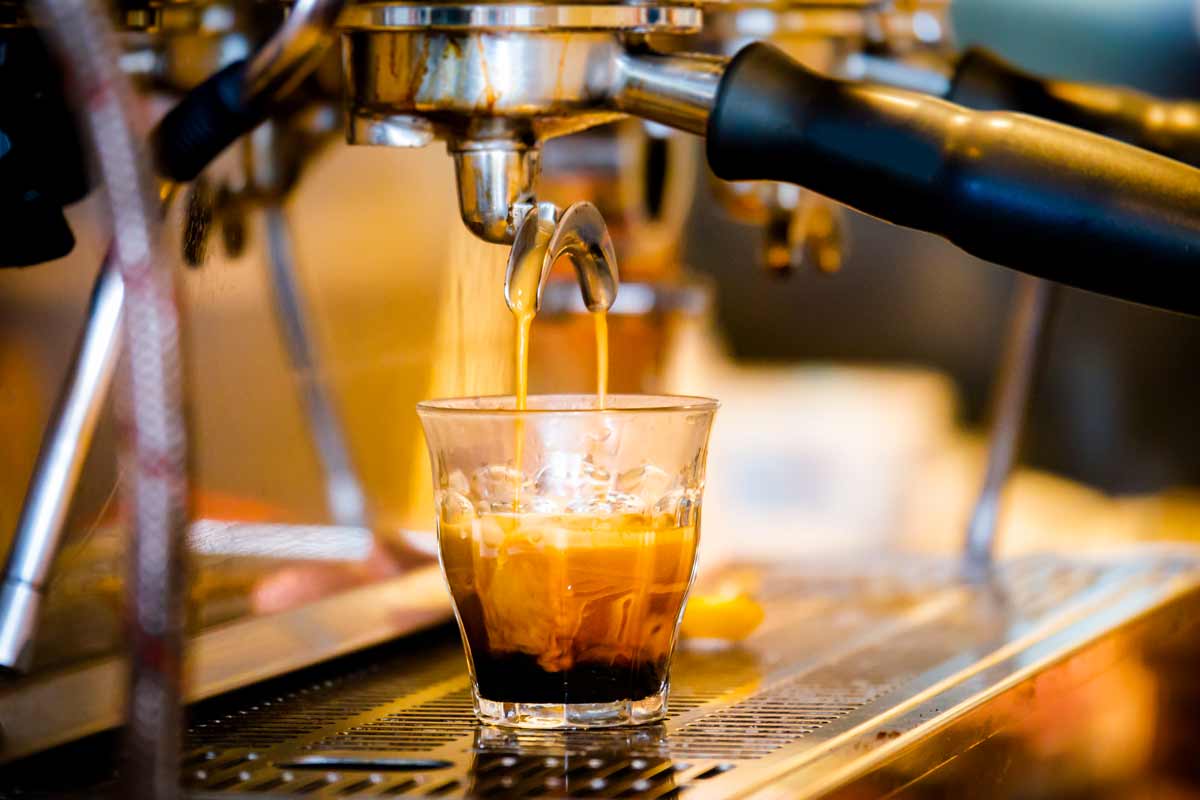
A handful of visual signals let you diagnose a shot without needing a lab. A properly extracted espresso should flow in a steady, syrupy stream - professionals call it the "mouse tail" - rather than spurting unevenly or gushing thin and fast. The crema on top should be thick, elastic, and golden brown rather than pale, thin, or quickly vanishing, since a poor crema is usually a direct signal that the oils weren't properly emulsified, whether from a grind that's off, insufficient pressure, or an unevenly tamped puck. Channeling - water finding a crack or weak spot in the packed coffee and rushing straight through it rather than passing evenly through the whole bed - is the single most common invisible flaw behind an inconsistent shot, and it's precisely the problem modern machines fight with a technique called pre-infusion: gently wetting the entire puck at low pressure, roughly 2 to 3 bars, before the full 9 bars arrives, so the coffee swells and settles evenly before the real extraction begins rather than getting blasted through whatever gap happened to form first.
What This Actually Means for Your Kitchen Counter
None of this means an expensive machine is wasted money - consistent temperature control, reliable pre-infusion, and a machine that doesn't drift in performance during a busy morning genuinely matter for repeatability. But it does mean the honest priority list for anyone building a home setup runs opposite to what the marketing on the box implies. A genuinely good burr grinder that lets you make fine, repeatable adjustments matters more than pump pressure ratings ever will - a machine advertising 19 bars paired with a mediocre blade grinder will consistently lose to a modest machine paired with a proper burr grinder, because the grinder is the variable actually steering the shot. Fresh beans matter enormously, since coffee begins losing its most volatile aromatic compounds within days of roasting regardless of how perfectly you dial in everything downstream. And the pressure gauge on the box, whatever number it claims, is almost certainly being quietly regulated down to the same 9 bars a spring accidentally discovered in a Turin workshop eighty years ago - which turns out to be exactly the number you wanted all along.