The island that was fought for 150 years
A small island with disproportionate influence
Saint Lucia: why a small island of fewer than 200,000 people rewrote Homer for the Caribbean, produced two Nobel Prize winners, and gave the world the fastest woman on Earth in 2024
Some places are fought over for so long and with such obsession that conflict becomes part of their identity.
Saint Lucia was once called “The Helen of the West Indies.”
Like Helen of Troy - whose beauty launched a legendary war - this small Eastern Caribbean island became the object of nearly 150 years of struggle between France and Britain. Control of the island changed hands fourteen times. The French captured it. The British took it back. The French returned again. Neither empire wanted to let it go.
In 1814 Britain finally secured permanent control, and Saint Lucia remained a British colony until gaining independence in 1979.
Today English is the official language, yet the island’s French past is impossible to miss. Towns carry names like Soufrière, Marigot, and Gros Islet. The local creole language, Kwéyòl, is rooted in French. The cuisine, music, and rhythms of conversation blend influences so thoroughly that Saint Lucia feels unlike any “pure” Caribbean culture.
The Volcano You Can Drive Into
On the island’s southwestern coast, near the town of Soufrière, lies a place officially described as the world’s only drive-in volcano.
And this is not tourism poetry.
Sulphur Springs is a geothermal field inside the collapsed caldera of an ancient volcano that imploded roughly 400,000 years ago. Over time, fractures opened in the crater walls, allowing sulfur gases, boiling mud pools, and mineral-rich hot water to rise to the surface.
You literally drive into an active geothermal system.
Step out of the car and you are met by bubbling gray mud, clouds of steam, and yellow sulfur crystals clinging to volcanic rock. The air smells like rainstorms and chemistry labs at once. Beneath your feet lies only a thin crust of earth above a volcanic system that has remained active for hundreds of thousands of years.
Nearby are open-air mineral baths rich in sulfur, magnesium, calcium, and potassium. Visitors cover themselves in volcanic mud before washing it away in naturally heated pools. It looks unusual and feels remarkably therapeutic.
Just a few kilometers north rise the Pitons.
The Pitons: Two Mountains That Look Unreal
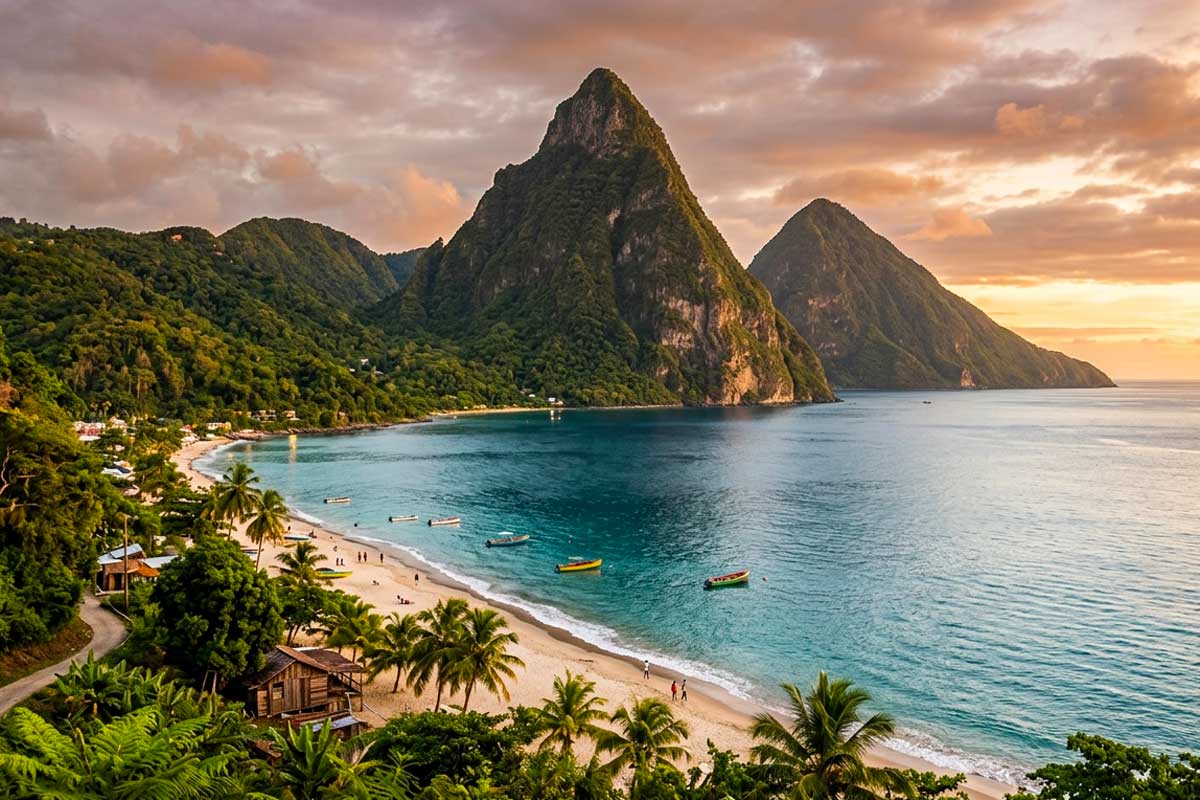
Gros Piton and Petit Piton are two volcanic peaks rising directly from the Caribbean Sea along Saint Lucia’s southwestern coast.
Gros Piton stands 798 meters high. Petit Piton reaches 743 meters.
Their near-symmetrical forms, steep jungle-covered slopes, and dramatic vertical rise from the water create a landscape so visually perfect that it almost appears computer-generated. Nature rarely builds with such geometry.
In 2004 UNESCO designated the Pitons Management Area a World Heritage Site.
Gros Piton is open to hikers: the official trail takes roughly four hours round trip and requires a guide. The climb is steep and humid, but the summit delivers one of the strongest panoramic views in the Caribbean - both Pitons, the town of Soufrière, the fractured coastline, and the deep blue Caribbean stretching to the horizon.
Petit Piton is far steeper and officially closed to regular tourist climbing.
Below the Pitons lies one of the richest marine ecosystems in the Eastern Caribbean. Saint Lucia’s volcanic origins created dramatic underwater topography: coral walls, drop-offs, caves, and deep reef systems unlike those around flatter islands.
Two Nobel Laureates, One Birthday
An island with fewer than 200,000 residents produced two Nobel Prize winners.
Per capita, Saint Lucia is considered one of the world’s leading nations for Nobel laureates.
Even more remarkably, both men were born on the exact same day - January 23 - fifteen years apart.
Sir Arthur Lewis, born January 23, 1915, received the Nobel Prize in Economics in 1979 for his groundbreaking work on the economies of developing nations. His “Lewis Model,” describing the relationship between traditional agricultural sectors and industrial growth, remains foundational in development economics.
He became the first Black Nobel laureate recognized in a scientific academic field rather than peace or literature.
Derek Walcott, born January 23, 1930, won the Nobel Prize in Literature in 1992 for writing that fused European literary tradition with Caribbean history and identity.
“Omeros”: Homer Rewritten for the Caribbean Sea
Walcott’s greatest work is titled “Omeros.”
Part epic poem, part novel, part philosophical meditation, it reimagines the structure of the Iliad and Odyssey within twentieth-century Saint Lucia.
The island’s fishermen bear names like Achille, Hector, and Philoctete. Helen becomes both a woman and a symbol of the island itself - the very “Helen of the West Indies.”
But “Omeros” is not a retelling of Homer. It is an argument with Western civilization conducted in the language of Western civilization itself.
Walcott confronts one of the defining questions of postcolonial literature: how do you write in the language of empire about what empire has done?
His answer was radical - to use the epic tradition itself to place Caribbean fishermen alongside the heroes of ancient Greece not as imitations, but as equals.
The poem moves through London, Lisbon, Dublin, Rome, and even Toronto - fragments of a former imperial world woven into a Caribbean story.
The Fastest Woman on Earth
On August 3, 2024, at the Olympic Games in Paris, 23-year-old Julien Alfred of Saint Lucia won the women’s 100-meter final.
10.72 seconds.
A national record. At the time, the eighth-fastest women’s sprint ever recorded.
Behind her finished reigning world champion Sha’Carri Richardson of the United States.
For Saint Lucia, it was the nation’s first Olympic medal of any kind - and it was gold, won in the most prestigious sprint event in the world.
After the race Alfred said: “I grew up running barefoot in school uniform. We didn’t have the infrastructure larger countries have.”
The island erupted into spontaneous celebration. Later, the government officially established Julien Alfred Day as a national holiday in her honor.
For a country this small, it felt like a historic turning point.
Marigot Bay: The Harbor Where Yachts Hide
Marigot Bay on the island’s western coast is widely considered one of the most beautiful natural harbors in the Caribbean.
A narrow entrance opens into a sheltered lagoon surrounded by tropical hills and palm trees. Inside, the water remains calm even when winds strengthen offshore.
During the age of naval warfare and piracy, the bay served as a natural hiding place for ships. In 1967 it appeared in the original “Doctor Dolittle” starring Rex Harrison.
Today Marigot Bay remains a living marina. Sailing yachts from across the Eastern Caribbean anchor here regularly. Visitors can stay at small waterfront hotels, charter boats, or simply spend an evening drinking rum beside the lagoon while palm trees and sail masts sway overhead.
Kwéyòl: A Language Built by History
Most Saint Lucians move effortlessly between English and Kwéyòl during everyday conversation.
Kwéyòl evolved during the seventeenth and eighteenth centuries from French vocabulary, African linguistic structures, and elements of Indigenous Caribbean speech.
It is a fully independent language with its own grammar and literary tradition - not “broken French,” as colonial authorities once dismissed it.
Every October the island celebrates Jounen Kwéyòl, Creole Day, when people wear traditional clothing, cook national dishes, and deliberately place Kwéyòl at the center of public life.
A few phrases worth knowing:
“Bonjou” - good morning.
“Mèsi” - thank you.
“Sa ka fèt?” - how are you?
Friday Night in Gros Islet
Every Friday evening, the streets of Gros Islet in northern Saint Lucia transform into a giant open-air party.
Residents wheel grills onto sidewalks. Fish, lobster, chicken, and seafood sizzle over charcoal fires. Music pours from bars and parked cars. People dance directly in the streets.
This is the Friday Night Jump Up - one of the few tourist-famous events in the Caribbean that still feels authentic precisely because nobody polished it into a performance.
Visitors are welcome, but the atmosphere still belongs to the locals.
Beaches: White Sand and Volcanic Black
Saint Lucia’s beaches divide into two entirely different worlds.
In the north are long white-sand beaches with calm water and developed resort infrastructure. In the volcanic southwest, the sand turns dark gray and black.
By law, every beach on the island is public. Luxury resorts may occupy the shoreline, but public access to the water must remain open.
Reduit Beach in Rodney Bay is Saint Lucia’s main family beach - wide white sand, shallow entry into calm water, restaurants, watersports, and one of the island’s best setups for families with children.
Smugglers Cove in the north hides between rocky cliffs. Visitors descend a long staircase before reaching calm crystal-clear water and one of the island’s most beautiful sunset spots.
Anse Chastanet near Soufrière combines dark volcanic sand with coral reefs only meters offshore. Snorkeling begins almost immediately after entering the water: sea turtles, parrotfish, moray eels, and more than 150 species of tropical fish inhabit the protected marine reserve.
Anse Cochon is a secluded dark-sand bay accessible mainly by boat or rough road. Its relative isolation preserved something increasingly rare in the Caribbean: untouched reefs, extraordinary water clarity, and silence.
Sugar Beach, positioned dramatically between the Pitons, is among the island’s most photographed locations. Its white sand was imported specifically to contrast with the dark volcanic mountains surrounding it. The view framed between the two Pitons has become one of the defining images of the Caribbean.
Underwater and Above the Jungle
Saint Lucia is not only about beaches.
The island’s waters contain shipwrecks, artificial reefs, and deep coral walls. The best-known dive site is Lesleen M, a cargo vessel intentionally sunk near Anse Cochon in 1986. Today its structure is covered in coral, giant sponges, sea fans, and schools of tropical fish.
For beginners, several PADI-certified dive schools operate on the island, including Scuba St. Lucia at Anse Chastanet Resort.
On land, visitors can explore zip lines above rainforest canopy, mountain-bike trails crossing old cocoa plantations, and hiking paths through tropical jungle.
From November through March, humpback whales and dolphins migrate along the coast. Whale-watching excursions depart from Rodney Bay and Soufrière.
Saint Lucia is also one of the Eastern Caribbean’s major sailing hubs. Rodney Bay Marina serves as a base for yachts traveling throughout the region.
Practical Information
The official currency is the Eastern Caribbean dollar (XCD), which is pegged to the U.S. dollar. Credit cards are widely accepted in tourist areas.
The best time to visit is December through April. June through October is the rainy season: hotter, more humid, but often 30-50 percent cheaper.
Direct seasonal flights operate from Toronto.
Saint Lucia does not rush to explain itself.
At first it reveals itself as a beautiful Caribbean island. Then as a volcanic landscape of extraordinary drama. Then as a country whose cultural density feels disproportionate to its size.
This is a place where you should see the Pitons from the sea, read at least part of “Omeros” before arriving, and listen carefully when locals switch from English into Kwéyòl in the middle of a sentence.
The Helen of the West Indies is still here.
Captured fourteen times - and never truly conquered.