
Mercedes-Benz EQS: the electric flagship that redefined luxury
The Mercedes-Benz EQS became one of those cars that matter not only as a product, but as a sign of a changing era. It is not simply an electric version of the S-Class, and not an attempt to replace the combustion engine with a battery inside a familiar body. The EQS was conceived as a separate architecture of luxury: quiet, aerodynamically refined, digital and almost seamless. With it, Mercedes-Benz tried to answer the central question of the premium segment: what should a large executive car look like when its future is no longer built around a gasoline engine?
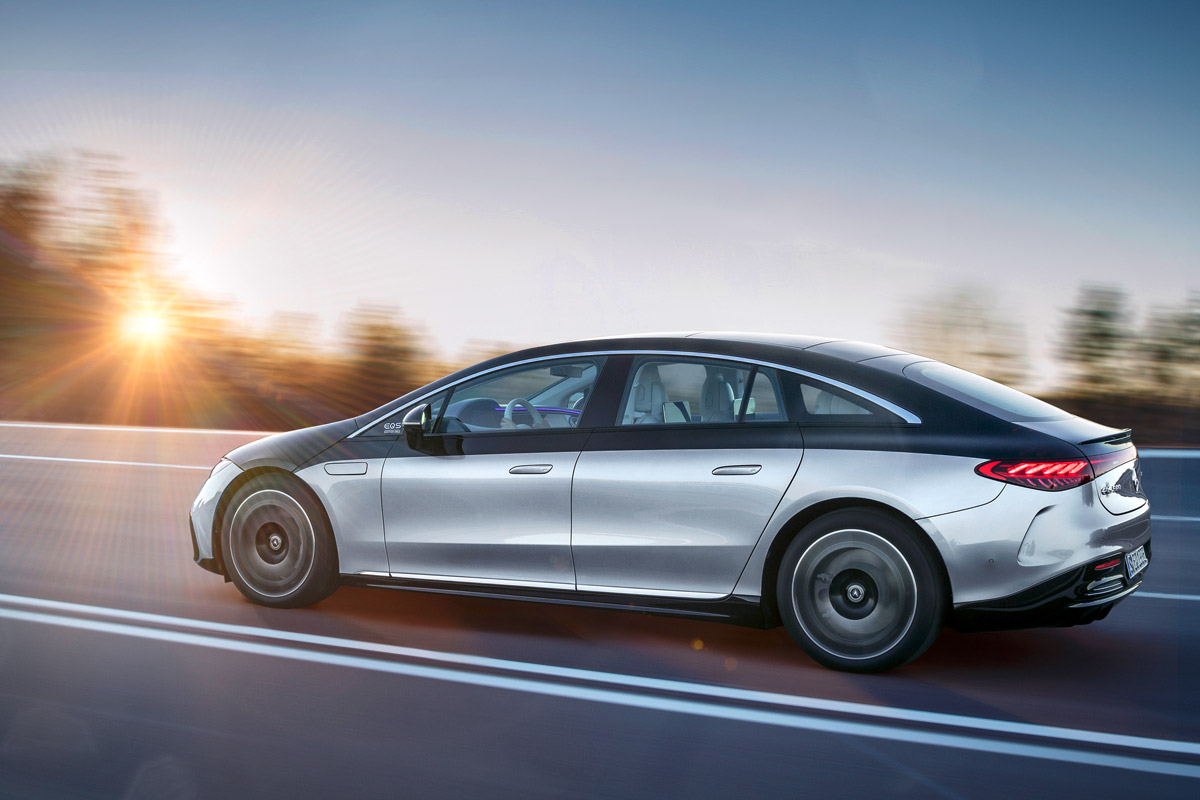
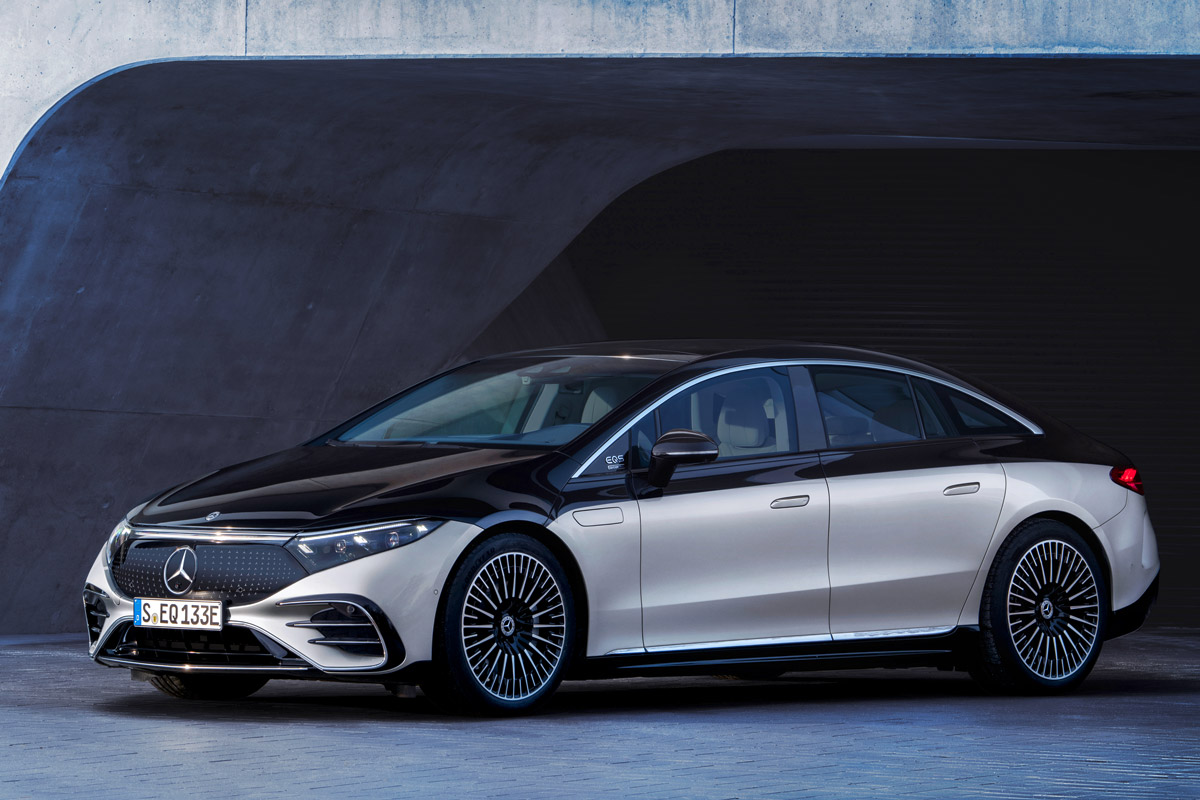
The EQS became the first fully electric luxury sedan from Mercedes-EQ and the first model from the brand built on a modular platform for premium and luxury electric vehicles. That is why it does not copy the classic shape of the S-Class, but offers a different philosophy: the long One Bow body arc, a cab-forward layout, almost seamless surfaces, a vast digital interior and the feeling of a car that does not pretend to be old-fashioned, but openly belongs to a new technological era.
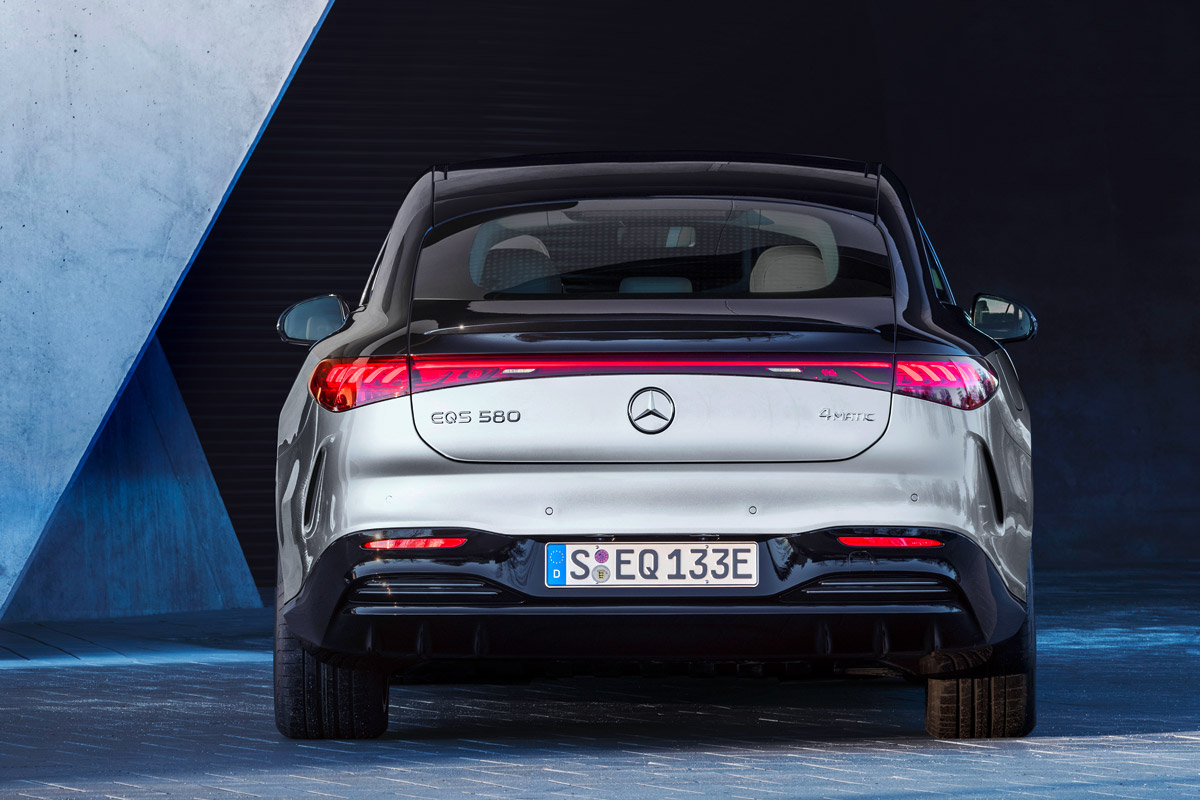
At launch, the model range included the EQS 450+ with 245 kW and the EQS 580 4MATIC with 385 kW. For its time, the car offered an impressive range of up to 770 km under the WLTP cycle, a usable battery capacity of up to 107.8 kWh and a record drag coefficient of Cd 0.20 for a production car. Later, the EQS lineup continued to evolve, receiving updates, a larger battery in certain markets, new versions and richer equipment. But the core idea remained the same: the EQS is Mercedes-Benz’s laboratory of electric luxury.
Aerodynamics as a new form of status
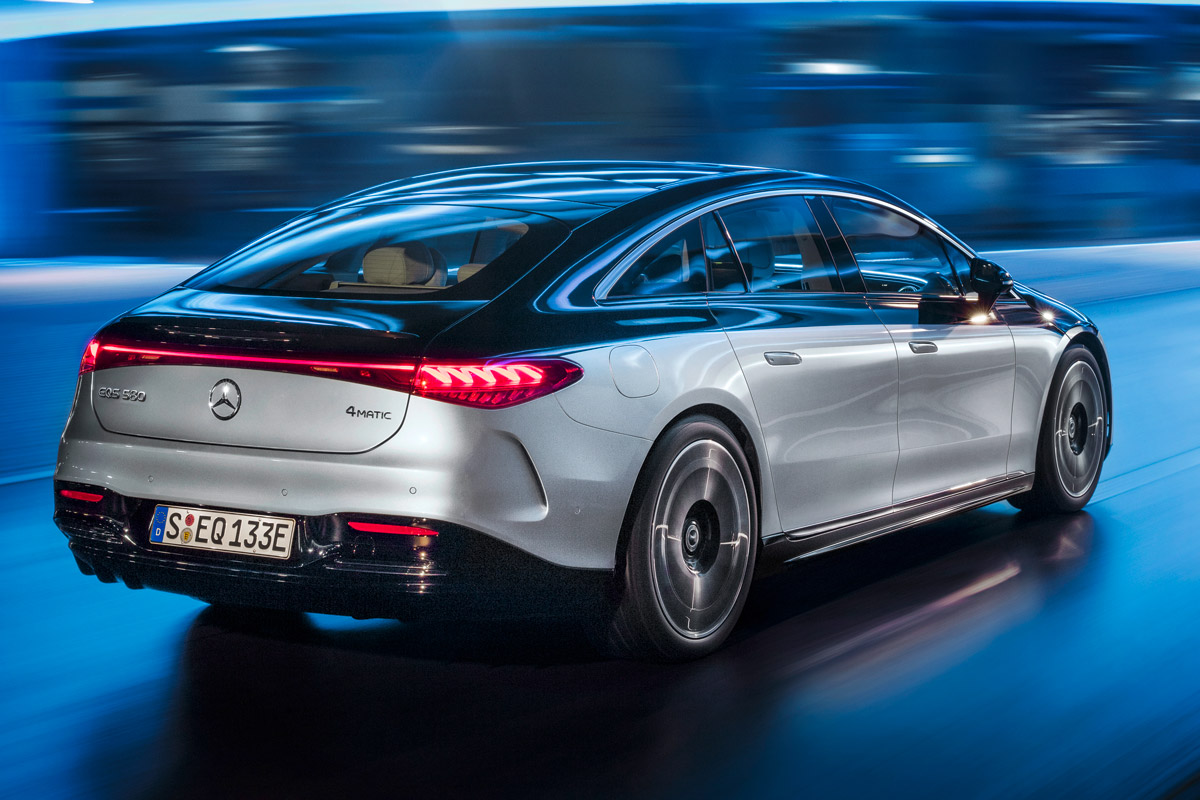
In old-school luxury cars, status was often expressed through a long hood, a large radiator grille and visual weight. The EQS chose another path. Its form is governed not by a familiar display of power, but by efficiency. The One Bow body looks almost futuristic: the front flows into the roof, the roof flows into the rear line, and the whole car appears to slip through the air.
The drag coefficient of Cd 0.20 became one of the EQS’s major engineering achievements. This is not merely a beautiful number for a press release. In an electric car, aerodynamics directly affect range, noise levels and the feeling of motion at high speed. The lower the air resistance, the quieter the cabin, the lower the energy consumption and the calmer the car feels on the highway.
That is why the EQS looks different from a classic executive sedan. Its design may challenge traditional ideas of luxury, but it is logical for a new era. This is luxury not as loud exterior aggression, but as silence, range, efficiency and technological purity.
Electric platform and range
The main difference between the EQS and many early premium electric vehicles is its dedicated electric architecture. The car was not built on the basis of an existing combustion-engine model. Its platform was designed from the start for a battery in the floor, electric drive units, a spacious interior and specific safety requirements.
The large battery, with a usable capacity of 107.8 kWh, allowed the EQS to offer a range of up to 770 km under WLTP in its most efficient version. For buyers of luxury sedans, this was essential: an electric flagship should not force the owner to think constantly about charging. It should provide a sense of freedom close to what large gasoline cars once offered with big fuel tanks.
Rear-wheel-drive versions of the EQS have an electric drive unit on the rear axle, while 4MATIC models add an electric motor at the front. This layout allows the car to combine efficiency in calm driving with high power and stability when needed.
Recuperation and intelligent energy management
One of the strengths of the EQS is its recuperation system. The car can slow down by returning energy to the battery, and in certain modes the driver can travel with minimal use of the brake pedal. Intelligent recuperation takes into account the road situation, terrain, traffic ahead and navigation data.
ECO Assist helps the car understand in advance when it is better to coast, when to increase recuperation and when to prepare for slowing down before an intersection, turn or vehicle ahead. The driver can also manually select recuperation levels using the paddles behind the steering wheel.
This is an important feature of a modern premium electric vehicle: efficiency is created not only by the battery, but by intelligence. The EQS saves energy not crudely, but almost invisibly, turning movement into a smooth flow of decisions made by the car together with the driver.
Charging and navigation with Electric Intelligence
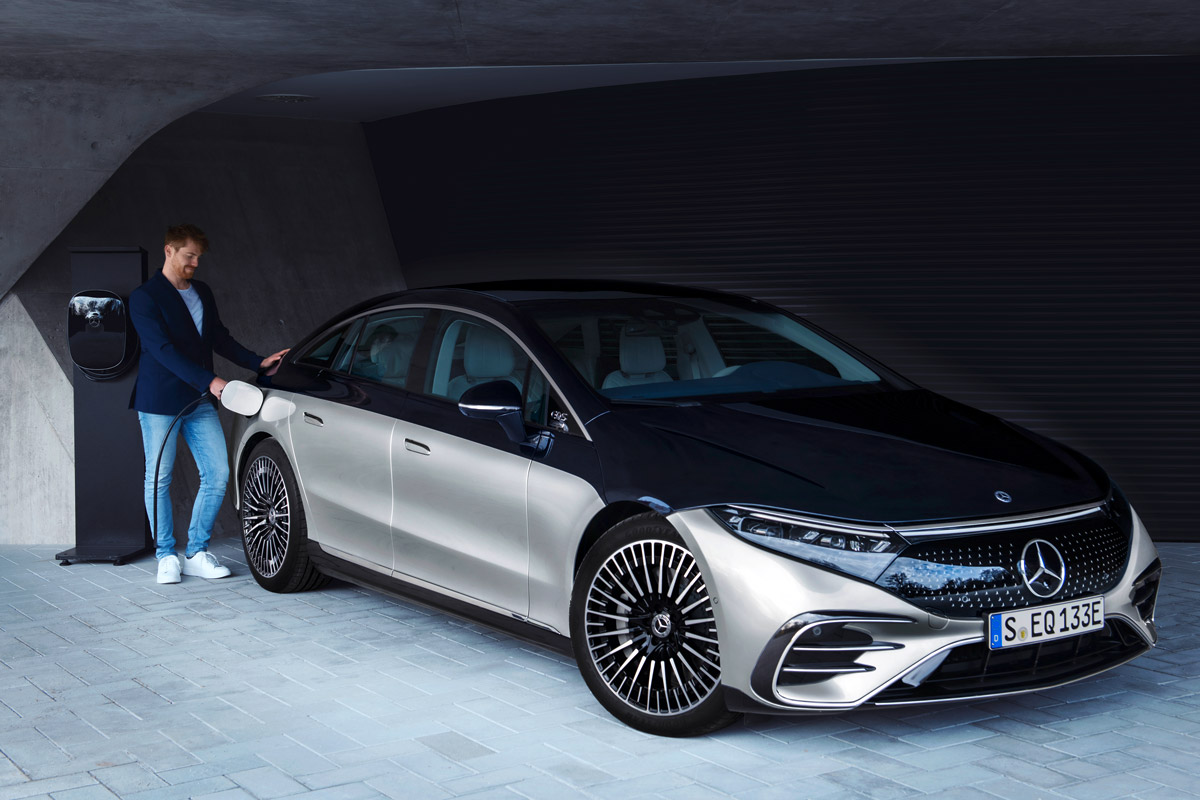
The EQS supports DC fast charging at up to 200 kW. Under ideal conditions, this allows the car to add a significant amount of range during a short stop: Mercedes-Benz stated that in around 15 minutes, enough energy could be added for up to 300 km of further driving under WLTP. At home or at a public station, the car can be charged with AC using the onboard charger, with available power depending on market and specification.
But charging speed is only part of the story. What matters is how the car plans the journey. Navigation with Electric Intelligence takes into account energy level, traffic, terrain, driving style, charging-station availability and required stopping time. It can dynamically adjust the route if traffic, energy consumption or driving conditions change.
For the owner, this removes the main psychological barrier of the electric car: the need to constantly calculate where to charge and whether the battery will last until the next point. The EQS makes this part of the car’s broader digital logic.
Mercedes me Charge and the new culture of charging
Through Mercedes me Charge, owners receive access to a broad network of charging stations in different countries. In Europe, the service was connected to hundreds of thousands of charging points, including IONITY fast-charging stations. Plug and Charge makes the process especially simple: the driver arrives at a compatible station, plugs in the cable, and authentication and payment happen automatically.
Mercedes-Benz also emphasizes the idea of Green Charging: the company balances the electricity used through Mercedes me Charge with corresponding certificates of origin from renewable energy sources. For a premium electric vehicle, this is an important part of the new luxury. Buyers increasingly want not only technology, but also a more responsible logic behind how that technology is used.
Design: One Bow and Black Panel
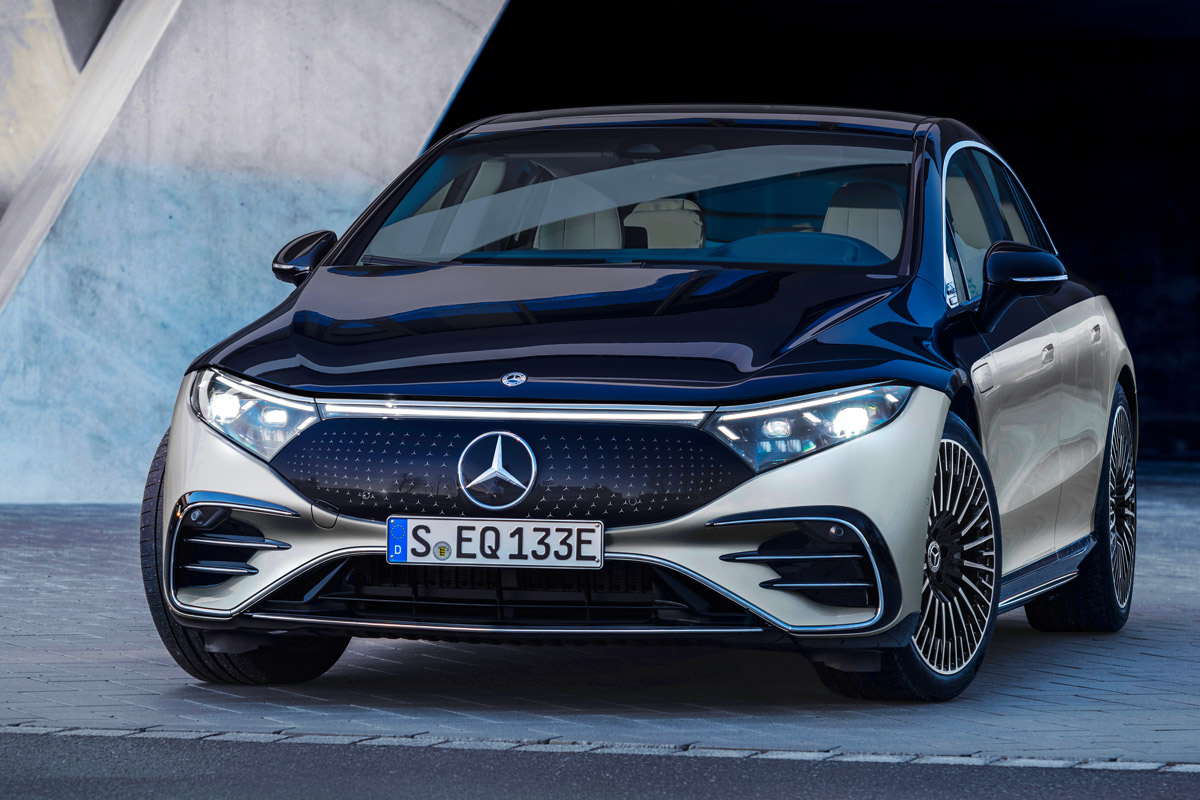
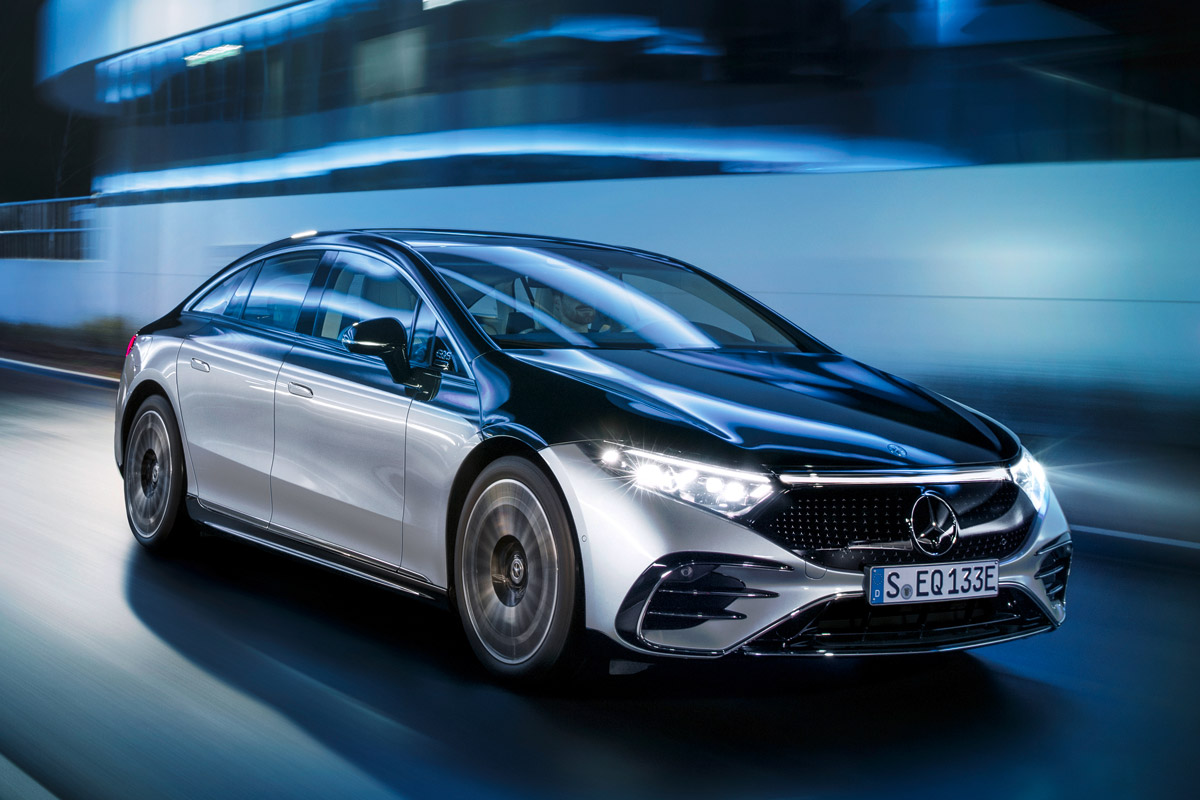
Although the EQS is conceptually close to the S-Class, visually it feels very different. The electric architecture allowed designers to move away from the classic proportions of a large sedan with a long hood. Instead, the EQS received a cab-forward stance, a flowing roofline and a body that looks as if it were sculpted in one continuous motion.
The front end uses the Black Panel design: instead of a traditional radiator grille, there is a black surface connected to the headlights and light strip. As an option, the panel can be decorated with a three-dimensional Mercedes-Benz star pattern, referring back to the historic symbol of the brand. It is an interesting meeting of past and future: the legendary star remains, but now it lives not on a classic grille, but on a digital, electric surface.
MBUX Hyperscreen: the interior as a digital lounge
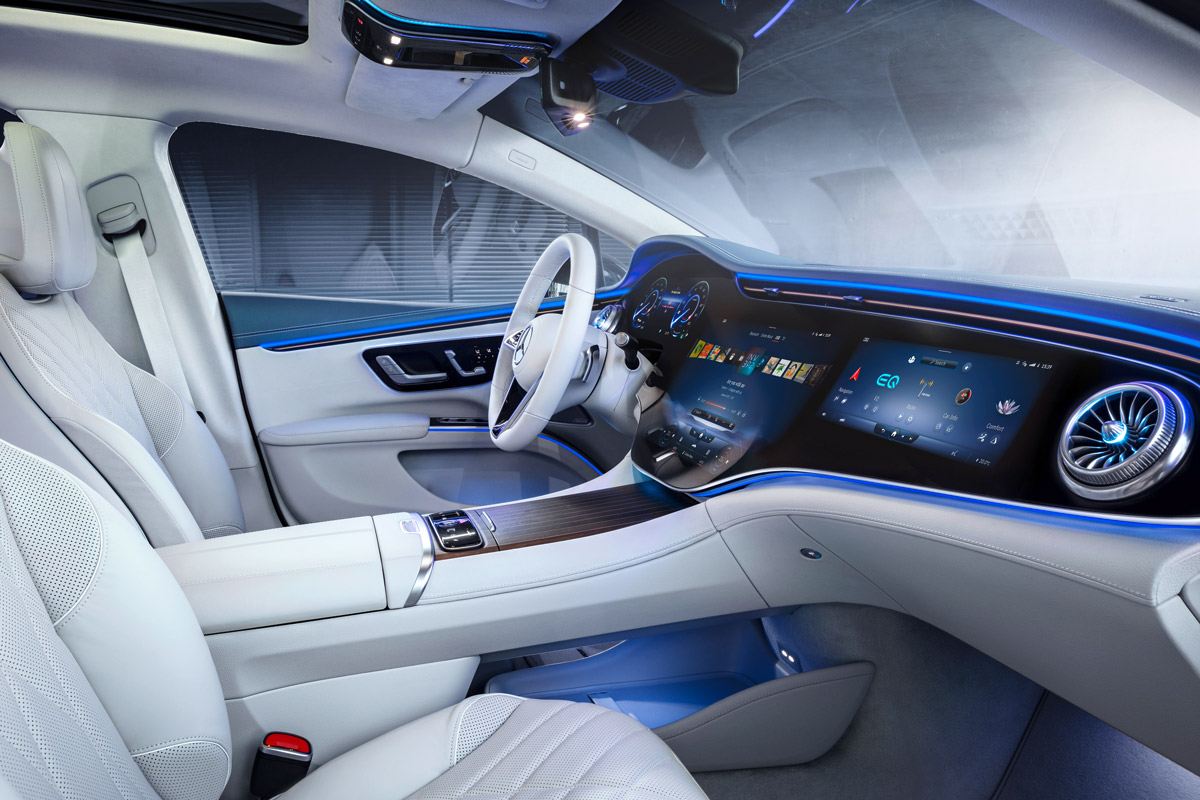
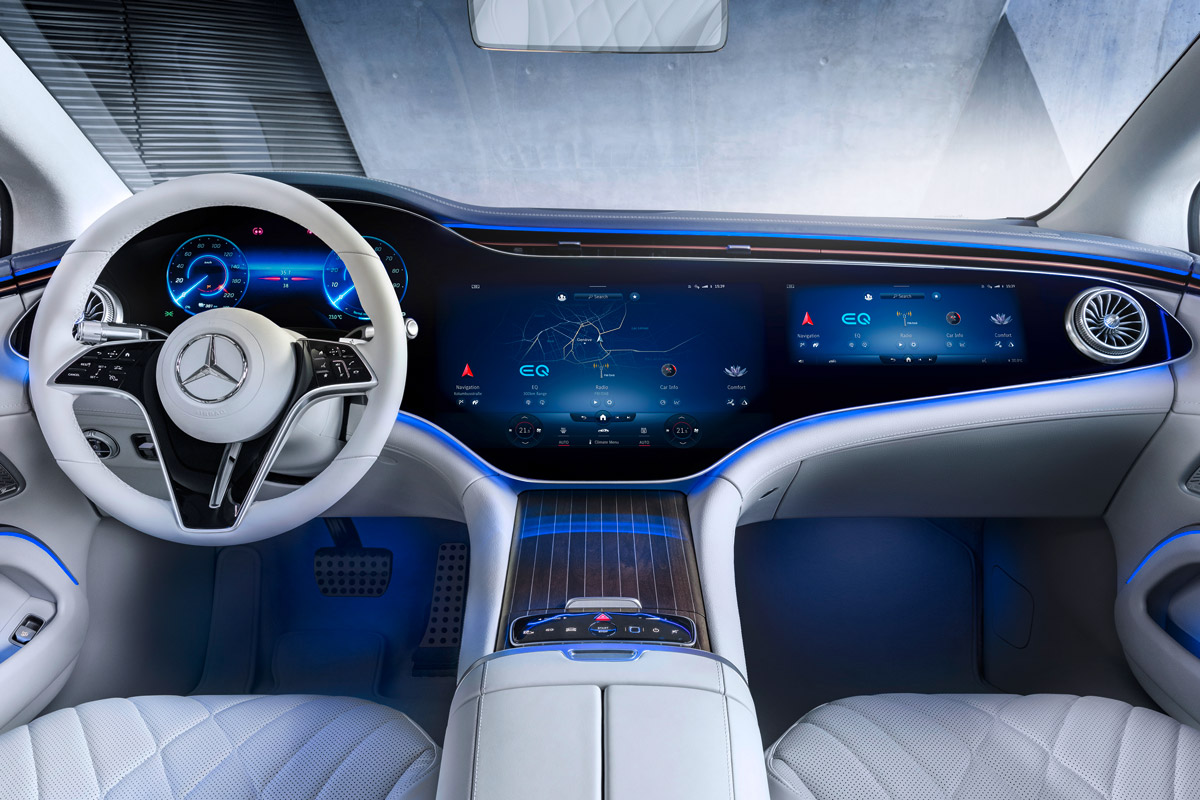
The main visual attraction inside is the optional MBUX Hyperscreen. This enormous curved glass module stretches almost the full width of the dashboard, from one A-pillar to the other. Under one continuous surface are three displays: the driver’s area, the central screen and a separate screen for the front passenger.
This changes the entire drama of the cabin. In a classic luxury sedan, the interior was built around wood, leather, metal and analogue instruments. In the EQS, a new dominant element is added to those materials: the digital surface. It does not simply display information; it becomes part of the emotional identity of the car.
The MBUX system can learn the user’s habits and bring relevant functions to the so-called zero layer - the top level of the interface, where important suggestions appear without the need to search through menus. This is especially important in a car with an enormous number of functions. Luxury today is not about giving the driver an endless list of possibilities, but about making them quietly available at the right moment.
Air, sound and atmosphere
The EQS shows that modern automotive luxury is increasingly connected not only with materials, but with invisible sensations: air quality, silence, light, sound and mood. ENERGIZING AIR CONTROL PLUS uses a high-grade HEPA filter, air-quality sensors, MBUX displays and pre-conditioning. The cabin air can be purified before entry, and the system can show fine-particle levels inside and outside the car.
The acoustic concept is equally interesting. The shift from combustion engine to electric drive changes the familiar sound of a car. Mercedes-Benz did not simply leave the silence empty. For the EQS, soundscapes such as Silver Waves and Vivid Flux were developed and can be played through the Burmester sound system. Additional ENERGIZING NATURE programs - Forest Glade, Sound of the Sea and Summer Rain - create an almost meditative atmosphere in the cabin.
This may seem theatrical, but in an expensive electric car such details make sense. When mechanical noise disappears, the car begins to create emotion in other ways.
Rear-axle steering, manoeuvrability and a large body
The EQS is a large car more than five metres long, but rear-axle steering helps it feel far more compact. In the standard version, the rear wheels can turn by up to 4.5 degrees, while the more advanced version with up to 10 degrees significantly reduces the turning circle.
This is especially important in cities, parking garages and narrow streets. A large electric flagship gains manoeuvrability unexpected for its size. These are exactly the kinds of engineering solutions that make luxury practical: the driver receives not only space and status, but less stress in real conditions.
Assistance systems, DIGITAL LIGHT and DRIVE PILOT
The EQS is equipped with a wide range of driver assistance systems. The car uses numerous sensors, cameras, radars and electronic control units that monitor distance, speed, the road situation, driver attention, light levels, precipitation and many other parameters.
DIGITAL LIGHT can project auxiliary markings and warning symbols onto the road. In each headlamp, light modules with micromirrors create a highly precise light image. This is no longer just lighting in the traditional sense, but an information tool that helps the driver better understand the road situation.
In combination with DRIVE PILOT, under certain conditions and on approved road sections, the EQS can operate in a highly automated driving mode. In Germany, the system was certified for use in dense traffic and traffic jams on autobahns at speeds of up to 60 km/h. This is an important step not only for Mercedes-Benz, but for the entire industry: the premium car is gradually becoming not merely a means of transport, but an intelligent platform capable of taking over part of the driving burden where the law allows it.
Safety in an electric architecture
Mercedes-Benz emphasizes that the principles of integrated safety do not depend on the type of powertrain. The EQS has a strong passenger cell, dedicated deformation zones, modern restraint systems and the PRE-SAFE preventive safety system as standard.
The electric architecture allowed the battery to be placed in the protected area of the vehicle floor. The absence of a large combustion engine in front also gave engineers more freedom when calculating frontal-impact behaviour. In addition to standard crash tests, Mercedes-Benz conducted additional component tests and load scenarios related to the specific characteristics of an electric vehicle.
Sustainability and Ambition 2039
The EQS became an important part of Mercedes-Benz’s Ambition 2039 strategy. The company has stated its goal of moving toward a carbon-neutral value chain and increasing the share of electrified models. The EQS uses resource-saving materials, including floor coverings made from recycled raw materials, while production is organized with the company’s climate targets in mind.
Mercedes-Benz stresses that it sees sustainability not only as the absence of a tailpipe, but as the entire life cycle of the vehicle: development, suppliers, production, charging, materials and use. For a luxury brand, this is no longer an optional topic, but part of a new premium responsibility.
Why the EQS matters
The Mercedes-Benz EQS did not please everyone visually, and that is exactly what makes it interesting. It did not try to be an electric S-Class in a familiar suit. It offered another form of luxury - quieter, smoother, more digital, more aerodynamic and more oriented toward the future.
Its significance lies not only in its range, Hyperscreen or record drag coefficient. The EQS showed that an electric flagship can be not a compromise, but an independent philosophy. In it, luxury is expressed not only through leather and wood, but also through silence, air quality, intelligent navigation, smooth recuperation, digital personalization, safety and the ability of the car to evolve after purchase.
That is the main meaning of the EQS. It did not merely translate the executive sedan into electricity. It tried to change the very language of the premium automobile. And even as the future of Mercedes-Benz continues to evolve - becoming more technological, more powerful and longer-range - the EQS has already secured its place as one of the first true electric flagships of the new era.