
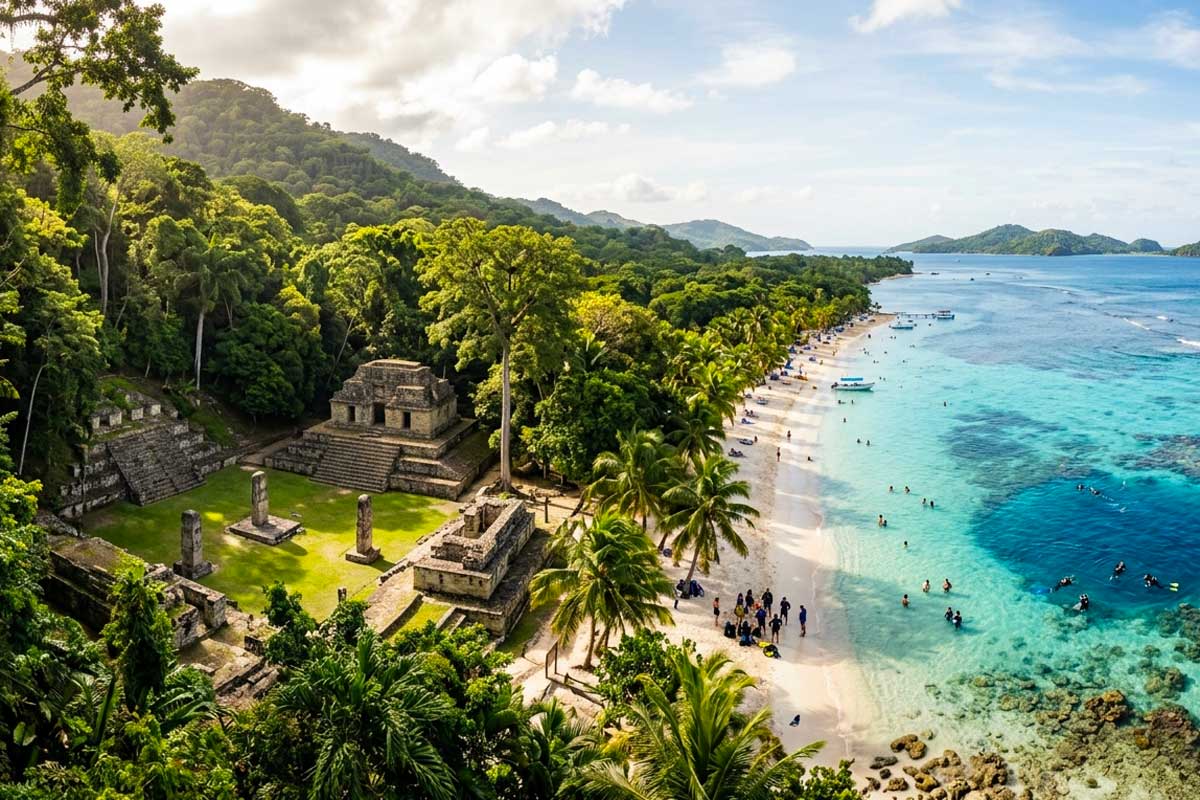
The Country of Depths
Honduras
Honduras: Maya cities beneath the jungle, a pirate archipelago, a people born from two continents - and why more travelers are flying here every year.
When Christopher Columbus sailed along the northern coast of an unfamiliar mainland in 1502, the navigators looked overboard and could not find the bottom. The sea disappeared into dark, unfathomable depths.
“Honduras” in Spanish literally means “depths.”
There is a legend - historians debate whether it is entirely true, but it is too compelling to ignore - that once the expedition finally escaped those dangerous waters near the eastern cape, Columbus exclaimed: “¡Gracias a Dios que hemos salido de esas honduras!” - “Thank God we have come out of those depths!” The cape on the border of Honduras and Nicaragua is still called Cabo Gracias a Dios - Cape Thanks to God.
The name became the perfect metaphor for the country itself. Deep in history. Deep in nature. Deep in cultural layers. And at the same time, remarkably underexplored by North American travelers.
This is a story about what is actually here.
Copán: The Athens of the Maya Beneath the Rainforest
In the far west of Honduras, near the Guatemalan border, the ruins of one of the greatest Maya cities rise from the Copán River valley.
Copán was designated a UNESCO World Heritage Site in 1980. Yet unlike Chichén Itzá in Mexico or Tikal in Guatemala, it remains surprisingly uncrowded. Visitors here tend to be serious lovers of archaeology rather than day-trip tour buses.
And that changes everything.
In Copán, you can move slowly. Read the stelae. Study the carvings. Think.
At its peak, between roughly 400 and 820 AD, Copán was the capital of a powerful Maya kingdom with a population exceeding twenty thousand people - larger than many medieval European cities of the same era. It was one of the great intellectual and artistic centers of ancient Central America.
Sixteen rulers governed the city over nearly four centuries. The last was Yax Pasaj Chan Yopaat - “Rising Dawn.” After his death in the ninth century, the kingdom rapidly declined.
Copán’s greatest masterpiece is the Hieroglyphic Stairway. Sixty-three stone steps covered with more than two thousand individual glyphs form the longest known Maya inscription ever discovered. It records royal accessions, wars, alliances, rituals, and the political history of the dynasty itself.
Another detail makes Copán especially fascinating to historians. The city’s founding ruler, K’inich Yax K’uk’ Mo’, appears not to have been born there at all. Isotope analysis suggests he likely came from Tikal in present-day Guatemala. An outsider established a dynasty that would go on to create some of the finest sculpture in the entire Maya world.
After the city’s collapse, the jungle swallowed it whole. Ironically, that is what preserved it: centuries beneath the rainforest canopy protected the stone carvings from erosion.
When Spanish explorer Diego García de Palacio encountered the ruins in 1576, he wrote back to Spain describing an astonishing lost city. Almost nobody paid attention. Serious archaeological excavations would not begin until the nineteenth century.
Today, the nearby town of Copán Ruinas is one of the most pleasant small travel hubs in Central America: cobblestone streets, coffee houses, boutique hotels, and a calm atmosphere rarely found elsewhere in the region.
Roatán: An English-Speaking Island Inside a Spanish-Speaking Country
About sixty-five kilometers off Honduras’ northern coast stretches a chain of Caribbean islands: Roatán, Utila, and Guanaja - the Bay Islands.
Roatán is the largest and most developed of them. It is also one of the most culturally unusual islands in the Caribbean.
The Spanish arrived after Columbus first sighted the islands in 1502. Later, the islands became bases for slave trading and pirate raids. By the seventeenth century, thousands of pirates reportedly operated here at the same time, including Henry Morgan - the very man whose name would later become synonymous with Caribbean rum.
The British controlled the islands for long periods, which explains why English remains widely spoken on Roatán today. Many island families speak Caribbean English as their native language, and culturally the island often feels closer to the Cayman Islands or Belize than to mainland Honduran cities.
The result is something rare: a Caribbean island with a distinctly British cultural imprint inside Spanish-speaking Central America.
The Beaches and Water That Bring People Back
Most visitors initially come to Roatán for the reef. Then they discover how beautiful the beaches themselves are.
West Bay Beach regularly appears on lists of the best beaches in the Caribbean. Powder-white sand, calm water, and a coral reef just offshore create an unusual combination: world-class snorkeling and classic tropical beach scenery in the same place, without boats or long transfers.
The water surrounding the island has the same intense turquoise color usually associated with the Maldives or Turks and Caicos. The reason is simple physics: shallow depth, bright Caribbean sunlight, and pale sandy seabeds.
At sunset, Roatán’s western coast becomes almost cinematic - wooden piers, palms, anchored sailboats, and golden light reflecting across the calm reef lagoon.
World-Class Reefs Without Luxury-Level Prices
The Bay Islands sit along the Mesoamerican Barrier Reef System - the second-largest coral reef ecosystem on Earth after Australia’s Great Barrier Reef.
That means the waters around Roatán and Utila contain some of the best diving in the Western Hemisphere: dramatic walls, underwater caves, shipwrecks, sea turtles, eagle rays, dolphins, and even whale sharks, which occasionally appear in these waters.
Yet prices remain significantly lower than on many comparable Caribbean islands.
Utila has long been known as one of the most affordable places in the world to earn a PADI certification. For many travelers, this is where they learn to dive for the first time.
Roatán offers a broader range of infrastructure: backpacker guesthouses in West End, mid-range boutique hotels, beach villas, and genuine luxury resorts with private beaches, spas, and personal butler service.
And remarkably, all of it coexists on one island without the sharp social divide often felt in expensive Caribbean destinations.
For snorkeling, many visitors simply walk directly into the water from the beach.
A People Born From Two Continents
If there is one people on Earth whose history sounds almost unbelievable, it is the Garifuna.
In the seventeenth century, a slave ship carrying West Africans wrecked near the island of Saint Vincent. Survivors reached shore, where Arawak and Carib Indigenous communities already lived. Instead of conquest or annihilation, cultures merged.
Over generations, African and Indigenous traditions blended into an entirely new identity - with its own language, music, cuisine, rituals, and worldview.
After a long war with the British Empire, roughly five thousand Garifuna people were deported in 1797 to Roatán - effectively abandoned on an unfamiliar island near a foreign mainland.
They survived. Later, they spread along the Caribbean coast of Honduras and throughout Central America.
Today, Garifuna communities exist across Honduras, Belize, Guatemala, and Nicaragua, as well as in major diaspora populations in New York, Toronto, and Los Angeles.
UNESCO has recognized Garifuna language, music, and dance as a Masterpiece of the Oral and Intangible Heritage of Humanity.
Punta drumming, dugu ritual songs, and seaside villages lined with wooden homes are not staged performances for tourists. This culture is alive here every single day.
Mainland Honduras: Beyond the Headlines
Most international travelers fly directly to Roatán and never see the mainland. From a safety perspective, that is understandable. Geographically, however, it means missing places found almost nowhere else.
Lake Yojoa - the country’s only natural lake - sits among mountains, waterfalls, and cloud forests. More than four hundred bird species have been recorded here, making it one of Central America’s premier birdwatching destinations.
Pico Bonito National Park near La Ceiba is among the most biologically rich protected areas in all of Mesoamerica. Mountain rivers, rainforest, quetzals, tapirs, and jaguars make the region especially attractive for eco-tourism.
Colonial towns such as Santa Rosa de Copán and Gracias reveal another side of Honduras entirely: slower, cooler, historical, and deeply traditional, with seventeenth-century churches and mountain streets paved in stone.
An Honest Conversation About Safety
Ignoring the subject of safety in Honduras would be dishonest.
The country did experience severe criminal violence, particularly during the early 2010s. Homicide rates have declined significantly since then, especially in tourist areas and on the islands, but organized crime remains a real issue in certain regions.
The Government of Canada continues to recommend a high degree of caution when traveling throughout the country.
In practice, however, conditions vary dramatically by location.
Roatán, Utila, and Copán Ruinas are considered substantially safer areas and receive thousands of international visitors each year. Most tourists on the Bay Islands experience no security problems at all.
Tegucigalpa and San Pedro Sula require considerably more caution, particularly at night and outside well-known routes.
As in much of Latin America, understanding geography matters more than judging the country as a single uniform reality.
Practical Notes
The local currency is the Honduran lempira (HNL), although U.S. dollars are widely accepted in tourist areas.
Canadian citizens may enter visa-free for up to ninety days.
The best time to visit is December through April. May through October is wetter and more humid, but also brings lower prices and fewer tourists, especially for diving trips.
Seasonal direct flights to Roatán operate from the United States and selected Canadian cities.
Columbus called this land “the depths” and was relieved to leave its waters behind.
Modern travelers leave with a very different feeling.
Here are Maya hieroglyphs forming the longest inscription in the ancient Maya world. Caribbean islands once ruled by thousands of pirates. A people who survived the Atlantic crossing, exile, and centuries of cultural isolation - and preserved music now recognized by UNESCO as part of humanity’s shared heritage.
This is not a country that can be understood through headlines alone.
Which is exactly why those who truly try to see it so often return.