
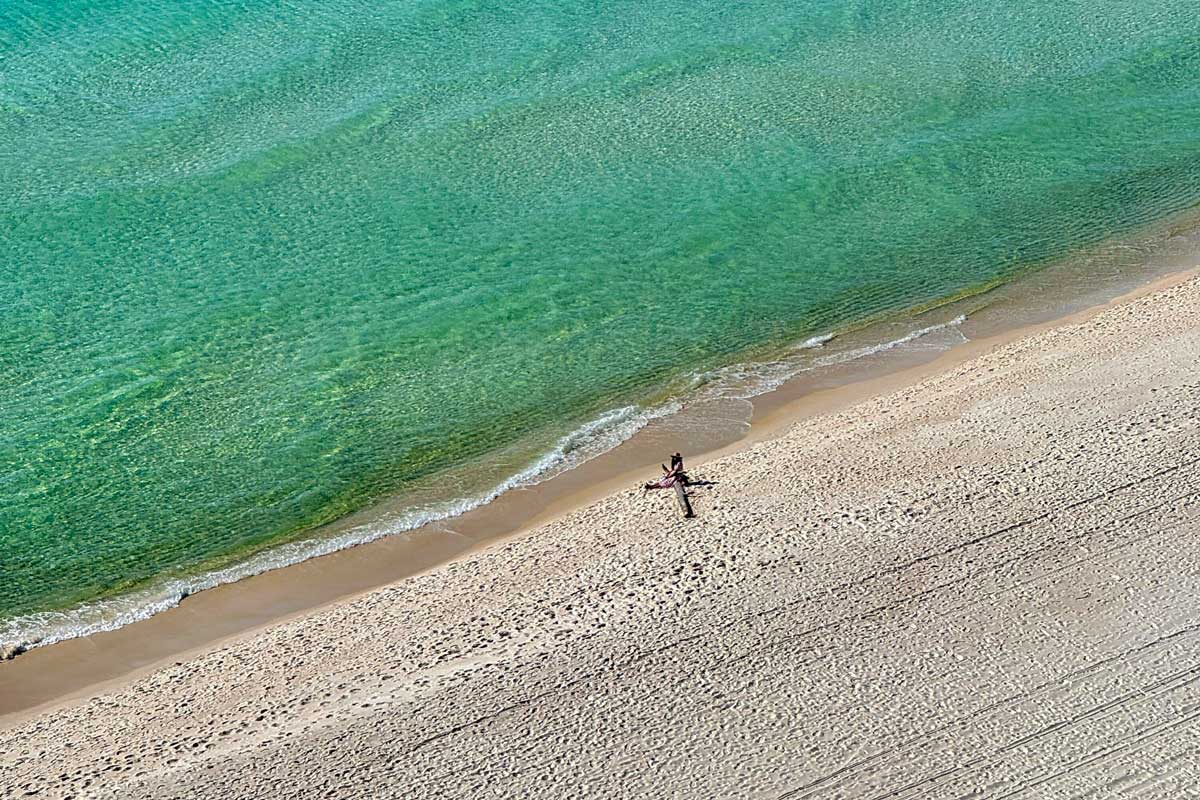
The white sand and emerald water of the Emerald Coast
Why this shoreline looks almost unreal
Some places seem not merely beautiful, but almost implausible. Florida’s Emerald Coast is one of them. Here, the sand is so white it recalls powdered sugar or dry starch, while the water shifts from clear turquoise to a deep emerald glow. At first glance, it feels like a visual trick: too clean, too bright, too perfect. But the power of this coast lies in the opposite. What we see is not a decorative miracle of nature, but a rare case in which beauty is assembled almost entirely from reality: geology, light, moving water and time that has learned to look like luxury.
There are landscapes we understand instantly. One look, and everything is clear: beautiful, pleasant, move on. The Emerald Coast works differently. It does not simply please the eye. It creates a brief inner pause, because it appears slightly more beautiful than a real shoreline seems entitled to be. The sand does not read as ordinary beach sand. It seems too white, too soft in appearance, too fine in texture. The water beside it does not look simply marine - it glows, changes, deepens before your eyes, moving from glassy transparency to saturated green-blue light.
In such places, mythology appears quickly. One wants to say that the water is special, that nature here is unique, that the sand has some secret composition - in other words, to invent an explanation that sounds beautiful but explains almost nothing. Yet in the case of the Emerald Coast, the truth is stronger than any tourist legend. This shoreline impresses precisely because its beauty rests not on romantic invention, but on concrete, material and almost severe things: minerals, erosion, sediment transport, wave action, water clarity and the angle of light.
The white sand of the Emerald Coast is, above all, quartz. This is what makes the beaches of northwest Florida so dazzlingly light. NASA Earth Observatory describes the white beaches of Florida’s Emerald Coast as being primarily composed of quartz grains from the southern Appalachian Mountains. Quartz is a strong, stable and resilient mineral. It survives immense distances and long geological processes during which other components are gradually lost, broken down or washed away.
This is where the most beautiful part of the story begins: the sand that now lies along the beaches of Pensacola, Destin, Fort Walton Beach and other places on the Emerald Coast once belonged to an entirely different world. Its journey began far away, in the rocks of the southern Appalachian Mountains. Over time, those rocks weathered and released quartz particles. Rivers carried the material toward the Gulf of Mexico, while marine processes sorted it, moved it, cleaned it and rearranged it until the coast acquired the appearance that now seems almost unreal.
This is one of those rare cases in which knowledge does not diminish beauty, but deepens it. A beach that first appears light, almost airy, was actually created by colossal forces operating over immense stretches of time. Behind the sensation of softness stand mountains that were worn down over millions of years. Behind this whiteness is not nature’s cosmetics, but the result of selection, endurance and time. There is a special expressiveness in that: the shore looks weightless, but its origin is grand and heavy.
Quartz matters not only as a source of colour. It defines the character of the place. Light, clean, well-sorted sand reflects sunlight differently from darker or more mixed beaches. It makes the shoreline visually clearer. It removes a sense of heaviness. It intensifies the contrast between land and water. That is why the sand of the Emerald Coast seems not simply white, but almost luminous. It does not compete with light - it works with it.
From this comes the great visual miracle of the coast: the water.
Its colour is often explained too simply. People say the water is emerald because of the white sand. There is truth in that, but only half the truth. The bright bottom does play a major role. When sunlight passes through clear shallow water, reaches the pale sand and reflects back, it creates a sense of internal illumination, making the sea appear not merely transparent, but lit from below. But if the explanation stops there, the picture becomes too flat.
In reality, the colour of water is always the result of several conditions aligning precisely. Depth matters. Clarity matters. The amount of suspended material matters. Whether the sea is calm or broken by wind matters. The angle of light matters - soft in the morning, almost vertical at midday, diffused under cloud. That is why the water along the Emerald Coast is never exactly the same. It is always changing, and that change is what makes it feel alive.
In the morning, the coast can look almost like watercolour: softer, clearer, more delicate. By midday, everything becomes sharper and brighter - the sand shines, the water gains intensity, and the whole shore looks as if someone has deliberately increased the contrast. By evening, the scene changes again: the light grows warmer, the surface deepens in tone, and the green notes move into a calmer, more complex range. After a storm, the same place can look completely different - heavier, more matte, less fairy-tale. This is important. The beauty of the Emerald Coast is not permanently attached to it like scenery. It is not a fixed decoration. It appears again and again as the result of a meeting between light, bottom, air and water.
There is almost an aristocratic restraint in this. The coast does not display its beauty as something guaranteed. It does not shout. It gathers itself into perfection only when conditions align. Perhaps that is why it leaves such a strong impression. We always remember most vividly the beauty that does not seem obligatory.
This shoreline has another quality that makes it almost tangible on a different level: it can be heard. The dry quartz sand here often squeaks underfoot. Not loudly, not theatrically, but in a fine, distinct way - almost like snow in deep cold or dry starch pressed between fingers. This, too, is not merely poetic effect, but physics: clean quartz grains rub against one another, and the sound becomes part of the experience. The beach works not only as an image, but as texture and acoustics. It is not simply beautiful; it is layered.
Perhaps that is why this coast remains so easily in memory. Not only because it is photogenic, though that is difficult to deny. Not only because its colours are too good for a random landscape. Rather, because one senses an inner logic in it. Everything here is connected to everything else. The whiteness of the sand cannot be separated from its mineral composition. The colour of the water cannot be separated from the character of the bottom. The impression of clarity cannot be separated from light and depth. And this almost impossible beauty cannot be separated from slow processes that began long before human beings and will continue after us.
The Emerald Coast gives an impression of perfection, but not artificial perfection, not designer perfection, not glossy sterility. On the contrary, it seems perfect precisely because it was not created by taste. There is no desire to please, no intention to be dramatic, no trace of posing. That is why its luxury feels so convincing. Nature is not decorating itself here; it is simply astonishingly exact in its results.
In a world where so much beauty is created for the gaze, the Emerald Coast reminds us of another kind of perfection: the kind that emerges as a by-product of reality. Mountains erode. Quartz remains. Rivers carry it to the sea. The shore sorts the material. Light finds the right angle. Water becomes clear enough to reveal the bottom and alive enough to turn reflection into colour. And at some point, a person walks onto the beach and sees not merely a beautiful shoreline, but the result of an almost impossible alignment of matter, time and light.
That is why this coast seems slightly more beautiful than expected. Not because it resembles a dream, but because it is almost too real. Real in the strongest sense of the word - a thing created by forces that have nothing to do with aesthetics, yet can one day produce a landscape that looks like perfection.
And perhaps this is the deepest charm of the Emerald Coast. It does not lead us away from reality; it returns us to it. It shows that sometimes the most impressive luxury in the world does not come from intention, decoration or the desire to create an effect. It comes from a long, patient process indifferent to everything human - a process that, at a certain moment, suddenly begins to look like a miracle.