
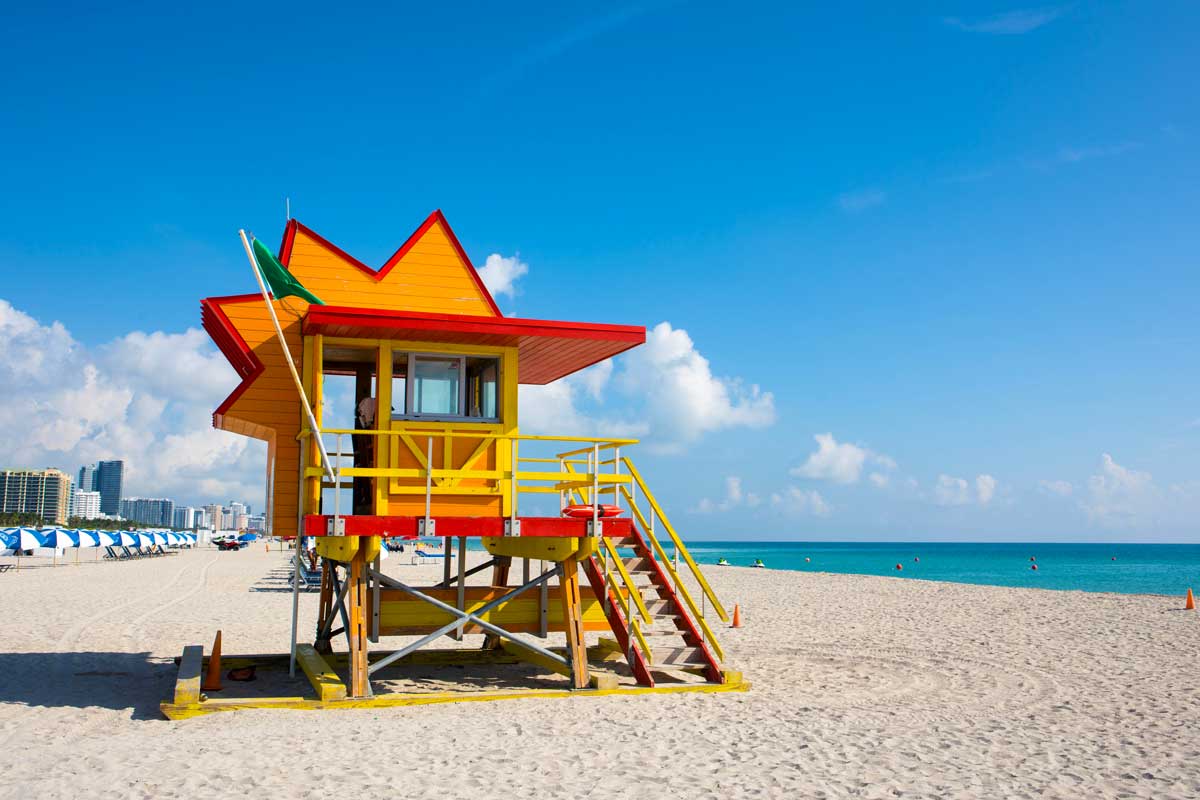
Ocean Drive - The main podium under neon sky
The street that was almost demolished
The real history of Ocean Drive is the story of the people who refused to let it erase itself. Ocean Drive is easy to look at. Pastel facades, neon signs, palms, the Atlantic running alongside - the whole stretch carries an almost cinematic quality, as if it was designed to be photographed. Which, in a sense, it was - though not initially, and not by anyone who would have predicted the outcome.
Behind the beautiful surface is a story nobody planned. A story about how one of the most recognizable streets in the world came within a vote or two of being demolished, and survived each time because of people nobody had asked to get involved.
The Hurricane and the Blank Canvas
In the early twentieth century, this was an island of mangrove swamp and barrier sand.
John Collins, a Quaker farmer from New Jersey, tried growing avocados. Brothers John and James Lummus, bankers, saw resort potential and began clearing the oceanfront. Carl Fisher, an industrialist with a developers appetite, built the causeway that connected the island to Miami and set about constructing a city.
Ocean Drive appeared in 1915 as a quiet residential road - Mediterranean Revival estates, palms, ocean views.
Then a hurricane destroyed most of it.
The 1926 hurricane leveled significant portions of the early construction. The destruction created, almost by accident, the conditions for something entirely new.
The Architecture That Should Not Exist
In the 1930s, while much of the world navigated the Great Depression, Ocean Drive was being rebuilt from the ground up. And rebuilt differently.
Architects Henry Hohauser and L. Murray Dixon created a style that existed nowhere else in such concentrated form: Tropical Deco.
It was Art Deco reinterpreted for a specific climate and a specific clientele. Rounded corners that echoed the streamlined forms of ocean liners. Horizontal eyebrow canopies that shielded glass from the harsh subtropical sun. Geometric reliefs on facades. Covered walkways that manufactured shade.
Hohausers Colony Hotel, which opened in 1935 at 736 Ocean Drive, is considered the first streamlined building on the entire street. Its neon sign - blue letters against a dark lilac field - became one of the most photographed facades in Floridas history.
By the late 1930s, Ocean Drive was a continuous architectural ensemble: dozens of buildings in a shared spirit, each distinct, the whole greater than any individual part.
Then the street began to age.
The Woman in Front of the Bulldozer
By the 1970s, Ocean Drive was what urban planners call a district in decline. Cheap rents, elderly residents, empty terraces. The city was considering demolition and high-rise redevelopment.
A journalist and community organizer named Barbara Baer Capitman decided to intervene.
In 1976, Capitman co-founded the Miami Design Preservation League with industrial designer Leonard Horowitz, convinced that the pastel buildings of the 1930s were a national architectural treasure rather than disposable infrastructure. She was not taken seriously. The opposition was significant.
She organized protest marches. She held vigils in front of threatened buildings. She stood in front of bulldozers.
On May 14, 1979, the Miami Beach Architectural District was listed on the National Register of Historic Places as the first urban twentieth-century historic district in the country. Without that designation - without Capitman - the Ocean Drive we know almost certainly would not exist.
The pastel color palette that became the streets visual signature was developed by Horowitz in the late 1970s and early 1980s as part of the restoration process. The colors were not original to the buildings. They were a conscious design decision, applied afterward, and they changed everything about how the district read to the eye.
Miami Vice and the Unexpected Audience
Preservation created the conditions. Television created the audience.
In 1984, the first episode of Miami Vice aired on NBC. Producer Michael Mann built the shows visual identity around the pastel architecture of South Beach - the light, the neon, the particular quality of ocean atmosphere. Ocean Drive became a backdrop the entire world saw at once.
Supermodels, photographers, fashion editors, film crews - the decade that followed the show transformed the district from a preserved neighborhood into a global destination.
The street had already made a different kind of film appearance a year earlier. The facade of the Sun Ray Hotel at 728 Ocean Drive appeared in Brian De Palmas Scarface in 1983. The building - constructed in 1953 - is still standing at that address. There is now a pharmacy inside.
Casa Casuarina: The Address That Became a Myth
Among all the addresses on Ocean Drive, one has a history that escapes architecture entirely.
1116 Ocean Drive. Casa Casuarina.
The house was built in 1930 by Alden Freeman, heir to the Standard Oil fortune through his father, Joel Freeman, who had served as Treasurer of the Standard Oil Trust. Freeman was fascinated by the history of the Americas, and he modeled his Miami Beach home on the Alcázar de Colón in Santo Domingo - the palace built in 1510 by Diego Columbus, son of Christopher Columbus. The name Casa Casuarina came from the lone casuarina tree on the property that survived the 1926 hurricane. Freeman reportedly carried two original bricks from the Santo Domingo palace back to Miami and incorporated them into the construction.
In 1992, Gianni Versace purchased the property.
He invested approximately $32 million in renovations and expansion, adding a south wing, gardens, and the now-famous mosaic-tiled pool.
On July 15, 1997, Versace was shot on the front steps of Casa Casuarina, returning from his usual morning walk.
The event made the address into one of those places that cannot be passed without acknowledgment - not because it is beautiful, though it is, but because history entered the stone.
Today, Casa Casuarina operates as a boutique hotel under the name The Villa Casa Casuarina.
Why This Street Is Different
Ocean Drive did not become what it is through planning.
There was no single architectural vision that governed the whole street. No developer with a decades-long strategy. No marketing campaign that decided a derelict Miami neighborhood would become a global visual icon.
There were architects in the 1930s who built affordable hotels for middle-class tourists, and built them well.
There was a woman in the 1970s who decided that beauty was sufficient reason to fight.
There was a designer who chose pastels instead of white.
There was a television producer who saw the right quality of light in a run-down district.
Each of them made a decision that was not required of them. Each of those decisions is still visible on the street today.