
How to become a billionaire on other peoples technologies
In the technology world, we tend to celebrate inventors: the new chip, the new platform, the new device that supposedly makes tomorrow unimaginable without it. But the real maturity of an industry begins not where brilliant products are created, but where someone figures out how to build a great business on top of everyone elses complexity. That is precisely what World Wide Technology has done. A private company from St. Louis, Missouri, it manufactures no phones, no servers, no microchips - and has grown into a global technology solutions provider with annual revenue exceeding 20 billion.
Not the Silicon Valley Story
The World Wide Technology story looks almost nothing like the standard mythology of American tech. There is no young genius in a hoodie, no garage laboratory where a culture-defining product is born, no romantic legend of the breakthrough that changed humanity. Instead: St. Louis, Missouri. Two entrepreneurs. Decades of discipline. And a remarkably clear-eyed understanding of how the corporate technology market actually works.
While other companies fought to become the next Apple, WWT's founders chose a far less romantic but often more durable role: to become the indispensable partner that the largest corporations, government agencies, and infrastructure clients turn to when they need complex IT solutions implemented quickly, safely, and correctly.
Behind this model stand two co-founders - David Steward and Jim Kavanaugh. Steward, born in 1951, is the majority owner and chairman. Forbes has named him the wealthiest Black American, with an estimated net worth of $11.4 billion - a fortune built not from a patent or an algorithm, but from the patient construction of something the technology industry genuinely cannot do without. Kavanaugh, born in 1963, came to business from an unlikely direction: he was a professional soccer player who represented the United States at the 1984 Los Angeles Olympics before co-founding WWT at the age of 27. Today his net worth is estimated at roughly $7.7 billion.
The easy version of this story is an inspiring tale of people who worked hard and succeeded. But that would be a cheap summary. What's far more interesting is that they became billionaires not by inventing a unique technology, but by understanding - earlier than most - what the technology market itself was becoming.
The Business of Other People's Complexity
Modern enterprise IT has become so intricate that even the largest companies in the world can no longer simply "buy the best product." They need someone who can verify whether dozens of solutions will work together, whether a system will hold under real-world load, how to migrate data without losing it, where the security vulnerabilities are, and how to reconcile cloud infrastructure, networking, AI, analytics, user applications, and legacy systems into something that actually functions. That growing complexity is the foundation on which WWT's business is built.
The company describes itself not as a hardware reseller but as a global technology solutions provider - and the distinction matters. The era when you could fill an office with servers, hand out laptops, and declare digital transformation complete ended long ago. Today's enterprise client is not paying for boxes. They are paying for everything working together: fast, secure, and without expensive mistakes. WWT sells exactly that.
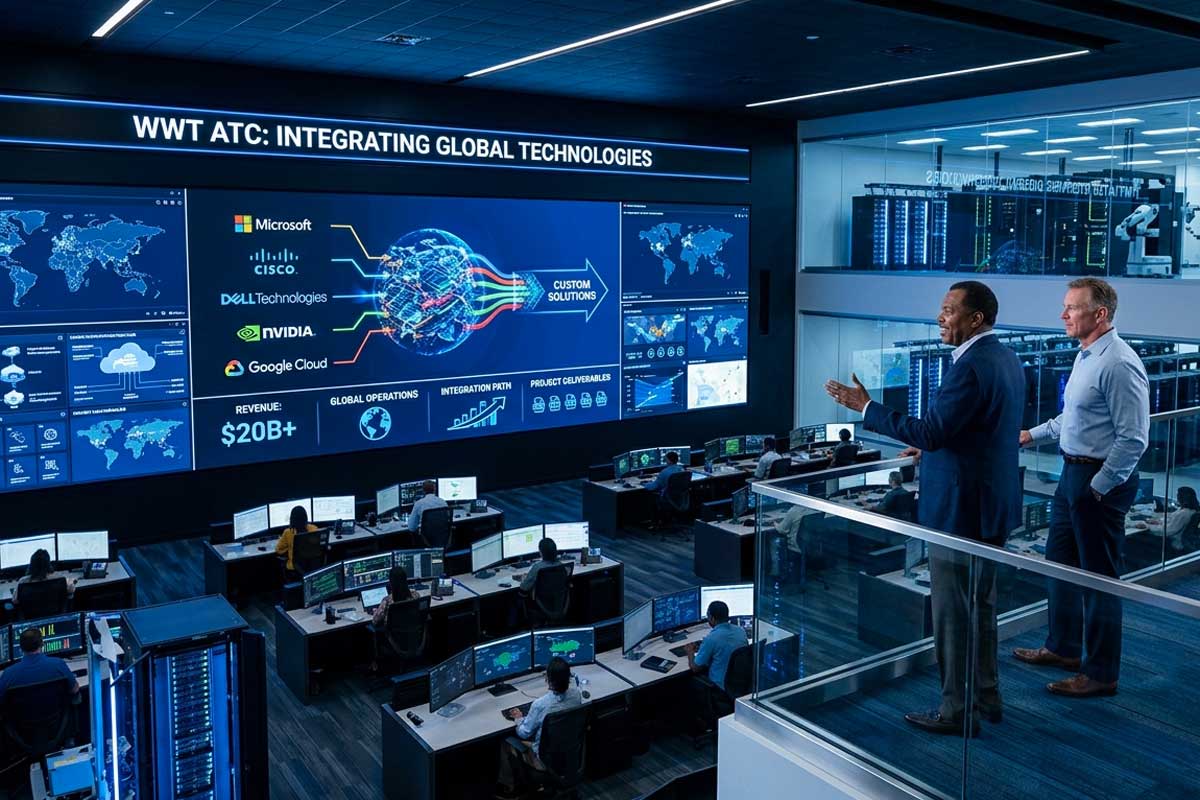
The heart of this model is the Advanced Technology Center, or ATC, at WWT's St. Louis headquarters. By the company's own figures, it is a large-scale testing and demonstration environment where clients and partners can design, test, validate, and compare technology solutions before committing real money to deployment. The ATC houses more than 20,000 virtual machines in a cloud environment, 500-plus equipment racks, 600-plus ready-to-deploy capabilities, 200-plus OEM partners, and over $1 billion in infrastructure investment. This is not a showroom or a corporate attraction - it is a place where technological risk is turned into a managed process.
More Than an Integrator
WWT earns its money not by telling clients "buy this" but by taking on the most expensive part of modern IT chaos: verification, assembly, integration, deployment, and scaling. This is especially valuable when a typical corporate technology stack now includes solutions from Microsoft, Cisco, Dell, NVIDIA, AWS, Google Cloud, and dozens of other vendors simultaneously. The more complex the market becomes, the more valuable the position of the one who can translate between all those worlds.
WWT works not only with large private enterprises but with government at every level. Federal agencies, defense, civilian departments, public health, states, municipalities, education - this entire segment is not secondary to the company's business but structural to it. In 2025, WWT was awarded a position on the U.S. Army's ITES-4H contract, a ten-year vehicle with a ceiling of $10 billion. That ceiling does not mean WWT receives all of those dollars - it means WWT has the standing to compete for that work, which says something about the company's place in the ecosystem.
The acquisition of Canadian firm Softchoice - completed in March 2025 for approximately $1.3 billion - marked an important inflection point. Softchoice brings expertise in software, cloud, cybersecurity, and AI, and significantly expands WWT's presence in Canada and in the mid-market commercial segment. The combined entity is positioned to serve not only Fortune 100 enterprise clients but also small and medium-sized businesses across North America. It signals that WWT is no longer purely a large-scale infrastructure integrator. It is deliberately moving toward higher-value services - the kind where clients pay not for delivery but for the entire journey from strategy to implementation.
What They Actually Sell
The old framing - "they don't make anything" - is increasingly beside the point. Yes, WWT manufactures no gadgets of its own. But reducing their role to "middleman" no longer holds either. The modern technology business is increasingly structured so that the most valuable participant in the chain is not the one who made the component, but the one who can assemble hundreds of components into a working outcome for a demanding client.
WWT does not sell servers or software licenses. It sells risk reduction. Speed of deployment. Technical confidence. Access to architectural expertise that is too expensive for most individual corporations to build internally. In a market this complex, that is a more defensible position than owning any single product.
A Different Kind of Tech Billionaire
Billionaires in technology are typically associated with visionary genius or with cult of personality. In WWT's case, the wealth grew from something almost old-fashioned: trust, execution, discipline, long-term relationships with major clients, and the determination to be indispensable at the hardest part of the chain.
Steward grew up in segregated rural Missouri, the son of a man who worked as a mechanic, janitor, and trash collector. He graduated from Central Missouri State University, spent years in corporate sales at Missouri Pacific Railroad and FedEx, and co-founded WWT with Kavanaugh in 1990 with $250,000 in starting capital. In the early years he went without a paycheck. He once watched his car get repossessed from the company parking lot. Kavanaugh personally drove a rented truck to Omaha to fulfill one of the company's first orders - 500 personal computers.
That origin story matters not as inspiration but as context. The company was built the way that mature, durable businesses are built: by being genuinely useful to clients who are hard to please, in a market that punishes poor execution.
Mature markets rarely reward only those who shout loudest about innovation. They tend to pay the ones who can turn someone else's innovation into a predictable, scalable business tool. World Wide Technology understood that before most of its competitors did - and that understanding, compounded over three decades, is what a $20 billion private company looks like.
Steward and Kavanaugh did not try to become the next Apple. They chose the more pragmatic role: to become the company that the world's most sophisticated technology buyers call when the market gets too complicated to navigate alone. In the current era of AI infrastructure buildout, cloud migration, and cybersecurity complexity, that role is not getting smaller. It is getting more essential.