
The Most Secretive Billionaire in the World
Most people who own something from Zara, Pull and Bear, Bershka, or Massimo Dutti have never heard the name Amancio Ortega. This is entirely by design. The founder of Inditex - the world's largest fashion retailer, with revenues exceeding $45 billion and stores in 93 markets - has given fewer than three interviews in his life. Until 1999, no photograph of him had ever been published. He has refused audiences with Spanish royalty, citing his busy schedule. He lunches in the employee cafeteria, does not wear Zara clothing, and has spent the majority of his life in the same port city in northwestern Spain where he opened his first store in 1975. His wealth, estimated at nearly $150 billion, makes him one of the ten richest people on earth. The man himself remains almost completely invisible - and that, as this story reveals, is no accident.
The Law of Silence
Amancio Ortega Gaona was born on March 28, 1936, in the small town of Busdongo de Arbas in the Spanish province of León. He was the youngest of four children born to Antonio Ortega Rodríguez and Josefa Gaona Hernández. His father worked as a stationmaster on the local railway and was a member of the Republican Left party.
The year of Ortega's birth was also the year the Spanish Civil War began. The province of León found itself on the side of the Republican forces. When Francisco Franco's Nationalist army crushed the uprising, many who had participated in Republican politics faced arrest, imprisonment, or worse. Antonio Ortega was among those who had to disappear. He moved his family west, to the Basque town of Tolosa, hoping to lose himself in the unfamiliar landscape and go unnoticed by Franco's police.
It was there that Antonio introduced his children to an iron rule: not one unnecessary word to strangers. Amancio Ortega followed that rule for the rest of his life.
After the Second World War, when Franco issued a general amnesty and widespread persecutions largely ceased, the Ortega family risked a return to mainstream Spain. They settled in La Coruña, a port city on the Atlantic coast of Galicia. Antonio found work as a laborer in a railway depot. His wife Josefa became a hotel maid. The older children - daughters Pepita and Josefa, and son Antonio - went to work as errand runners in a tailoring workshop that made bespoke shirts for wealthy clients. At thirteen, the youngest, Amancio, joined them.
The workshop owner told Amancio's father: he'll never make a proper tailor - a tailor must be light and sociable, must know how to charm a client. But the young Amancio had no intention of following the lessons of a provincial couturier. He was too aware of what cheerful, well-dressed gentlemen had done to families like his, when they found out the truth about one's past.
He stayed quiet. He watched. He learned.
Only once, in a rare conversation with his long-time friend and biographer Xavier Blanco, did he recall what stayed with him most from childhood: We were coming home from the store, my mother and I, and she went in to buy bread and milk. She didn't have the money, and she begged the shopkeeper to extend credit. He threw us out. I swore I would earn enough money that my family would never go without again.
From Bathrobes to Bikinis
At fifteen, Ortega dropped out of school and took a job as a sales assistant at a clothing store called La Maja. It was there that he met Rosalía Mera Goyenechea, who would become his business partner and first wife.
In 1963, at the age of twenty-seven, he started his first company, Confecciones GOA - his initials, reversed. On Rosalía's advice, he began making women's swimwear: bikinis were the defining garment of the era. The business grew into a family operation. Amancio designed and cut the pieces at home, his brother Antonio handled commercial negotiations, his sister Josefa kept the books.
In 1966 Amancio married Rosalía. Two years later their daughter Sandra was born. In 1971 came a son, Marcos, who was born with cerebral palsy. As his biographer Blanco would write, the birth of Marcos changed Amancio Ortega forever - the boy's incurable condition became, for his father, the wound from which he never fully recovered, and which drove him to find consolation almost entirely in his work. Ortega would later establish a foundation bearing his name, donating enormous sums to research into cerebral palsy and oncology - including 300 million euros to supply Spanish public hospitals with cancer-detection equipment.
In 1975, the business was hit hard. The oil crisis had dried up demand for beach holidays, and new medical warnings about skin cancer from ultraviolet radiation sent further shockwaves through the swimwear trade. Retailers began canceling orders. The company teetered on the edge of bankruptcy.
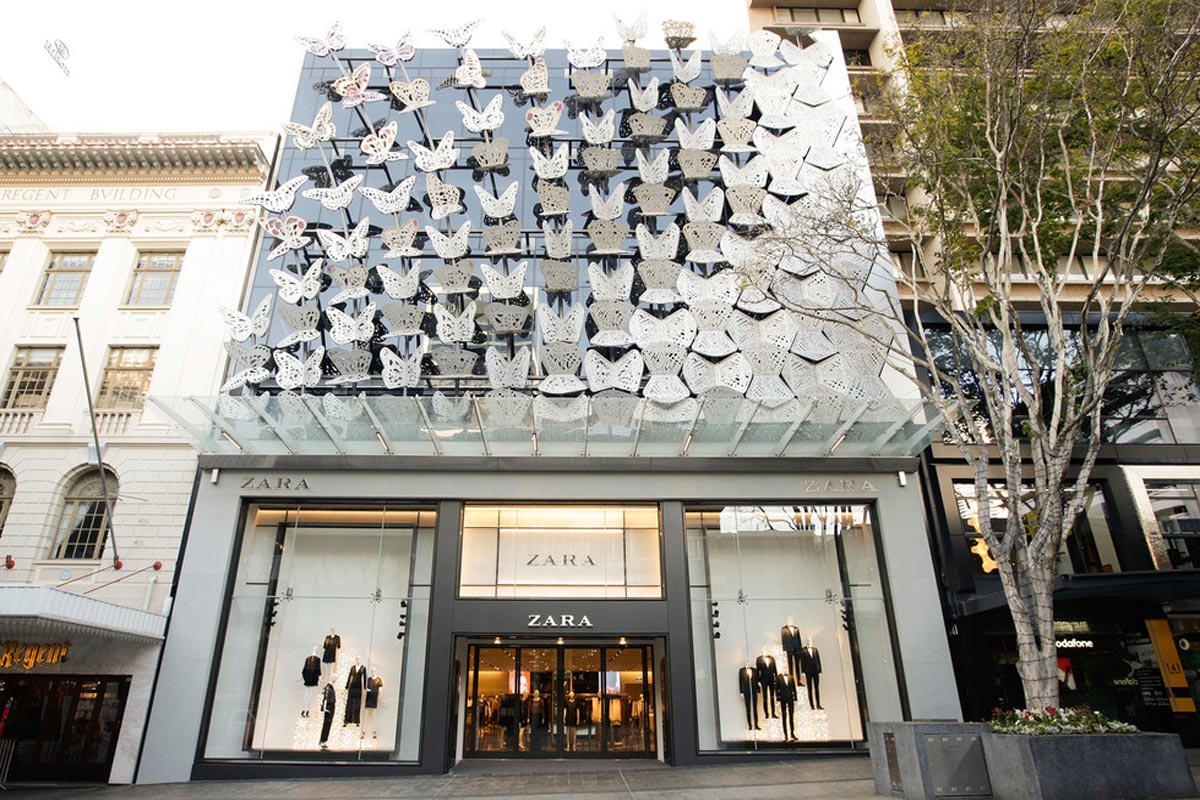
Ortega decided to sell directly to the customer himself. With what money remained, he leased a ground-floor space in the center of La Coruña. On May 15, 1975, the first Zara opened its doors. He had originally wanted to call it Zorba, after Anthony Quinn's character in the film Zorba the Greek - but that name was already registered. So he rearranged the letters and went with Zara instead.
Fast Fashion Before Fast Fashion Had a Name
The goal of Zara, Ortega said, has always been the democratization of fashion. Unlike the prevailing idea that fashion is a privilege of the wealthy, we offer accessible fashion inspired by the taste, passion and everyday life of modern men and women.
The province of La Coruña was ideal for the enterprise. For generations, men there had fished the Atlantic for cod while their wives wove cloth and sewed clothing for all of Spain. Ortega, with the instincts of a man who had been watching how businesses worked since the age of thirteen, built a structure that controlled the entire production chain - from textile factory to finished garment to retail floor.
Business analysts who have studied the Inditex phenomenon identify three pillars of its success: controlled labor costs, extraordinary speed of production, and a unique distribution system. Ortega built his supply network around hundreds of small workshops in the poorer provinces of Spain and Portugal - cooperatives of pensioners, single women, and in some cases young workers earning modest wages. The wages were low by national standards; the workers, in regions where no other work existed, were glad to have them.
Crucially, Ortega never shifted production to Southeast Asia, as most of his competitors eventually did. Chinese and Vietnamese labor was cheaper, yes - but what Ortega cared about was not minimum cost but maximum speed. The typical fashion company's production cycle - design in one country, dyeing in another, assembly in a third - takes between one and three months. Zara's complete cycle, from design concept to store shelf, takes as few as ten days. In a world where new trends are set by a Netflix series or a Taylor Swift video on Monday and expected in stores by the following week, that speed is decisive.
Ten days was not even his personal best. Inside Inditex, the legend persists: Ortega would sometimes call the design department himself to describe a jacket he had just seen on a motorcyclist at a traffic light. By evening, a sketch was expected on his desk. Within a week, the item would be hanging in stores.
The philosophy behind this was called fast fashion - a term Ortega essentially invented in practice. Each week, roughly a third of the items in his stores are replaced. The clothes are not designed to last forever. Discard what bores you. Buy what excites you now. This was not just a business model - it was a new relationship between consumers and clothing, and it reshaped the entire industry.
Equally striking is what Ortega does not spend money on: advertising. His main competitor, HandM, invests more than five percent of annual revenue in marketing. Zara spends less than half a percent. Ortega's conviction is that the best advertisement for a fashion brand is the clothing itself - seen on peers, worn in the street, desired because others desire it. Better to lower prices than spend money on billboards.
He also refuses, on principle, to hire celebrity designers to create collections - an industry staple. Zara builds its collections on close observation of what the world's best designers are producing, and delivers affordable versions of those ideas to stores faster than the originals can be copied by competitors. In the fashion world, this has never been entirely without controversy. But it has never stopped being profitable.
Brand After Brand
The success of Zara was rapid. By 1985, Ortega had opened his first international store, in Portugal. In 1989, Zara arrived in New York; in 1990, in Paris. On the basis of the growing store network, Ortega incorporated a holding company: Inditex. In 1991 came Pull and Bear, aimed at teenagers. Then Massimo Dutti for older customers. In 1998, Bershka. Then Stradivarius. Then Oysho, specializing in lingerie and loungewear. In 2001, Inditex went public on the Madrid stock exchange. In 2003, a Zara opened in Moscow - since closed following Russia's invasion of Ukraine in 2022, when Inditex withdrew from the Russian market entirely, where it had been generating six percent of total revenues.
Today, Inditex operates approximately 5,460 stores across 93 markets worldwide, having made a strategic decision to reduce the number of locations while making each one larger. Annual revenues for fiscal year 2025 exceeded 40 billion euros - roughly $45 billion. Profits reached a record 6 billion euros. Ortega himself, who owns approximately 59 percent of Inditex, receives more than 3 billion euros annually in dividends alone - and reinvests most of it in real estate.
His property portfolio, managed through his private holding company Pontegadea, spans prime office buildings and logistics properties in Madrid, London, New York, Seattle (including a building occupied by Amazon's headquarters), Miami (where he owns The Epic Residences and Hotel, one of the most luxurious properties in the United States), Paris, Lisbon, and elsewhere. He also owns Torre Picasso, the famous 43-story office tower in Madrid. The portfolio's total value has been estimated above $17 billion.
The Private Life of the World's Richest Retailer
None of this wealth has visibly changed Amancio Ortega's daily life. He continues to live in La Coruña. He eats in the employee cafeteria. He hosts no banquets and attends no galas. He is rarely photographed and has given fewer than three interviews in his life. When he is photographed, he is wearing a blue blazer, a white shirt, and grey trousers - none of them from Zara.
His one known extravagance was a private jet, a Bombardier Global Express BD-700, which he once used to fly around the world for a purpose that also revealed his method: he would land in a city, take a taxi to the center, walk the neighborhood, list the available rental spaces, then sit at a café and watch the flow of people for hours before deciding whether to open a store. After the aircraft was involved in a near-catastrophe over the Mediterranean, he lost his appetite for flying. The jet is now leased out. Ortega bought himself a yacht, the Valoria, and a farm outside the city.
He married his second wife, Flora Pérez Marcote, in 2001, having lived separately from Rosalía Mera since the mid-1980s and divorced her in 1986, paying what was at the time the largest divorce settlement in Spanish history - 600 million dollars in company shares. Flora had been his personal assistant and had given birth to their daughter Marta in 1984.
Rosalía Mera, who had co-founded Zara and was for many years the richest self-made woman in Spain, died in August 2013 from a brain hemorrhage while on holiday with her daughter on the island of Menorca. She had remained a director of the Amancio Ortega Foundation until her death.
The Heiress Who Stacked Shelves
In November 2001, the staff of a Bershka store inside a shopping center in La Coruña received a shock. The quiet 17-year-old salesgirl who had been calmly restocking shelves for over a year - a tanned, modestly dressed young woman named Marta Pérez - turned out to be the new owner of the entire chain. Marta was Amancio Ortega's younger daughter.
After a heart attack that year prompted Ortega to think seriously about succession, he concluded that Marta was the right person to eventually lead the empire. His elder daughter Sandra had devoted herself to raising her three children and to the charitable foundation. Marta would have to earn it. She was to join a store without any special status and work for a full year without privileges.
She did. Then she went further: running a store in London, managing operations in Shanghai and New York, working her way through every layer of the organization before joining Inditex's board of directors. In 2022, she became Chairwoman of Inditex - the most powerful position in the world's largest fashion company. She now lives in La Coruña with her husband, Spanish equestrian champion Sergio Álvarez Moya (Marta is a professional rider herself; her father built her a personal equestrian club, Casas Novas), and their son, named Amansio Ortega Álvarez after his grandfather.
The Philosophy Behind the Silence
Amancio Ortega's fortune, as of 2026, places him among the ten wealthiest people on earth - the richest person in Spain, and one of the most successful retail businessmen in history. He achieved this without ever seeking attention, without celebrity endorsements, without investor roadshows, and without a single memorable public statement beyond a handful of sentences about the democratization of fashion.
What he built instead was a system: one that moved faster than anyone else, cost less to operate than rivals assumed was possible, and compounded returns so quietly and so consistently that by the time the world understood what had happened, a man who had started by sewing bathrobes in his living room in 1963 was worth more than most countries spend in a year.
In a world that rewards loudness, the lesson of Amancio Ortega is unusual. Sometimes the quietest person in the room is the one who has already won.