
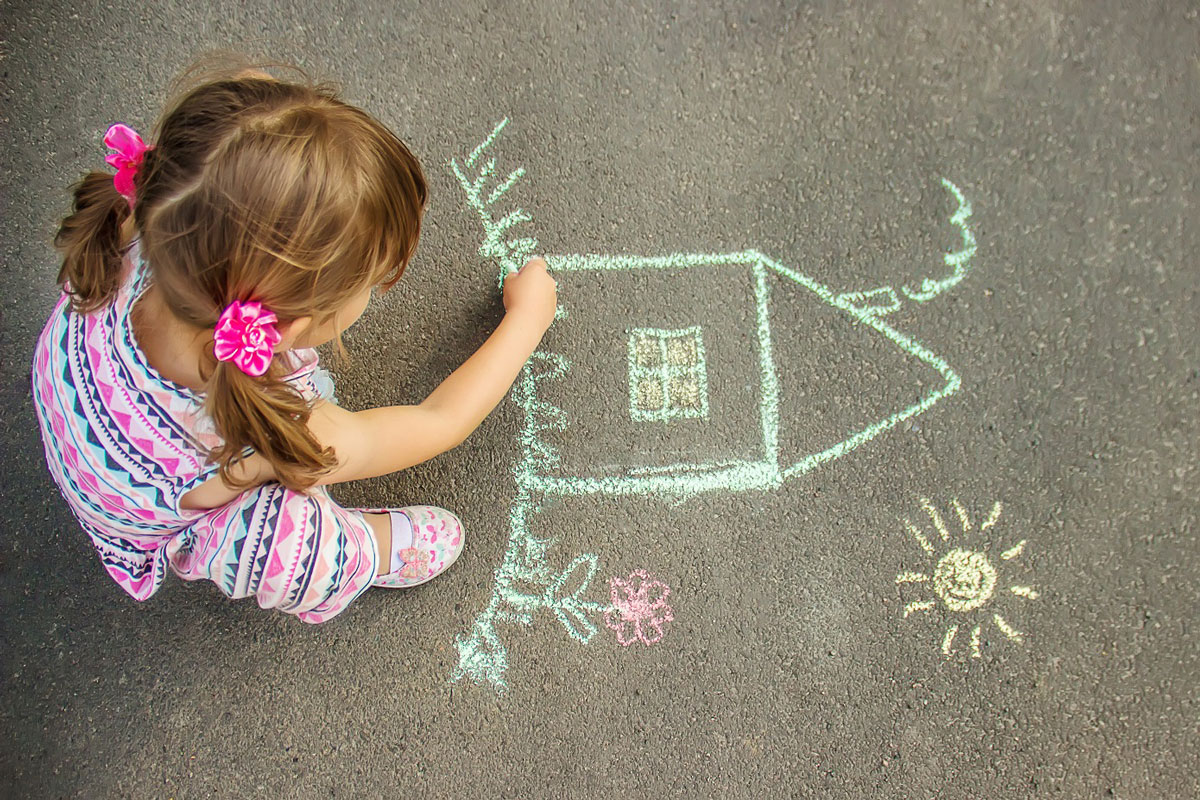
How to read a childs drawing
Maybe he is trying to tell you something
A childs drawing is rarely just a picture. To an adult, it may look like a house, a sun, a mother, a father and a few figures with uneven arms. To the child, it may be a way of describing a world they cannot yet explain in words. A drawing can contain joy, fear, jealousy, a need for attention, a sense of safety or, on the contrary, inner tension. But childrens drawings must be read with great care: not as a diagnosis and not as a ready-made psychological code, but as an invitation to look more closely at the child and speak with them more gently.
Drawing can indeed reveal a great deal. Not because every colour or every line has a universal secret meaning, but because children often express through images what they find difficult to put into language. A child may not say, “I miss Dad,” “I am jealous of the baby,” “I am afraid when people argue,” or “I want to be noticed.” But sometimes these feelings may appear in whom they draw, whom they leave out, whom they make large, whom they make small, who stands nearby and who ends up far away.
The main mistake parents make is trying to decode a drawing like a puzzle. One black crayon does not mean depression. A large figure does not always mean dominance. The absence of a family member is not automatically a warning sign. A child may be tired, may not have had time, may have forgotten, may not have wanted to draw a complicated figure, or may simply have been absorbed in another part of the story. A child’s drawing matters not by itself, but in context: the child’s age, mood, behaviour, family situation and, most importantly, what the child says about the picture.
Why drawing helps us understand a child
Many parents assume that the simplest thing is just to talk. But children, especially young ones, do not always know how to explain their feelings in words. Even adults often struggle to describe anxiety, hurt, loneliness or fear honestly. For a child, it is even harder: they may feel a great deal, but not yet have the language for it.
Drawing gives a child freedom. On a sheet of paper, they do not have to answer correctly, choose adult words or justify their emotions. They can show the world as they feel it at that moment. That is why a drawing can sometimes become a gentle way to see what the child is not saying directly.
But it is important not to turn drawing into a test. If an adult stands nearby, corrects the child, asks too many questions or says, “Why did you draw Dad like that?”, the child quickly begins to draw not themselves, but the adult’s expectations. Then the drawing loses its most valuable quality - sincerity.
How to invite a child to draw the family
One of the most common subjects for observation is a family drawing. Offer the child a simple phrase: “Draw our family however you want.” Do not specify who must be included, do not suggest the size of the figures, and do not ask the child to add a grandmother, a dog or a younger sister. The fewer instructions you give, the more freedom the child has.
It is best to give the child paper, pencils or markers and some space. There is no need to monitor every line closely. You can be nearby, but do not interfere. Observe calmly: whom the child draws first, whom they spend more time on, whom they place nearby, whom they place far away, whether they return to a particular figure, and whether they comment while drawing.
When the drawing is finished, do not rush to conclusions. It is better to ask softly and openly: “Tell me who is here,” “What are they doing?”, “Who is standing where?”, “What is happening in this picture?” Often the child’s explanation is more important than any outside analysis. What seems alarming to an adult may have a very simple meaning for the child.
What to pay attention to
First, notice whom the child included and whom they did not. If someone close to the child is absent, that is not a reason to panic, but it is a reason to ask gently: “Where is Dad?”, “Was your brother there too?”, “Did you want to draw him?” Sometimes the child will explain: “Dad is at work,” “My brother is sleeping,” “I didn’t have time,” “He is in another room.” But if the same person repeatedly disappears from drawings, or the child clearly avoids talking about them, that may be a meaningful signal.
Second, look at the distance between figures. If everyone stands close together, holds hands or looks at one another, it may reflect a feeling of closeness and safety. If the child draws themselves far away from everyone else or separately, this may suggest loneliness, hurt or emotional distance. Again, what matters is not one drawing, but a recurring pattern.
Third, consider the size of the figures. A very large figure may be perceived by the child as important, powerful, strong or dominant. A very small one may feel less visible, weaker or more distant. If a child consistently draws themselves tiny beside large adults, it may be worth paying attention to their self-perception. Perhaps they lack confidence, a sense of voice or emotional space.
Fourth, notice detail. The person whom a child draws with special care often occupies an important place in their inner world. This may be a beloved person, an authority figure, someone they admire, or, conversely, a source of strong emotion. It is important to look not only at the beauty of the drawing, but at the emotional emphasis.
Fifth, look at facial expressions and actions. Smiles, open postures, shared activity, play, a walk or a celebration may point to a pleasant emotional experience. Shouting, sharp teeth, aggressive gestures, tears, heavy crossing-out or scenes of conflict deserve more attention. There is no need to be frightened immediately, but it is worth gently asking what is happening in the picture and how the characters feel.
Sixth, notice hands. In popular interpretations, missing hands are sometimes linked to a feeling of helplessness or inability to act. But in young children, this is often simply a stage in drawing development. Age matters. If a child already draws figures well but repeatedly shows someone without hands in emotionally tense scenes, it may be worth looking more closely.
Seventh, consider colour. Colours may reflect mood, but they do not work as a rigid chart of meanings. Red may suggest anxiety, anger or simply a favourite colour. Black may mean fear, drama, contrast or the choice of the strongest pencil. The important question is not whether the child used a dark colour once, but how they use it, what stories repeat and how they themselves explain the picture.
What parents should not do
Do not interrogate. Questions such as “Are you afraid of Dad?” or “Why did you draw yourself so small?” may frighten the child and make them withdraw. Ask neutrally instead: “Tell me about this person,” “What is he feeling?”, “Where are you in the picture?”
Do not scold a child for a “wrong” drawing. If the child drew the family differently from the way you hoped, it is not an insult and not a verdict on you as a parent. It is their experience at a particular moment. Your task is not to correct the picture, but to understand what may stand behind it.
Do not make major conclusions from one drawing. Children draw under the influence of mood, fatigue, cartoons, conversations, events at daycare or school. Repeated themes are what matter: who keeps disappearing, who is always far away, who is always angry, who is always small, where the child places themselves and what stories they tell.
When to seek professional help
An unusual drawing by itself does not mean there is a problem. But if drawings suddenly become consistently dark, aggressive or frightening, if a child repeatedly depicts themselves as alone, disappearing, injured or helpless, if scenes of violence, intense fear or destruction appear often, and if the child’s behaviour also shows anxiety, withdrawal, sharp mood changes, sleep problems or refusal to communicate, it is better not to guess on your own.
In such a situation, it is wise to consult a child psychologist. Not to “diagnose by drawing,” but to gently understand what is happening with the child and help the family create a calmer and safer environment.
The child matters more than the drawing
Children’s drawings can be surprisingly honest. But they should not become a tool for parental anxiety or a reason for rushed accusations. They are more like a window through which we can glimpse how a child feels in the family, among loved ones and within their small world.
If you want children’s drawings to show more closeness, warmth and calm, do not begin with the pencils. Begin with the atmosphere at home: attention, conversation, predictability, respect for the child’s feelings and the willingness to hear them even when they speak not in words, but in lines, colours and small figures on a sheet of paper.