
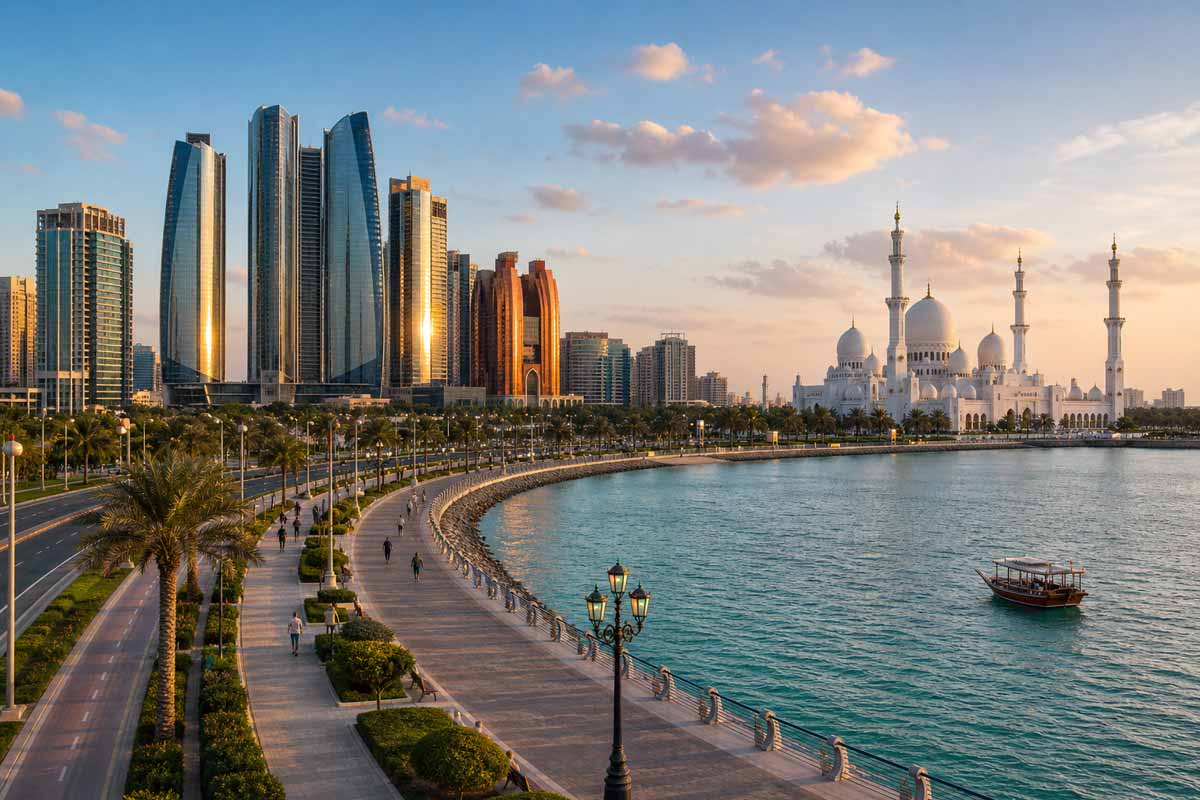
The quiet luxury of the Emirates: why Abu Dhabi deserves the trip
Dubai knows how to enter the frame first. It is louder, taller, faster, more visible. It has long been the tourist symbol of the UAE - a city of skyscrapers, shopping malls, beach clubs, records and spectacular energy. But the United Arab Emirates has another capital: calmer, wealthier and perhaps more interesting for travellers who are already tired of trips built only around the “wow” effect.
Abu Dhabi long remained in the shadow of its northern neighbour not because it had nothing to show. Quite the opposite: it did not need to prove its importance so insistently. It is the largest emirate in the country, the political centre of the UAE and one of the wealthiest regions in the world. A significant share of the nation’s oil wealth is concentrated here, but the real intrigue of today’s Abu Dhabi lies elsewhere: the city is increasingly transforming raw-resource power into cultural, tourism and architectural power.
If Dubai built its image of the future as a show, Abu Dhabi is building the future as a system. Museums, beaches, entertainment islands, mangrove reserves, new aviation infrastructure, family resorts, Formula 1, art districts, high-end hotels and a long-term bet on cultural tourism. This is no longer just a “day trip from Dubai,” but a destination in its own right - one that is increasingly competing for travellers who want not only spectacle, but meaning.
Recent figures show that the strategy is working: according to the Department of Culture and Tourism Abu Dhabi, the emirate welcomed 26.6 million visitors in 2025, while hotel revenues reached AED 9.1 billion. The official Tourism Strategy 2030 sets an even more ambitious target: 39.3 million visitors and a tourism contribution to GDP of AED 90 billion by 2030.
For readers from Toronto, Abu Dhabi also has a purely practical advantage: it is not only a point on the map of the Persian Gulf, but also a convenient aviation hub. Etihad lists a direct Toronto-Abu Dhabi route with a usual flight time of around 13 hours and 20 minutes, and Terminal A at Zayed International Airport is one of the largest and most technologically advanced terminals in the region.
But the main reason to look more closely at Abu Dhabi is not logistics. The main reason is its tone.
This is a city where luxury increasingly looks not like gilding, but like space. Wide roads, clean waterfronts, island resorts, green areas, calm architecture, less rush, less aggressive visual noise. In Abu Dhabi, one can still experience Arabian scale - but without the feeling that you are constantly being persuaded to be impressed.
Corniche: a city with room to breathe
One of the best places to feel this difference is the Corniche. In Gulf cities, walkability is not always an obvious quality: many areas in the region were historically built around the car, air-conditioned shopping centres and quick movement between destinations. Abu Dhabi is softer in this sense. There are genuinely places to walk - along the sea, beaches, parks, bicycle paths, cafés and viewpoints.
The Corniche is not just a postcard. It is an urban stage where the character of the capital becomes visible: water and beach on one side, towers, hotels, offices, restaurants and city life on the other. It does not have Dubai’s nervous verticality, but it does have a sense of measured calm. Abu Dhabi does not cancel the metropolis; it makes it easier to breathe inside it.
This side of the city reveals itself even more strongly in the mangrove areas. Eastern Mangrove Lagoon and other coastal ecosystems are reminders that Abu Dhabi is not only oil, concrete and glass. Mangroves protect the shoreline, provide habitat for birds and marine life, and offer visitors a rare opportunity in the Emirates to see nature not as hotel décor, but as a living part of the city. Kayaking among the mangroves is one of those experiences that changes your understanding of Abu Dhabi: it turns out that here, one can seek not only air-conditioned comfort, but quiet.
Saadiyat Island: beach, art and a new cultural geography
The second key to understanding the city is Saadiyat Island. Its name is often translated as “island of happiness,” which may sound almost too promotional to a traveller. But Saadiyat really has become the place where Abu Dhabi gathered its strongest arguments: white sand, calm sea, five-star resorts and a cultural district gradually becoming one of the most ambitious museum projects in the world.
The beach side of Saadiyat is about soft sand, beautiful water, space, good hotels and a more relaxed rhythm. It is especially appealing to those who want a premium beach stay without the feeling of crowds. An important detail: the island is connected to conservation efforts, including protection of hawksbill sea turtles that nest on local beaches. Saadiyat therefore feels not merely like another “luxury shore,” but like an attempt to connect resort economics with care for the place itself.
But Saadiyat’s true global recognition came through Louvre Abu Dhabi. It is important to correct an old misconception: this is not a branch of the Paris Louvre in the usual sense. It is an Emirati museum created under an intergovernmental agreement between France and the UAE. The Louvre itself calls it the first universal museum in the Arab world, and the agreement allowed Abu Dhabi to use the Louvre name and collaborate with French cultural institutions.
Louvre Abu Dhabi is powerful not only because of its collection. Yes, it presents art from different eras and civilizations, arranged not according to the usual national principle, but as a conversation between cultures over time. Yet Jean Nouvel’s building may well be the main exhibit. Its enormous silvery dome weighs around 7,500 tonnes - roughly the same as the Eiffel Tower - and consists of 7,850 “stars” layered in eight levels. Light passes through this structure in patches, creating the effect known as a “rain of light.”
This is one of the rare museums worth recommending even to people who usually get tired of museums. Not because you can rush through the galleries in an hour, but because the spatial experience itself works almost physically: water, shade, stone, dome, light, silence. In Dubai, viewers are often struck by height. At Louvre Abu Dhabi, they are struck by pause.
And this is only the beginning of the cultural bet. The Saadiyat Cultural District has already gained important new institutions: Zayed National Museum officially opened on December 3, 2025, dedicated to the history of the UAE and the legacy of Sheikh Zayed, while Guggenheim Abu Dhabi, designed by Frank Gehry, is expected to become the largest museum in the Guggenheim network and further strengthen the district as an international centre for contemporary art.
This is where Abu Dhabi becomes especially interesting. It is not trying to copy a European museum capital, nor is it simply buying famous names. It is building a new cultural geography: the Arab world as a place where East, West, Africa, South Asia, Islamic heritage, contemporary art, architecture and the money of the future meet. Of course, there is strategy in this. But for the traveller, the result is very concrete: Saadiyat is gradually becoming a place worth planning an entire trip around.
Yas Island: speed, parks and the family scenario
If Saadiyat is the island of art and beach quiet, Yas Island is the opposite pole. It is an island of speed, adrenaline and family entertainment. It is home to Yas Marina Circuit, where the Formula 1 Grand Prix is held, and around it has grown an entire world of theme parks, hotels, restaurants, shopping centres and attractions.
Ferrari World Abu Dhabi remains one of the main symbols of Yas. It is the world’s first Ferrari theme park, and Formula Rossa remains one of the most extreme roller coasters on the planet: acceleration up to 240 km/h, a height of 52 metres and forces reaching 4.8G.
Nearby are Warner Bros. World Abu Dhabi, Yas Waterworld, SeaWorld Abu Dhabi, CLYMB Abu Dhabi with indoor extreme activities, Yas Mall, the beach, golf, hotels and free island shuttles. For a family, this is a highly convenient structure: one can stay on Yas for several days and hardly think about logistics. For children, there is entertainment. For adults, there are restaurants, beach time, Formula 1, shopping and the chance not to turn every day into a transfer.
Then comes another blow to Dubai’s monopoly on big headlines: Disney and Miral have announced plans to build a new Disney theme park on Yas Island. It will be the first Disney park in the Middle East, and the very fact of the project shows where the island is heading.
To put it directly, Yas is no longer merely a “local entertainment island.” It is a bid to become one of the world’s leading themed entertainment clusters. Here Abu Dhabi is acting pragmatically: it is not competing with Dubai on the field of skyscrapers, but assembling an alternative - culture on Saadiyat, entertainment on Yas, nature in the mangroves, a government and heritage core in the centre, and premium resorts along the shore.
Luxury without haste
At the same time, Abu Dhabi has something Dubai often lacks: a sense of less hurry. This does not mean the city is provincial or dull. Quite the opposite - there is a great deal of money, ambition and development here. But its energy is less demonstrative. In Dubai, the visitor is almost inevitably invited to participate in a performance of success. In Abu Dhabi, you can allow yourself simply to observe - and that can be far more pleasant.
Who is this city especially right for?
First, for those who have already been to Dubai and want a different version of the Emirates. Not “even higher and even brighter,” but calmer, more cultural, more spacious.
Second, for families. Yas provides clear entertainment infrastructure, Saadiyat offers beaches and hotels, and the city provides safety, comfort and good logistics.
Third, for mid-range and premium travellers who care about hotel quality, beach, service and comfort, but do not want to live inside a constant show.
Fourth, for those flying through the Gulf onward to India, Southeast Asia, Africa or the Maldives. Abu Dhabi is easy to turn into a two- or three-day stopover, but it would be a mistake to think that two days are enough. Today, this destination asks for more time.
There are nuances. Summer heat can be extreme, so the best season for walking, beaches and an active itinerary is roughly from November to March. Nightlife exists, but it is not the city’s main point. Those looking for a round-the-clock club rhythm will probably find Dubai more suitable. Abu Dhabi wins not through the number of stimuli, but through the quality of the pauses between them.
Not an alternative to Dubai, but another Emirates scenario
The best travel scenario is not to oppose the two cities, but to use their difference. Dubai and Abu Dhabi are separated by roughly 140 kilometres and can be combined conveniently in one itinerary. But if Abu Dhabi used to be treated as “one day for the mosque, the Louvre and Ferrari World,” that approach now feels outdated. The city has outgrown the excursion format.
The Sheikh Zayed Grand Mosque remains one of the strongest visual impressions in the capital. Its white marble, symmetry, scale and evening lighting create a sense of ceremony that modern buildings rarely achieve. But today’s Abu Dhabi no longer depends on one or two symbols. It is compelling as a system: the mosque, the Louvre, Saadiyat, Yas, the mangroves, the Corniche, Qasr Al Watan, Qasr Al Hosn, new museums, beach resorts, Formula 1, gastronomy, the airport and a cultural strategy.
That is why the question “Abu Dhabi or Dubai?” is becoming the wrong question. Dubai remains powerful, bright, convenient and easy to sell as a destination. But Abu Dhabi no longer looks like its quiet appendix. It offers another kind of luxury - less nervous, less vertical, less dependent on records.
This is its new strength. Abu Dhabi wants to be a city people return to not only for photographs, but for a feeling of space, taste and quiet confidence.
And perhaps that is exactly what feels most attractive today.