
How to wear a bandana with style
A bandana is one of those small accessories that can change an entire outfit faster than a new jacket or an expensive bag. A square of cotton may seem simple, almost accidental, but behind it stands a surprisingly long cultural biography: shepherds, cowboys, workers, bikers, hippies, hip-hop, skaters, runways, resort collections and modern street style. That is the power of the bandana. It can be practical, rebellious, romantic, relaxed or almost aristocratic - depending entirely on how you wear it.
A classic bandana is usually a square cotton scarf with a bold ornamental print. The most recognizable pattern is paisley, with its curved teardrop motifs. It is important not to confuse this with jacquard: jacquard is a weaving technique, while paisley is a motif. Its history reaches back to Persian and Indian textile traditions, while its Western name is associated with the Scottish town of Paisley, where fabrics with this ornament were widely produced in the nineteenth century. The word bandana itself is more often connected not with the Spanish banda, but with the Indian bandhani - a tie-dye textile technique whose name comes from a Sanskrit root meaning “to bind” or “to tie.”
The practical past of the bandana is equally rich. Shepherds and cowboys used it to protect the face from dust, sun and wind. Workers wore it around the neck or head to absorb sweat and shield themselves from dirt. In American culture, the bandana became part of the cowboy image, and later an element of biker, rock, skate and hip-hop aesthetics. In the 1960s and 1970s, hippies embraced it as a symbol of freedom and informality. Later, the bandana became part of street fashion - sometimes a sign of belonging to a particular subculture, sometimes simply a way to give an outfit more character.
Today, the bandana feels current again not because fashion is merely nostalgic, but because modern style loves objects with history. It has appeared in the language of Dior, Gucci, Jacquemus, Saint Laurent and many independent brands. But wearing a bandana well means not turning it into a caricature. Balance is everything: a little Western, a little French nonchalance, a little summer freedom - but never the feeling of a costume for a themed party.
Method 1. Classic on the head
The most recognizable option is to fold the bandana diagonally into a triangle, place the centre against the forehead and tie the ends at the back of the head. It is a direct, strong gesture with references to retro style, biker culture, beach dressing and early streetwear.
To make it feel modern, keep the rest of the outfit calm: a white tank, an oversized shirt, jeans, linen trousers, minimal sunglasses. The brighter the bandana, the less decorative noise you need around it. If the scarf is too large, fold the edge slightly before tying it so it sits closer to the head and does not create unnecessary bulk.
Method 2. As a slim headband
Roll the bandana into a narrow strip and tie it around the head. The knot can sit on top, to the side or at the back. A front knot gives a more feminine, slightly 1960s effect. A back knot feels calmer, more contemporary and works for both women and men.
This method is especially useful in summer: hair is kept away from the face, and the outfit looks intentional without becoming too dressed up. A bandana headband works beautifully with loose hair, a low ponytail, soft waves, a short haircut and even a very minimal outfit that needs one lively accent.
Method 3. Around a hat
A bandana can replace the ribbon on a hat - straw, cowboy, fedora or boater. Fold it into a strip, adjust the width to the proportions of the crown and wrap it neatly around the hat. The ends can be tucked in, tied in a small knot or left to fall loosely on one side.
This is one of the most beautiful summer uses, especially for travel, beach towns, wineries, music festivals and relaxed resort style. The main rule is not to overload the outfit with too many other active details. A hat with a bandana is already expressive enough on its own.
Method 4. Under a baseball cap, bucket hat or sun hat
A bandana can also be worn under another hat - a baseball cap, bucket hat, panama hat or soft summer hat. For this, it is better to choose a smaller, thinner scarf, fold it into a strip or triangle and tuck the ends so the fabric does not bulge.
This method has a practical purpose: the bandana protects the hair, absorbs sweat and adds another layer to the look. Visually, it belongs closer to skate, surf and outdoor aesthetics. To avoid looking accidental, keep the palette under control: for example, a neutral bucket hat, white T-shirt, denim shorts and a bandana in one accent colour.
Method 5. In the hair
A bandana works beautifully as an accessory for women’s hairstyles. It can be tied around a low ponytail, wrapped around the base of a bun, woven into a braid or used instead of a scrunchie. This instantly makes the outfit feel more alive and summery, even if the clothes are very simple.
For a more elegant effect, choose a bandana in muted tones or a softer fabric. For a vacation, festival or beach setting, a brighter colour and stronger pattern can work beautifully. A bandana looks especially good with a white shirt, linen dress, denim jacket, gold earrings and natural makeup.
Method 6. As a top
A bandana can be worn as a crop top or light summer top, but this method requires taste and the right context. It works best at the beach, in a resort look, at a music festival or in a very relaxed summer setting. For the city, soften the effect: wear an open white shirt, linen blazer, denim jacket or light cardigan over it.
The fabric must be dense enough, and the scarf must be the right size. A bandana that is too small will look unsafe and accidental; one that is too thin will not hold the right shape. A more grown-up version is not to tie it as a revealing top, but to use it under a jacket or shirt as a colour accent.
Method 7. Instead of a belt
Roll the bandana into a strip, thread it through the belt loops of jeans, shorts or linen trousers and tie it in front or to the side. This works best with a high or mid-rise waist, where the bandana actually emphasizes the waist rather than looking like a random cord.
For women, this is often easier because there are more trousers and skirts with a higher rise. Men should choose a larger bandana or use it not as a full belt, but as a decorative detail on one belt loop. This keeps the outfit calmer and more contemporary.
Method 8. Around the neck
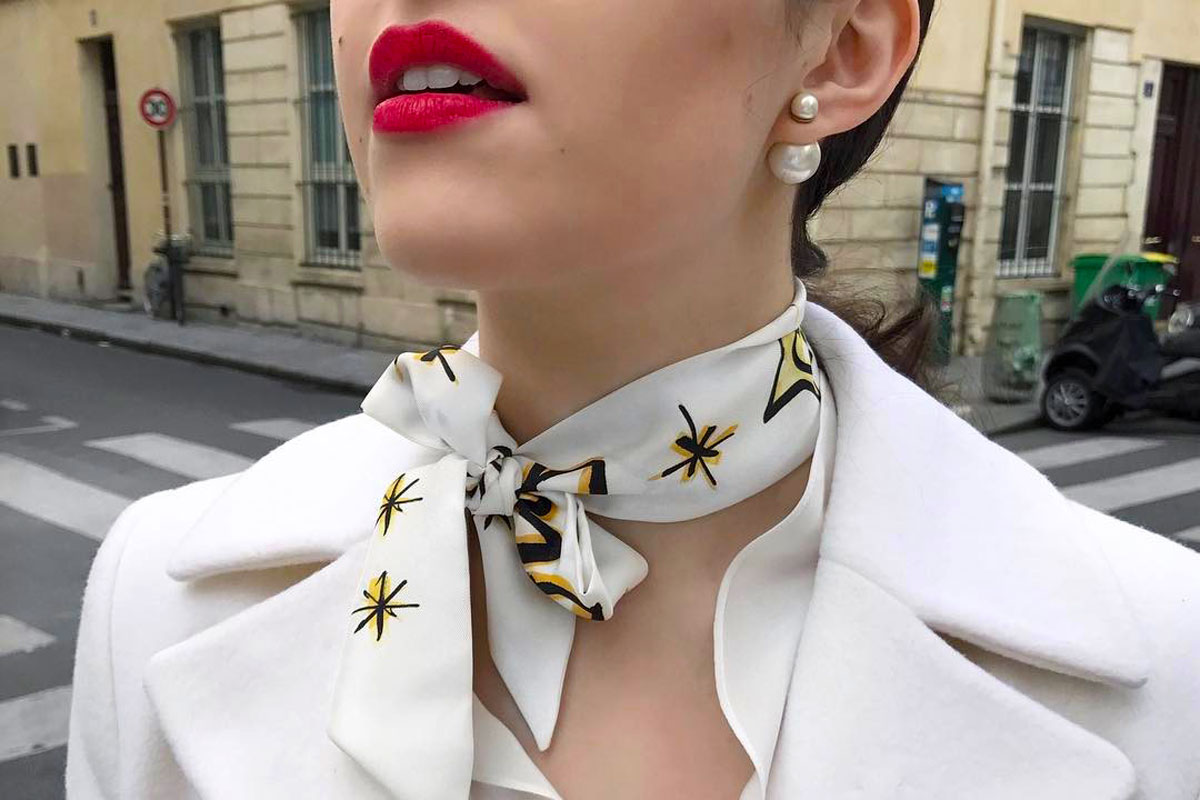
A bandana around the neck is one of the most stylish and versatile options. It can be worn as a small scarf, a loose cowboy neckerchief, a choker or a neat knot under the collar of a shirt. Much depends on the fabric and how close it sits to the neck.
A tightly tied bandana looks graphic and slightly rock-and-roll. A loose knot in front creates a more relaxed Western mood. If the bandana is barely visible under a buttoned denim or cotton shirt, it begins to function almost like a silk neck scarf, but without the formality.
This method adapts easily to different styles: with a leather jacket, the look becomes more rock-inspired; with a white shirt, it feels French and effortless; with denim, it leans Western; with a linen suit, it becomes resort elegant.
Method 9. As an accent on a bag, wrist or pocket
If you are not ready to wear a bandana on your head or neck, use it as a small decorative accent. Tie it to the handle of a bag, around the wrist, on a belt loop, near the waist, around the ankle or place it in a chest pocket as a relaxed pocket square.
On a bag, a bandana looks best not when it completely wraps the handle, but when it is tied in a small knot at one attachment point. This makes the accessory feel alive without looking overdone. It works especially well with bags in Western, boho, denim, canvas, raffia, suede, vintage or casual leather styles. With a very strict classic bag, it may look accidental unless the rest of the outfit supports the idea.
How to choose a bandana
The most versatile bandana is cotton, square, medium-sized and printed with a clear but not overly loud pattern. Red, navy, black, white, sand, olive or chocolate will be easier to incorporate into a wardrobe than neon or excessively busy colours.
For a more elevated effect, pay attention not only to the print, but also to the fabric. Cotton feels casual and honest; silk or a cotton-silk blend is softer, more feminine and more elegant; linen feels more relaxed and resort-like. The finer and more refined the fabric, the less the bandana resembles a costume accessory and the more easily it enters a modern wardrobe.
The main rule
A bandana works best when it feels like a natural part of the outfit, not an attempt to play a role. If you combine it with cowboy boots, a leather jacket, a hat, fringe and heavy jewellery all at once, the look may slip into costume. But if you take one bandana and pair it with a simple white shirt, jeans, a linen dress or a calm blazer, it immediately feels modern.
A stylish bandana is not about loudness. It is about character. It adds colour, history, movement and a touch of nonchalance. That is why this small square of fabric has lived so long in fashion: it does not dictate rules, but gives you a way to tune the outfit to yourself.