
An Island, divided without war
Saint Martin - Sint Maarten
Saint Martin - Sint Maarten: two countries, one island, no border - and everything else you should know before visiting.
On March 23, 1648, two soldiers met on Concordia Hill in the center of a small Caribbean island.
One walked from the north. The other from the south.
The point where they met became the border between France and the Netherlands - a border that still exists today.
According to legend, the French soldier carried a bottle of wine while the Dutch soldier brought gin. Before setting off, both men drank and began walking around the island in opposite directions. The Frenchman covered more ground. That, supposedly, is why the French side of Saint Martin occupies roughly sixty percent of the island, while Dutch Sint Maarten controls the remaining forty.
Of course, the story is a myth. Reality was more pragmatic: during negotiations, the French had naval power anchored offshore, and the Dutch preferred to compromise on territory rather than escalate the situation. Yet the legend survived because it captures the spirit of the island better than any official treaty ever could.
Saint Martin / Sint Maarten is often called “The Friendly Island.” It is not a tourism slogan. It is an accurate description of how life here actually works.
An Island Without Border Control
The island covers only about ninety square kilometers - roughly half the size of Toronto.
There are no checkpoints between the French and Dutch sides. No passport control. No customs booths, barriers, or immigration lines. The border is marked only by small roadside monuments and bilingual signs.
You drive along a lagoon with green hills on one side and palm trees on the other, and suddenly notice the pavement has changed, the road signs look different, and café menus switch into French. That is what crossing from one country into another feels like here.
For Canadians accustomed to the heavily controlled U.S. border, the experience feels almost surreal.
The Treaty of Concordia, signed in 1648, allowed residents of both sides to move freely across the island and share natural resources. That principle has survived for more than 370 years. Borders shifted sixteen times, empires changed, wars came and went - but the idea of an open island endured.
Two Different Islands Inside One
Officially, these are separate jurisdictions with different legal systems, currencies, and governments. In reality, they are two very different personalities separated by only a short drive.
French Saint Martin feels like Europe transplanted into the Caribbean.
As an overseas collectivity of France, it reflects European standards in gastronomy, service, and infrastructure. Fresh products arrive from Martinique and Guadeloupe, and many chefs were trained in the traditions of French culinary culture.
Marigot, the capital of the French side, resembles a small Mediterranean coastal town that somehow drifted into the tropics: seafood markets in the morning, café terraces, proper croissants, espresso that tastes unmistakably French, and a slower rhythm of life.
The beaches on the French side are generally less commercialized. There is more open space, less aggressive tourism, and a noticeably calmer atmosphere. French law guarantees public access to every beach - a principle that exists only theoretically in many parts of the Caribbean but is largely respected here.
Dutch Sint Maarten, by contrast, feels like the Caribbean with a practical Dutch approach.
There are more casinos, larger shopping districts, busier cruise terminals, and bigger resorts. Philipsburg, the capital, stretches along a broad bay lined with white sand and Front Street - the island’s main shopping boulevard, which turns into a flood of cruise passengers, music, jewelry stores, and duty-free boutiques whenever ships dock in port.
This is also where Princess Juliana International Airport is located - one of the most famous airports in the world. Most of the island’s commercial infrastructure is concentrated here: banks, supermarkets, marinas, yacht services, and major hotels.
In the simplest terms: the French side feeds you better, the Dutch side entertains you bigger.
Maho Beach and the Truth About the Airplanes
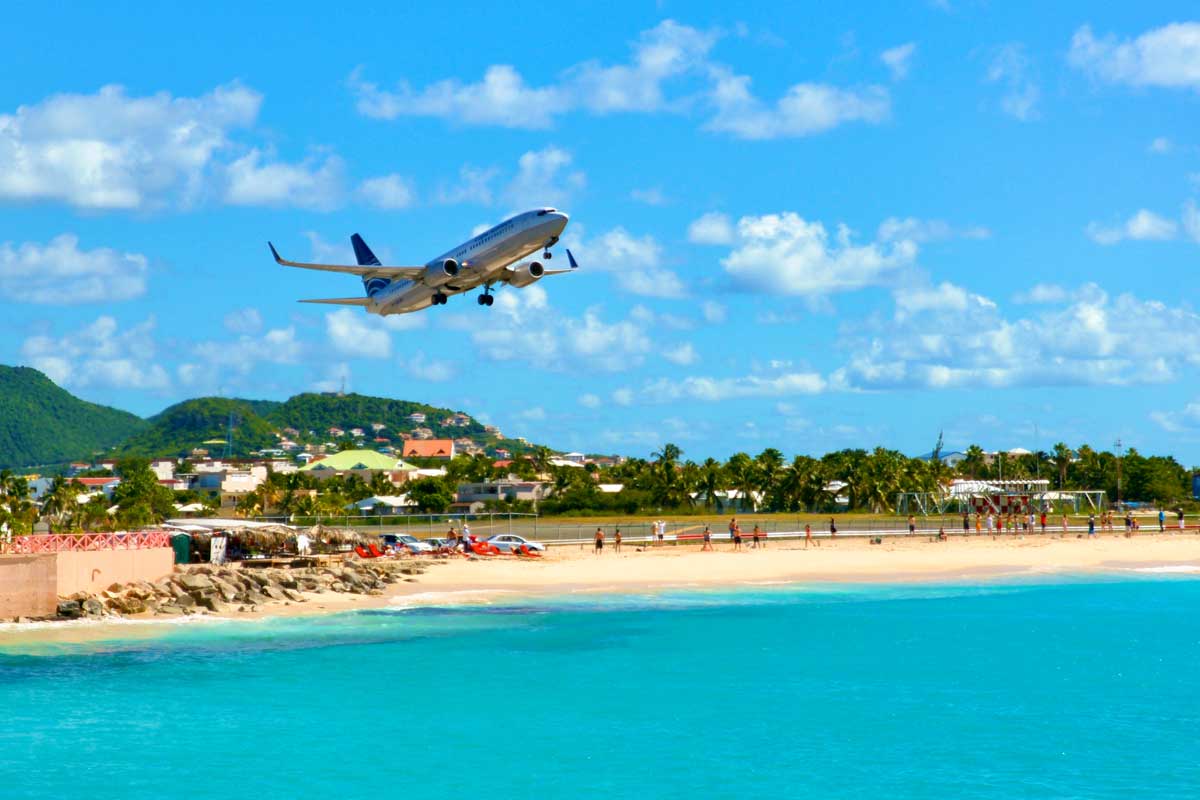
Maho Beach became an internet phenomenon long before Instagram existed.
The runway at Princess Juliana Airport ends only a few dozen meters from the beach. Landing aircraft pass so low overhead that visitors can see the landing gear, rivets, and airline logos in extraordinary detail.
Videos from this beach attracted millions of views back in the early YouTube era.
But there is an important detail many travel videos used to ignore.
In 2017, a woman was killed after jet blast from a departing aircraft threw her against concrete barriers near the runway. Following the incident, the famous fence people used to hold onto was removed, and safety warnings became much stricter.
Watching planes land from the beach remains safe and spectacular. Standing directly behind large aircraft during takeoff is not.
This is one of those places where reality is more impressive than social media - but also demands common sense.
Orient Beach: The French Version of Freedom
Orient Beach on the French side is an officially recognized nude beach - one of the few in the Caribbean with fully legal status.
The reality, however, is far calmer than many North Americans expect.
Most of the beach is a perfectly ordinary Caribbean shoreline with restaurants, loungers, kite surfers, and families in swimsuits. The naturist section occupies a separate area and coexists peacefully with the rest of the beach.
On French Caribbean territories, attitudes toward nudity are far less anxious and moralized than in Anglo-American culture. Topless sunbathing and naturism are generally treated as personal freedom rather than provocation.
On the Dutch side, Cupecoy Beach has a similar reputation - a smaller beach framed by sandstone cliffs, known for dramatic sunsets and a more secluded atmosphere.
At the same time, the island offers plenty of family-friendly beaches: Grand Case, Baie Rouge, Friar’s Bay, Baie Longue, Simpson Bay, and many others with soft sand, calm water, and excellent swimming conditions for children.
Flamingos, Lagoons, and Water Like Glass
Most visitors never venture beyond the resort beaches. That is a mistake.
On the French side lies the Saint-Martin Nature Reserve - a protected marine area of mangrove lagoons, coral reefs, sea turtles, and migratory birds. Pink flamingos can occasionally be seen in the salt ponds, especially during migration season.
Tintamarre and Pinel Island, just offshore from Saint Martin, are famous for snorkeling and remarkably clear turquoise water. Both can be reached by boat within minutes.
Mullet Bay, on the Dutch side, is considered one of the island’s most beautiful beaches: a wide curve of white sand, calm water, and far fewer tourists than nearby Maho Beach.
Meanwhile, Simpson Bay Lagoon - one of the largest inland lagoons in the Caribbean - is filled with yachts from around the world, reflecting how deeply the island is connected to international sailing culture.
Porto Cupecoy: Monaco in Caribbean Scale
On the Dutch side, near Simpson Bay Lagoon, lies Porto Cupecoy - a development often described as the Caribbean answer to Monaco.
A marina with fifty-four slips, including berths for megayachts up to seventy-five meters long. Mediterranean-inspired architecture with arcades, ochre façades, tiled roofs, restaurants, boutiques, and luxury residences directly connected to the marina.
Sint Maarten has become one of the primary yachting hubs of the Caribbean. Vast fleets of private vessels spend the winter season moving between Antigua, St. Barts, and the British Virgin Islands, and this island serves as one of their key logistical bases.
Private Villas and Public Beaches
On the French side, the Terres Basses district contains the island’s most exclusive residential enclave.
Large villas hidden behind gates, hedges, and palm trees. Private docks, cliffside pools, and estates worth tens of millions of dollars.
Yet French law maintains an important principle: shorelines remain legally public. Even beside the most secluded villa, beaches technically remain accessible by walking along the waterline.
In practice, access varies. But the principle itself remains unusual in a region where many coastlines are effectively controlled by resorts and private developments.
Irma: The Hurricane That Changed the Island
On September 6, 2017, Hurricane Irma - one of the most powerful Atlantic hurricanes ever recorded - struck the island directly.
Wind gusts approached 300 km/h. More than ninety percent of buildings on the Dutch side were damaged or destroyed. The French side suffered similarly devastating losses.
The airport shut down. The port stopped functioning. An island dependent on tourism became a humanitarian disaster zone within hours.
Recovery took years. The Dutch side rebuilt faster thanks to large-scale financial assistance and a more centralized administrative response. The French side recovered more slowly, and several hotels never reopened.
Today, the island has largely returned to full operation. But Irma remains part of local memory - and a reminder that even the world’s most beautiful places are never entirely protected from nature.
Practical Information
The French side uses the euro; the Dutch side primarily uses the U.S. dollar. Credit cards are accepted almost everywhere.
Canadian citizens can enter both sides visa-free.
The best time to visit is December through April. January to March is peak season. August through October carries elevated hurricane risk.
Renting a car is strongly recommended. It is the only practical way to explore both sides of the island, hidden coves, beaches, and viewpoints outside the resort zones.
Saint Martin / Sint Maarten is a rare example of a border that connects rather than divides.
Two countries. Two languages. Two currencies. Two political systems.
And one island where people have spent centuries living as though those differences matter far less than outsiders assume.
Perhaps that is why the story about the French soldier with wine and the Dutch soldier with gin survived for centuries.
Because in the end, the important part is not who walked farther.
The important part is that both sides decided not to fight.