
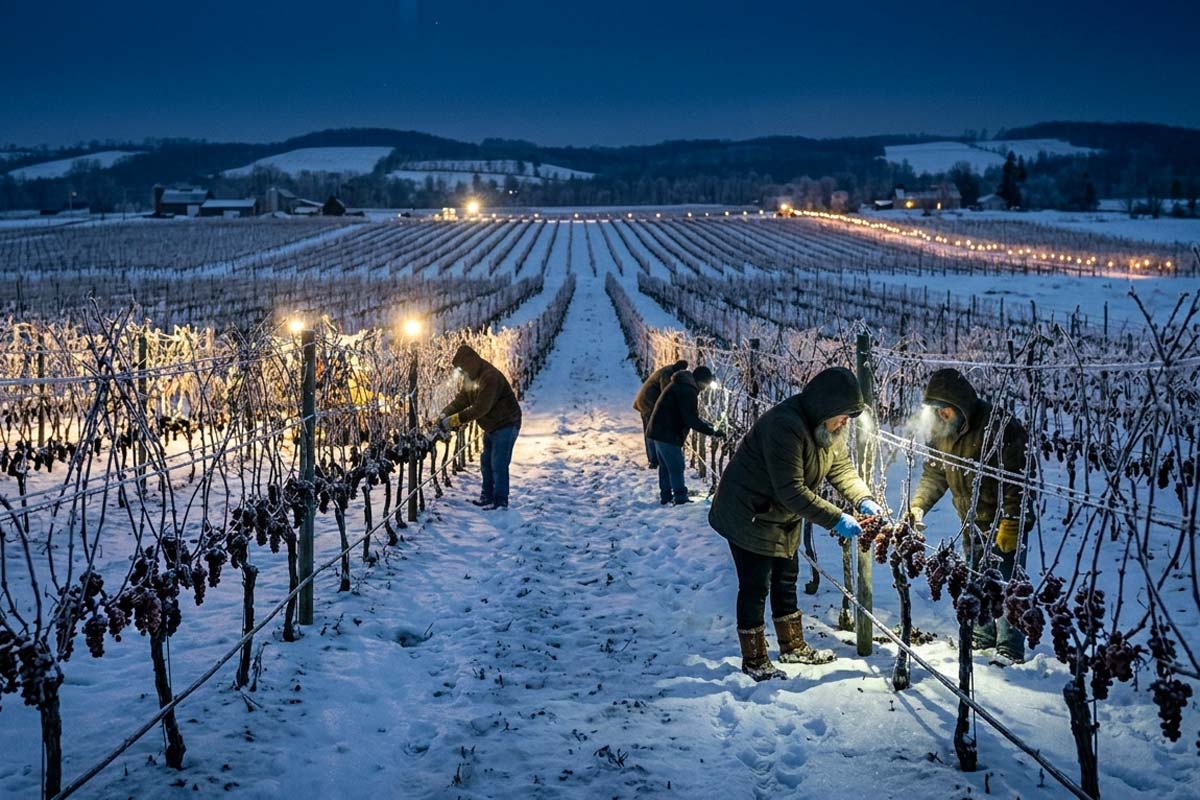
Liquid gold at minus eight
Why Niagara Icewine Is Not a Tourist Souvenir - But One of the Worlds Most Unique Wines. Every winter, something almost cinematic happens on Ontarios Niagara Peninsula: in the middle of the night, vineyard workers walk into frozen vineyards and harvest grapes by hand after they have turned to ice. Temperatures fall below -8°C. Sometimes far lower. The grapes, intentionally left on the vines long after the regular harvest, have spent months exposed to snow, wind, dehydration and occasionally noble rot. What remains inside is an intensely concentrated juice packed with sugar, acidity and aromatics - so concentrated that it does not fully freeze even in deep winter cold.
This is how Icewine is born.
Only a tiny amount of juice can be extracted from these frozen grapes. Several kilograms of fruit may produce just one small bottle. That is one of the reasons authentic Icewine commands premium prices around the world.
And it is also why great Icewine should never be dismissed as a “sweet tourist wine.” At its best, it is one of the most technically demanding and luxurious styles of winemaking on the planet.
From Germany to Niagara
The origins of Icewine trace back to Germany in the late 18th century, when an unexpected frost forced winemakers to press frozen grapes rather than lose the harvest entirely. The result was extraordinary: a wine with remarkable sweetness balanced by vivid natural acidity.
But in Europe, true Eiswein remained rare. Producing it requires both a high-quality harvest and a hard freeze at exactly the right time - conditions that do not happen reliably every year.
Canada changed the story. In 1984, Inniskillin Winery in Niagara-on-the-Lake released the country’s first commercial Icewine, and Canadian winemakers quickly realized they possessed something Germany did not: dependable winter freezes.
Today, Canada is considered the world leader in Icewine production, with Ontario’s Niagara Peninsula at the center of the industry. Most Canadian Icewine is still produced here, less than two hours from Toronto.
Why Canadian Icewine Sets the Standard
In Canada, Icewine is not simply a marketing term - it is a tightly regulated category protected by some of the strictest production standards in the wine world.
By law, grapes must freeze naturally on the vine at temperatures below -8°C before harvest can begin. Artificial freezing is prohibited. Harvesting takes place overnight or in the early morning while the grapes remain frozen solid. Pressing must also occur at subzero temperatures.
Every batch is certified through VQA (Vintners Quality Alliance), ensuring multiple levels of quality control and authenticity.
That level of regulation has helped Canadian Icewine build a global reputation, particularly in luxury markets such as Japan, South Korea and China, where premium dessert wines are highly prized.
What Happens Inside the Bottle
Icewine is all about concentration.
When frozen grapes are pressed, most of the water remains trapped as ice crystals while only a small amount of dense, intensely flavoured juice is extracted. Juice yield is typically just 5-10% of what regular wine grapes would produce. That is why Icewine is traditionally bottled in smaller 375 ml bottles.
Sugar levels in the grapes often exceed 35-40 Brix - nearly double that of standard wine grapes. Fermentation becomes extremely slow and may continue for months as yeast struggles in such a concentrated environment.
The result is a wine with luxurious sweetness, bright acidity and remarkable aromatic complexity. Great Icewine should never taste simply sugary or heavy. Its brilliance lies in balance.
Vidal is the signature grape of Ontario Icewine because its thick skin allows it to survive harsh Canadian winters. The resulting wines often show notes of apricot, peach, honey, pineapple and tropical fruit.
Riesling Icewine offers a more citrus-driven, mineral and high-acid profile, while Cabernet Franc produces rare rosé or red Icewines with vivid berry and currant character.
How to Drink Icewine Properly
Most people experience Icewine incorrectly - too warm and in portions that are far too large.
The ideal serving temperature is 8-10°C. Served warmer, Icewine can lose freshness and feel overly sweet.
Portion size matters as well. This is not a wine for oversized glasses. A serving of 50-75 ml is often enough to fully appreciate its complexity without overwhelming the palate.
Classic pairings include blue cheeses such as Gorgonzola or Roquefort, foie gras, fruit tarts, vanilla-based desserts and high-quality dark chocolate. The contrast between salt, bitterness or creaminess and the wine’s concentrated sweetness creates extraordinary balance.
Yet one of the most memorable ways to enjoy Icewine is also the simplest: slightly chilled, slowly sipped on a winter evening with no food at all. In that moment, the nickname “liquid gold” suddenly makes perfect sense.
A Rare Wine Produced Near Toronto
In recent years, Icewine production in Ontario has become increasingly difficult. Warmer and less predictable winters have reduced harvest consistency and lowered production volumes.
As a result, authentic Canadian Icewine is becoming even rarer - not disappearing, but evolving into an increasingly limited luxury product.
For residents of Toronto, that reality feels especially remarkable. One of the world’s most distinctive wines is produced practically in the city’s backyard.
And perhaps this is the perfect time to rediscover Niagara Icewine - not as a souvenir, but as a world-class wine with a story, a climate and a level of craftsmanship found almost nowhere else on Earth.