
The Water that should not exist
Havasu
Havasu: turquoise waterfalls in the heart of the Arizona desert, eight centuries of life beneath the canyon walls - and the rare place where two rivers meet without immediately becoming one.
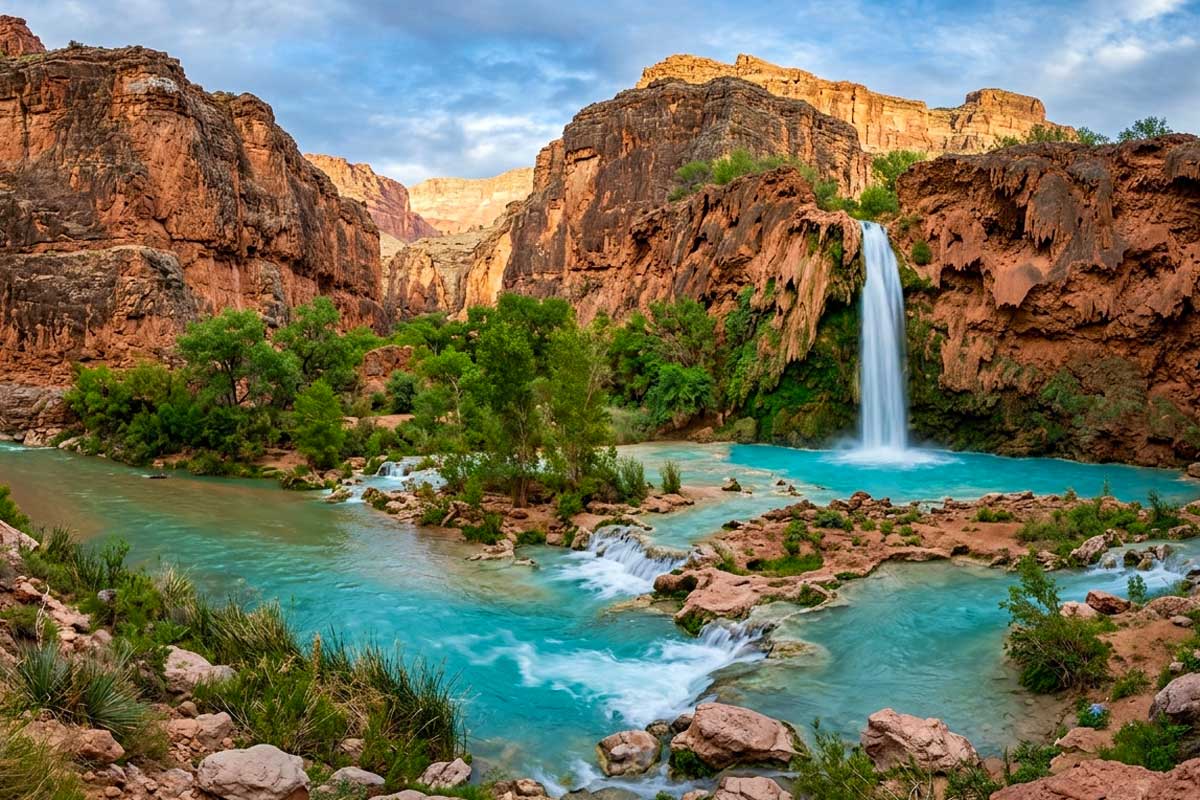
In the middle of the Arizona desert, a few hours from Las Vegas, there is water of a color that should not exist here.
Not blue. Not green. Truly turquoise - the kind of shade usually associated with the Maldives, French Polynesia, or the Caribbean Sea. The kind of water people expect to find beside palm trees and tropical humidity, not among scorched canyon walls, red limestone cliffs, juniper trees, and cacti.
And yet it is here.
Permanent. Year-round. Nearly the same temperature in January as in July - about 21 degrees Celsius.
This is Havasu Creek, flowing through the homeland of the Havasupai tribe, whose name means “people of the blue-green water.”
You cannot drive here. You cannot enter without a permit. And you cannot truly understand the place without hiking more than sixteen kilometers down into the canyon - or arriving by helicopter, if you are lucky enough to secure a seat.
That is precisely why Havasu remains one of the most extraordinary destinations in North America: not an attraction designed for tourism, but a real world that still exists on its own terms.
Eight Hundred Years Below the Rim
The village of Supai lies at the bottom of a side canyon branching off the Grand Canyon.
There is no road leading to it.
No pavement. No dirt road. Not even a vehicle trail. The only access is a ten-mile hike descending roughly 640 meters into the canyon. Or a helicopter, operating only a limited number of flights depending on weather and availability. Or pack mules, still used here to transport cargo.
Because of this, Supai remains the only community in the continental United States where mail is still delivered by mule.
This is not a historical reenactment for visitors. It is daily life.
The Havasupai people have lived in these canyons for approximately eight hundred years. Traditionally, they moved seasonally between the canyon floor and the plateau above: farming near Havasu Creek in warmer months and hunting on the plateau during winter.
The creek was never simply beautiful water. It was survival itself.
Then came the U.S. federal government.
Five Hundred Eighteen Acres
In 1882, the United States officially defined the Havasupai reservation boundaries.
Five hundred eighteen acres.
Less than one square kilometer of habitable canyon land, cut off from the surrounding plateau where the tribe had hunted and traveled for generations.
It became one of the smallest reservations in America.
Meanwhile, ranches, tourism routes, and Grand Canyon infrastructure expanded across the land above them.
The Havasupai spent decades fighting in court.
In 1968, the Indian Claims Commission ruled that the land had been taken illegally. Yet even then, the tribe did not immediately regain its territory.
Only in 1975 did Congress pass legislation connected to the expansion of Grand Canyon National Park that returned approximately 185,000 acres of ancestral land to the Havasupai people.
It remains one of the rare large-scale legal victories for an Indigenous nation in U.S. history.
Today, the tribe has roughly 650 enrolled members, about 450 of whom live permanently in Supai. Most work in tourism: the lodge, campground, mule transport, trail operations, and helicopter services.
Visitors are welcomed warmly - but with one important understanding: this is not unclaimed wilderness. It is someone’s homeland.
Why the Water Is That Color
The answer is geology, chemistry, and light - not Photoshop.
Havasu Creek is fed by underground springs from the Coconino Aquifer beneath the Kaibab Plateau. As the water filters through limestone formations, it becomes rich in calcium carbonate and magnesium.
When the mineral-heavy water emerges into sunlight, dissolved compounds scatter light in a very specific way. Portions of the red spectrum are absorbed while blue-green wavelengths reflect more intensely.
The result is that unforgettable turquoise color that appears almost impossible in a desert landscape.
The creek remains close to the same temperature year-round - around 21 degrees Celsius - because it originates underground.
The same calcium carbonate also creates travertine, the porous limestone forming natural terraces, dams, and pools along the creek.
The water is literally building its own landscape.
After major floods, channels can shift, cascades can reform, and pools can disappear or emerge again. Havasu never looks exactly the same twice.
Five Waterfalls, One Canyon
The waterfalls of Havasu Creek unfold one after another through the canyon.
Fifty Foot Falls and Rock Falls were created after the devastating flood of 2008, which destroyed the original Navajo Falls and permanently reshaped part of the canyon.
Here, water is not only beauty. It is geological force.
Havasu Falls is the iconic centerpiece: roughly thirty meters of falling water framed by red canyon walls, cottonwood trees, and pools so turquoise that photographs are often mistaken for digitally enhanced images.
They are not exaggerated. The colors are genuinely that intense.
Mooney Falls is the tallest cascade in the system at about sixty meters. Reaching the bottom requires descending a steep cliff using chains and ladders anchored directly into the limestone wall. It demands caution and physical confidence.
But the pool beneath it is among the most spectacular places anywhere in the Grand Canyon region.
Beaver Falls lies farther downstream, about six kilometers beyond the main campground. The trail crosses streams and narrow canyon sections, keeping visitor numbers much lower. The travertine terraces here feel quieter, wilder, and almost untouched.
Where the Waters Refuse to Blend
Beyond Beaver Falls, the canyon narrows and grows silent.
Havasu Creek continues another thirteen kilometers before meeting the Colorado River deep inside the Grand Canyon.
And here something remarkable happens.
The pale turquoise water of Havasu meets the dark green current of the Colorado - and the two do not immediately merge.
For several visible meters, the rivers flow side by side, separated by a striking boundary of light and dark water.
The phenomenon is caused by differences in density, temperature, mineral composition, and flow dynamics. Full mixing requires time and turbulence.
Two-toned river confluences exist elsewhere in the world, but few appear this visually dramatic.
Reaching the confluence requires either a multi-day rafting expedition on the Colorado River or an additional twenty-five-kilometer hike beyond the campground.
Most visitors never make it there.
Those who do usually say the same thing: this was the moment that justified the entire journey.
Permits That Disappear in Minutes
Havasu has one of the most competitive permit systems in North America.
Reservations for the next season open on a specific day each February. Tens of thousands of people attempt to access the tribal booking system simultaneously. Servers frequently overload. Most permits disappear within minutes.
Campground fees typically range between $100 and $125 USD per person per night, plus mandatory tribal fees.
It is expensive - but this is not ordinary camping.
The alternative is Havasupai Lodge in Supai village, a small hotel entirely operated by the tribe.
Most travelers stay three to four days. Hiking down and back in a single day is technically possible, but it defeats the purpose of the place.
Practical Information
The trail begins at Hualapai Hilltop, roughly four to five hours by car from either Las Vegas or Phoenix.
Cell service and Wi-Fi are extremely limited on the trail. There are no ATMs outside the village. Cash is essential.
Hikers should carry at least three to four liters of water per person for the descent, plus extra for the climb back out.
The best seasons are March through May and late September through early November. Summer temperatures inside the canyon can exceed 40 degrees Celsius.
The Last Thing Worth Knowing
The campground area traditionally used by visitors was historically a Havasupai cremation site.
This is not a ghost story designed for tourists. It is simply part of the truth of the place.
And it changes how the canyon feels.
When you sit beside your tent at dusk, watching turquoise water move beneath towering red canyon walls, it becomes clear that Havasu is not merely a “hidden Arizona waterfall.”
It is a homeland where people have lived longer than the nation surrounding them has existed - a place where a tribe first lost nearly everything, and later regained only part of it.
Turquoise water in the middle of the desert. Eight centuries of uninterrupted life beneath the canyon walls.
And down below, where Havasu Creek meets the Colorado River, two waters travel beside one another for a while before finally becoming one.
Some things manage to remain themselves - even beside something much larger.