
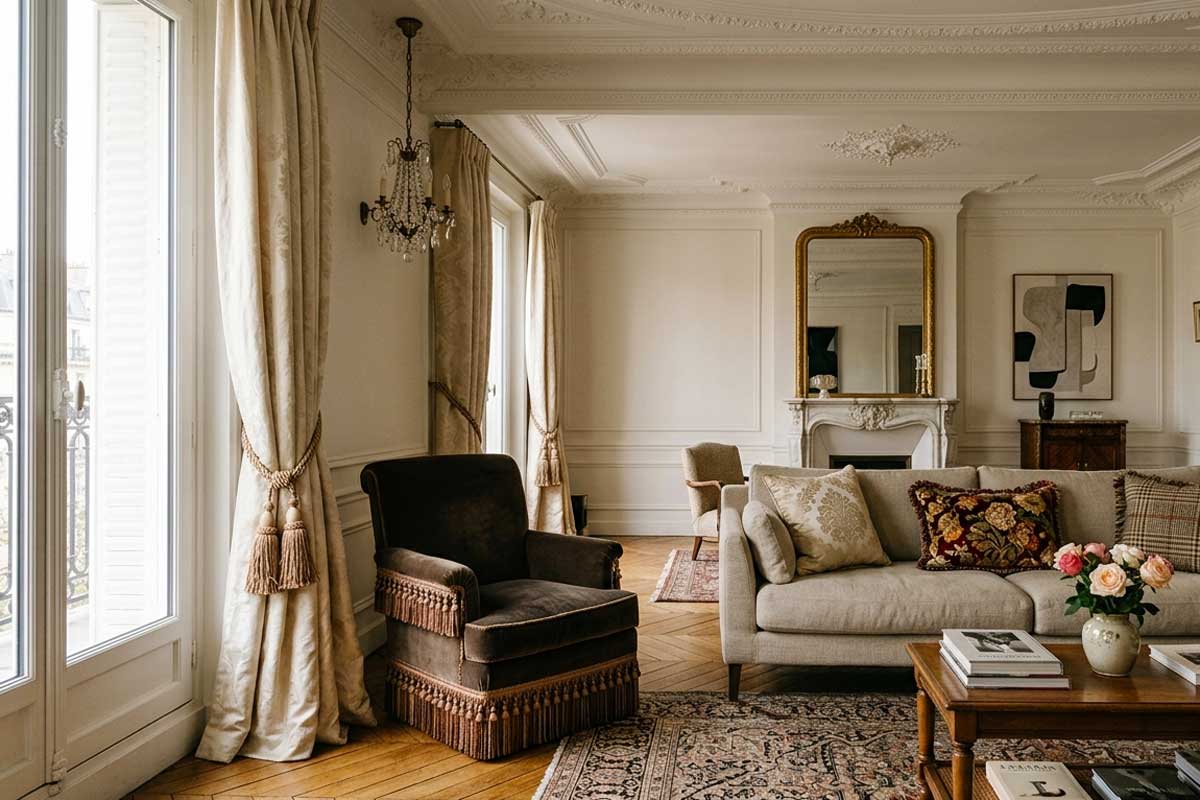
French interior code
How textiles bring elements together
There are interiors that live and die by their furniture. Others that owe everything to art on the walls. But some spaces - the most memorable ones - are held together by fabric. Not as an afterthought once the renovation dust settles, but as a structural element of atmosphere itself. The French understand this better than almost anyone. In their interiors, textile is rarely accidental. It softens architecture, bridges centuries, adds depth and touch, and often becomes the very layer that transforms a beautiful apartment into a space with genuine character.
Beyond Velvet and Tassels
The French approach to textile is not simply a story of heavy drapes, bullion fringe, and theatrical brocade - though Paris remains, without question, the world capital of decorative fabric. The annual Paris Déco Off - known in design circles as the fashion week of interiors - draws over 40,000 visitors each January to more than 150 showrooms across Saint-Germain-des-Prés and the Right Bank, where the world's most celebrated fabric houses unveil their new collections. At the 2026 edition, the prevailing currents were unmistakable: a confident return of silk damask; the "thrill of frill" (as designer Martin Brudnizki memorably put it), with passementerie - tassels, rosettes, bullion fringe, and gimp - reemerging with couture-like exuberance; painterly plaids; and animal and fauna motifs rendered as spectral, almost abstract presences woven into velvet and wool. But what defines the French interior is never theatricality for its own sake. It is complexity with discipline.
Textile Doesn't Decorate a Room - It Completes It
One of the most important habits in the French interior tradition is refusing to treat fabric as secondary. In a well-composed Parisian apartment, curtains, upholstery, coverlets, trims, tablecloths, and even the lining of a lampshade carry as much weight as the plaster moldings or the parquet beneath your feet. This is not about softening a room after the fact. It is part of the room's architecture from the beginning.
This is precisely why French interiors feel so collected even when they contain many disparate objects. Textile acts as mediator: connecting white walls to antiques, a pared-back kitchen to ornate cornicing, a contemporary bed to aged oak floors. In a recent Parisian bedroom featured in Architectural Digest, it was linen drapery - quietly pooling, barely colored - that held the entire space together. The fabric functioned as soft architecture.
History and Modernity Must Support Each Other
The French interior is rarely a period recreation. Even where there are carved stone mantels, antique doors, and gilded chairs, there is almost always a contemporary counterpoint - a pale plaster wall, a clean-lined sofa, a muted neutral base. It is against this calm ground that historic or heavily ornamented textile begins to sing.
A weighty curtain in an ancestral fabric can coexist with the most restrained contemporary trim. Conversely, a bold printed cloth becomes far more distinguished when it has no competition. This instinct - to marry past and present without tipping into museum territory - is equally visible in modern Parisian apartments and in the homes of designers who allow antique objects to live alongside an almost improvisational contemporary freedom.
Texture Matters More Than Color
One of the most recognizable marks of the French approach is a love not merely of color, but of surface. A French interior rarely holds together on a flat palette. Even when the tones are soft and neutral, the textile almost always introduces layers: linen, velvet, silk, wool, blended weaves, worn trim, old jacquard, embroidery, matte cotton beside a softly lustrous silk. This is why French monochrome almost never reads as dull. Where a simplified interior might offer a single beige sofa and a pair of linen curtains, the French version introduces variations in cloth weight, surface texture, color depth, patina, fringe, fold, and sheen. This is not decorative excess. It is a way of making a room sensuous and alive without resorting to chromatic aggression.
Pattern Is Permitted - With Discipline
The French are considerably more at ease with mixing prints than many lovers of the cautious contemporary interior. But it is important to understand: a good French pattern mix is not chaos. It holds together through shared color temperature, a repeating accent hue, similar saturation, and almost always a calm base around the perimeter.
A stripe, a floral, a plaid, and an animal print can coexist in a single room without falling apart - provided they share an underlying logic. Paris Déco Off 2026 confirmed exactly this: the return of painterly plaids, silk damasks, and fauna-inspired motifs, presented not in aggressive, maximalist readings but in interiorized, noble iterations.
For a smaller apartment, this is an especially valuable lesson. The problem is never pattern itself - it is the absence of hierarchy. One print can carry the room; another serves as background; a third barely registers. When everything shouts at once, the space collapses. When pattern has a role, the room becomes richer.
Detail Is Not Decoration - It Is Evidence of Taste
In French textile culture, finishing details carry extraordinary weight. Passementerie - braids, fringe, tassels, borders, decorative edgings - is experiencing a genuine renaissance, and not by accident. Designers are once again seeking ways to give interiors not bare luxury, but the sense of a hand, a craft, a conclusion. Both Architectural Digest and Elle Decor have noted the return of trims, tassels, fringe, and decorative edging as markers of a new, more tactile decorative sensibility. At Déco Off 2026, designer Martin Brudnizki's collaboration with Samuel and Sons reimagined passementerie as something unexpectedly architectural - not soft, but structural.
But there is a critical boundary here. The French interior deploys detail in a way that never tips into prop or costume. Tassels work when they have context: a historic cloth, a well-scaled room, the right architecture, good furniture. Without that context, they read as theater. With it, they give a room that particular quality of effortless chic that is so nearly impossible to imitate.
Luxury, in France, Is Rarely Loud
One reason French interiors read as expensive is that they almost never deploy all their most powerful effects at once. Leopard print, velvet, deep wine, antique gilt, heavy fringe, dense drapery, a complex rug - all of it is possible, but never simultaneously at full volume. One element takes the lead; the rest provide support.
This is the adult version of luxury: not displaying everything you have, but knowing precisely when enough is enough. A French room can be deeply layered without ever feeling overwrought. There is always a pause - a plain wall, a simple sofa silhouette, a length of undyed linen, a sweep of smooth plaster - that gives the active textile room to breathe and be heard.
A Neutral Palette Is Not the Absence of Character
The old cliché that a French interior must be richly colored and velvet-draped is long obsolete. Neutral, creamy, sandy, smoky, chalky, and warm-white palettes are as native to the French home as printed cloth and inherited furniture. But what distinguishes the French use of neutrals is how precisely they are deployed.
In the French approach, a neutral palette is never emptiness or sterility - it is a ground for relief, fabric, wood, plasterwork, aged metal, soft light, and complex textile. Where a simplified interior might dissolve into safe beige, the French version works through nuance: warm white against raw linen, biscuit beside faded velvet, a milk-washed wall next to antique passementerie, a soft greige ground beneath a storied print.
Why This Still Works
The French textile approach does not age because it is not built on any single trend. It rests on a few enduring ideas: respect for history, love of craft, textile as architecture, complexity without chaos, luxury without volume. And perhaps most importantly, it is unafraid of something the contemporary interior too often tries to exile: softness, drape, the trace of a hand, a slight excess, the sense that a space is not merely comfortable but emotionally generous.
This is why French rooms are so difficult to copy literally. Their secret is not in the curtain with the tassel, nor in the antique armchair as such. Their secret is in knowing how to make textile say more about a space than any words ever could.