
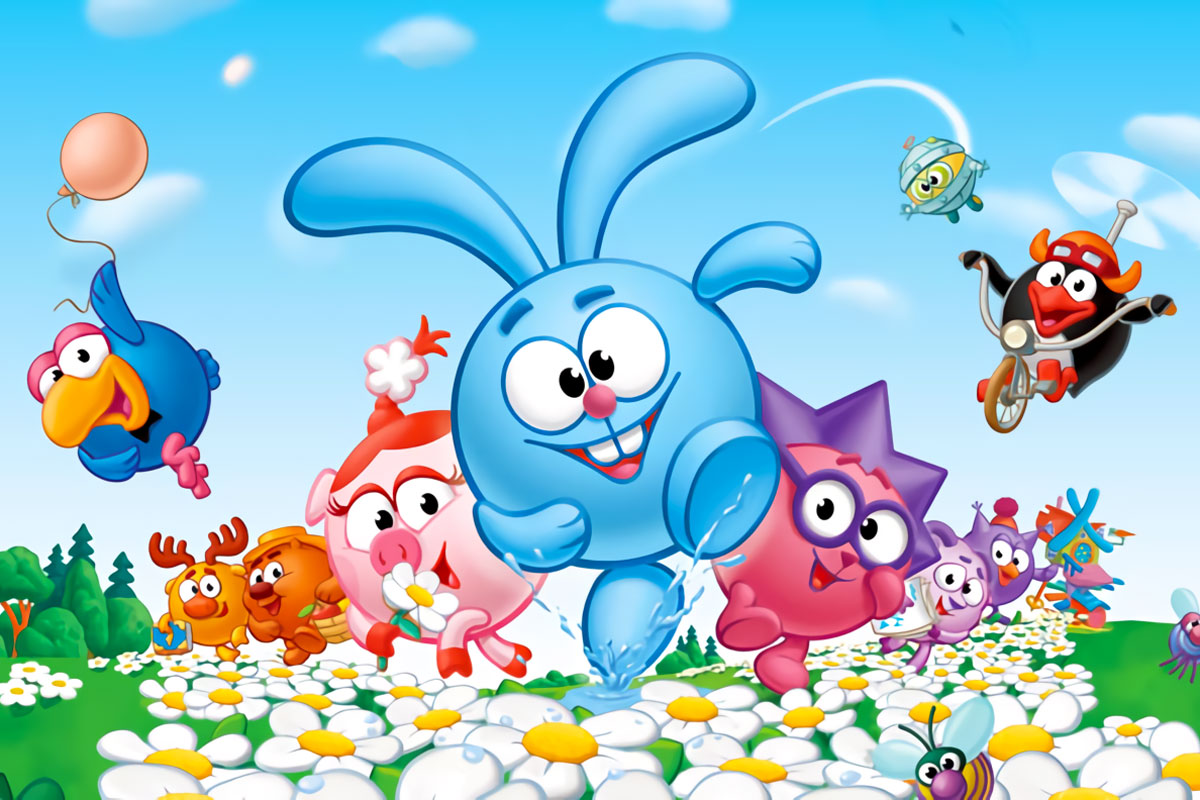
How the cartoon about round animals became an international brand
The success story of the cult series
The first episodes of KikoRiki appeared on television in the early 2000s, and since then the round characters created by artist Salavat Shaykhinurov have become part of the childhood of millions of viewers. What began as a bold idea from a small group of enthusiasts gradually turned into one of the most recognizable brands in Russian animation. Today, KikoRiki is known far beyond Russia: under the names KikoRiki, GoGoRiki and other localized versions, the series has been shown in more than 90 countries, and its international audience has become a major part of its success. Its expansion into China proved especially significant, giving the characters a new life and a vast viewer base.
This is the story of how one simple visual idea - all the characters are round - grew into an entire universe: with philosophical stories, educational projects, feature films, international adaptations and a large commercial ecosystem.
Creation
The story of KikoRiki began in 2002, when two young creators - designer Ilya Popov and artist Salavat Shaykhinurov - came to Anatoly Prokhorov, co-founder of the Pilot animation studio and one of the creators of the legendary Pilot Brothers. Popov and Shaykhinurov were working at a small company called Fun Game and were involved in board game development, but they came to Prokhorov with a far more ambitious idea: to create a large animated series for preschool and early elementary-school children.
The project appeared almost by chance. According to Prokhorov’s recollections, Popov and Shaykhinurov brought the first sketches of characters with an unusual working title. The main visual discovery was already there: all the characters were to be round. The simplicity of the form made them instantly recognizable, easy for children to draw and highly convenient for animation. But the idea itself was anything but small: from the beginning, the creators spoke of hundreds of episodes.
Prokhorov recalled that people often came to him with different concepts. He would carefully analyze the material, honestly explain what was missing, offer comments and send the authors away to rework it. Usually, no one came back. But Popov and Shaykhinurov did. A few months later, they returned with more developed characters, complete with personalities, movement and the potential for a long screen life. Prokhorov looked at the material - and gave the project the green light.
Production
From the very beginning, Shaykhinurov wanted the design to be as simple as possible, almost childlike. Krash is a circle with two looped ears. Chiko is a circle with little angular spines. Wally is a circle with curls. This simplicity proved brilliant: the characters did not intimidate children with complexity, but instead invited them to pick up a pencil and draw them on paper.
Yet behind the visual simplicity stood a complex production process. KikoRiki was made using Flash animation, which helped reduce costs compared with more traditional methods, but the project still required serious financing. A minute of animation cost less than the industry average, yet producing a six-minute episode remained an expensive undertaking.
Part of the cost of the first episodes was covered by government grants connected with cultural and educational programs. The remaining funding was raised through the efforts of the team, while Ilya Popov took on the role of general producer. From the very beginning, it was clear that if the project was to live for a long time, it would need not only a strong idea, but also a sustainable business model.
The first episodes premiered on Russian television in the early 2000s. Very quickly, KikoRiki became a regular part of children’s programming and then moved far beyond the boundaries of an ordinary animated series.
A cartoon for the whole family
One of the main secrets of KikoRiki’s popularity is that its creators never spoke down to children. They did not simplify the world into primitive morals or reduce the plot to a straightforward lesson. On the contrary, the series was built to be understandable for children and interesting for adults. That rare quality made it a true family cartoon.
Behind the charming visual style were wise, ironic and often unexpectedly deep stories. KikoRiki includes thrillers, melodramas, westerns, science fiction, detective stories, philosophical parables and everyday comedies. At the same time, the series preserves a gentle humour and a soft tone. Even when the story plays with serious themes, it never turns into drama for drama’s sake.
The series is full of allusions, hidden meanings and cultural references - from classic cinema and world literature to painting, mythology and popular culture. A child sees a funny story about favourite characters, while an adult may notice a second layer: a quotation, a genre game, a philosophical question or subtle irony.
Anatoly Prokhorov called this approach developmental dramaturgy. The idea is that a child develops not through direct instruction, but through the movement of the story itself: the actions of the characters, the consequences of their choices, the dialogues, pauses, doubts and small moral decisions.
Unlike many children’s series, KikoRiki rarely presents its moral lesson directly. The creators trust the viewer. They expect children to sense for themselves when their favourite characters act dishonestly, foolishly or selfishly. That is why the series often feels more grown-up than its visual style might suggest.
A good example is the episode “The Big Race.” Krash and Chiko wreck their car, but Rosa and Wally kindly give them a ride almost to the finish line. In the final seconds, Krash and Chiko jump off the cart, grab the trophy and declare themselves the winners. Rosa only sighs dreamily about how nice it must be to win a race. The creators do not lecture and do not place a moral full stop at the end. They leave the viewer to judge the characters’ actions.
Educational elements are woven into the story just as naturally. Sometimes it is the history of radio, sometimes the basics of safety, sometimes a question of ethics, health or how the world works. But knowledge is almost always presented not as a school lesson, but as part of a living story.
A world without violence
When creating the characters, the authors looked toward the best family models in world children’s culture - from Winnie-the-Pooh to Sesame Street. All the heroes form a diverse but friendly community. They argue, make mistakes, get offended, reconcile, invent, dream, procrastinate, feel afraid and try again. This is not a sterile world without problems, but a world without malice.
The KikoRiki live in Daisy Vale, separated from the Big World by the sea, forest, mountains and desert. There are no traditional villains. Conflict arises not from the battle between good and evil, but from differences in personalities, desires, fears, ambitions and misunderstandings. That is what makes the series closer to real childhood: most everyday conflicts do not happen because someone is evil, but because people are different.
Each central character represents a distinct temperament, worldview and set of interests. Krash is energy, curiosity and adventure. Chiko is caution, shyness and rationality. Wally is melancholy, poetry and vulnerability. Rosa is dreaminess, self-esteem and the desire to be admired. Dokko is science, learning and comic helplessness in the face of ordinary life. Pin is engineering thinking and invention. Barry is work, earth and practicality. Carlin is culture, memory and theatricality. Olga is care, sport and everyday wisdom. Together they form not just a set of characters, but a small model of society.
KikoRiki as a business
Popov and Prokhorov understood that government support could not last forever. From the beginning, KikoRiki therefore had to become not only an artistic and educational project, but also a commercially sustainable one.
The sale of television rights did not cover the full cost of production, so television was seen not only as a source of income, but also as a powerful promotional platform for developing the brand. The main bet was placed on character recognition, licensed products, publishing projects and the long life of the franchise beyond the screen.
In the mid-2000s, the company created to manage the brand began actively selling licenses. Hundreds of KikoRiki products appeared on the market: from ice cream, cereals and drinks to clothing, shoes, toys, magazines, books and educational materials. Over time, the range expanded into thousands of items, and the brand became a complete commercial ecosystem.
Special attention was given to education. Developmental books, alphabets, magazines, colouring books and sticker albums appeared in the very first years of the project. This was a natural continuation of the series’ core idea: not simply to entertain the child, but to create a friendly, understandable and developmental environment around them.
The KikoRiki universe
From the beginning, the creators planned a large but not endless series. Maintaining a high level of writing for decades is difficult, especially when every episode is expected to be not only funny, but meaningful. Nevertheless, an entire universe gradually grew around the original series.
In 2006, The ABCs of KikoRiki was launched - an educational project in which the characters explained traffic rules, safety, behaviour, reading, children’s rights, health, internet literacy and financial literacy in a light and funny way. The format proved so flexible that the educational direction became one of the most important parts of the franchise.
Later came KikoRiki: New Adventures, a continuation of the original project in 3D animation. The stories became longer, the visual style changed, and new characters joined the familiar cast. The move into three-dimensional animation drew mixed reactions: some viewers accepted the update, while many fans missed the earlier 2D aesthetic.
Then came Pin-Code, a science-education project in which the characters explained how the world works, along with inventions, programming, physics, nature and modern technology, in language children could understand. It was aimed not only at very young viewers, but also at a broader children’s audience interested not just in watching, but in understanding how things are made.
In 2015, BabyRiki appeared - a separate project for the youngest viewers. This is no longer a philosophical family comedy, but a gentle educational series for preschool children. Its task is different: first concepts, simple emotions, everyday situations and a safe visual world for toddlers.
Beginning in 2011, KikoRiki also moved onto the big screen. The first film, KikoRiki: Team Invincible, served as a prequel to the original series, telling how the characters left their familiar world for the Big World and met Barry and Pin. The film became an energetic parody of detective stories, thrillers and superhero cinema, while preserving the humour and personalities of the original series.
In 2016, KikoRiki: Legend of the Golden Dragon arrived in theatres - an adventure comedy set not on the characters’ home island, but in tropical jungles. Ancient prophecies, treasure hunters and obvious references to Indiana Jones and Lara Croft shaped the story. The film was more genre-driven and dynamic, but still relied on the recognizable mixture of humour, morality and play with popular culture.
In 2018, KikoRiki: Deja Vu appeared, with the writers freely playing with the clichés of time-travel stories, adventure films, westerns, medieval epics and science fiction. The characters visited different eras, and Krash met a future version of himself. This film moved furthest away from the intimate philosophy of the early KikoRiki and came closer to adventure action, while still treating the beloved characters with care.
International expansion
After succeeding on Russian television, KikoRiki gradually began moving abroad. In the United States, the series aired as GoGoRiki on The CW in a children’s programming block. In Europe and other markets, it became known as KikoRiki. For international audiences, the series had to be not merely translated, but adapted: character names, dialogue, jokes, rhythm and cultural allusions had to work for viewers unfamiliar with the Russian context.
By now, the project is known in more than 90 countries. Different sources give different figures for the number of languages and territories, but the main point is clear: KikoRiki became one of the few Russian animated brands able to enter the international market and remain there not merely as an exotic curiosity, but as a full-fledged family product.
China became an especially important direction. Entering the Chinese market for foreign animation is extremely difficult: it requires licenses, approvals, adaptation of materials, translation of large volumes of content and strict selection. Children’s animation is reviewed especially carefully, because it concerns not only entertainment, but also values, education and cultural compatibility.
To reach Chinese television, the rights holders had to prepare an extensive package of documents, video materials in the required format, dialogue lists, translations and detailed information about the episodes. In effect, a significant portion of the series had to be adapted in advance, before there was even a final certainty that the project would be granted access to the audience.
The effort paid off. In China, KikoRiki gained broad recognition, and the local audience became one of the largest outside Russia. For the project, this was not only a commercial success, but also an important proof of the universality of its idea. The round characters from Daisy Vale turned out to be understandable to children raised in a different language and cultural environment.
That, perhaps, is the central phenomenon of KikoRiki. It was born as a very local project, with Russian humour, intonation, cultural references and an almost domestic philosophy. But at its core were things understood in any country: friendship, curiosity, fear, mistakes, reconciliation, the desire to be heard and the need to live in a world where no one has to be perfect in order to be loved.