The Whiskey That Congress Had to Legally Define
Everything Worth Knowing About Bourbon
Here's something that sets bourbon apart from every other spirit on a bar cart: it is one of the only alcoholic beverages in the world whose identity is written directly into federal law. You cannot legally call a whiskey "bourbon" unless it meets a precise list of government requirements - where it's made, what it's made from, and how it's aged. Scotch has traditions. Cognac has appellations. Bourbon has an act of Congress. That single fact tells you almost everything about how seriously Americans have always taken this particular amber liquid - seriously enough to protect it by statute, seriously enough to keep it flowing through a constitutional loophole during the one period in American history when alcohol itself was illegal, and seriously enough that people have gone to prison over stealing it. This is the story of how a corn-based whiskey from the edge of the American frontier became a legally defined national symbol - and what you actually need to know before you pour yourself a glass.
What Bourbon Actually Is, By Law
To be sold in the United States as bourbon, a whiskey must be produced entirely in the U.S., distilled from a grain mixture - called a mash bill - that is at least 51 percent corn, distilled to no more than 160 proof, entered into the barrel at no more than 125 proof, and aged in a brand-new, charred oak container. Nothing may be added except water to adjust the proof. No coloring, no flavoring, no blending with anything except more bourbon.
Here is the detail that surprises almost everyone: there is no legal minimum aging period. Wild Turkey's longtime master distiller, Jimmy Russell - who has held the job for more than seventy years, longer than anyone else alive - has pointed out that, strictly by the letter of the law, you could fill a new charred oak bucket straight from the still, dump it into a holding tank a moment later, and legally call the result bourbon. It wouldn't be good bourbon. But it would be bourbon. The only aging requirement kicks in if a producer wants to use the term "straight bourbon," which legally requires a minimum of two years in the barrel - and any bourbon aged less than four years must say so on the label.
One more common misconception worth clearing up: bourbon does not have to be made in Kentucky. It can legally be distilled anywhere in the United States. Kentucky simply produces about 95 percent of it, for reasons that turn out to be geological rather than legal - more on that shortly.
A Name Nobody Can Fully Trace
The most repeated bourbon origin story credits a Baptist minister named Elijah Craig with inventing the entire category in 1789, supposedly after a fire accidentally charred his storage barrels and he noticed, almost by chance, that the burnt wood improved the whiskey dramatically. It's a wonderful story - a preacher-turned-distiller stumbling into America's native spirit. It is also, according to most serious whiskey historians, almost certainly not true. Craig ran a real distillery and did make corn-based whiskey, exactly as dozens of his contemporaries did throughout the region at the time; there is simply no solid historical evidence that he specifically discovered barrel charring, and every written reference crediting him with the invention postdates his life by decades. Even Heaven Hill, the company that markets a bourbon under his name and calls him "the father of bourbon" in its own advertising, acknowledges the claim is more legend than documented fact. The earliest solid documentary evidence of anyone recommending charred barrels for whiskey is a letter from 1825, written by a Lexington, Kentucky grocer to a distiller, essentially passing along a tip he'd heard: char the inside of your barrels, and the whiskey improves.
The name "bourbon" itself has a cleaner paper trail, though it's less romantic than the Elijah Craig legend. In 1785, American settlers pushing west of the Appalachians carved out a massive Kentucky county named Bourbon, in honor of France's royal House of Bourbon, in gratitude for French support during the American Revolution. As that enormous original county was later subdivided into smaller ones, people in the region kept referring to the broader area informally as "Old Bourbon." The principal Ohio River shipping port for the region's whiskey was Maysville, Kentucky, and barrels leaving from there were stenciled "Old Bourbon" to mark their point of origin - likely the first corn-based whiskey many buyers downriver in New Orleans had ever tasted. Over time, the name stopped referring to the place and simply became the name of the whiskey itself.
The Prohibition-Era Loophole That Kept Bourbon Alive
When the United States banned the production and sale of alcohol nationwide in 1920 under the Volstead Act, it left exactly two legal exceptions: sacramental wine for religious use, and medicinal alcohol prescribed by a licensed physician. This single carve-out is arguably the reason bourbon survived as an American industry at all.
Only six distilleries in the entire country were granted federal licenses to continue producing whiskey specifically for medicinal purposes throughout the thirteen dry years. A doctor with a Treasury Department permit could write a patient a prescription for up to one pint of spirits - usually whiskey or brandy - every ten days, on a special numbered government form. The going rate was roughly three dollars for the doctor's visit and another three dollars to have the prescription filled at a pharmacy - real money at the time, which meant medicinal whiskey was, in practice, a luxury largely available to people who could afford it. Physicians prescribed it for an almost comically broad range of conditions - a 1922 survey of the American Medical Association found that a majority of physicians who responded believed whiskey had genuine therapeutic value, for ailments ranging from influenza to diabetes to simple old age. Winston Churchill, struck by a car in New York in 1931, reportedly obtained a doctor's note for medicinal alcohol to help him through the recovery. Roughly eleven million such prescriptions were written annually throughout Prohibition, and one Chicago-based pharmacy chain - Walgreens - expanded from twenty stores to over five hundred during the exact years alcohol was supposedly banned nationwide, a growth spurt historians largely attribute to its role filling those prescriptions. The loophole was, by nearly every honest account at the time, wildly abused - but it also meant that a handful of licensed Kentucky and Tennessee distilleries kept their stills legally running and their aging warehouses legally stocked through the entire dry era, which is a meaningful part of why bourbon as a serious American industry didn't simply vanish for thirteen years and have to be reinvented from scratch after Repeal in 1933.
Bourbon, Scotch, and Tennessee Whiskey Aren't the Same Thing
The core distinction between bourbon and Scotch whisky comes down to grain and barrel. Bourbon is corn-forward and must age in a brand-new charred oak container every single time; Scotch is typically barley-forward and is almost always aged in barrels that have already held something else - often bourbon itself, since American law's insistence on new barrels every time means the used ones have to go somewhere, and Scottish and Irish distillers are the biggest buyers of secondhand American bourbon barrels in the world.
Tennessee whiskey is the more interesting comparison, because legally, it very nearly is bourbon. Jack Daniel's, the best-selling whiskey brand on Earth, meets essentially every requirement the law sets for bourbon and could, if it wanted to, put "bourbon" on the label. It doesn't, entirely by choice, out of regional pride and a genuine difference in process. Tennessee whiskey undergoes an additional step called the Lincoln County Process before it ever touches a barrel: the clear, unaged spirit is filtered slowly through a thick bed of sugar maple charcoal, sometimes taking several days to trickle all the way through. This mellows the spirit, stripping out some of the harsher congeners before aging even begins, which is part of why Tennessee whiskey often tastes rounder and softer than a comparable bourbon. The origins of the process itself are genuinely disputed - credit has been claimed for a South Carolina family recipe, and more recent scholarship has pushed to properly credit Nathan "Nearest" Green, an enslaved and later freed master distiller who taught a young Jack Daniel how to distill and is now recognized by name on Jack Daniel's own historical materials.
The Great Pappy Van Winkle Heist
If you want proof that bourbon has become a genuine cultural obsession rather than just a drink, look no further than "Pappygate." In October 2013, Buffalo Trace Distillery in Frankfort, Kentucky reported that more than 200 bottles of its ultra-allocated Pappy Van Winkle bourbon - along with cases of Van Winkle rye - had vanished from a supposedly secure, locked area of the facility. Retail value: roughly $26,000. Actual value on the secondary collector's market, where individual bottles regularly changed hands for $1,000 to $5,000 or more: substantially higher.
The investigation took nearly two years and eventually revealed something more mundane and more unsettling than an outside heist: it was an inside job that had been quietly running since at least 2008. A senior Buffalo Trace employee named Toby Curtsinger, later dubbed "The Bourbon King" in a Netflix documentary about the case, was accused of running a bourbon-trafficking operation involving employees from both Buffalo Trace and rival distillery Wild Turkey, along with truck drivers and even a few police officers. Nine people were eventually indicted for operating a criminal syndicate. Curtsinger pleaded guilty to theft and trafficking charges and faced a fifteen-year sentence - but ultimately served just thirty days, thanks to a shock-probation program for first-time non-violent offenders. Investigators recovered roughly $100,000 worth of stolen whiskey in total, though the Van Winkle family insisted the recovered bottles be destroyed outright rather than resold, out of concern that stolen bottles could have been tampered with or refilled along the way. The case remains genuinely unresolved in some of its details, and the bulk of what was originally stolen has almost certainly been consumed by people who had no idea - or didn't ask - where it came from.
What Bourbon Actually Does to the Body - and Who Should Leave It Alone
It's worth being honest here, rather than romantic. Bourbon is alcohol, and alcohol's effects on the body are well studied and not particularly mysterious. In moderation - generally defined by U.S. health guidance as up to one standard drink per day for women and up to two for men - it acts as a central nervous system depressant, producing the relaxation and mild euphoria most people drink for, along with measurable effects on coordination, judgment, and reaction time that persist longer than most people assume.
Recent research complicates the once-popular idea that light drinking is actively good for you. A 2024 review found that even low-dose alcohol consumption is associated with measurable impacts on liver enzymes and fat metabolism, and that the old narrative of a truly "safe" amount of daily drinking has weakened considerably as the research has gotten better. None of this means an occasional glass of bourbon is dangerous for a healthy adult - but it does mean the category of "health drink" doesn't really apply, whatever older marketing once implied.
Some groups have real, specific reasons to skip it entirely, not just moderate it. Pregnant women should not drink at all - the World Health Organization and virtually every major health authority recommend complete abstinence throughout pregnancy, since no safe threshold for alcohol exposure to a developing fetus has ever been identified, and the potential effects are lifelong. People with any form of liver disease, including fatty liver disease unrelated to alcohol, should discuss any drinking at all with their physician, since even moderate intake has been shown to accelerate liver injury in people whose liver is already compromised. Anyone taking medications that interact with alcohol needs to check specifically - this is a longer list than most people expect, including many antibiotics, antidepressants, antihistamines, benzodiazepines and other sedatives, muscle relaxants, opioid pain medications, and blood thinners like warfarin. Some of these interactions occur even at moderate, one-or-two-drink levels, not just with heavy drinking. And anyone with a personal or family history of alcohol use disorder should treat any "just have a glass and see" advice with real skepticism; the safest amount, for that group, is genuinely none.
Never Just Neat on an Empty Stomach: How to Actually Drink Bourbon
Here's a pattern worth naming honestly: pouring bourbon neat, alone, on an empty stomach, as a habit rather than an occasion, is exactly the drinking pattern that tends to slide into dependency without anyone noticing it happening. Alcohol absorbed on an empty stomach hits faster and harder, which means it's easier to drink more than intended before you feel anything - and easier to reach for "just one more" without registering how many that actually was. The single most protective habit in this entire article isn't a health fact. It's simple: always eat something first, and treat bourbon as something you pair with a moment, not something you default to.
Food is the easiest fix, because bourbon genuinely rewards being paired rather than drunk alone. Smoked and grilled meats are the most natural match - barbecue with real char, a good burger, smoked brisket - because bourbon's own charred-oak sweetness echoes what's already on the plate. Aged, sharp cheeses work the same way: a good cheddar, a firm gouda, even a wedge of blue cheese against the whiskey's caramel notes. Dark chocolate is close to a perfect match, since it shares the same caramelized, slightly bitter register that comes from the barrel char. Pecan pie, bread pudding, or anything built around brown sugar and butter leans the same direction. And a handful of roasted or spiced nuts on the table does more to slow a pour down than most people expect - it gives your hands and mouth something to do between sips, which naturally paces the whole evening.
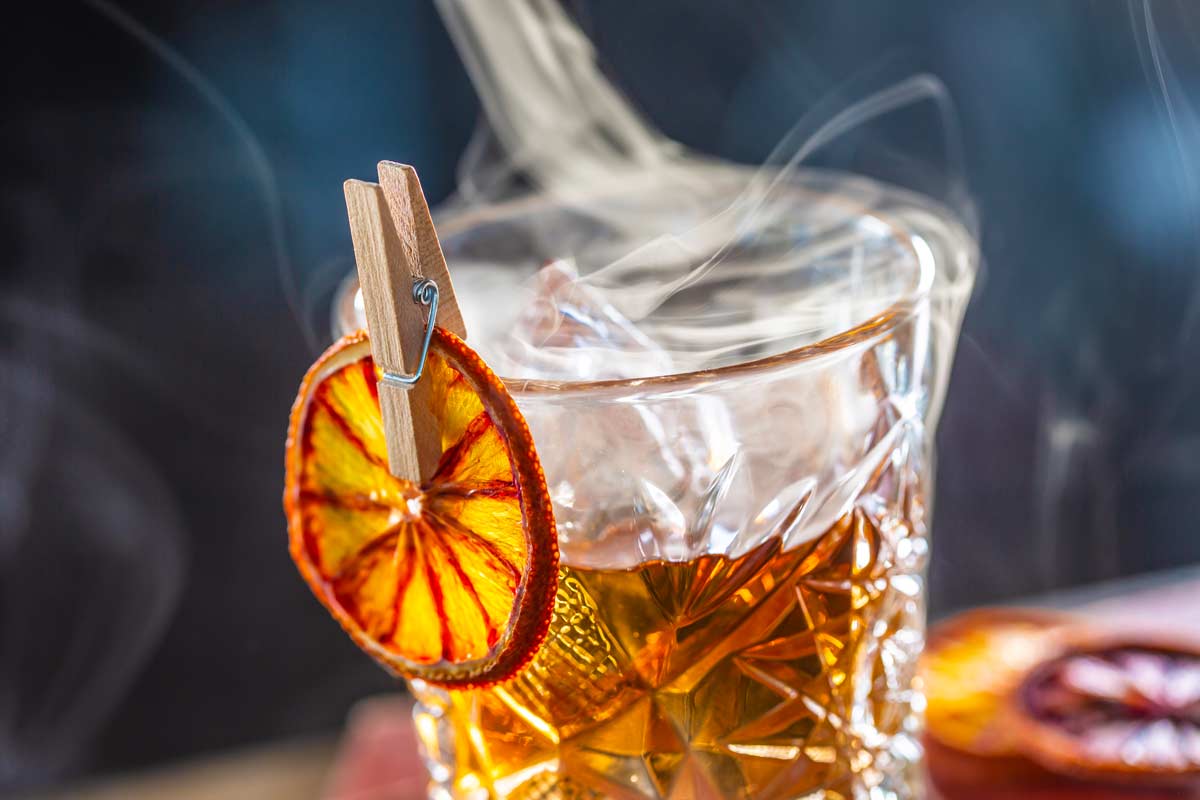
Cocktails are the other real answer, and they're not a lesser way to drink bourbon - they're arguably the more responsible one, since dilution is built into the format. An Old Fashioned - bourbon, a sugar cube or simple syrup, a few dashes of bitters, a large ice cube, an orange twist - stretches a two-ounce pour across a slow twenty minutes rather than three fast swallows. A Manhattan, built with sweet vermouth and bitters and served up, does something similar while adding real flavor complexity. A Whiskey Sour, with fresh lemon juice and a touch of sugar, cuts the proof further and reads as a genuinely different, lighter drink. The Mint Julep - bourbon, sugar, crushed ice, fresh mint, traditionally served in a frosted silver cup - is built specifically for slow sipping over a long, hot afternoon, which is exactly the pace it should be enjoyed at. A Boulevardier swaps in Campari and sweet vermouth for something bitterer and more aperitif-like. And on a simple night, bourbon with a splash of ginger ale or soda over ice turns a strong pour into something you can genuinely nurse through a long conversation rather than finish in five minutes.
The through-line across all of this: eat before you drink, choose a format that slows you down when you can, keep a glass of water within reach and actually drink it between pours, and treat the bottle as something for an evening with people or a considered occasion - not a default reach at the end of every hard day. That habit alone does more to keep bourbon a genuine pleasure, rather than a quiet problem, than anything else in this article.
Why Kentucky, Specifically
Kentucky's dominance of bourbon production - that consistent 95 percent figure - comes down almost entirely to geology rather than law. The region sits on a deep shelf of limestone that naturally filters groundwater, stripping out iron (which can introduce off-flavors and discolor whiskey) while adding calcium and magnesium that genuinely benefit fermentation. Combine that water with Kentucky's harsh seasonal temperature swings - brutal summer heat, real winter cold - and you get barrels that expand and contract dramatically through the year, driving the spirit deep into the wood grain each summer and pulling it back out each winter in a way that accelerates flavor extraction far more than a milder, more stable climate would allow. The Kentucky Bourbon Trail, a formal tourism route linking distilleries including Buffalo Trace, Woodford Reserve, Maker's Mark, Wild Turkey, Four Roses, and Jim Beam, now draws visitors from around the world specifically to see this process in person - the barrel houses, the limestone springs, the century-old rickhouses where the whiskey simply waits.
The Point of All of This
Bourbon's entire story - the disputed origin, the loophole that kept it alive through Prohibition, the inside-job heist, the specific limestone under a specific patch of American ground - adds up to something that isn't really about the whiskey at all. It's a story about how seriously a young country decided to protect one thing it had genuinely made itself, at a moment when very little else about American culture felt distinctly American. That's worth knowing next time you pour a glass. Not because it makes the whiskey taste any better - it won't. But because knowing where something actually came from, rather than the legend printed on the label, tends to make you appreciate it more honestly. Which, as it happens, is not a bad description of bourbon at its best.