
Beyond the Ribeye
A guide to the meat you have not tried yet - and already want
There are people who can choose a steak with their eyes closed. They know the difference between prime and choice, remember exactly where the longissimus ends and the fat cap begins, and will argue passionately about whether to salt before or after searing. These people are respected. But there is another category - those who realized at some point that the classic beef ribeye is not the summit, but only the beginning of the conversation. That the world of steaks extends far beyond USDA Prime. That the same grill can hold bison, elk, wild boar, or ostrich - and deliver a fundamentally different experience each time. This text is for the second group. And a little - for those who haven't yet decided which one they want to be.
Wagyu: Meat as Meditation
Let's start with what everyone has heard of, but few truly understand.
Wagyu is neither a breed nor a brand. It is a group of Japanese cattle breeds united by a genetic predisposition to exceptional intramuscular fat. That fat - distributed not on the outside of the cut but within the muscle fibres themselves, in a fine white web - is what we call marbling. And it is precisely that marbling that makes wagyu what it is.
The Japanese marbling assessment system - the BMS, or Beef Marbling Standard - runs on a scale from 1 to 12. Standard USDA Prime beef, widely considered the finest in North America, corresponds to roughly BMS 4-5. Genuine Japanese A5 begins at BMS 8 and reaches 12. At that level, the ratio of fat to muscle tissue in a single cut can approach 50 to 50.
What does that mean in terms of flavour?
You don't eat A5 the way you eat a regular steak. It's not a case of "more of the same, just juicier." It's an entirely different sensory system. Wagyu fat melts at a slightly lower temperature than the fat in ordinary beef - close to body temperature. The result is a cut that quite literally dissolves on the palate. The flavour is rich, buttery, with nutty and umami notes that linger long after the last bite.
An important detail: a proper A5 portion is not 300 grams. It's 80 to 120 grams, at most. More is simply too much. This is not a flaw - it is the nature of the product.
Now for the key confusion. In North America, the word "wagyu" is used with considerable looseness. Under US regulations, beef can be labelled wagyu if the animal contains as little as 46.9% Japanese genetics. Real American wagyu is typically a cross between Japanese Black cattle and Angus. It is a good product - better marbled than USDA Prime - but it is not the experience that genuine Japanese A5 delivers. The difference is like that between a fine local Pinot Noir and a Grand Cru from Burgundy. Both deserve attention. But they are not the same thing.
If you want authentic Japanese A5, look for a certificate of origin on the packaging. Reputable specialty butchers and certain Japanese restaurants in Toronto carry the real thing.
Best for: those who value a gastronomic experience above all else. Not quantity - precision of sensation.
Bison: Canadian Meat with a Continental History
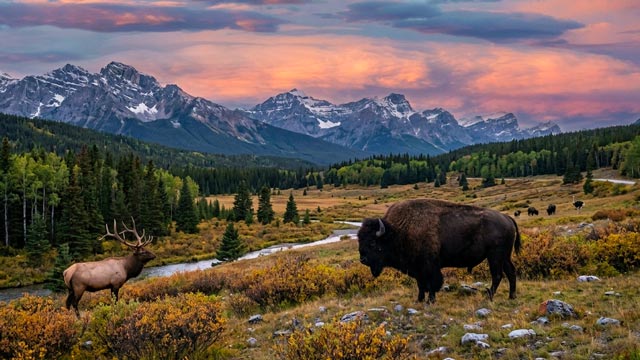
Bison is not exotic. It is local. Before the arrival of Europeans on the Great Plains, tens of millions of bison grazed across the continent - the largest herd of land mammals that has ever existed in the Americas. By the end of the nineteenth century, fewer than a thousand remained. Today the population has recovered to several hundred thousand animals, with a significant share grazing across the prairies of Manitoba and Alberta. For residents of Toronto, this means one thing: bison is available, and it is worth trying.
The flavour profile of bison is clean, slightly richer than beef, with a barely perceptible wild note that doesn't put you off - it simply adds character. Many people describe it as the taste of "real meat" - free of the neutrality that conventional beef has acquired through generations of industrial breeding.
The nutritional case in its favour is compelling. A standard portion of bison ribeye contains approximately 177 calories and 6 grams of fat, while delivering 30 grams of protein. A beef ribeye of the same weight runs around 265 calories and 17 grams of fat. In terms of iron, bison outperforms beef by roughly 50 per cent - which makes it particularly valuable for women, people managing anaemia, and those who train regularly.
Bison is almost never raised in industrial conditions. It grazes on open pastureland, without antibiotics or growth hormones - not because the farmer chose to do it differently, but because bison simply do not survive in feedlots.
One note on cooking: because of its low fat content, bison cooks faster than beef and is less forgiving of mistakes. Medium-rare is ideal. Well done means tough and dry. Watch the internal temperature: 57-60°C, followed by a rest of no less than five minutes.
Best for: those who want red meat without the fat load. People managing low iron. Anyone who values a local product with a real story behind it.
Elk: Wild North on a Plate
Elk - whether you call it elk or moose, depending on the species - is meat that Canadians know far better in theory than in practice. Most have encountered it only as sausage at a hunting camp.
An elk steak is a different conversation entirely.
Elk meat is deep red, very lean, and carries a pronounced but not aggressive game flavour - somewhere between beef and venison, with grassy and woodland notes. There is no marbling here - elk live in constant motion, and the structure of the meat reflects that clearly. The texture is firm, the finish long. Elk is rich in zinc, iron, and vitamin B12. Fat content is among the lowest of any steak-worthy meat, which makes it an interesting choice for those who want depth of flavour without extra calories.
Elk demands respect for its leanness when cooking: high heat, brief time, with butter or rendered fat in the pan. A marinade of juniper, rosemary, and red wine is classical and correct.
In Canada, elk is available at specialty game meat shops.
Best for: those who enjoy assertive, characterful flavours. Those who want maximum protein at minimum fat. Eaters who care about where their meat comes from.
Wild Boar: A European Tradition on a Canadian Plate
Wild boar is one of those products that in Europe is entirely ordinary - particularly in Germany, Italy, Poland, and France - while in North America it still reads as a gastronomic adventure.
Boar meat is darker than domestic pork, richer in flavour, with nutty and mushroom notes that come from a diet of acorns, roots, and forest berries. The fat is distributed differently than in farmed pig: there is less of it, it carries more aroma, and it lacks that refined, neutral quality we have come to expect from commercial pork.
A wild boar steak is typically medallions cut from the loin or tenderloin. It cooks quickly, takes well to bold sauces - lingonberry, game jus, dark beer - and will not forgive being overdone. Internal temperature: 65-68°C. Fully cooked, but not dry.
One important note: unlike wild elk or venison, the boar you find in shops is almost always farm-raised rather than truly wild. This does not mean inferior quality - responsible farms feed their animals naturally and allow for movement. But don't expect the same raw intensity you'd get from an animal that has roamed a forest its entire life.
Best for: those who want to move beyond beef without committing to a radically different flavour. An excellent entry point into the world of game.
Ostrich: Red Meat from a Bird
Ostrich is a product that breaks categories. Technically, it is poultry. In practice, ostrich meat is red - resembling veal in colour and structure, with a flavour profile close to beef but with a more delicate finish. There is no poultry flavour whatsoever. The taste is clean, faintly sweet, with good depth. Nutritionally, it is close to ideal for those who monitor their diet: very low in fat (comparable to chicken breast), high in iron and protein. And unlike many lean meats, it is naturally tender - no long marinade required.
Like bison, an ostrich steak will not forgive overcooking: medium or medium-rare, fast, on a properly heated pan or grill.
Ostrich is rarely found in mainstream supermarkets, but it is readily available at specialty game shops. Australian farms supply frozen meat across North America.
Best for: those who want red meat but are limiting fat for medical or personal reasons. An excellent alternative for people managing cholesterol who miss a proper steak.
Venison: A Subtlety Not Everyone Notices
Venison - deer meat - is more accessible than it might seem.
In flavour, venison is closest to elk, but more refined. Less of the forest, more of the elegance. The meat is deep red, lean, with a distinct mineral finish. In careful preparation - tenderloin medallions in brown butter with thyme - venison makes a strong case for being the most delicate of all game meats.
Toughness is the most common mistake made with venison. Because it contains virtually no intramuscular fat, the meat must be cooked either quickly at high heat, or slowly at low temperature for the tougher cuts. There is no middle ground.
Best for: those drawn to subtle, refined flavours. Anyone looking for the cleanest possible meat with minimal intervention.
Yak: A Mountain Guest
Yak is the least familiar entry on this list - and one of the most interesting. Yak is raised primarily in Tibet, Mongolia, and the Canadian Rockies, where a small number of farms keep animals on high-altitude pastureland. The flavour is richer than beef, cleaner than bison, with a nutty and faintly sweet finish. Fat content is low; protein content is high.
A yak ribeye - if you can find one, and in Canada it is genuinely possible through specialty suppliers - is a steak that needs no embellishment. Salt, pepper, butter, a good pan.
Best for: committed gastronomic explorers. Those for whom even wagyu is no longer enough of a conversation starter at the table.
A Final Note
A steak is not simply a piece of meat. Behind the word stands a specific animal, a specific ecosystem, specific work by a specific farmer, and a specific choice made by the person who bought it. Bison from the Canadian prairies is a gastronomic and historical choice at once. Japanese A5 is gastronomy as meditation. Elk or wild boar is a conversation with something that moved through the world rather than standing still in it.
All of it is available. All of it can be cooked in an ordinary kitchen. And all of it leaves an aftertaste - not only on the palate, but in the mind.
The ribeye isn't going anywhere. But sometimes it's worth asking the butcher what else he has.