
Beyond the Obvious
Ten destinations people dream about for years - but almost never actually book. And that is a mistake.
There is one travel list almost everyone creates mentally long before their first truly memorable trip. The Maldives. Bora Bora. Tuscany. Barcelona. Cherry blossoms in Japan. The list is beautiful, logical, and already documented on Instagram from every possible angle.
And then there is another list.
The one made of places that exist more as ideas than itineraries. Someday. When there is more time. “oo complicated. Maybe later. An Arctic archipelago where polar bears outnumber people. A kingdom that measures happiness instead of GDP. A volcanic island lost in the middle of the Pacific farther from civilization than almost anywhere else on Earth. These destinations rarely become actual plane tickets - not because they are impossible, but because they demand slightly more intention than an ordinary vacation.
This story is not about extreme tourism or testing personal limits. It is about a different category of travel altogether - journeys that quietly alter the way the world feels afterward. And surprisingly, nearly all of them are accessible from Toronto, Vancouver, Montreal, or New York with little more than one or two long connections.
Bhutan: the country that intentionally limits tourism
Bhutan remains one of the very few nations on Earth that deliberately opened itself to tourism only in 1974. Not because it lacked infrastructure. Not because it was isolated. Simply because it could afford not to rush.
Tucked into the Eastern Himalayas between China and India, this Buddhist kingdom became globally known for an unusual national philosophy: Gross National Happiness. In 1972, Bhutan’s fourth king declared that development should not be measured by economics alone. Psychological well-being, environmental sustainability, cultural preservation, leisure, and social harmony became official state priorities.
This is not branding language for tourism campaigns. Government policy is genuinely built around these metrics.
Bhutan is also the world’s only carbon-negative country. Forests cover more than seventy percent of its territory, and the constitution legally requires that at least sixty percent remain forest forever. Nearly all electricity comes from hydropower.
Every visitor pays a mandatory Sustainable Development Fee of approximately $100 USD per day. The revenue funds healthcare, education, and environmental protection. The result is immediately visible: no mass tourism, no oversized resorts, no overcrowded landmarks.
The country’s most iconic site is Taktsang Monastery - the Tiger’s Nest - clinging impossibly to a vertical cliff more than 3,000 meters above the Paro Valley. According to legend, Guru Rinpoche flew here on the back of a tigress to meditate in a cave. Built in the seventeenth century, the monastery can still only be reached on foot.
Getting there: Druk Air flights via Bangkok or Delhi. Roughly twenty hours total from Toronto. Visa required through a licensed tour operator.
Svalbard: the Arctic archipelago where polar bears outnumber people
Svalbard, the Norwegian Arctic archipelago above the Polar Circle, is home to roughly 2,500 people - and around 3,000 polar bears.
The bears are not confined to reserves. Humans are the guests here.
Outside settlements, local regulations strongly recommend carrying protection against wildlife, which is why most excursions are conducted with trained guides.
Svalbard is also known for another remarkable reality: people are effectively not allowed to die there. Permafrost prevents normal decomposition, so burials have largely ceased and critically ill residents are transferred to mainland Norway.
Inside a mountain near Longyearbyen sits the Global Seed Vault - humanity’s agricultural backup archive. More than a million seed samples from around the world are preserved underground in case of global catastrophe. The vault has already been used once to help restore Syrian agricultural collections destroyed during war.
Summer brings four months of uninterrupted daylight. Winter delivers polar night, northern lights, and an Arctic silence difficult to describe.
Getting there: via Oslo to Longyearbyen. Roughly eighteen to twenty hours from Toronto.
Easter Island: the most isolated inhabited island on Earth
Rapa Nui - officially part of Chile - is considered the most remote inhabited island on the planet. The nearest populated land lies more than 2,000 kilometers away.
Nearly seven hundred stone moai statues stand across the island. Some weigh dozens of tons. The largest unfinished moai, still resting in the quarry, measures twenty-one meters tall and weighs approximately 270 tons.
How the island’s inhabitants transported such massive monuments without wheels or advanced machinery remains unresolved. Multiple theories exist - from wooden sled systems to “walking” statues - but no consensus has been reached.
Rapa Nui also became one of the world’s most powerful examples of ecological collapse. The island was once densely forested. Trees were cut down for transportation, construction, and fuel until the ecosystem failed. Without forests came the collapse of fishing, transportation, and food systems.
By the time Europeans arrived, the civilization was already in dramatic decline.
Today, Easter Island remains one of the most psychologically extraordinary places on Earth - less because of the statues themselves than because of the overwhelming feeling of isolation surrounding them.
Getting there: Toronto → New York or Miami → Lima or Bogotá → Santiago → Rapa Nui. LATAM operates direct flights from Santiago.
The Azores: the Atlantic most travelers overlook
Nine volcanic islands in the middle of the Atlantic Ocean form one of Europe’s most underrated destinations.
And yet reaching them is surprisingly easy: a direct Air Transat flight from Toronto to São Miguel takes approximately five and a half hours.
São Miguel, the archipelago’s main island, is famous for Sete Cidades - twin crater lakes, one emerald green and the other deep blue, sitting inside a vast volcanic caldera. From above, the landscape barely looks real.
The Terra Nostra thermal gardens - iron-rich hot springs surrounded by nineteenth-century botanical landscapes - have become one of the islands’ defining experiences.
The Azores are also considered one of the world’s premier whale-watching regions. The islands lie directly along major migration routes for sperm whales, humpbacks, and even blue whales. Between April and October, sightings are extremely common.
Getting there: direct Air Transat service or flights through Lisbon with TAP Air Portugal or SATA.
Greenland: the Arctic without roads
Ninety percent of Greenland is covered by ice. Most towns are not connected by roads at all - transportation happens by aircraft, helicopter, or boat.
And yet Greenland is geographically closer to Canada than many Caribbean destinations.
Its most spectacular natural wonder is the Ilulissat Icefjord, a UNESCO World Heritage Site where gigantic icebergs drift slowly past the coastline. Some were formed from ice more than 100,000 years old.
Few places on Earth allow travelers to step directly onto a continental ice sheet and walk for hours toward an endless frozen horizon.
Getting there: via Copenhagen or seasonal Air Greenland routes from Canada.
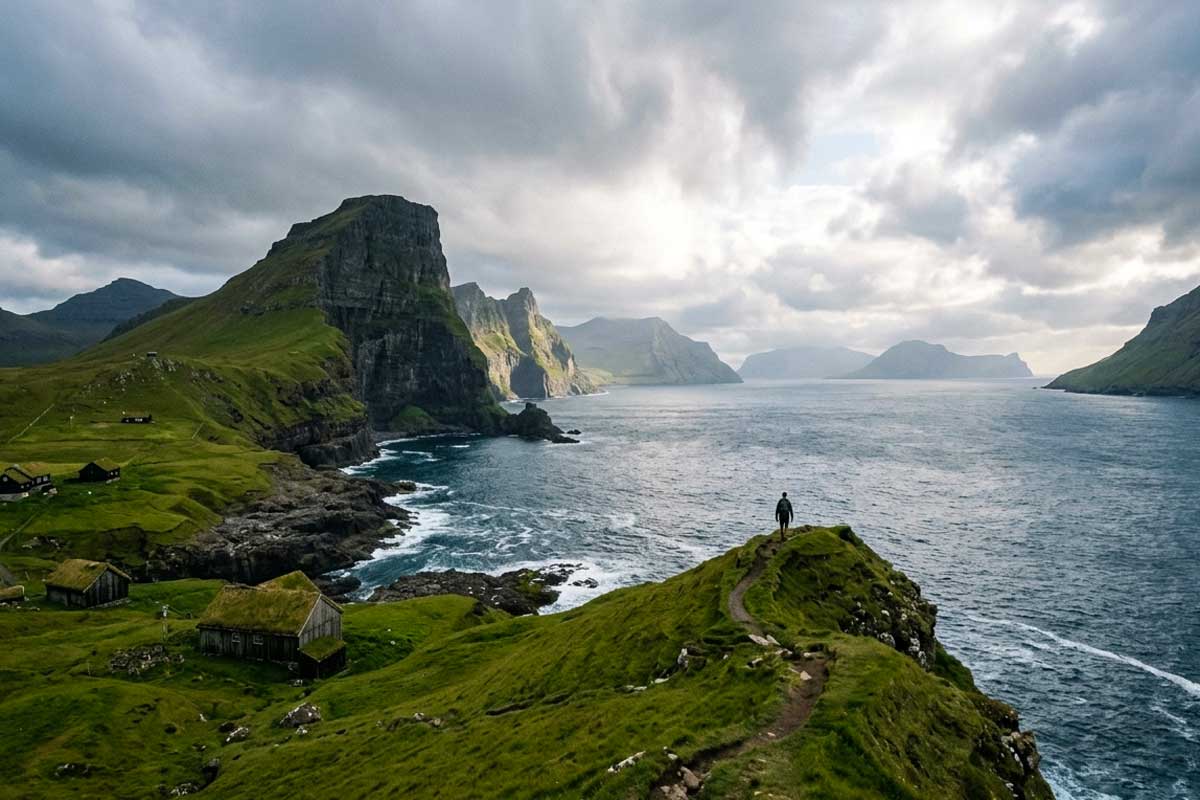
The Faroe Islands: a vertical landscape
The Faroe Islands look like someone merged Iceland, Norway, and the Scottish Highlands into a single landscape.
Eighteen volcanic islands between Iceland and Norway are home to just fifty thousand people - and hundreds of thousands of sheep.
Waterfalls plunge directly into the ocean. Lakes appear suspended above cliffs. Villages cling to impossible green ledges over the Atlantic.
The most famous viewpoint overlooks Lake Sørvágsvatn, which appears to float high above the sea because of a remarkable optical illusion.
The village of Gásadalur remained nearly isolated until 2004, accessible only on foot through a mountain pass before a tunnel finally connected it to the rest of the islands.
Getting there: via Copenhagen or Reykjavík with Atlantic Airways.
The Marquesas Islands: the far edge of the Pacific
Even Paul Gauguin eventually considered Tahiti too civilized - and sailed farther, toward the Marquesas.
These islands remain among the most isolated places in the Pacific Ocean. There are no turquoise lagoons or polished tropical clichés here. Instead: black volcanic cliffs, wild horses, violent surf, and ancient tiki ceremonial platforms left behind by a culture devastated within generations of European arrival.
On Hiva Oa lie the graves of both Paul Gauguin and Jacques Brel - two men who deliberately chose the farthest edge of the world over Europe.
This is not a conventional resort destination. It feels more like the end of civilization itself.
Getting there: Los Angeles → Papeete → Hiva Oa via Air Tahiti.
Haida Gwaii: Canada’s Galápagos
One of North America’s most extraordinary archipelagos lies not somewhere deep in the Pacific - but just off the coast of British Columbia.
Haida Gwaii consists of more than 130 islands covered in ancient temperate rainforest, shaped by biological isolation and Indigenous culture unlike anywhere else in Canada.
The Haida Nation never formally surrendered its lands or signed treaties relinquishing territory.
SGang Gwaay, a UNESCO World Heritage Site, preserves rare mortuary totem poles standing among rainforest and ocean fog.
The islands are often compared to the Galápagos because prolonged isolation created unique local forms of wildlife and plant species found nowhere else.
Getting there: Vancouver → Prince Rupert → ferry or regional flight.
Oman: luxury without spectacle
Oman surprises travelers expecting another version of Dubai.
There are no overwhelming skylines or artificial islands here. Instead, Oman offers desert canyons, frankincense plantations, ancient ports, and mountain villages suspended between centuries.
The Musandam Peninsula, with its dramatic fjord-like coastline, looks as though Norway collided with the Arabian Peninsula. Wadi Bani Khalid reveals emerald pools hidden among red mountains. The coastal city of Sur still builds traditional wooden dhows by hand.
At the same time, Oman quietly hosts some of the Middle East’s finest luxury resorts. Places like Six Senses Zighy Bay and Alila Jabal Akhdar focus less on spectacle and more on silence, architecture, and landscape.
Oman also remains one of the safest and most comfortable countries in the region for independent travelers.
Getting there: via Dubai, Doha, or Abu Dhabi.
Antarctica: the last frontier
Antarctica belongs to an entirely different scale of experience.
The seventh continent has no permanent population and belongs to no nation. Access is possible only during the austral summer, from November through March, usually via Ushuaia in Argentina.
Expedition ships cross the Drake Passage and reach the Antarctic Peninsula roughly two days later.
Beyond that point begins another world entirely: icebergs the size of city blocks, penguin colonies numbering in the hundreds of thousands, and stretches of silence unlike anything else on Earth.
International treaties prohibit permanent hotels, resource extraction, and environmental disturbance, preserving Antarctica in a condition remarkably close to what early explorers encountered more than a century ago.
Getting there: Toronto → Buenos Aires → Ushuaia, followed by an expedition cruise.
Why places like this matter right now
Most destinations on this list are changing faster than people realize.
The Arctic is warming rapidly. Greenland’s glaciers are retreating. Antarctica receives more visitors every year. Even the world’s most isolated islands are slowly becoming part of the global tourism system.
That is precisely why journeys like these matter more now than ever.
Traveling to places defined by their fragility and remoteness feels fundamentally different from visiting cities built for permanence. There is less predictability, less infrastructure, and far more genuine discovery.
Destinations like these rarely become just vacations.
They become experiences that stay with people far longer than photographs ever do.