
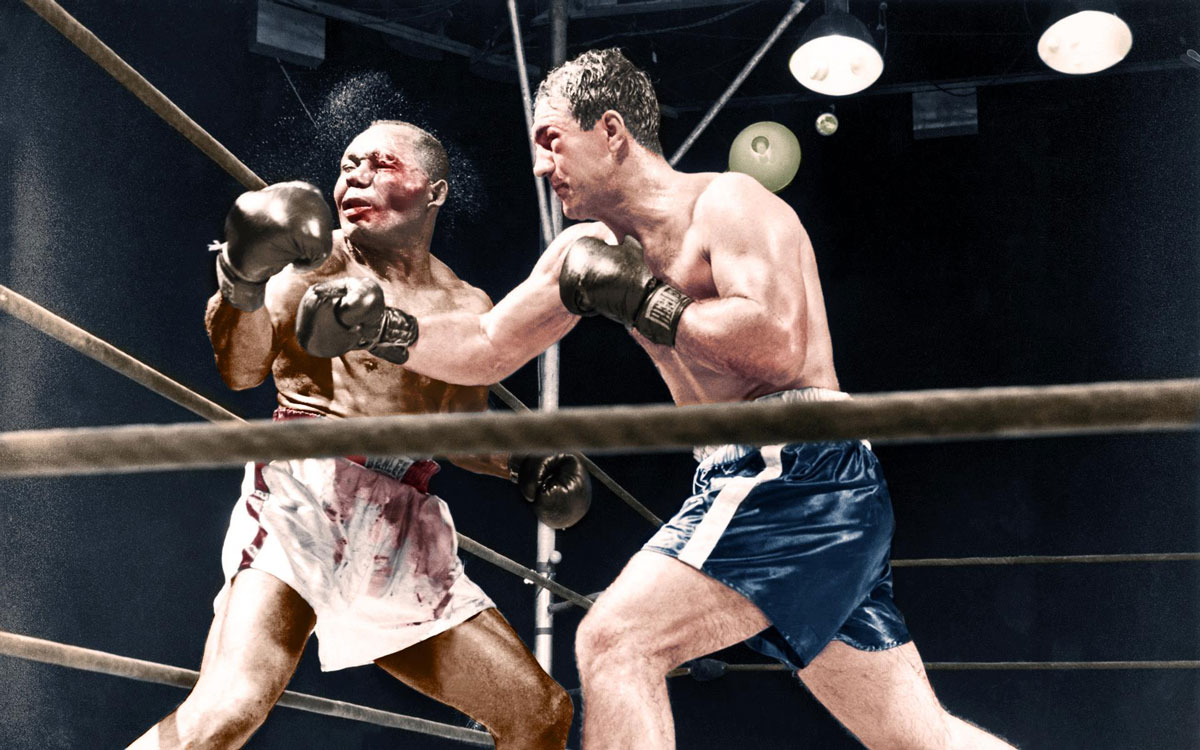
The real story of boxer Rocky
Almost everyone has seen Rocky, the film starring Sylvester Stallone. But long before the cinematic Rocky, there was a real Rocky: Rocky Marciano, world heavyweight boxing champion and one of the most legendary fighters of the twentieth century. He ended his professional career without a single defeat: 49 fights, 49 victories, 43 of them by knockout. In heavyweight history, it remains one of the most famous and difficult records ever achieved.
Rocky Marciano was world heavyweight champion from 1952 to 1956. He was known as “The Brockton Blockbuster.” He was not the tallest, the most polished, or the most elegant boxer of his era. But he possessed something that can never be fully taught: endless willpower, brutal endurance, fanatical discipline, and terrifying short-range punching power. He could look awkward, absorb punishment, move forward through blood and pain - and sooner or later, the opponent usually ended up on the canvas.
On August 31, 1969, one day before his 46th birthday, Rocky Marciano died in a plane crash. He was a passenger aboard a small private Cessna 172 flying from Chicago toward Des Moines, Iowa. The weather deteriorated, the pilot did not have sufficient instrument-flying experience, and the plane crashed near Newton, Iowa. Marciano was killed along with pilot Glenn Belz and passenger Frankie Farrell. In a sudden and almost absurd way, the life of a man who had seemed nearly indestructible in the ring came to an end.
News of his death quickly spread through the sporting world. For millions of boxing fans, Marciano was not merely a former champion. He was a symbol of an older America: the son of immigrants, a man from a working-class city, a fighter without aristocratic polish, but with a character that could not be broken.
Experts still debate exactly where Marciano belongs among the greatest heavyweights of all time. Some rank the gifts of Joe Louis, Muhammad Ali, Joe Frazier, or Lennox Lewis higher. There is logic in that. Marciano did not have Ali’s fluidity, Louis’s classical technique, or the size of many later champions. But there is one fact no argument can erase: he retired as an undefeated world champion. Forty-nine times he entered the professional ring, and forty-nine times he left it as the winner.
Across his entire career, Marciano was knocked down only twice: once in his first fight with Jersey Joe Walcott, and once against Archie Moore. That is especially impressive when one considers the experienced, powerful, and dangerous opponents he faced. He did not avoid hard fights. On the contrary, his style was built on pressure, physical attrition, close-range combat, and the constant threat of a knockout. Where other champions won with beauty of movement, Marciano won with relentlessness.
The future champion’s real name was Rocco Francis Marchegiano. He was born on September 1, 1923, in Brockton, Massachusetts, into a family of Italian immigrants. His father worked in a shoe factory, the family lived modestly, and from an early age Rocky learned what hard labour meant. He held various low-paying jobs, helped his family, became used to physical strain, and understood that life gives nothing away for free.
As a young man, Marciano dreamed more of baseball than boxing. He was strong, durable, stubborn, and hoped to find his future in sport. But baseball did not become his path. After military service and his first amateur bouts, he gradually found his way into boxing - not as a glamorous dream, but as a punishing craft that demanded daily pain, exhaustion, and repetition.
During the Second World War, Marciano served in the U.S. Army and was stationed in Britain. It was there that he began boxing more seriously. This was not yet the grand professional stage, but it was where he began to understand that his strength did not lie in elegant technique. It lay in his ability to move forward, apply pressure, endure punishment, and break an opponent’s resistance.
After returning to America, Marciano began his professional career. His manager was Al Weill, and his chief trainer was Charley Goldman, one of the men who transformed Rocky’s raw natural power into an effective boxing style. Goldman understood that Marciano would never become a classic tall heavyweight with a long jab. He had short arms, was relatively small for the division, and did not move with obvious grace. So the strategy became a low stance, constant pressure, inside fighting, and devastating short punches.
Marciano trained with obsessive intensity. He ran long distances, worked the heavy bag, drilled punches, strengthened his body, and pushed himself into the kind of condition that allowed him to maintain a pace most opponents could not survive. His legendary stamina became one of the main reasons for his victories. He could lose rounds, take punches, look damaged - and still keep coming. The longer a fight went, the more dangerous Marciano became.
A special place in his career belongs to the fight with Joe Louis in October 1951. Louis was no longer the invincible “Brown Bomber” of his greatest years, but his name still stood for boxing greatness. For Marciano, defeating Louis was a crucial step toward a title shot. Rocky himself later struggled emotionally with the victory: he respected Louis and knew he had beaten an aging legend. But boxing has no room for sentimentality. To become champion, one sometimes has to pass through living myths.
On September 23, 1952, Marciano fought Jersey Joe Walcott for the world heavyweight title. It became one of the most dramatic championship fights in heavyweight history. In the very first round, Walcott knocked Rocky down. The champion was more experienced, more technically refined, and for much of the fight appeared in control. Marciano was behind on points, his face was damaged, but he kept stalking his opponent.
In the thirteenth round came the moment that entered boxing history. Marciano landed his famous right hand, later remembered as one of the most destructive punches in heavyweight boxing. Walcott collapsed, and Rocky became the new world champion. That fight explains better than almost any other why Marciano became a legend: he could be hurt, exhausted, and technically outboxed, yet remain dangerous until the very last second.
After winning the title, Marciano’s fame grew with every fight. He defended the championship against Jersey Joe Walcott, Roland La Starza, Ezzard Charles, Don Cockell, and Archie Moore. His two fights with Ezzard Charles were especially brutal. In their first meeting, Charles lasted the full 15 rounds and became the only man to go the championship distance with Marciano. In the rematch, Charles inflicted a terrible cut on Rocky’s nose, and the fight was close to being stopped. But once again Marciano did what he did best: he gathered his will, increased the pressure, and knocked his opponent out.
Outside the ring, Marciano was not a cruel man. On the contrary, many remembered him as kind, modest, and open. He spoke respectfully about his opponents and rarely allowed himself arrogance. The contrast between his human gentleness and his mercilessness in the ring only strengthened his legend. In ordinary life he could be polite, even shy. Once the bell rang, he became a machine of pressure.
An essential part of his image was absolute discipline. Before fights, Marciano went into training camp, limited contact with the outside world, watched his diet, ran constantly, and organized his entire life around preparation. His training routine became part of the myth: early-morning roadwork, punishing gym sessions, endless repetition of punches, and a refusal to waste energy on anything unnecessary. It was not the romance of sport. It was a hard, almost monastic service to a single goal - victory.
In April 1956, while still at the height of his fame, Rocky Marciano announced his retirement from boxing. He was only 32 years old. He left as an undefeated champion with a perfect record of 49-0. There were several reasons: fatigue, family, accumulated injuries, and the desire to walk away before the ring took too much from him. Unlike many fighters, he managed to stop in time.
After leaving boxing, Marciano went into business, took part in public appearances, appeared on television, and remained a favourite of the public. He travelled frequently, met people, gave speeches, earned money, and tried to protect his capital. His life was no longer that of an active fighter, but the fame of the champion followed him everywhere.
In the late 1960s, Marciano took part in an unusual project called The Super Fight - a computer simulation and staged film comparing great heavyweights from different eras. In the final version, Marciano “defeated” Muhammad Ali. Of course, this did not prove who would really have won. Boxing exists in real time, with real bodies, mistakes, styles, and eras. But the project itself shows how powerful Marciano’s reputation remained years after his retirement.
His tragic death only fixed his image more firmly in sporting mythology. He did not leave as an old man, a defeated fighter, or a forgotten champion. He left while still a powerful symbol of invincibility. That is the magic of Marciano’s story: it is not only about boxing, but about character, work, pain, discipline, and the price of victory.
Today, the name Rocky Marciano is often mentioned alongside Rocky Balboa, the character created by Sylvester Stallone. But it is important to be precise: the main inspiration for the movie character was Chuck Wepner, the New Jersey boxer who unexpectedly lasted almost an entire fight against Muhammad Ali. At the same time, the name Rocky and the Italian-American identity of Stallone’s hero inevitably evoke Marciano. Perhaps the fairest way to put it is this: Wepner inspired the story, Stallone created the myth, and Marciano had shown long before them what an unbreakable man could look like in real life.