
From music from the air to eavesdropping without bugs
Legendary personalities who changed the world
The Theremin family had French roots, and the name itself reached far back into history. Among Lev Theremins ancestors were soldiers, clergymen, musicians, and artists. In the scientist and inventor himself, two rare gifts came together with extraordinary force: the mind of a physicist and the soul of a musician. He belonged to that unusual kind of person for whom science, art, technology, and imagination were never separate worlds.
In the spring of 1926, engineer Lev Theremin demonstrated one of the earliest Soviet systems of “distant vision” - the term then used for television - at the People’s Commissariat of Defence. The camera lens was placed outside, the screen was set up indoors, and senior Soviet military officials watched in astonishment as moving figures appeared on the screen. According to later recollections, such demonstrations made a breathtaking impression. Only yesterday, transmitting a moving image over a distance had seemed like science fiction. Theremin was turning it into an engineering fact.
It took him remarkably little time to approach this almost impossible task. But then, impossible tasks never seemed to exist for Theremin. From a young age, he astonished those around him with his abilities: he was fascinated by mathematics, physics, electricity, experiments, and homemade devices. Something in his room was always glowing, ringing, sparking, or exploding. At university he studied physics and astronomy, while also taking cello classes at the St. Petersburg Conservatory.
Before the revolution, Theremin completed military engineering school and served in a radio-technical unit of the Russian army. After the change of regime, he was not pushed aside. On the contrary, the new authorities put him to work in electrical and radio-technical service. Soon he was placed in charge of one of the country’s most important radio facilities, the Tsarskoye Selo radio station.
After demobilization in 1920, Professor Abram Ioffe invited Theremin to work at the Physical-Technical Institute. The young engineer was assigned to study radio measurements of the dielectric constant of gases under changing temperature and pressure. During experiments, he noticed that the apparatus produced a tone whose pitch and intensity changed depending on the position of the hand near the electric field. An ordinary physicist might have dismissed it as a side effect. But a physicist with musical training heard not noise, but melody. Theremin tried to shape these sounds into a musical phrase - and it worked.
At first he called the new instrument the etherphone or aerophone, but before long it became known as the thereminvox - Theremin’s voice. That name has survived to this day.
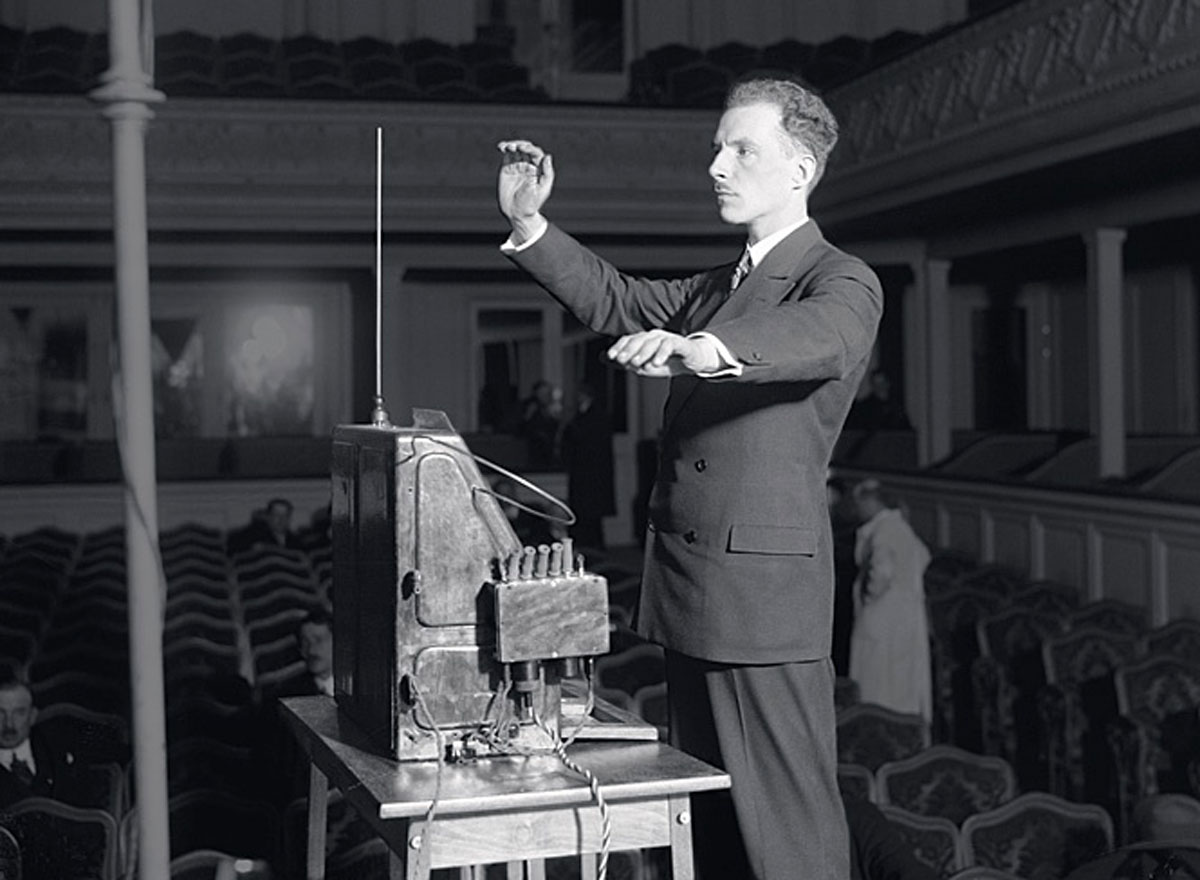
Thus one of the first electronic musical instruments in history was born. The theremin sounded without being touched: the performer controlled pitch and volume by moving the hands through an invisible electromagnetic field. Using the same principle, Theremin also developed alarm systems: when a person entered the instrument’s field, a signal sounded. In time, similar ideas would become part of a whole family of contactless sensors and security systems.
For Lev Sergeyevich, this was the first step toward international fame. His colleagues joked that “Theremin plays Gluck on a voltmeter.” The inventor was not offended. In 1921, he demonstrated his instrument at the All-Russian Electrotechnical Congress. The audience was stunned: no strings, no keys, no familiar body of an instrument - and yet the sound was alive, flexible, almost human. Newspapers wrote with enthusiasm, concerts were broadcast on radio, and Theremin, with his electric instrument, fit perfectly into an age obsessed with electrification.
A few months after the congress, Theremin was invited to the Kremlin. First, he demonstrated his alarm system. The device was connected to a large vase with a flower, and as soon as one of those present approached it, a bell rang loudly. According to Theremin’s recollections, one military man decided to test the system: he put on a warm hat, wrapped his arm and leg in a fur coat, and slowly crawled toward the vase. The alarm still sounded.
But the true star of the meeting was the thereminvox. The instrument made such an impression that Theremin was given the opportunity to travel around the country and demonstrate his invention to wide audiences. Electric sound was to become not only a musical marvel, but also a symbol of a new technological age.
Another almost fantastical episode in Theremin’s life is connected with Lenin’s name. Lev Sergeyevich was fascinated by the idea of defeating death and studied experiments involving the preservation of living tissue at low temperatures. When Lenin died, Theremin, according to later accounts, proposed considering the possibility of freezing the body in the hope that future science might one day bring a human being back to life. But the decision to embalm Lenin had already been made. The idea seemed unbelievable at the time, although decades later similar dreams would reappear in the form of cryonics.
An episode that could have changed history
Today, when we pass a government building and see a surveillance camera on the wall, it is hard to imagine how extraordinary the very idea of remote visual observation seemed in the 1920s. In the spring of 1926, this was exactly what Theremin was working on: the transmission of images over a distance. His distant-vision system made it possible to observe moving objects on a screen, and by the standards of its day, it was an outstanding technical achievement.
Theremin began working on television - or distant vision, as it was then called - at the suggestion of his mentor Abram Ioffe in the second half of 1924. Seeking to complete his studies at the Petrograd Polytechnic Institute, he chose one of the most fashionable and difficult technical problems of the time: transmitting an image over a distance. By 1925, he had produced an experimental television apparatus.
For Theremin himself, the subject was not entirely new. As early as the beginning of the 1920s, he had given surveys of distant-vision research at scientific seminars and followed global developments in the field. As always, he chose his own path: he assembled known devices and principles into a new and unexpected system.
Theremin developed several versions of a television apparatus consisting of transmitting and receiving units. The first demonstration model, created in late 1925, used a 16-line image breakdown. It could show the general features of a face, but recognizing the person was difficult. The second version used a more advanced 32-line scanning system.
In the spring of 1926, he created the next version, which formed the basis of his diploma project. It used 32- and 64-line scanning, with the image reproduced on a large screen. Early tests showed that the image quality was already sufficient to recognize a person, provided they did not move too abruptly.
One of the first successful public demonstrations of the “Thereminvisor” took place in 1926 at the Physical-Technical Institute during the defence of Lev Theremin’s diploma project, “An Apparatus for the Transmission of Images at a Distance.” Later, the installation was shown at scientific congresses. Newspapers wrote about it with excitement, and Theremin’s name was placed beside those of the great inventors of the era. It seemed that practical application was only a short step away from laboratory experiment.
Almost immediately afterward, Theremin was summoned to the Council of Labour and Defence, where he was asked to create a distant-vision system for military purposes, including use by border troops. The work quickly became classified.
The technical requirements were extremely demanding: the apparatus had to function outdoors in ordinary daylight and provide a significantly clearer image. One of the later versions, designed for roughly 100 lines, was demonstrated to military and government leaders. In practice, Theremin’s design proved workable, especially considering the limited technical base of the country at the time.
Yet the fate of this work turned out differently. Once the project was classified, almost no open publications followed, and Theremin’s television developments did not receive broad continuation either in the Soviet Union or abroad. Television moved along another path, and the title of one of the principal pioneers of practical electronic television later became associated with Vladimir Zworykin and other engineers. Theremin remained in the history of television as a man who approached the idea of transmitting moving images at a remarkably early stage, but who never turned it into a mass technology.
The Grand Opéra, Europe, and angelic voices
In the summer of 1927, an international conference on physics and electronics was held in Frankfurt am Main. The young Soviet state needed to present itself as a country of the future - a country of electricity, science, and engineering daring. Theremin and his instrument became one of the delegation’s great sensations.
Europeans were struck both by his lectures and by his concerts. The sound of the theremin was described as “heavenly music” and “voices of angels.” Unlike any familiar instrument, it required no touch. The musician seemed to draw sound out of thin air. For audiences of the 1920s, it was almost magic - but magic backed by physics.
Invitations followed from Berlin, London, and Paris. The Paris concert was especially spectacular: the conservative Grand Opéra gave its hall to a Russian inventor and his unheard-of instrument. The audience filled the theatre, and the success was so loud that Theremin was transformed from a Soviet engineer into an international celebrity.
Meanwhile, Abram Ioffe, then in the United States, received proposals from American companies interested in manufacturing theremins. Theremin was to go to America - officially to demonstrate the instrument, establish scientific contacts, and organize production. But his trip also had another dimension: Soviet agencies understood very well how valuable a gifted inventor could be in a country where radio, electrical engineering, industry, and military technology were developing at extraordinary speed.
America: fame, business, and a new life
Young, striking, and brilliantly educated, Lev Theremin arrived in America like a man from the future. His instrument was already surrounded by European fame, and in New York he entered an environment where a technical miracle could quickly become a commercial product.
Theremin gave his first American concert for the press, scientists, and musicians. The success was impressive. With permission from Soviet authorities, he established a studio and company in New York connected with the production and demonstration of theremins. Concerts followed in Chicago, Detroit, Philadelphia, Cleveland, and Boston. American audiences embraced the theremin with enthusiasm: it was the instrument of the electrical age, a symbol of new art and new technology.
Major companies, including RCA, became interested in licenses and industrial production. In 1929, RCA did release a commercial version of the theremin, hoping it would become a mass-market home musical device. But the market proved more difficult than the advertising departments had imagined. Playing the theremin was far harder than it looked.
The Great Depression struck musical and entertainment ventures hard. People had little appetite for expensive exotic instruments. Yet Theremin had another field: security and contactless systems. His ideas for motion sensors and spatial control proved useful for institutions, banks, and protected sites. The exact details of many contracts and projects remain unclear, but one thing is obvious: Theremin knew how to turn a physical principle into a working device.
A cake for the violinist with a theremin
Over time, critical voices began to emerge amid the chorus of admiration. The theremin was beautiful, but playing it in tune was extraordinarily difficult. The performer had no keys, frets, strings, or other physical guides. Everything depended on ear, muscle memory, absolute precision of movement, and the ability to control the space around the body.
Theremin himself was an inventor and a musician, but the instrument needed a true virtuoso. That virtuoso was Clara Reisenberg, later known as Clara Rockmore. Born in Russia, she had been a child prodigy on the violin and was considered a musician with a great future. Health problems forced her to give up the violin, but the theremin offered her a new path in music.
Clara quickly understood the instrument’s possibilities and became one of the central figures in its history. She did not merely perform on the theremin; she helped Theremin improve it, demanding greater precision, a wider range, and more refined control of sound. It was Clara Rockmore who proved that the theremin could be not only a spectacular technical wonder, but a genuine concert instrument.
Between Theremin and Clara there arose a personal closeness often described as a romantic story. He was older, already marked by a complicated marriage and divorce; she was young, gifted, and brilliant. Theremin knew how to court in unusual ways: he might present a cake that rotated on its axis or arrange a small electrical miracle to delight the woman who understood his music better than almost anyone.
But this romance did not end in marriage. Clara chose another man - Robert Rockmore, a lawyer and successful impresario. Her musical career was secured, and the name Clara Rockmore would later become inseparable from the art of playing the theremin.
Why did the walls seem to move?
In America, Theremin lived on a grand scale. He rented a large house in New York that contained his private rooms, workshop, and studio. Musicians, scientists, artists, engineers, patrons, and curious celebrities gathered there. According to recollections, his guests included people from some of the most influential circles of American society.
Albert Einstein held a special place among these encounters. He was interested in the relationship between music, space, and visual images. Theremin, perhaps better than anyone, could turn such an idea into a device. He created light-and-music systems and worked with rhythm, movement, sound, and illumination. His Rhythmicon, developed in collaboration with composer Henry Cowell, became one of the early experiments in electronic rhythm and automated musical structure.
In Theremin’s studio, sound could generate light, movement could become music, and walls, under carefully controlled illumination, seemed almost alive. To visitors, it looked like science fiction. To Theremin, it was simply the natural continuation of physics.
By the mid-1930s, he was famous, in demand, and surrounded by myths. Some considered him a successful entrepreneur and almost a millionaire. Others believed that Soviet intelligence stood behind his American years. The truth was probably more complex and more ordinary: Theremin was at once an inventor, performer, businessman, Soviet citizen abroad, and a man of interest to more than one government agency.
An inventor under observation
How closely Theremin was connected with Soviet structures during his years in the United States remains a subject of debate. He later spoke of contacts and assignments, but many details remain obscure. In any case, his position was unusual: he lived in New York, moved among the elite, worked with advanced technologies, and remained a man from the Soviet Union in an age of growing international suspicion.
During these years, Theremin became fascinated by one of his most fantastic ideas: an instrument that would turn dance into music. He called it the Terpsitone, after Terpsichore, the muse of dance. Unlike the theremin, in which sound was controlled by the hands, the Terpsitone responded to movements of the entire body. The dancer literally became the musician, and movement became the source of sound.
To create a concert program, Theremin invited dancers. Among them was Lavinia Williams, a talented African American dancer. She captivated him not only as an artist, but as a woman. In 1930s America, marriage between a white man and a Black woman challenged social norms. After their marriage was registered, many doors in New York society did indeed close to Theremin. His social circle narrowed, his contacts became more complicated, and Soviet structures may have viewed the situation as a problem.
In 1938, Theremin suddenly left the United States and returned to the USSR. The circumstances of his departure remain unclear. Some versions speak of an order from Soviet authorities; others suggest abduction or forced return; still others point to a combination of pressure, debts, and political circumstances. Lavinia remained in America. Husband and wife never saw each other again.
An absurd sentence
Ten years after leaving Russia, Theremin returned to the Soviet Union - and soon discovered that the country he had left was no longer the same. Many of his old colleagues were gone from the institutes, the atmosphere was heavy, and suspicion was everywhere. In 1939, he was arrested.
According to his own recollections, it happened in an almost routine manner: a man with a briefcase came to his hotel room, said that they needed to go and clarify everything, and before long Theremin found himself in Butyrka prison. The accusations were typical of the era of the Great Terror: fantastical, absurd, and deadly serious.
In some retellings, Theremin was linked to an absurd “plot” surrounding the assassination of Kirov, even though Kirov had been killed in 1934, while Theremin was still in the United States. Such details seem almost grotesque, but that was precisely the logic of Stalinist cases: plausibility was not required for an accusation.
Theremin received a prison-camp sentence. At first he was sent to hard labour, and later, as a valuable engineer, transferred to a closed design bureau - one of the so-called sharashkas, where imprisoned specialists worked on defence projects. There he worked on radio control, radar, and special systems. His talent was once again needed by the very state that had just declared him a criminal.
A Trojan horse from the Young Pioneers
The most famous special device associated with Theremin’s name became known in the West as The Thing and in Soviet terminology as Zlatoust. In August 1945, U.S. Ambassador W. Averell Harriman received a carved wooden plaque bearing the Great Seal of the United States. The gift was presented by Soviet schoolchildren as a gesture of friendship between wartime allies. The plaque was hung in the ambassador’s residence.
Inside was an astonishingly elegant device. It had no power source and no active electronic components. It came alive only when an external radio signal of a specific frequency was directed at it. A membrane inside the device vibrated with the sound of speech, altering the reflected signal. Conversations in the room could then be intercepted from a distance.
The device remained undetected for roughly seven years and was discovered only in 1952. In technical elegance, it became one of the most famous espionage devices of the twentieth century and anticipated many principles of passive radio-frequency identification.
Another line of work was the Buran system, usually described as a predecessor of the laser microphone. It made it possible to detect sound vibrations from window glass using a directed beam. In an age when electronics were still bulky, such solutions seemed almost unbelievable.
In 1947, Theremin received the Stalin Prize. The paradox was almost surreal: a man who had passed through prison and secret forced labour was officially honoured by the state for work that could not be publicly discussed. After his release, he was given an apartment and continued to work in secret laboratories.
Official recognition equal to the scale of his talent never truly came. Many of his inventions remained classified, and for many more years he continued to work within the same system that had controlled his fate.
His personal life also entered a new chapter during this period. Theremin married Maria Gushchina, and they had twin daughters. For almost twenty years he continued to work on special projects, from speech recognition and voice identification to hydroacoustics and other classified fields. But over time priorities changed, bureaucratic absurdities increased, and in the 1960s he retired from the secret system under whose invisible eye he had lived for nearly forty years.
Theremin never dies
He was around seventy. It would have been natural to assume that the great inventor’s life was over. But Lev Sergeyevich remained faithful to his motto: “Theremin never dies” - a phrase based on the Russian spelling of his surname read backward. He found work in the acoustic laboratory of the Moscow State Conservatory and returned to what he loved most: sound, electricity, and music.
In 1968, a journalist from The New York Times, preparing a story about the Moscow Conservatory, unexpectedly learned that the legendary Theremin was alive. In America, the news felt almost like a resurrection: many had believed that he had died in the late 1930s. After the publication, letters, reporters, and old acquaintances began reaching out to him. But Soviet administrators were frightened by the sudden attention to a man with a classified past, and Theremin was dismissed from the conservatory. Part of his equipment was destroyed or thrown away.
Later, he worked in the acoustics laboratory at Moscow State University, holding a modest technical position. He restored and improved theremins, experimented with new ways of controlling sound, and took part in projects connected with electronic music. The age of synthesizers was arriving, and many of Theremin’s ideas, which had seemed fantastical in the 1920s, were becoming part of reality.
He taught the theremin to his relative Lydia Kavina, who became one of the leading performers on the instrument and carried his tradition into Europe and the United States. In the late 1980s, Theremin began to be invited abroad again. In 1989, already in very old age, he travelled to a festival of experimental music in France.
Near the end of his life, he surprised many by joining the Communist Party. When asked why, he answered simply: “I promised Lenin.” Earlier, he had not been accepted because of his criminal record. Theremin became a communist only in 1991 - almost at the same moment the Soviet Union itself was collapsing.
Swan song
In 1951, the future American filmmaker Steven M. Martin saw the film The Day the Earth Stood Still. What struck him was not only the aliens, but the unearthly sound of the theremin in the film’s score. Many years later, he became interested in the history of the instrument and its creator. The search led him to Clara Rockmore and then to the idea of making a documentary about Lev Theremin.
Many years passed before the director was able to come to Moscow, meet Theremin, and invite him to America. The elderly maestro walked through the streets of New York, struggling to recognize the places where such an important part of his life had once unfolded. The most moving moment was his meeting with Clara Rockmore. She had long resisted, saying that age was not kind to a woman.
“Oh, dear Clara, what does age matter to us now?” the 95-year-old Theremin told her.
After the trip to America, he also managed to visit the Netherlands for the Schoenberg-Kandinsky festival. Returning to Moscow, he found his room wrecked: broken furniture, smashed equipment, ruined notes. His daughter took him in. Lev Sergeyevich’s strength was fading. On November 3, 1993, he died.
Steven M. Martin’s film Theremin: An Electronic Odyssey was released after its subject’s death. But the theremin lives on. Its sound can still be heard in classical music, cinema, experimental projects, and modern electronic culture. Among those who deeply admired Theremin was Robert Moog, the creator of the famous Moog synthesizers. He saw in Theremin not merely the inventor of a strange instrument, but one of the first people to understand that the music of the future would be born where electricity, movement, and human imagination meet.