
How to manage everything and stop postponing
Life hack from the President of the United States
Everyone goes through periods in life when tasks are first postponed until later - and then, eventually, everything turns into a permanent state of emergency. Lets be honest: many of us live this way for months at a time. As the joke goes, never put off until tomorrow what you can put off until the day after tomorrow. Why is planning so difficult for us? Where does this habit come from - pushing deadlines as long as they can still be pushed? And, most importantly, how do we dig ourselves out from under a pile of urgent work? Try a life hack from a president.
What is the Eisenhower Matrix? If ordinary office workers can accumulate a mountain of unfinished tasks, imagine what happens to presidents. The 34th president of the United States, Dwight D. Eisenhower, who held office from 1953 to 1961, could hardly complain of boredom. Running a country and keeping an enormous amount of information in mind is no simple matter. Over time, Eisenhower came to understand that the entire agenda had to be organized by two criteria: importance and urgency. “What is important is seldom urgent, and what is urgent is seldom important,” the president once said. This phrase became the foundation of the famous Eisenhower Matrix - a simple and genuinely effective system for managing working time. We do not know whether the 34th president of the United States personally invented this table. Most likely, he did not create it himself, but his quotation and his approach to work became the intellectual basis of this time-management method.
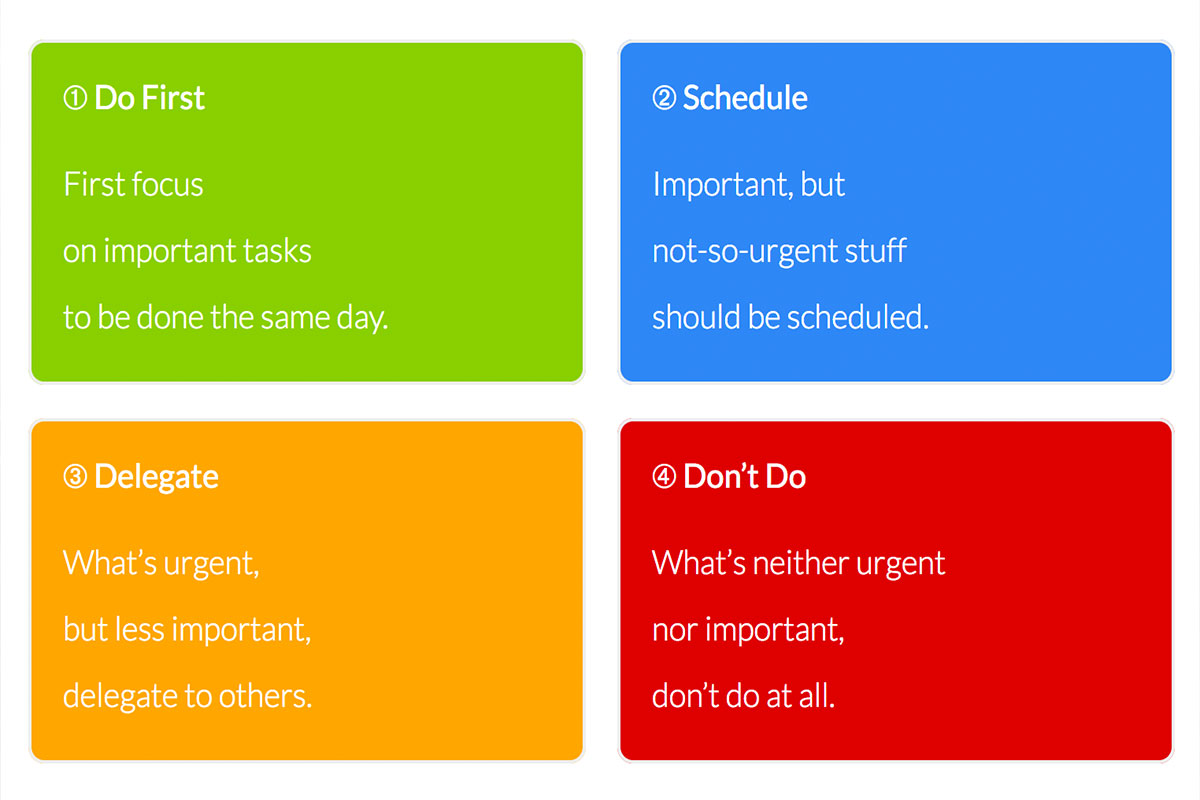
So, to understand how it works, take a sheet of paper and a pen, and divide the page into four squares. This is where we will distribute current tasks. They can be: urgent and important; not urgent, but important; urgent, but not important; not urgent and not important.
Before we place tasks into the squares, we need to determine which tasks should be considered important.
An important task is one that moves you closer to achieving your goal.
This means that the first step in planning is setting goals. Do not rush through this stage, because the success of the entire method depends on it. So, what goals do you want to achieve in the long term? What kind of person do you want to become in the future? For convenience, goals can be divided into categories:
- Family and loved ones - strengthen your relationship with your spouse and children, have another child, spend more time with relatives.
- Health and well-being - switch to a healthier diet, improve your physical shape, establish a better sleep routine, give up a harmful habit.
- Self-improvement - become more mindful in everyday life, develop certain character traits, learn a new skill, read important books.
- Work and career - improve your qualifications, become a department head, change professions and succeed in a new field, start your own business.
- Rest and leisure - take a trip, devote more time to a hobby, stop working on weekends.
These are only a few examples of long-term goals. You will need to formulate your own. And do not forget to rank them by priority, so that in situations where you have to choose between one task and another, you know which one matters more to you.
Have you set your goals? Now you can place any task into the correct square of the Eisenhower Matrix. It is easier than it seems. At first, you may find it more convenient to draw the matrix on paper; later, it will simply appear in your mind automatically.
Every task can be assigned to one of the four squares. Here are a few examples:
- Urgent and important: water is overflowing from the bathtub; a website is down because of a coding error; a tooth is severely aching; a child is crying.
- Not urgent, but important: get a health check-up; spend the weekend with your family; develop and present a plan for improving production to management; read a good book.
- Urgent, but not important: the internet has gone down; an old acquaintance is calling; you need to participate in a survey; a bill needs to be paid.
- Not urgent and not important: watch television; scroll through social media news feeds; play a computer game; drink tea with colleagues.
Why We Are Always Busy but Never Get Anything Done
Why do we constantly end up in crisis mode, and why do deadlines fall apart? Where does our precious time go? It seems that we are always busy with something, yet the workday passes, and by evening we realize that we have completed barely half of what we were supposed to do. Either we take the remaining work home, leaving ourselves no time for rest or family, or we postpone the unfinished tasks until tomorrow, then until the day after tomorrow, and so on.
The problem is that we spend too much time in the wrong squares. Which tasks do you think are the most important? The correct answer is: important, but not urgent. These are the tasks that move us toward our goals. But because they are not urgent, we tend to postpone them - until the weekend, until vacation, until “a better time,” which somehow never arrives.
So what are we busy with instead? Usually, with tasks from the urgent and important square. At first glance, this seems right: if a task is truly significant and cannot wait, why not deal with it immediately? That is true - but it is worth understanding where these urgent and important tasks come from. As a rule, they are either tasks from the important but not urgent square that we postponed for too long, or problems that arose because we ignored that same square.
For example, you needed to go to the dentist and treat a small cavity. But the tooth did not hurt, so the matter was not urgent. You kept postponing the appointment again and again, until the tooth began to ache badly. Now it has become an urgent and important problem, and solving it will take more time and money than it would have taken a month earlier. While the tooth does not hurt, a visit to the dentist can be scheduled at any convenient time. But unbearable pain will force you to drop everything and rush to the dentist in the middle of a workday. As a result, a backlog of unfinished work appears. This is how the snowball forms: first you postpone an important task, then you solve it in crisis mode, taking time away from other work, which later must also be done in a rush - and often carelessly.
It turns out that we are constantly putting out fires, even though it would be far more effective to deal with the causes of those fires. Instead of making time for tasks from the important but not urgent square, we spend our time on the important and urgent square. The situation is made worse by the fact that we also have to deal with problems from the urgent but not important square. These tasks - emails, bills, visits, paperwork - do not bring us closer to our goals, but we cannot simply refuse to do them. Finally, our remaining reserves of time and energy are consumed by activities that are neither urgent nor important - in other words, by procrastination. What else can we call activities that do not move us toward our goals and that no one requires us to do, yet somehow we still spend our time on them?
There is an opinion that procrastination is a fear of doing truly meaningful work. We know that a project deadline is approaching, but we have postponed starting the work for so long that the amount of effort now required in a short period of time frightens us. So we invent pseudo-tasks for ourselves - reading the news, chatting with colleagues, browsing the internet - anything to avoid thinking about the growing mountain of urgent work. How can we escape this cycle? Try the four D rule.
The Four D Rule
For each square of the matrix, there is a solution that begins with the letter D in English. If one of your important but not urgent tasks is expanding your English vocabulary, here is a chance to learn or remind yourself of four useful words at once: important and urgent tasks - Do. Important but not urgent tasks - Decide when to do them. Not important but urgent tasks - Delegate. Not important and not urgent tasks - Delete.
So, anything that immediately requires your attention and matters for achieving your goal should be done without delay. Other important tasks - the ones you may be tempted to postpone indefinitely - should be entered into your work schedule for the coming week and completed exactly when planned.
Time-consuming small tasks should be assigned to someone else. Perhaps one of your subordinates can handle part of your routine work, and for that person it may actually be a task from the important but not urgent square, because it helps them practise new skills. As for paying taxes and bills, obtaining documents, or making medical appointments, there are now many convenient online services for these purposes. Spend a few minutes registering, learn how they work, and deal with small tasks during a free moment directly from your smartphone.
As for tasks that are neither important nor urgent, gather your willpower and remove them from your life. Aimless scrolling through social media, funny videos and amusing pictures online, online games, television programs - all of these time-eaters prevent you from moving toward your goals. Eliminate them, and you will notice that you are beginning to regain control over your life. Once you stop procrastinating, you will have time for tasks from the other three squares. There is no other way: unfortunately, scientists have not yet mastered the technology for manufacturing extra time, or a 25th hour in the day. And you do not need one. Simply decide what you can give up without harming yourself or others, and you will immediately have time for activities that are truly useful.
The Eisenhower Matrix has long been adopted by individuals and entire companies. This simple yet effective method can be useful for a schoolchild, a student, an office worker, and a homemaker alike. Housework, homework, business-management tasks, project assignments - all of these can be distributed across the matrix, helping you see what can be delegated, what must be handled as soon as possible, and what only steals your precious minutes. Time is the most valuable thing we have. Use it wisely and move steadily toward your goals!