
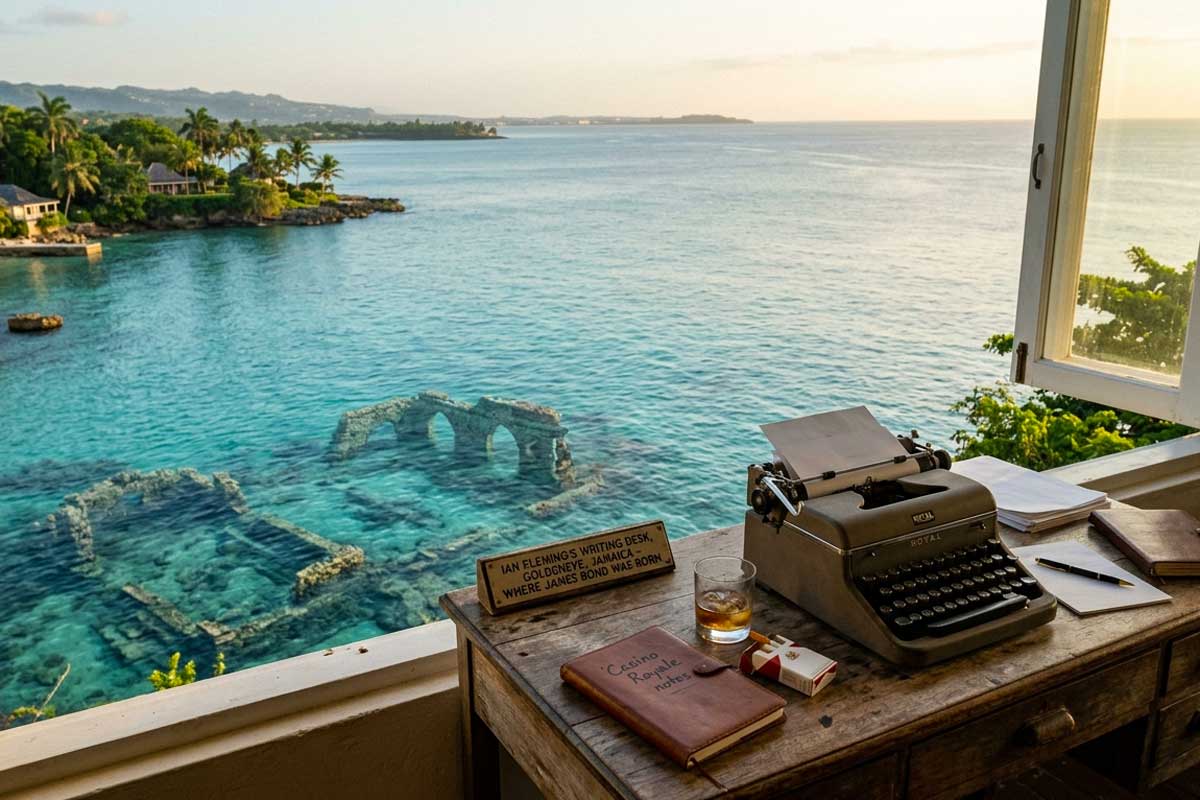
The most beautiful island?
Jamaica
Jamaica - from a pirate city at the bottom of the sea to the writing desk where James Bond was born.
In May 1494, Christopher Columbus first saw Jamaica from the deck of his ship. The fairest island eyes have ever beheld, - he wrote. A century and a half later, English Puritans looked at a Jamaican port city and saw the exact opposite: the wickedest city in the Christian world. Both were right.
Jamaica is an island with several personalities, several histories, and several reputations that barely fit into a single story. It is not only reggae, rum, and beaches - although it is certainly that too. It is a city that literally sank beneath the sea. The writing desk where James Bond was created. Coffee considered among the finest in the world and shipped mostly to Japan. Descendants of formerly enslaved people who forced the British Empire into a peace treaty as equals.
All of that exists on one island.
Pirates, Gold, and 11:43 in the Morning
On Sunday, June 7, 1692, just before noon, the Jamaican city of Port Royal experienced its final moment.
The watches recovered by divers from the seabed in 1969 had stopped at exactly 11:43.
At the time, Port Royal was the richest - and according to many contemporaries, the most sinful - city in the Western Hemisphere. Roughly 6,500 residents. More than 2,000 brick buildings rising as high as four stories, an extraordinary luxury in the seventeenth-century Caribbean. Running water. Wide streets. And by some estimates, every fourth establishment was either a tavern, a brothel, or a gambling house.
The Catholic Church publicly called Port Royal “the wickedest city in Christendom.”
Pirates and privateers operating under British authority were based here, officially licensed by the Crown to attack Spanish ships. Henry Morgan himself - the man whose name would later become synonymous with Jamaican rum - established his headquarters in the city. One of the most successful privateers of his era eventually became Jamaica’s lieutenant governor.
At 11:43 a.m. on June 7, 1692, an earthquake estimated at magnitude 7.5 struck Jamaica. Port Royal had been built on a narrow sand spit. Under the force of the tremors, the ground liquefied - a phenomenon now known as soil liquefaction. Thirty-three acres of the city disappeared into the sea within seconds. Houses, warehouses filled with gold, streets, docks, and people vanished beneath the water. A tsunami followed and destroyed much of what remained.
More than two thousand people died.
Today, the ruins of Port Royal rest beneath eight to twelve meters of water near Kingston. It is one of the Caribbean’s most extraordinary diving sites: tropical fish now swim above the streets and rooftops of a seventeenth-century pirate city. The surviving section of Port Royal remains a small historic settlement and museum. The stopped watches are still on display.
Bond. James Bond. Jamaica.
In 1942, British naval intelligence officer Ian Fleming arrived in Jamaica for a secret wartime conference focused on German submarine activity in the Caribbean.
He fell in love with the island almost immediately.
In 1946, Fleming purchased fifteen acres of land overlooking a quiet bay in the village of Oracabessa on Jamaica’s north coast. The property had once been a donkey racetrack. He named his estate GoldenEye after a secret operation he had designed during World War II in case Nazi Germany invaded Gibraltar.
On February 17, 1952, Fleming sat down at a wooden desk in his Jamaican villa and began writing a novel.
By the end of the winter, Casino Royale was finished. James Bond had been born.
For the next fourteen years, Fleming returned to Jamaica every winter from January through March and wrote at the same desk. Every Bond novel was written there fully or partially. Jamaica appears throughout Dr. No, Live and Let Die, The Man with the Golden Gun, and several short stories. The 2021 film No Time to Die opens with Bond living in retirement on Jamaica’s northeastern coast.
The wooden desk still survives.
GoldenEye is now a luxury boutique resort owned by Chris Blackwell, founder of Island Records and the man who introduced Bob Marley to the world. Fleming’s villa can still be rented as a private residence. Jamaica gave the world both Bond and reggae - one of those rare statements that happens to be literally true.
Noël Coward and the Pirate Lookout
A few kilometers from GoldenEye stands the estate known as Firefly.
It belonged to Noël Coward - playwright, composer, actor, and one of the sharpest British wits of the twentieth century. He originally came to visit Fleming and ended up staying for years.
At first, Coward lived in a seaside villa called Blue Harbour. Guests included Elizabeth Taylor, Richard Burton, Marlene Dietrich, Peter O’Toole, Princess Margaret, and Winston Churchill. Eventually, the stream of visitors became so constant that Coward bought a second house high in the hills for solitude.
Firefly stands on what had once been a lookout point used by Henry Morgan himself. From the hilltop, the entire northern coastline unfolds below - the perfect vantage point for spotting Spanish ships long before they reached shore.
Noël Coward died here on March 26, 1973, and was buried in the garden.
His writing desk, personal belongings, watercolor paintings, and photographs of famous guests remain open to visitors. The panoramic view has barely changed since the age of pirates.
The Coffee Japan Cannot Stop Buying
In 1728, Jamaica’s governor, Sir Nicholas Lawes, received several Typica coffee seedlings from Martinique - descendants of plants originally brought from Ethiopia.
They were planted in the Blue Mountains east of Kingston.
The result was extraordinary.
Volcanic soil, cool nights, constant cloud cover, and the slow maturation of coffee cherries at elevations between 900 and 1,800 meters created a flavor profile nearly impossible to duplicate elsewhere. Jamaica Blue Mountain coffee is famously smooth, low in bitterness, and layered with delicate chocolate and nutty notes.
It is often called “the champagne of coffee.”
To carry the Jamaica Blue Mountain designation, the beans must be grown within a tightly regulated zone spanning four parishes. Global production remains extremely small.
More than eighty percent of the crop is exported to Japan.
The relationship began in 1969, when the first major shipment arrived in Tokyo. Japanese consumers immediately embraced the coffee’s delicate flavor profile, and the connection became so strong that January 9 is officially celebrated in Japan as Blue Mountain Coffee Day.
There is another unusual detail: Jamaica Blue Mountain is traditionally exported in wooden barrels, a practice intended to preserve aroma during transport.
The People Who Defeated the British Army
After Britain captured Jamaica from Spain in 1655, the Spanish armed many enslaved Africans before retreating and left them in the mountains as a problem for the new rulers.
Those communities fled deep into the jungle and formed independent settlements.
They became known as the Maroons, from the Spanish word cimarrón - “wild.” They mastered guerrilla warfare, used their intimate knowledge of the mountains, and gradually made British military campaigns in the rugged Cockpit Country nearly impossible.
The First Maroon War lasted for decades.
In 1739, Britain signed a peace treaty with the legendary leader Nanny, today recognized as a national hero of Jamaica. The Maroons were granted freedom, land, and self-government. It remains one of the very few cases in colonial history where a European empire formally recognized the autonomy of formerly enslaved people.
The village of Accompong still exists today. Descendants of the Maroons continue living there while preserving elements of traditional self-governance.
What Else the Island Holds
Jamaica’s northern coastline - the resort corridor stretching from Montego Bay to Port Antonio - is the version most visitors recognize from postcards.
But every corner of it carries its own story.
Port Antonio is widely considered the island’s most beautiful and peaceful resort region. In 1946, Hollywood actor Errol Flynn was caught in a storm near the coast and drifted into the harbor. He fell in love with the area, bought Navy Island, and helped turn Port Antonio into a fashionable retreat for Hollywood celebrities during the 1950s.
Nearby Blue Lagoon is one of Jamaica’s most iconic natural landmarks. The deep lagoon, connected to the sea, changes color throughout the day from brilliant turquoise to deep violet depending on sunlight and depth.
Negril’s Seven Mile Beach is among the Caribbean’s longest uninterrupted stretches of white sand and calm water. Its sunsets are considered among the finest in the region.
Doctor’s Cave Beach in Montego Bay became famous for its crystal-clear water so long ago that visitors were already arriving in the early twentieth century for what they believed was therapeutic sea air.
Dunn’s River Falls near Ocho Rios is one of the few waterfalls in the world visitors can actually climb directly through the flowing cascades. It remains one of the Caribbean’s most recognizable natural attractions.
For families, Jamaica offers everything from large all-inclusive resorts with waterparks and kids’ clubs to catamaran cruises, bamboo rafting along the Martha Brae River, stingray encounters, and excursions into the Blue Mountains.
Flamingos can also occasionally be seen in protected coastal lagoons and wetlands along Jamaica’s southern shoreline, although the island does not have the massive colonies found in places like Aruba or the Bahamas.
Ackee and Saltfish
Jamaica’s national dish is ackee and saltfish.
Ackee is a tropical fruit originally from West Africa that is poisonous until fully ripened. Once mature, its soft yellow flesh develops a creamy texture and is traditionally cooked with salted cod, onions, peppers, and spices.
It is one of those dishes impossible to fully describe until you try it yourself.
An Honest Word About Safety
Jamaica does have one of the world’s higher violent crime rates. Most of that violence is concentrated in specific neighborhoods of Kingston and a handful of urban areas.
The resort regions along the north coast - Montego Bay, Ocho Rios, Negril, and Port Antonio - function within a separate tourism infrastructure with a significantly higher level of security and control.
Both Canada and the United States recommend increased caution: use licensed transportation, avoid unfamiliar neighborhoods, and apply common sense.
Most travelers who approach Jamaica as a real country rather than a vacation fantasy leave without problems - and with a very strong impression.
The Airport Named After Ian Fleming
Ian Fleming International Airport is not in Kingston or Montego Bay. It sits near Oracabessa, only minutes from GoldenEye.
It was named after the man who had the imagination to see a former donkey racetrack beside a quiet bay as the perfect place to spend twelve years creating fourteen novels.
Nearby is James Bond Beach.
That is not a marketing slogan. The beach is genuinely called that.
Columbus called Jamaica “the fairest island.” Puritans called it “the wickedest.”
The island gave the world reggae, Bob Marley, Usain Bolt, James Bond, and a coffee Japan cannot stop importing. Beneath its waters lies a sunken pirate city from the seventeenth century. In its mountains live descendants of people who forced the British Empire to negotiate with them as equals.
That is an enormous amount of history for an island only eighty kilometers wide.