
The Liqueur Only Two Monks on Earth Know How to Make
Chartreuse
Somewhere in the French Alps, inside a monastery whose monks have taken a vow of near-total silence, two men currently hold in their memory the complete formula for one of the most sought-after liqueurs on earth. They will never write it down in full. They will never explain it to a journalist, a distiller, or an heir apparent - until, near the end of one of their lives, it is quietly passed to a third. This is not a marketing story. It is simply how Chartreuse has been made for close to three hundred years, and it is the reason a bottle of green liquid, in a world that documents everything, remains one of the last genuine mysteries you can hold in your hand.
A Manuscript Nobody Could Read
The story begins in 1605, when François-Annibal d'Estrées, a marshal in the court of King Henry IV, delivered a mysterious manuscript to a Carthusian monastery near Paris. Its pages, in the elaborate, coded language of Renaissance alchemy, promised something extraordinary: the formula for an Elixir of Long Life, built from more than 130 herbs, roots, flowers, and spices. Where the marshal obtained it, he never said. He may not have fully understood it himself.
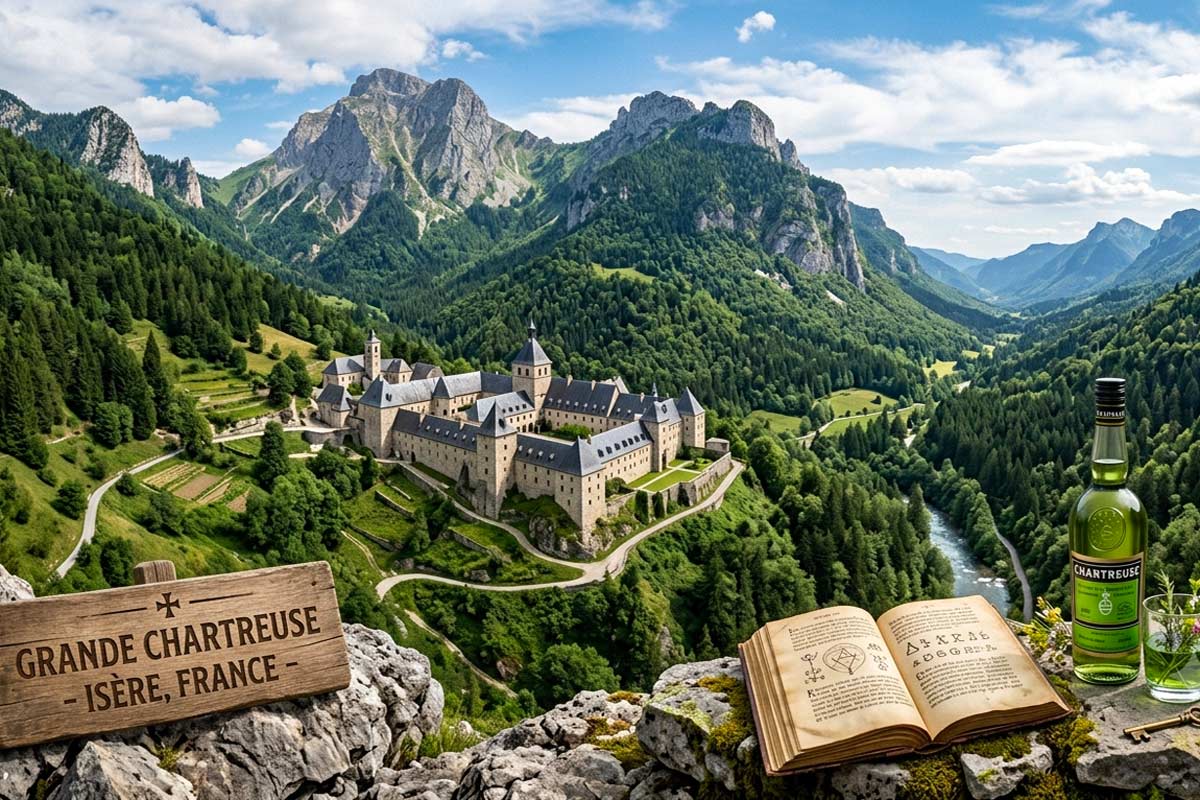
The monks certainly didn't. The recipe was so dense and so encoded that it defeated every attempt at decipherment for well over a century. It eventually made its way to the order's motherhouse, the Grande Chartreuse monastery high in the mountains north of Grenoble that gives the liqueur its name. There, in 1737, the monastery's apothecary, Brother Jérôme Maubec, finally cracked it. The result was the Elixir Végétal de la Grande Chartreuse - potent, medicinal, sold in tiny bottles as a tonic, and still produced today at a formidable 69 percent alcohol by volume. It remains the oldest Chartreuse product in continuous existence, older than the green and yellow liqueurs the world now knows by name.
Exile, a Smuggled Secret, and a Return
The recipe survived the century that followed only through a sequence of events that reads like fiction. In 1793, during the French Revolution, the Carthusians were expelled from France along with every other religious order in the country. One monk attempted to carry the original manuscript into exile, was arrested en route, and imprisoned in Bordeaux. Before his imprisonment ended his ability to act, he managed to smuggle the document to a friend outside the order, who - convinced the Carthusians would never return to France - sold it to a pharmacist in Grenoble. Neither the friend nor the pharmacist ever deciphered it. In 1810, Napoleon ordered that all secret medicinal formulas in France be submitted to the Ministry of the Interior for review; the Chartreuse recipe passed through this process without ever being fully exposed. When the pharmacist died, the manuscript finally made its way back to the Carthusians, who returned to their monastery in 1816 and resumed production.
History repeated itself in 1903, when new anti-clerical laws once again expelled religious orders from France. The monks carried their secret to Tarragona, in Catalonia, and kept distilling there, while the French government seized their original distillery and trademark and allowed a separate company to produce a liqueur it also called Chartreuse - using no part of the actual recipe. The counterfeit version never truly succeeded, and international courts eventually upheld the Carthusians' ownership of the name. A group of local businessmen in Voiron eventually bought up the shares of the company using the seized distillery and returned them to the monks as a gift, allowing the brothers to reclaim their original production site.
In 1935 a landslide destroyed that rebuilt distillery. This time the French government itself stepped in, sending army engineers to relocate and rebuild the facility near Voiron. After the Second World War, the expulsion order was formally lifted, and the Carthusians became, once again, ordinary legal residents of the country whose government had exiled them twice.
The Color With No Other Name
By the 1830s, the monks had developed something gentler than the original elixir: a milder liqueur eventually named Chartreuse Jaune - Yellow Chartreuse - sweeter, lower in alcohol, built around honeyed, floral notes. In 1840 came its more assertive sibling, originally called Liqueur de Santé and known today simply as Green Chartreuse: herbal, sharp, unmistakably alpine, and, remarkably, colored by nothing but the chlorophyll of its own ingredients. To this day, it is the only naturally green liqueur produced anywhere in the world without artificial coloring.
That color was distinctive enough to escape the bottle entirely. By the late nineteenth century, "chartreuse" had entered the English language as the name of a shade - the yellow-green now printed on paint chips and fashion mood boards worldwide, most of whose users have no idea it was named after a liqueur made by cloistered monks in the French Alps.
What Actually Goes Into the Bottle
The formal facts are almost comically sparse, by design. Chartreuse is built from 130 different plants, herbs, and flowers, macerated in wine alcohol, distilled, and aged in oak casks inside what is often described as the largest liqueur cellar in the world. Beyond that, the recipe - the exact plants, their proportions, the order of their combination - is known to only two Carthusian monks at any given moment. They alone prepare the herbal mixture at the monastery before it travels to the distillery for the rest of the process. When one of the two nears the end of his life, he transmits his half of the knowledge to a successor, ensuring the chain is never broken and never fully written down in one place outside a single locked manuscript, to which only the head of the order holds the key.
No patent has ever been filed, because a patent would require the formula to be publicly disclosed. Three centuries of trade secrecy have outlasted every other form of intellectual property protection available.
Green Chartreuse is bottled at 55 percent alcohol by volume; Yellow Chartreuse at a gentler 40 to 43 percent. Special bottlings push further in both directions: the VEP line - Vieillissement Exceptionnellement Prolongé, or "exceptionally prolonged aging" - spends a decade or more in oak before release, developing a darker color and a deeper, woodier complexity, and now commands anywhere from $300 to $500 or more per bottle among collectors. Vintage bottles produced before the 1903 exile, when they surface at auction, are treated as genuine liquid antiques.
The Monks Who Chose to Stay Small
For years, growing global demand for Chartreuse - driven substantially by the craft cocktail revival in the United States - pushed the monastery's commercial arm to produce more. The monks said no. In a decision made quietly around 2019 and confirmed publicly in 2023, the Carthusians announced they would cap production at approximately 1.6 million bottles a year - a hard ceiling, regardless of demand. Their stated reasoning was direct: manufacturing at ever-larger scale conflicted with both their environmental values and, more fundamentally, with the life of solitude and prayer that is the entire reason the order exists. "We are monks, not businessmen," read their public statement at the time.
The effect on the market was immediate and durable. Bottles vanished from shelves across North America and Europe. Bars began rationing pours. Prices for what remained climbed sharply, and a liqueur that had spent decades as an affordable, slightly esoteric ingredient became something closer to a luxury allocation, chased by collectors the way whisky enthusiasts chase a discontinued single malt. The monks, notably, have shown no interest in reversing course. Production and distribution are handled by a separate commercial entity so that the brothers themselves are never pulled from their cells and their silence into the business of meeting market demand - but the ceiling on how much Chartreuse can exist in the world each year was, and remains, entirely their decision.
How the World Actually Drinks It
For much of the twentieth century, Chartreuse was best known as a digestif - something poured neat, in a small glass, after dinner, the way one might serve a fine cognac. It still works beautifully that way; Yellow Chartreuse, gentler and more floral, is often the better entry point for a first taste.
Its second life came through cocktails, and one drink in particular is responsible for reintroducing Chartreuse to an entire generation. The Last Word - equal parts gin, Green Chartreuse, maraschino liqueur, and fresh lime juice - was invented at the Detroit Athletic Club sometime around 1916, priced as the most expensive cocktail on the club's menu, and then vanished almost entirely for the better part of a century, surviving only as a single mention in a 1951 cocktail manual. In 2003, Seattle bartender Murray Stenson found that mention while researching old recipes, added the drink to the menu at the Zig Zag Café, and watched it become a regional favorite that then spread, bar by bar, across the country and eventually the world - a central artifact of the American craft cocktail renaissance of the 2000s. Stenson passed away in 2023, having lived to see the liqueur he helped popularize become nearly impossible to find, and having become, in the process, a permanent footnote in the history of Chartreuse itself.
Other classics followed in its wake: the Bijou, which pairs Green Chartreuse with gin and sweet vermouth into something dark and contemplative; the Alaska, built on gin and Yellow Chartreuse; and countless modern riffs built by bartenders who understand that a small amount of this liqueur can restructure an entire drink around it.
The Point of All of It
What makes Chartreuse genuinely rare, in a world with very little left to discover, is not its taste - although the taste is extraordinary, shifting across the tongue from herbal to medicinal to something close to honey within a single sip. It is the fact that its origin, its exact composition, and its future scarcity are all, by deliberate choice, controlled by men who have taken vows to want almost nothing that the modern world wants: no fame, no wealth, no explanation, no scale. Everyone else in the story - the marshals, the pharmacists, the businessmen, the bartenders, the collectors paying hundreds of dollars for a single bottle - has spent four centuries trying to get closer to a secret that two silent monks in the French Alps have simply, patiently, refused to give up.