
Gunsmith designer Peter-Paul von Mauser
Paul Mauser was the celebrated German designer of small arms and the founder of the company that produced them. Among his creations were weapons that long outlived their inventor. The best-known designs associated with his name include the Mauser 98 rifle, the Mauser C96 pistol, and the Zig-Zag revolver. In 1912, in recognition of his outstanding contribution to the development of German arms, Mauser was granted a baronial title and became von Mauser. He died before the outbreak of the First World War, yet his Mauser 98 rifle remained the standard weapon of the German infantry until the end of the Second World War.
Paul Peter Mauser did not become a gunsmith by chance. He was born in the town of Oberndorf am Neckar into the family of a blacksmith-gunsmith employed at the Royal Württemberg Arms Factory. Mauser was the thirteenth child in the family. At the age of twelve, he began working at the same arms factory as his father, even before completing primary school, which he finished only in 1852. After his schooling, the future designer continued his training in the craft of gunsmithing. In 1859, he was called up for military service. Mauser was assigned to the artillery and served at the Ludwigsburg Arsenal, which only strengthened his choice of future profession. During his service, he studied the mechanism and operating principles of artillery guns in detail, and after demobilization he began working on the creation of a small breech-loading cannon.
It was this cannon and the shell for it that became the first inventions of Mauser the design engineer. In 1865, he managed to improve the breech mechanism of the Prussian needle gun, and later refined this invention by significantly improving its ignition system. It was a period when cartridges with metallic cases were being widely introduced. They had already become common among hunters and were first used in combat during the American Civil War of 1861-1865.
In 1868, together with his brother Wilhelm and the American Charles Norris, Mauser patented in the United States a new breech-loading rifle fitted with a combat leaf spring in the bolt handle. At the same time, the Mauser brothers were working in Liège, Belgium, to improve the design of the rifle bolt. Across the world, rifle calibres were also being reduced to four lines. At that time, this type of small arm interested every European army. Wilhelm, who had a strong commercial instinct, tried to secure government orders from the German states. Between 1867 and 1870, he conducted negotiations with Austria, Prussia, and Bavaria.
The brothers demonstrated their new creation - an 11 mm rifle - in 1871 at the Prussian Royal Shooting School in Spandau. The rifle made a very favourable impression on the military, and after several design changes it was adopted under the designation Gewehr 1871. That same year it entered service in Prussia and Württemberg, which immediately ordered 100,000 rifles.
The recognition of the successful rifle, the large order for it, the commercial abilities of Wilhelm Mauser, and the assistance of the Federal Bank all helped the brothers purchase from the Württemberg government the Royal Arms Factory in their native town, where their father had once worked. This marked the birth of the world-famous company known as Mauser Brothers and Co. During this period, the brothers actively worked on new models of small arms. In 1877, Paul Mauser presented a 9 mm single-shot pistol equipped with a vertically sliding bolt. In 1878, the company released a revolver with a break-open frame and an upward-lifting breech section of the barrel and cylinder. It allowed all fired cartridge cases to be extracted simultaneously - the so-called break-action system.
After the spread of smokeless powder, Peter Paul Mauser created a small-calibre rifle that would serve as the model for nearly all subsequent types of small arms. The key feature of the new design was a magazine box with a clip, positioned outside the breech mechanism. The cartridges in the clip were arranged in a staggered pattern and fed into the chamber by means of a special handle located at the rear of the rifle bolt. Within a short time, various modifications of this rifle were adopted by more than 20 countries around the world. This period in the designer’s life was darkened only by the death of his brother Wilhelm. The story of the creation of the Mauser C96 pistol is particularly interesting and full of mysteries.
The Waffenfabrik Mauser enterprise passed to Paul Mauser (1838-1914) after the death of his brother Wilhelm Mauser (1834-1882) in 1882. By that time, the merits of the Mauser arms company were already widely recognized, thanks to the production of reliable long-barrelled firearms. Fidel Feederle (1859-1930) was appointed manager and head of the experimental workshop at Mauser’s arms factory. Together with his brothers Josef Feederle (1872-1944) and Friedrich Feederle (1848-1940), he became deeply involved in the design of a self-loading pistol.
Paul Mauser submitted patent applications for his pistol to numerous patent offices around the world. In Germany, the Reich patent was registered under number 90430 on September 11, 1895. In France, he received patent 253098 on January 10, 1896. A patent was also granted in Great Britain in 1896, in the United States under number 584479 on June 15, 1897, and in Russia under number 1675 on January 31, 1899.
During the Second World War, Mauser’s factory in Oberndorf was destroyed. The company’s unique weapons collection was looted, and almost all of its documentation was destroyed - according to some sources by American troops, according to others by French forces. For this reason, many mysteries remain regarding the number of weapons produced and the number of variations of the Mauser C96 pistol. To this day, the question of Paul Mauser’s own involvement in the pistol’s development continues to be debated.
According to one version, the main credit actually belongs to the Feederle brothers. However, since the pistol was developed at Mauser’s enterprise and the brothers were only hired employees, the rights to the pistol belonged to Mauser himself.
According to another version, Paul Mauser made a substantial contribution to the design, eliminating a number of technical problems and working for almost a year on the pistol together with the Feederle brothers and the factory’s senior master, Geiser. Supporters of this version point out that the U.S. patent law in force at the time allowed a patent to be registered only to the designer who had developed the product, not to the owner of the company where the weapon had been created.
Their work on the pistol proceeded without Paul Mauser’s knowledge and, judging by some documents, even against his will. In keeping with the trend of the era, the brothers placed the pistol’s magazine in front of the trigger guard, similar to the designs of the first pistols by Bergmann, Reiger, and Laumann. Naturally, for their pistol they initially used the readily available and widespread 7.65 mm Borchardt bottleneck cartridge. On the basis of this cartridge, the 7.63 mm Mauser cartridge was soon developed specifically for the pistol. The weapon was originally called the P-7.63 or Feederle Pistol. By the time Paul Mauser accidentally discovered the Feederle brothers’ work on the pistol, the weapon was almost complete. Mauser’s business instinct prevailed over his personal ambitions: not only did he not forbid the continuation of the project, he joined in the work to improve it. He understood the potential of the weapon and its possible commercial success, and realized that if he delayed, his potential competitors Browning and Luger might occupy the market niche for short-barrelled firearms. On March 15, 1895, the prototype of the Mauser C96 pistol fired its first shot.
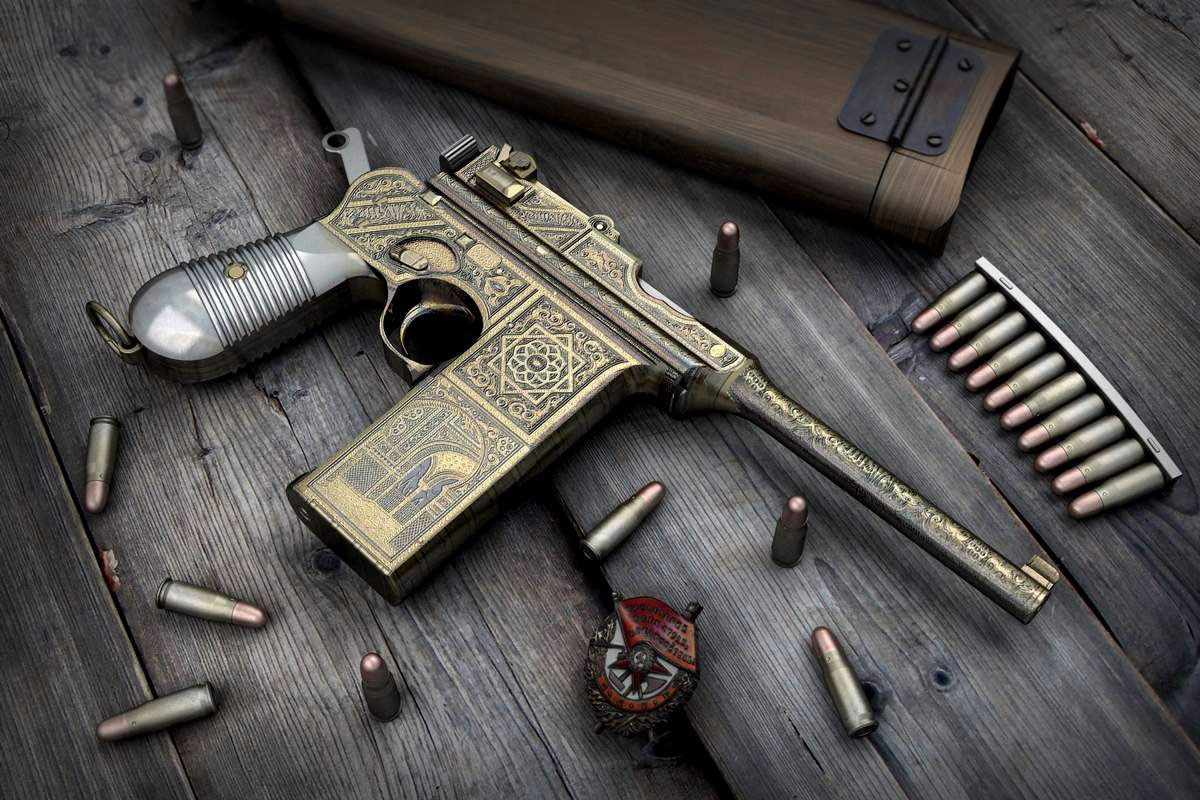
The pistol received the name Mauser C96, meaning Construction 1896, to distinguish it from the 6.35 mm Mauser pistol. In the company’s specifications, however, it continued to be called the Mauser-Selbstlade-Pistole, or Mauser self-loading pistol. The phrase “Broomhandle” is also frequently used together with the name Mauser C96. The Mauser C96 Broomhandle received this nickname because of the distinctive shape of its grip, which resembled the handle of a broom.
In an attempt to secure a military order, Mauser developed several versions of the pistol. A lighter Mauser C96 appeared with a six-round magazine, as well as a version with an increased magazine capacity of up to 20 rounds. The magazines in these pistols were fixed, not detachable, and were loaded from above either one cartridge at a time or with special ten-round stripper clips, similar to rifles. The cartridges in the magazine were arranged in a staggered pattern. The sector sight, marked up to 1,000 metres, was undoubtedly a marketing move: when firing at such a distance, bullet dispersion both vertically and horizontally reached several metres.
Mauser also produced a pistol-carbine based on the Mauser C96. This weapon had a longer barrel fitted with a fore-end, and its pistol grip could be replaced with a shoulder stock, turning it into a full-fledged self-loading carbine.
The Mauser C96 pistol had very respectable ballistic characteristics, and its accuracy at distances of 100 to 150 metres - far beyond the usual range of a conventional pistol - was impressive. With its detachable wooden holster used as a shoulder stock, the pistol effectively turned into a carbine.
Production of the Mauser C96 began in 1896 and at first resembled semi-handcrafted manufacture. The weapon remained in production until 1939, and in total more than one million pistols were made. Over that period, the design of the pistol did not change radically, yet the Mauser C96 exists in more than a hundred variations. Although the pistol was never officially adopted as a standard service weapon by any country in the world, it enjoyed great popularity on the civilian arms market. Travellers and explorers purchased it eagerly, as did wealthy connoisseurs of firearms. It should be noted that the pistol was very expensive. According to the price list, a Nagant revolver cost 25 rubles, a Browning 1900 pistol cost 18 rubles and 50 kopecks, while a Mauser pistol-carbine with a stock, ramrod, and a ten-round clip of blank cartridges for practice cost 40 rubles.
The Mauser pistol was also eagerly purchased by officers, who used it as a personal weapon for self-defence. In Russia, the Mauser C96 was among the weapons recommended for purchase by military officers in addition to the standard 7.62 mm Nagant revolver.
The Mauser C96 became a vivid chapter in the history of short-barrelled firearms. The pistol had undeniable advantages: enormous power, long range, high accuracy, and a wooden holster that could be used as a stock. Its high price, unusual and instantly recognizable silhouette, and reliable mechanism gave its owner a special status. Possession of such a weapon indicated either wealth or military distinction.
The pistol also had a number of serious shortcomings: its large weight and dimensions, the complexity and high cost of manufacture, the inconvenience of loading and unloading, the difficulty of assembly and disassembly, and its sensitivity to dirt. These drawbacks prevented it from being officially adopted as a standard service weapon in any country.
Beginning with the Anglo-Boer War, the Mauser pistol was used in various wars and many local military conflicts. Winston Churchill, later Prime Minister of Great Britain, wrote in his memoirs that it was the Mauser C96 that saved him during the battle with Sudanese dervishes at Omdurman on September 2, 1898. The pistol went through several civil wars and both world wars.
Many models of the pistol are highly valued by collectors, and the price of rare Mauser C96 variants sometimes exceeds 20,000 dollars.
Curiously, this most famous of Mauser’s pistols initially lost two competitions. First, the military in Turin had no need for it, and then it failed to gain acceptance in Bern. Although the pistol was not initially adopted by any European army, it became quite widespread and quickly gained popularity. The armies of Germany, Czechoslovakia, and several other countries adopted it only in 1908, after modernization. To Russians, this pistol is widely familiar mainly from feature films. The Mauser became popular because it was an inseparable part of the image of Civil War commissars and Cheka officers. On screen, the German pistol was as much a part of their image as the leather jacket with its obligatory chest bow.
The pistol’s distinctive and memorable appearance was reinforced by its walnut wooden holster-stock. At the front end of the stock there was a steel insert with a locking mechanism and a lug for attaching it to the pistol grip. The use of such a stock made it possible to bring the aimed firing range of the Mauser up to 100 metres, a serious distance for any pistol.
Yet even greater fame was brought to the designer by the Mauser 98 rifle, which was adopted by the German army on April 5, 1898. In German sources, it is known as the Gewehr 98, or G98 for short. This rifle, designed for the 7.92×57 mm cartridge, became one of the most successful small-arms designs of the entire 20th century. It was first tested in combat in 1900-1901 in China during the suppression of the so-called Boxer Rebellion. Today, the Mauser 98, together with structurally similar rifles made by other manufacturers under different official names, is considered the most widely produced non-automatic rifle in history. According to expert estimates, more than 100 million such rifles have been produced worldwide, including both military and civilian versions, such as hunting rifles. Only one other small arm can rival such production numbers - Mikhail Kalashnikov’s famous assault rifle.
The G98 became one of the most famous bolt-action magazine rifles in the world. No major military conflict of the first half of the last century was without the use of this Mauser rifle or members of its extensive family. The rifle remained in service even after the end of the Second World War, successfully outliving its designer. Today, alongside the Mauser C96 pistol, it has become an essential attribute of films and computer games set in that era.
Peter Paul Mauser remained passionate about small arms until the end of his life. He truly loved his work. Until his final days, he was one of the first to arrive at his enterprise at seven o’clock in the morning. He personally discussed every new idea and concept with his leading designers. In the last years of his life, he received a large number of honours. In 1912, he was awarded the title of baron and elevated to the nobility for his services to Germany. That same year, he received a medal from the Association of German Engineers. In addition, von Mauser was a holder of the Prussian Order, Third Class, bore the title of Commercial Councillor from 1898 onward, and received many other distinctions.
The gunsmith died on May 29, 1914, from an embolism. He passed away in his native town, only days before the outbreak of the First World War - one of the greatest conflicts in human history and one of the most serious tests for the weapons he had designed.